This 10-Acre California Museum Is Filled With Giant Desert Sculptures Made From Castoff Objects
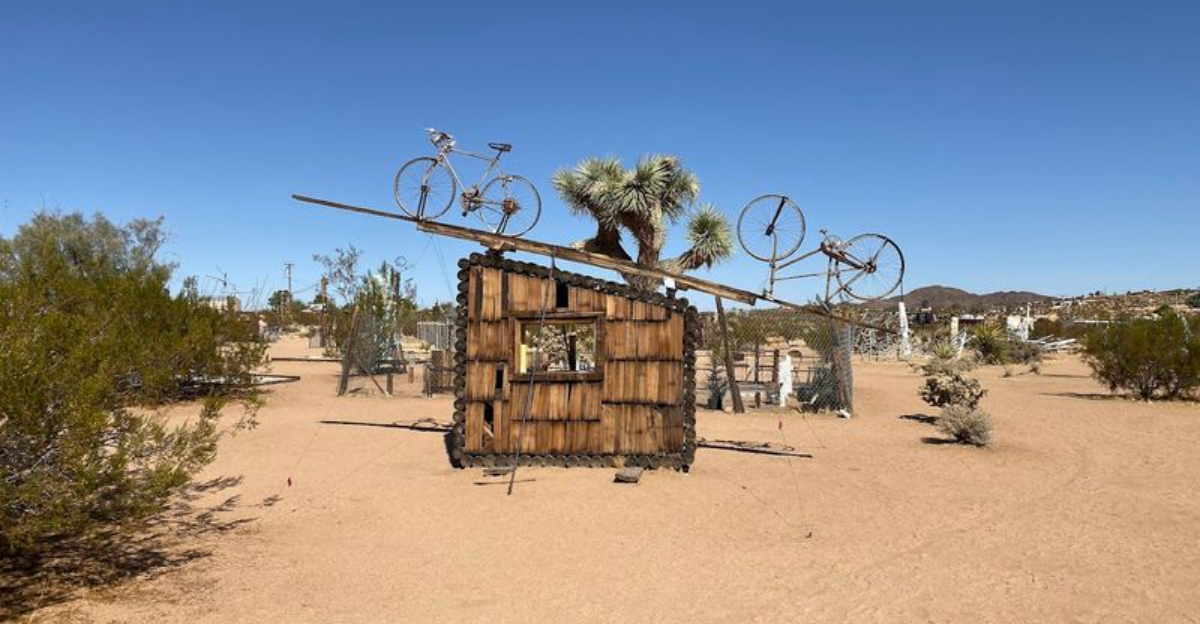
Something about desert art hits differently when it feels both forgotten and alive.
One California museum turns castoff objects into giant sculptures that seem to rise out of the landscape with real attitude, making the whole place feel surprising and oddly moving at the same time.
Spread across 10 acres, it does not come across like a quiet gallery experience.
It feels bigger, wilder, and far more personal, like imagination has been given full permission to take over.
Weathered materials carry new life here, and that transformation is part of what makes a visit linger in your mind.
Wonder shows up quickly in a setting like this. So does curiosity.
By the time you leave, the desert may look the same, but it is hard not to feel like you have seen it in a completely new way.
What the Museum Actually Is and How It Came to Be
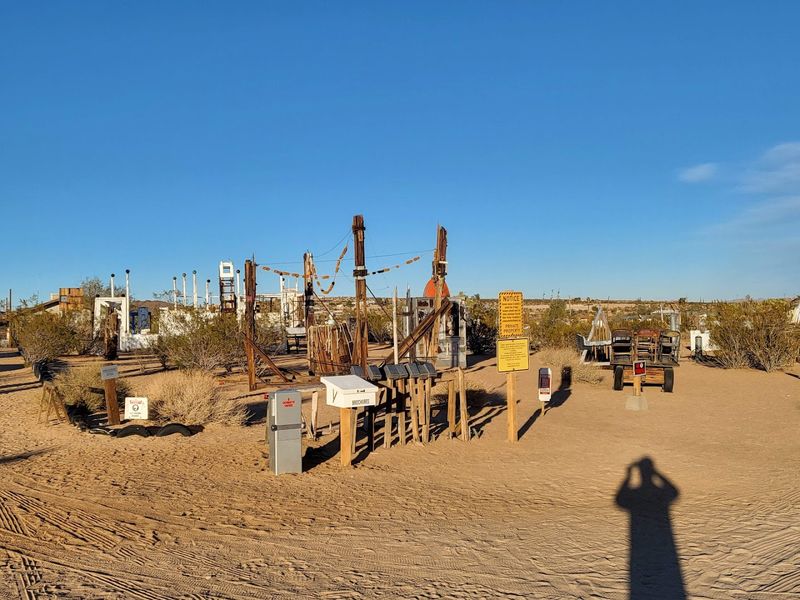
Most museums ask visitors to stay behind a velvet rope, but at the Noah Purifoy Outdoor Desert Art Museum, the sculptures surround visitors on all sides as soon as they step past the welcome kiosk.
The museum sits on 10 acres of open Mojave Desert in Joshua Tree, California, and holds around 120 large-scale assemblage works built from discarded everyday objects.
There are no galleries, no climate-controlled rooms, and no guided tour scripts.
The foundation behind the site describes it as one of California’s major art-historical sites, and preservation groups have recognized it as an important work of Black assemblage art.
The Cultural Landscape Foundation has noted that the harsh desert setting, with its Joshua trees, cholla, creosote, and yucca, actively changes the sculptures over time.
That ongoing transformation was part of the original intent.
The museum is open every day of the year from sunup to sundown and is completely free to enter. Visitors are asked to sign in at the welcome kiosk near the entrance.
Groups of more than 10 people are expected to make arrangements with the Noah Purifoy Foundation in advance before showing up at the site.
The Artist Behind the Desert: A Life Built Around Discarded Materials
Born in Alabama in 1917, the artist who built this desert museum spent decades redefining what art could be made from.
After building a significant career in Los Angeles and becoming a central figure in the city’s Black Arts Movement, the creator of this site later moved his practice to the Mojave Desert.
Over there, he spent the final chapter of his life constructing the outdoor museum that now carries his name.
Much of his early national recognition came from work made directly from the debris of the 1965 Watts rebellion.
A landmark 1966 exhibition titled 66 Signs of Neon used salvaged neon tubing and rubble from the uprising to create work that was both politically charged and formally striking.
That approach, turning discarded and broken material into meaningful art, became the foundation of everything that followed.
After years of policy work with the California Arts Council, he returned fully to studio practice and eventually relocated to Joshua Tree.
From the late 1980s until his passing in 2004, he built the assemblages that now fill the desert grounds.
The Noah Purifoy Foundation was established in 1999 to preserve and maintain the site as a permanent cultural center and sculpture park.
Getting There: The Road to Blair Lane and What to Expect on Arrival
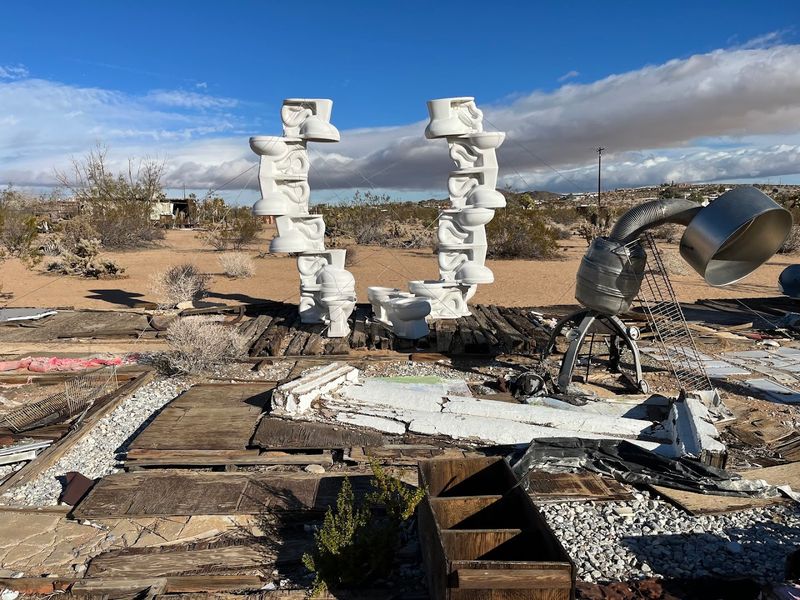
Getting to the museum is part of the experience, and a little preparation goes a long way.
The official address is 63030 Blair Lane, Joshua Tree, CA 92252, and most of the drive from the main highway is on paved road until the final approach, which is a graded dirt road.
The Noah Purifoy Foundation specifically warns visitors to drive carefully because recent storms can damage the road surface.
The site sits roughly five miles off the 29 Palms Highway, and there are signs along the route that help guide visitors toward the entrance.
Parking is available directly at the site, with designated spots near the welcome kiosk.
Visitors should park only in the marked areas and avoid pulling onto adjacent private property, as the museum sits within a quiet residential stretch of the desert.
At the entrance, visitors will find a welcome kiosk where sign-in is expected. Brochures and a numbered map of the installations are typically available there as well.
Donations are accepted and can be made via a QR code at the site.
The foundation no longer accepts cash donations after the donation box was vandalized, so digital giving is the preferred option for those who want to support the space.
No Contest (1991): A Work That Refuses to Play by the Rules
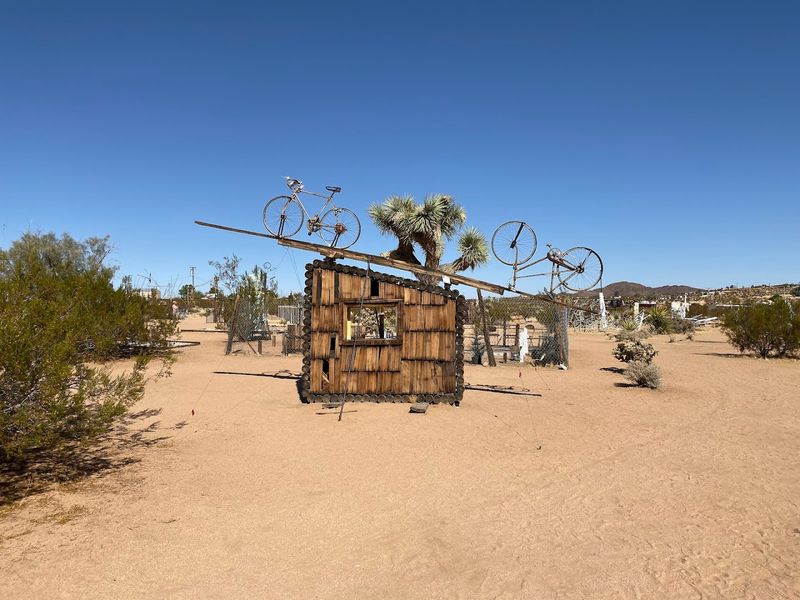
Among the many named works spread across the grounds, No Contest from 1991 stands out as a piece that captures the blunt honesty running through the entire museum.
The title alone carries a kind of dry wit, and the assemblage itself tends to reward visitors who slow down and spend time with it rather than moving quickly from one piece to the next.
Found objects throughout the collection are rarely used in ways that reference their original purpose directly.
Instead, they are stacked, welded, tied, and positioned in ways that force the viewer to look at familiar materials with fresh eyes.
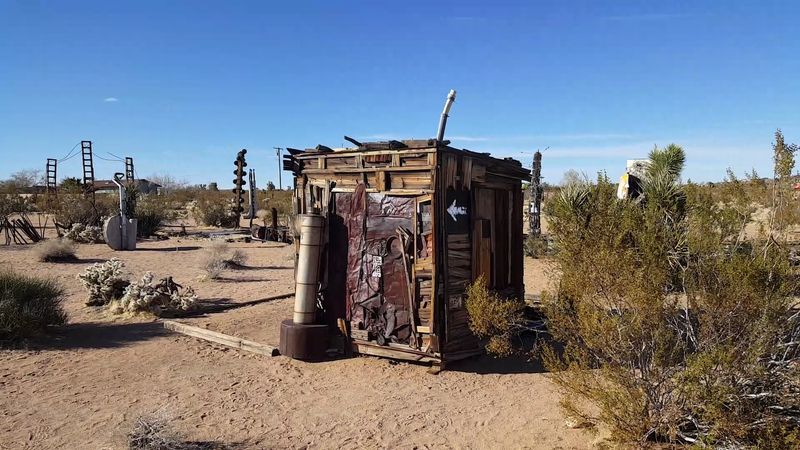
Bowling balls, tires, corrugated metal sheets, aluminum trays, and folding chairs appear throughout the grounds in configurations that feel both deliberate and almost accidental at the same time.
The desert light shifts throughout the day, and the shadows cast by assemblages like No Contest change significantly depending on the time of visit.
Morning visits tend to offer softer light and cooler temperatures, while afternoon sun creates sharper contrasts and longer shadows across the sandy ground.
Either way, the work looks different each time, which is very much in keeping with the museum’s broader philosophy of change and impermanence.
Carousel (1996) and Aurora Borealis (1999-2000): Motion and Light in the Desert
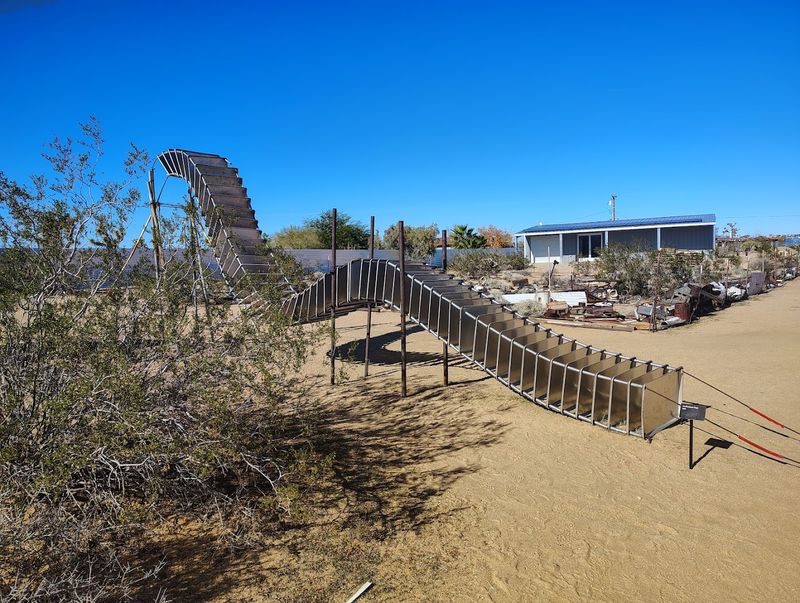
Two of the most visually arresting works on the grounds are Carousel from 1996 and Aurora Borealis, created between 1999 and 2000.
Both pieces engage with the idea of movement and light in ways that feel especially charged given their desert setting.
Carousels are associated with childhood joy and circular motion, while aurora borealis evokes shifting color and atmospheric spectacle, and neither of those references is accidental.
Aurora Borealis in particular has a quality that changes depending on the time of day and the angle of the sun.
Desert light is famously intense and directional, and assemblages made from reflective materials like aluminum trays or metal scraps respond to that light in ways that softer materials never could.
Late afternoon visits, when the sun drops lower toward the horizon, can make certain pieces glow in ways that feel almost theatrical.
Carousel sits as a contrast, grounded and horizontal in feeling where Aurora Borealis reaches upward. Together they illustrate the range of moods present across the 10-acre site.
The museum never feels like a single statement; it feels more like a whole world of ideas accumulated over roughly 15 years of sustained, solitary creative work in one of the most visually extreme landscapes in California.
San Francisco-Oakland Bridge (1997): Civic Scale in the Open Mojave
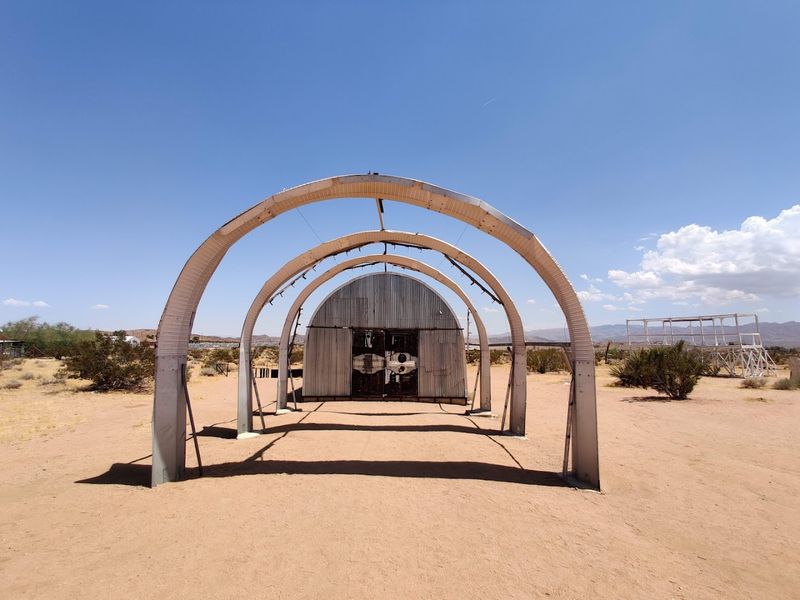
Referencing one of California’s most recognizable pieces of infrastructure, San Francisco-Oakland Bridge from 1997 brings an unexpected civic scale to the desert landscape.
The work doesn’t attempt to replicate the bridge in any literal sense, but the title anchors it to something massive and collectively understood, which makes the use of discarded materials feel even more pointed.
Infrastructure and permanence are themes that run quietly through a lot of the work at the museum. Bridges are built to last for generations, maintained by public funds, and celebrated as engineering achievements.
The assemblages here are built from what gets thrown away, left exposed to one of the harshest climates in North America, and allowed to weather and decay on their own terms.
That tension between durability and disposal is something visitors tend to feel more than they articulate.
The piece also demonstrates how the artist’s titles often do a lot of quiet work.
A bowling ball or a folding chair is a neutral object in isolation, but once it becomes part of something, the viewer is asked to think about connection and public life in an entirely new way.
That reframing is one of the most consistent pleasures the museum offers to anyone willing to slow down and look carefully.
How the Desert Itself Becomes Part of the Art
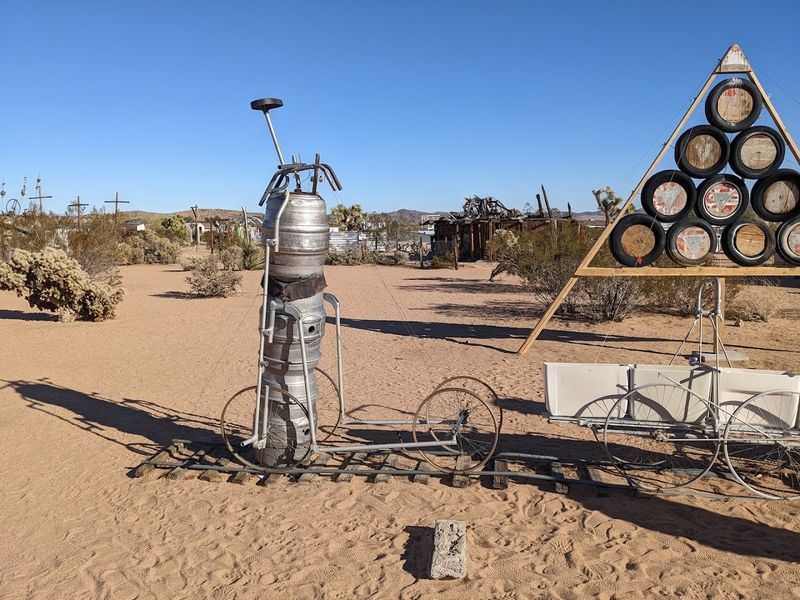
One of the most unusual aspects of the museum is that decay is not a problem to be solved but a condition that was always part of the plan.
The harsh Mojave environment, with its extreme heat, cold nights, occasional flash floods, and relentless UV exposure, actively changes every piece on the grounds.
The Cultural Landscape Foundation has noted that the desert landscape itself, including Joshua trees, cholla, creosote, and yucca, participates in the ongoing transformation of the work.
Rust spreads across metal surfaces. Paint bleaches and flakes. Wood warps and splits. Fabrics dissolve over years of sun and wind.
Rather than treating these changes as damage, the museum frames them as part of what the assemblages mean.
Materials that were discarded by society are now being slowly reclaimed by a landscape that operates entirely outside of human economies of value and waste.
Visitors who return to the museum after several years often notice significant changes in specific pieces, and that temporal dimension adds something that no indoor museum can replicate.
The work is literally not the same from one year to the next, which means every visit is technically a first-time encounter with the current state of the sculptures.
That quality of constant, slow transformation is one of the most genuinely thought-provoking things about spending time at this site.
Practical Tips for Planning a Visit to the Museum
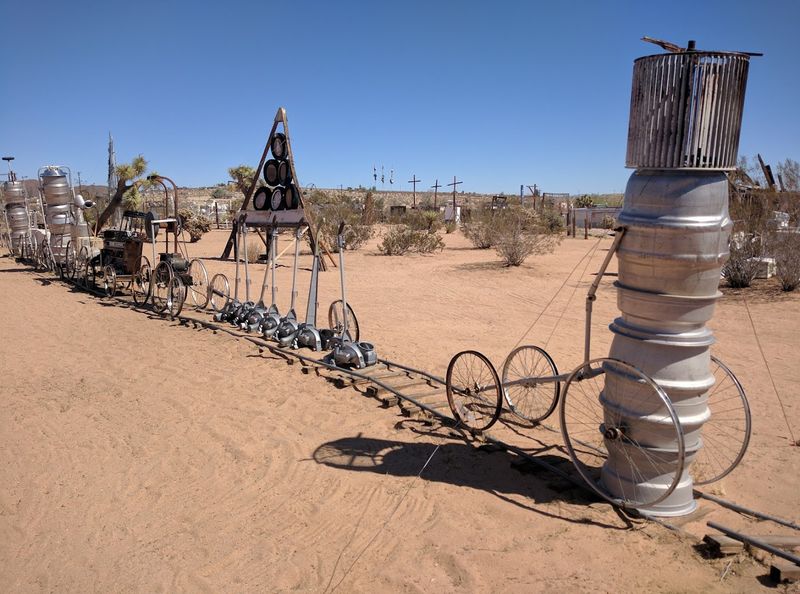
A few practical details can make the difference between a comfortable visit and a difficult one.
The museum has no shade structures, no food or water vendors, and no indoor areas to retreat to if the temperature climbs.
Bringing water, wearing sun protection, and visiting during the cooler hours of the morning or late afternoon are the most commonly shared pieces of advice from people who have spent time there.
Leashed dogs are allowed on the grounds, though the foundation and experienced visitors both caution that the desert ground can get extremely hot, and paw protection may be worth considering during warmer months.
The final stretch of road to the museum is a graded dirt road, and the foundation specifically asks visitors to drive carefully because storm damage can affect the road surface. Most of the drive from the main highway is paved.
Groups of more than 10 people are expected to contact the Noah Purifoy Foundation before visiting rather than arriving without notice.
Visitors are also asked to respect the surrounding residential area by driving slowly, staying within the museum grounds, and not littering on the approach road or the property itself.