Florida Is Home To The Oldest Masonry Fort In America And It’s Seriously Impressive
There is something deeply humbling about standing in front of a structure that has outlasted everything time could throw at it. Three and a half centuries.
Countless storms. Generation after generation of people who came, stared, and left speechless.
And yet, here it stands. Florida is home to the oldest masonry fort in the entire continental United States, and this place does not just hold history.
It is history. The walls are made from a material found nowhere else on earth, and Florida’s oldest city wraps itself around this fortress like it was always meant to be there.
Florida is also full of surprises, but nothing quite prepares you for this one. Once you learn what makes this fort truly one of a kind, you will not want to stop reading.
A Fort Built From Seashells And Brilliant Engineering
Most structures were built to be tough. This one was built to be almost impossible to destroy, and the secret ingredient is stranger than you would expect.
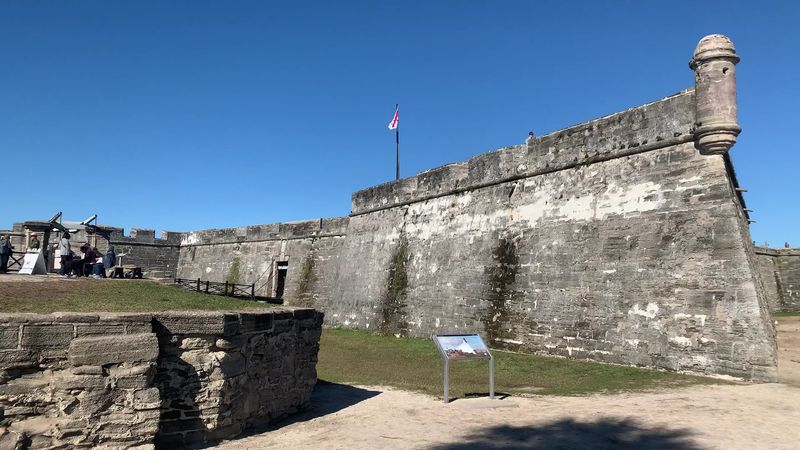
The Castillo de San Marcos was constructed almost entirely from coquina, a local stone made from millions of compressed ancient seashells. It is semi-rare, porous, and honestly looks unassuming up close.
But here is the brilliant part. Coquina walls absorb impact instead of shattering.
Anything thrown at them would simply lodge right into the surface and stop. Spanish engineers discovered this remarkable quality and built an entire legacy around it.
Construction began in 1672 and took 23 years to complete. The coquina was quarried from nearby Anastasia Island, a place the Spanish called the King’s Quarry.
Skilled workers from Havana, Cuba contributed their expertise alongside local labor from nearby communities.
Oyster shells were burned in kilns to make the lime mortar holding everything together. Walking up to these walls today, you can actually see the shells embedded in the stone.
You will find the Castillo at 11 S Castillo Dr, St. Augustine, FL 32084. It is genuinely one of the most fascinating places you will ever touch a wall and feel centuries beneath your fingertips.
The Star Shape Was No Accident
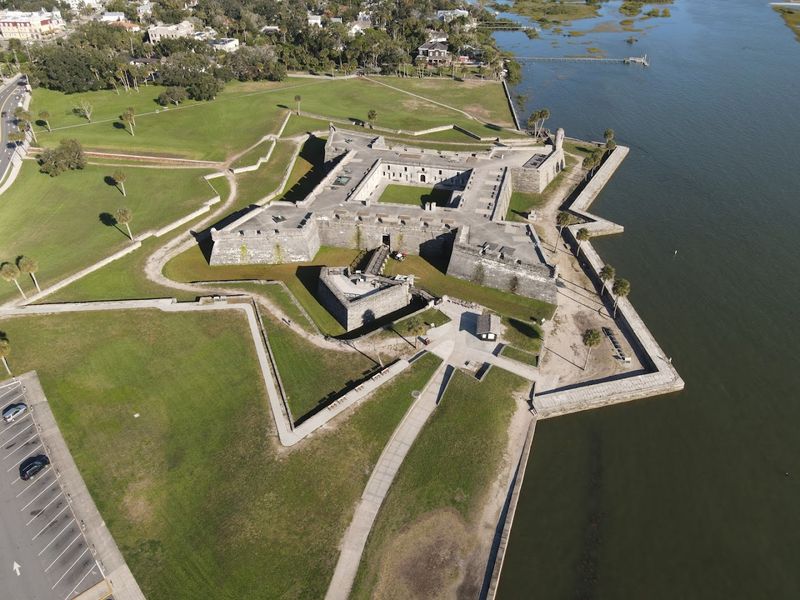
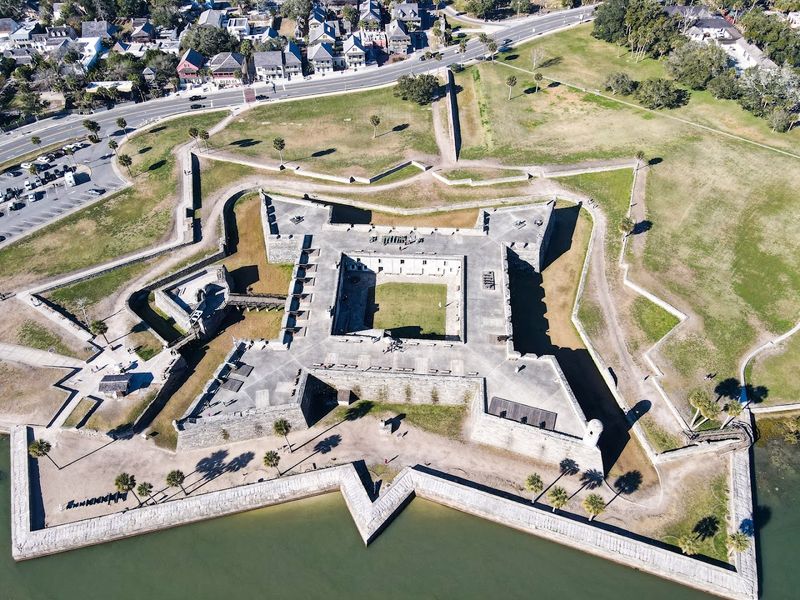
You might look at the fort’s shape from above and think it looks like a geometric puzzle. That shape was actually a stroke of pure genius.
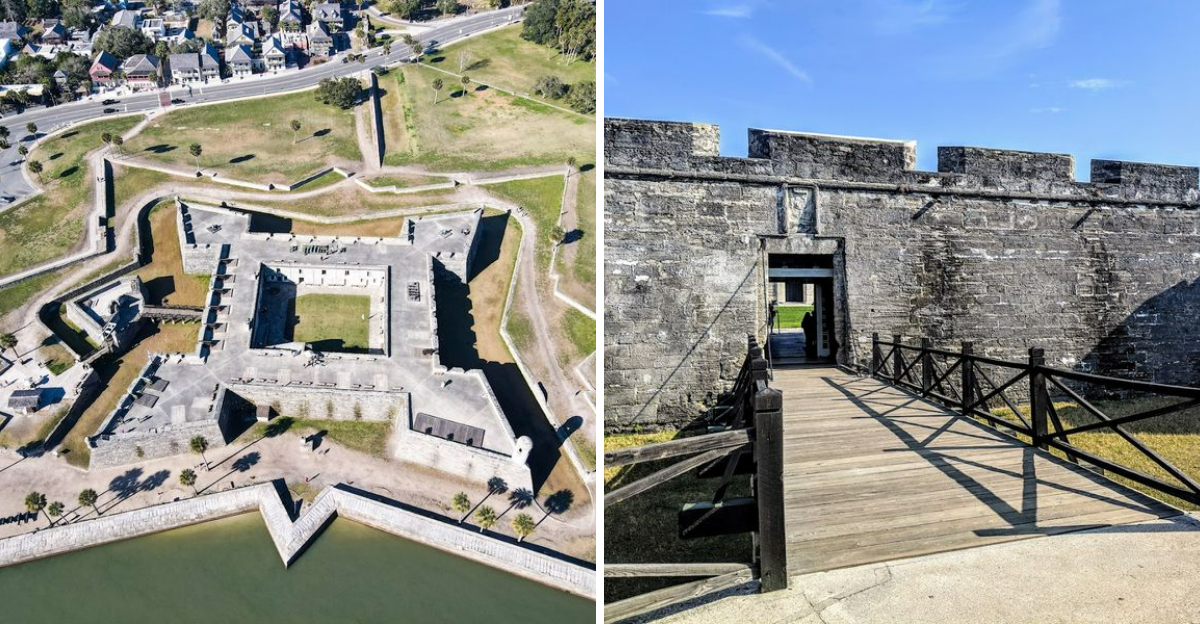
The Castillo follows the Vauban star fort design, featuring four angular bastions named San Pedro, San Pablo, San Carlos, and San Agustin. Each bastion juts outward so the entire outer wall stays visible from multiple angles, with no blind spots anywhere.
The design also includes a moat that could be flooded with seawater from Matanzas Bay. A sallyport served as the only entrance, and drawbridges controlled access completely.
Walls at the base range from 14 to 19 feet thick. Standing inside and pressing your hand against one of those walls, you feel the sheer mass of the thing.
The interior opens into a large courtyard called the Plaza de Armas, surrounded by rooms that once housed people, supplies, and stories. The whole layout rewards slow exploration.
Every corner reveals another layer of the original Spanish engineering that kept this fort standing for centuries.
Never Taken By Force Through Centuries Of Conflict
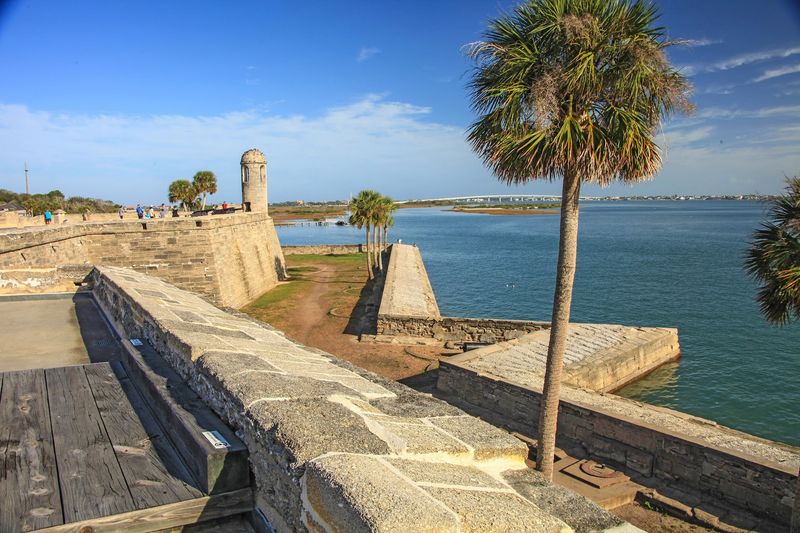
Here is a fact that genuinely stopped me when I first read it. The Castillo de San Marcos has never once fallen.
Not once in its entire history.
The coquina walls proved extraordinary through every challenge this fort ever faced. Where other materials would have crumbled, coquina simply absorbed the pressure and held firm.
Historians still marvel at it.
Ownership did change over time, but always peacefully through treaties and transfers. Spain, Great Britain, and the United States each held the fort at different points in history.
During British control it was renamed Fort St. Mark. The Americans called it Fort Marion for a period.
Its original Spanish name was restored in 1942, which feels like a rightful correction.
The fort became a National Monument in 1924 and joined the National Park Service in 1933. That layered history adds real weight to every step you take inside.
You are walking through centuries of carefully preserved story.
The Upper Deck View Will Make You Stop Walking
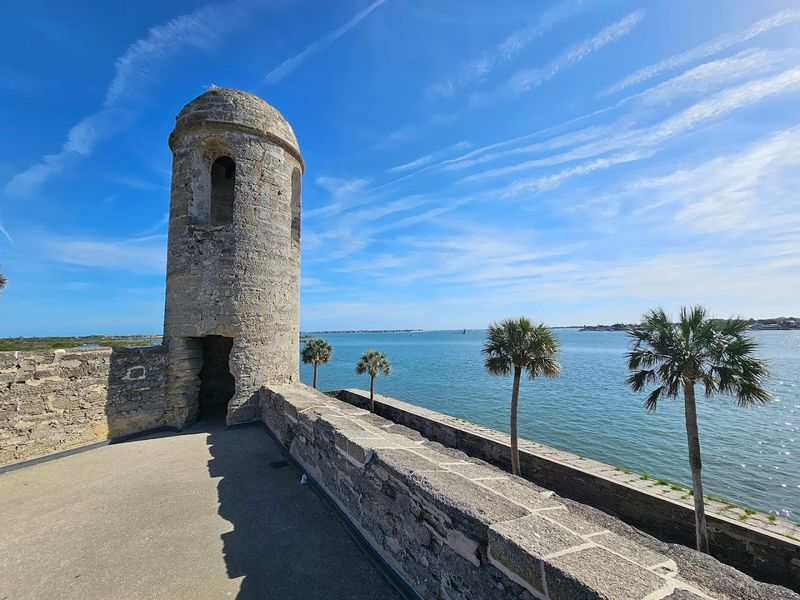
Nobody warned me that climbing to the upper deck would completely steal my attention. The view from up there is something else entirely.
Matanzas Bay stretches out in front of you, wide and sparkling. The city of St. Augustine fans out to the sides, a mix of old rooftops and church spires.
The ocean breeze hits you immediately and does not let go.
The upper deck is where history and landscape collide in the most beautiful way. Standing where people once stood centuries ago, scanning the same shimmering water they watched every single day, feels genuinely surreal.
Sunrise and sunset visits hit differently up here. The light off the water turns golden, and the whole scene looks like something from a painting.
Comfortable walking shoes are a must because the surfaces are uneven in places. Bring sun protection too, since there is very little shade on the upper level.
Open daily except Thanksgiving Day and Christmas Day. First admission is 9 AM and last admission is 5 PM.
Plan enough time to linger up here. Rushing this view would be a real mistake.
Ranger Talks And Cannon Demonstrations Are Worth Scheduling Around
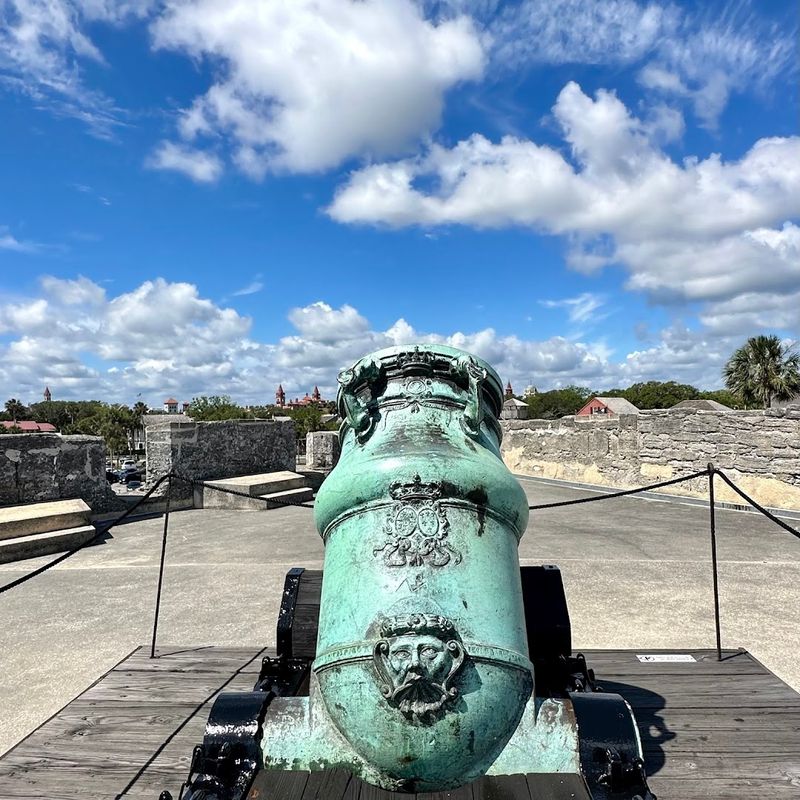
Walking through the fort on your own is great. Walking through it right after a ranger talk is a completely different experience.
Park rangers at the Castillo are genuinely passionate about this place. They explain construction techniques, the human stories behind the stone walls, and fascinating details that make everything click into place.
That kind of insider knowledge changes how you see every single room.
The live demonstrations are a separate level of memorable. Watching and hearing that kind of history come alive from the walls of a 350-year-old Spanish fort is the kind of thing that makes kids and adults both stop and stare.
Check the schedule before you visit because demonstrations do not happen every single day. Attending on a day with live programming makes the entry fee feel like a bargain.
Entry is covered under the America the Beautiful National Parks Pass. Standard adult tickets can be purchased online or at the entrance, and staff are consistently helpful and friendly.
The fort is well organized and easy to navigate at your own pace. Restrooms are available on site, which is a practical detail worth knowing before you head up to the upper levels.
The Interior Rooms Tell Stories That Textbooks Skip
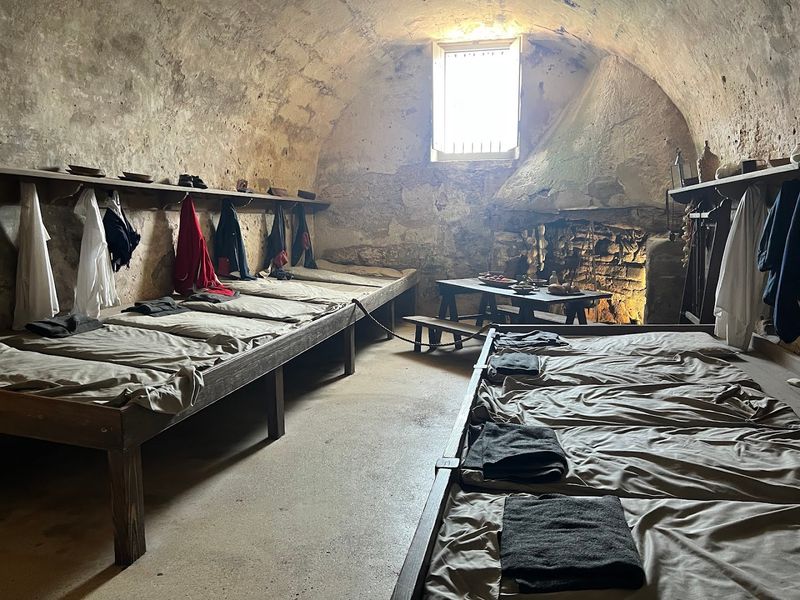
Most people expect a fort to be all walls and cannons. The interior rooms of this one carry a quieter, more human kind of history.
Once inside, you move through chambers that tell stories of daily life, cultural exchange, and survival across centuries. The rooms are small and the ceilings are low, which immediately tells you something about what life inside these walls actually felt like.
Historical exhibits throughout the interior explain the fort’s role in Spain’s New World empire. St. Augustine was the northernmost outpost of that empire, which made it a critical anchor point for the entire region.
The stories here go far beyond architecture and engineering. The fort also housed Native Americans connected to the construction and mission periods of early Florida.
That layer of history is one that most school curricula skip entirely.
Exhibits are informative without being overwhelming. You can move through at your own pace and spend as long as you want in each space.
The Plaza de Armas courtyard at the center gives you a moment to breathe between rooms. Sitting there and looking up at the walls surrounding you on all sides is a surprisingly peaceful and grounding experience.
A Family Visit Here Hits Differently Than A Museum
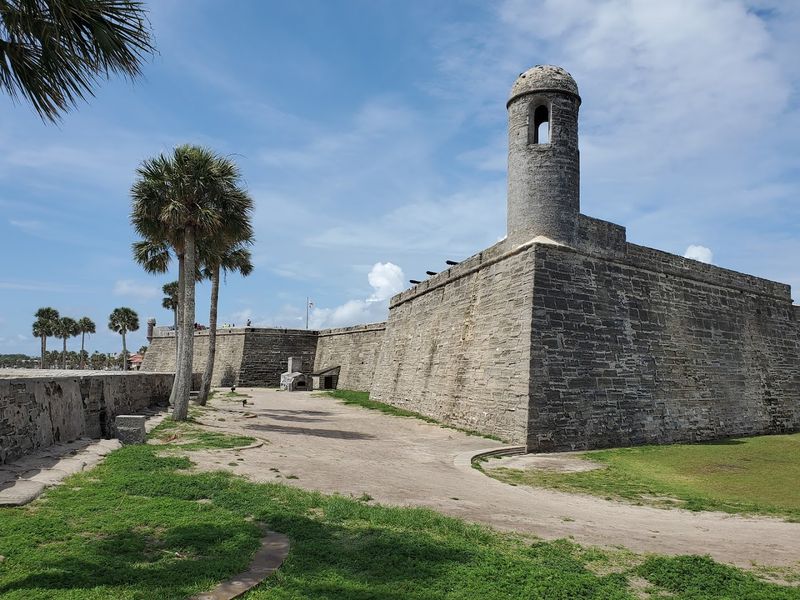
My nephew is eight years old and has strong opinions about what counts as boring. The Castillo passed his test with flying colors, which is saying something.
There are cannons to look at, thick walls to walk along, and views of the water from every elevated section. Kids can explore freely in a way that most museums do not allow, and that freedom makes a real difference.
The fort is completely walkable and easy to navigate with children. Surfaces are solid and the layout is open enough that younger visitors can roam without getting lost.
Seeing park rangers in period-style uniforms adds an element of theater that younger visitors respond to immediately. The cannon demonstrations turn history into something physical and loud and exciting.
A gift shop on site carries some genuinely interesting items, not just generic souvenirs. Note that the gift shop closes about 20 minutes before the fort itself closes, so plan your shopping accordingly.
The fort sits right next to the historic district of St. Augustine, making it easy to combine with other nearby attractions, restaurants, and shops. Parking fills up quickly in the area, so arriving early or using the parking app for the lot at around $2.50 per hour saves a lot of circling around.
The Moat And Drawbridges Are Straight Out Of A History Book
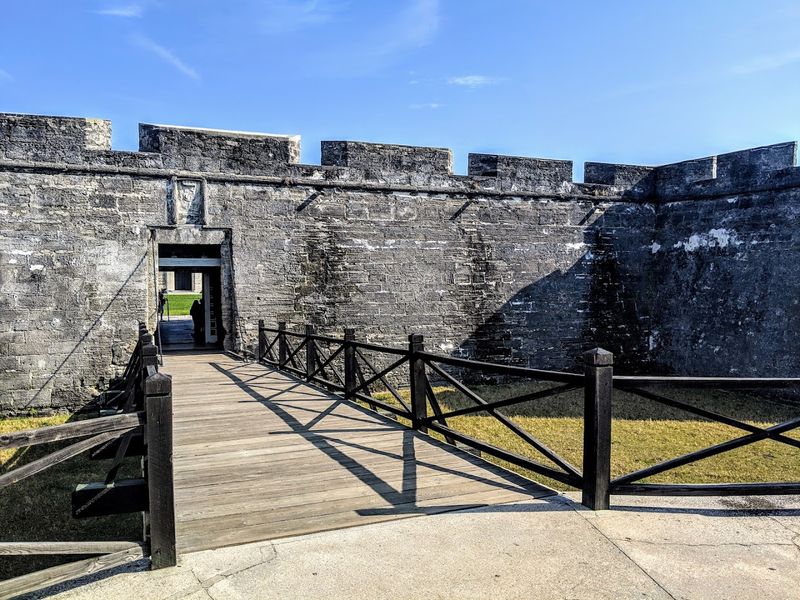
Walking across the drawbridge into the Castillo for the first time feels almost theatrical. You half expect someone in armor to appear at the gate.
The moat surrounding the fort was designed to be flooded with seawater from Matanzas Bay. This turned the entire fortification into an island when needed, cutting off any ground-based assault before it could reach the walls.
Multiple drawbridges controlled access at different points. The sallyport served as the primary entrance, a narrow, controlled passage that funneled anyone entering into a space where defenders held every advantage.
Even today, walking through the sallyport gives you a sense of the deliberate design. The passage is dim, the walls press close, and the shift from open air to enclosed stone is immediate and striking.
The exterior of the fort is completely free to walk around. You can circle the moat, look up at the walls from outside, and get a real sense of the scale without paying an entry fee.
That outside walk alone is worth doing before you go in. Seeing the full star shape from ground level, with the bastions jutting out at each corner, makes the engineering feel real in a way that reading about it simply cannot match.
Why This Fort Belongs On Every Florida Itinerary
Some landmarks feel important because someone told you they are. This one earns it on its own terms, the moment you actually stand in front of it.
History lovers get deep context and well-preserved architecture. Families get space, cannons, and views that hold everyone’s attention.
Casual visitors get stunning scenery and an easy, self-guided experience that never feels forced.
The fort is open seven days a week from 9 AM to 5 PM. More information and entry details are available at nps.gov/casa.
Combining this visit with the rest of St. Augustine’s historic district makes for a genuinely full and satisfying day. Everything is close together and walkable from the fort.
Florida has no shortage of impressive places to see. But there is only one oldest masonry fort in the continental United States, and it has been standing right here for over 350 years, waiting for you to show up.