11 Oregon Mountain Views That Feel Almost Too Beautiful To Be Real
There is something about standing on a mountain ledge in Oregon that makes the rest of the world go quiet. Not the famous overlooks you see on postcards.
Not the pullouts crowded with tour buses. The ones I found took effort, patience, and more than a few wrong turns.
Oregon has a long habit of hiding its best work behind unmarked roads and forgotten trails. Every single one of these views stopped me in my tracks.
Some made me laugh out loud from the sheer scale of it all. Others just left me standing there, speechless, staring at ridgelines that seemed to go on forever.
Oregon does not give these moments away easily, but when it does, you feel it in your chest.
1. Dee Wright Observatory
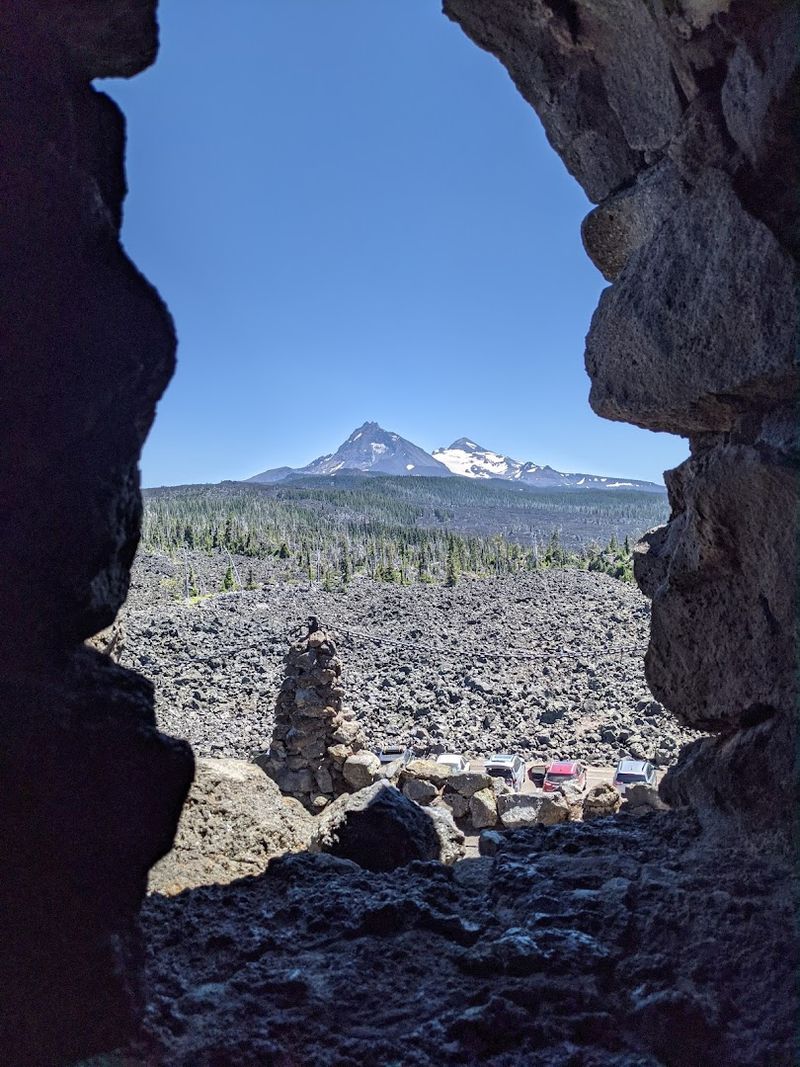
Standing on a lava field at more than 5,100 feet, this place looks like another planet. The Dee Wright Observatory sits right on McKenzie Pass along OR-242 in Sisters, OR 97759.
Built entirely from volcanic rock in the 1930s, it is genuinely one of the coolest structures you will ever climb.
The view through the stone windows frames each Cascade peak like a painting. Mount Washington, the Three Sisters, and Belknap Crater all line up perfectly.
The lava field stretching in every direction adds a dramatic, almost eerie quality to the scene.
Getting there requires driving a narrow, winding highway that closes every winter under heavy snow. That means summer and early fall are your windows.
Pack layers because wind comes fast up here. The paved half-mile loop around the observatory gives you shifting angles on every peak.
Most visitors spend way longer here than planned. Bring a camera with a wide lens and plenty of storage.
2. Rowena Crest Viewpoint
Few viewpoints in the Pacific Northwest hit this hard from the roadside. Rowena Crest Viewpoint sits at 6500 Historic Columbia River Hwy, Mosier, OR 97040, right off the old highway with almost no effort required to reach it.
Park, walk thirty feet, and your jaw drops.
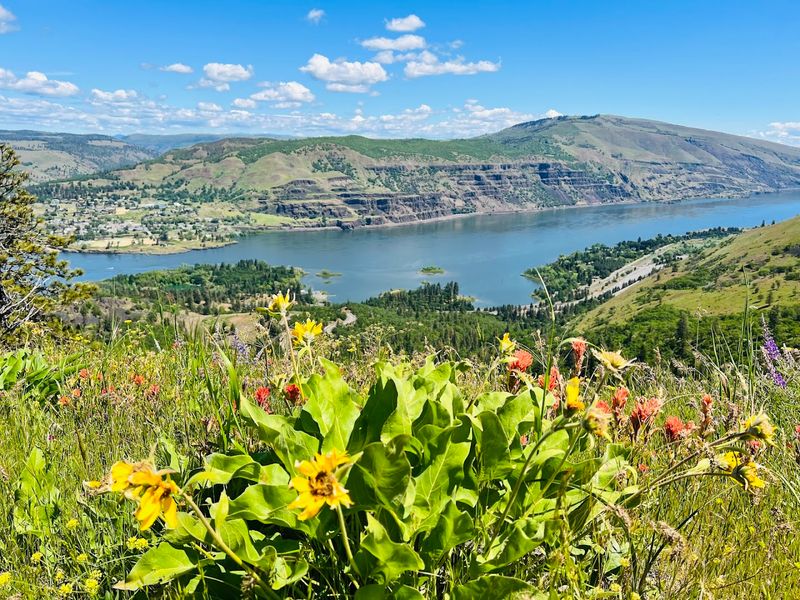
The Columbia River curves dramatically below you, and the gorge walls roll out in every direction. Spring is the showstopper season here.
The Tom McCall Nature Preserve bursts with golden balsamroot and rare lupine, covering the plateau in color.
The viewpoint area sits around 650 feet above sea level, giving you a wide look across the gorge. You get a sweeping 180-degree perspective that photographs simply cannot capture fully.
The contrast between the dry eastern side of the gorge and the lush western forests is visible from this single spot. Arrive early on spring mornings to beat the weekend crowds.
A short trail loops the preserve for even wider angles. This one feels like a postcard that somehow got even better in real life.
3. Panorama Point County Park
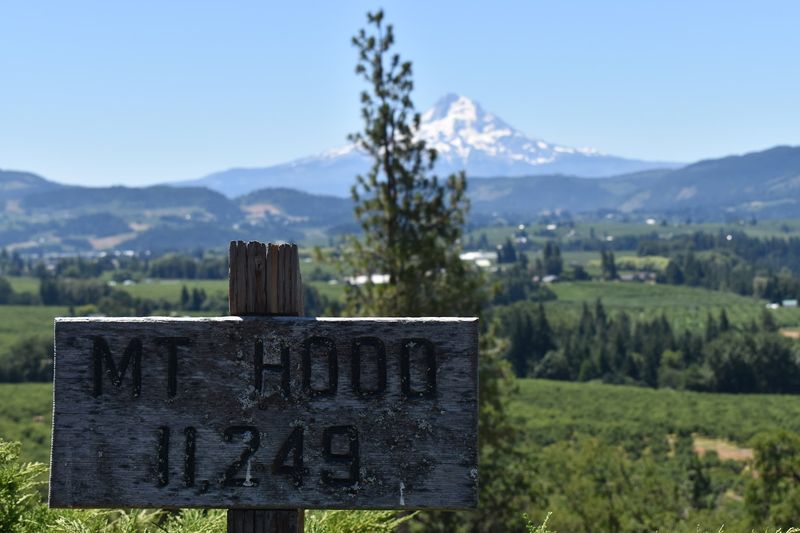
Fruit trees in bloom with a snow-capped volcano behind them is a combination that should not be this easy to find. Panorama Point County Park at 1212 Eastside Rd., Hood River, OR 97031 delivers exactly that view, completely free of charge.
Spring is the obvious star season here.
The Hood River Valley spreads out below you in a patchwork of orchards and farms. Mount Hood dominates the skyline with almost theatrical presence.
On clear days, Mount Adams peeks over the ridge to the north, adding a bonus peak to the scene.
The park itself is small and simple, just a grassy area with a fence and a view. No trails, no visitor center, no fuss.
That simplicity is honestly part of the charm. You show up, you look, you feel genuinely lucky.
April and May bring the best blossom displays. Weekday mornings are quieter and the light is softer.
Bring coffee and take your time.
This is the kind of view that makes you want to move to the Hood River Valley immediately.
4. Timberline Lodge Viewpoint
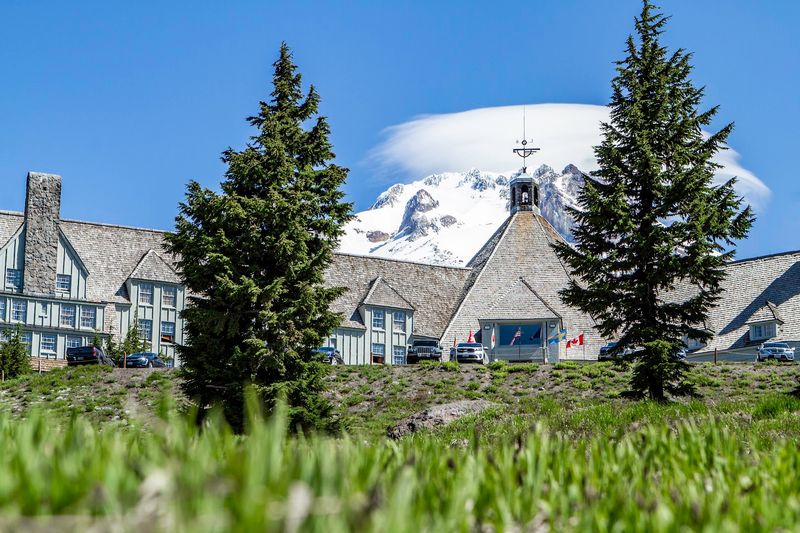
Standing at 6,000 feet on the south slope of Mount Hood, Timberline Lodge is one of those places that earns its reputation every single time. The viewpoint at 27500 E Timberline Rd., Government Camp, OR 97028 gives you unobstructed access to the mountain above and the valley far below.
It is genuinely stunning in both directions.
The lodge itself was built in the 1930s as a Works Progress Administration project. The stonework, the hand-carved details, the sheer permanence of it all feel remarkable against the wild alpine backdrop.
Looking south from the lodge, the valley drops away toward Portland and the Willamette Valley.
Timberline sits just below the Palmer Snowfield, which holds snow year-round. On summer mornings, you can watch skiers and snowboarders heading uphill while wildflowers bloom at your feet.
The combination of history, architecture, and raw mountain scenery makes this feel like more than just a viewpoint. Arrive before 9 AM to beat tour groups.
The sunrise light on the upper mountain glaciers is worth the early alarm clock.
5. Trillium Lake
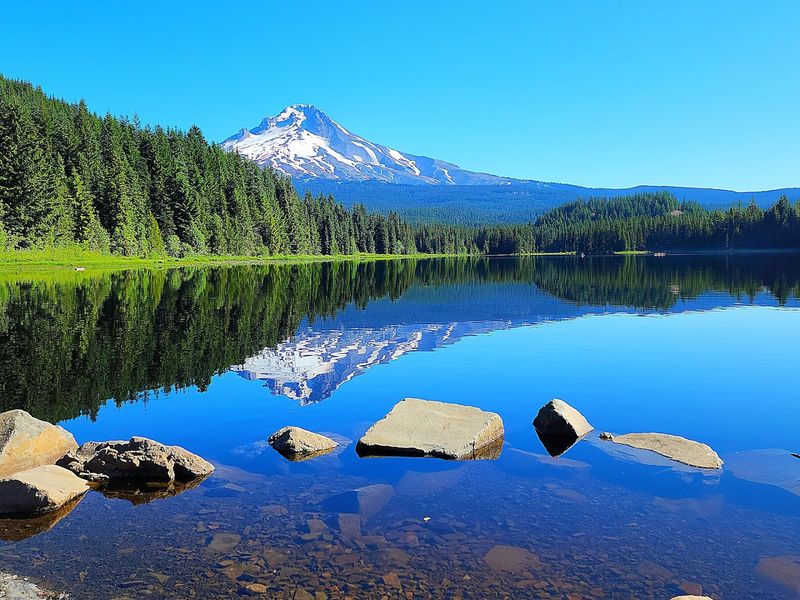
If a mountain could have a perfect portrait taken, this would be the location. Trillium Lake at 32798 E Trillium Lake Loop Rd., Government Camp, OR 97028 produces one of the most photographed reflections in the entire Pacific Northwest.
Mount Hood mirrors itself in the still water with almost suspicious perfection.
The lake sits at about 3,600 feet elevation, making it accessible even when higher viewpoints are closed. The loop trail around the lake is flat, easy, and just over two miles long.
Every angle offers a slightly different composition with the mountain behind the treeline.
Sunrise is the magic hour here without question. The sky turns pink, the water goes glassy, and the reflection of Mount Hood looks almost too good to be real.
Fishing is popular at the lake too, which adds a relaxed, unhurried atmosphere. The campground nearby means you can wake up right here without rushing from town.
Weekends fill fast in summer, so midweek visits are strongly recommended.
This spot genuinely never gets old no matter how many times you return.
6. Wallowa Lake Tramway
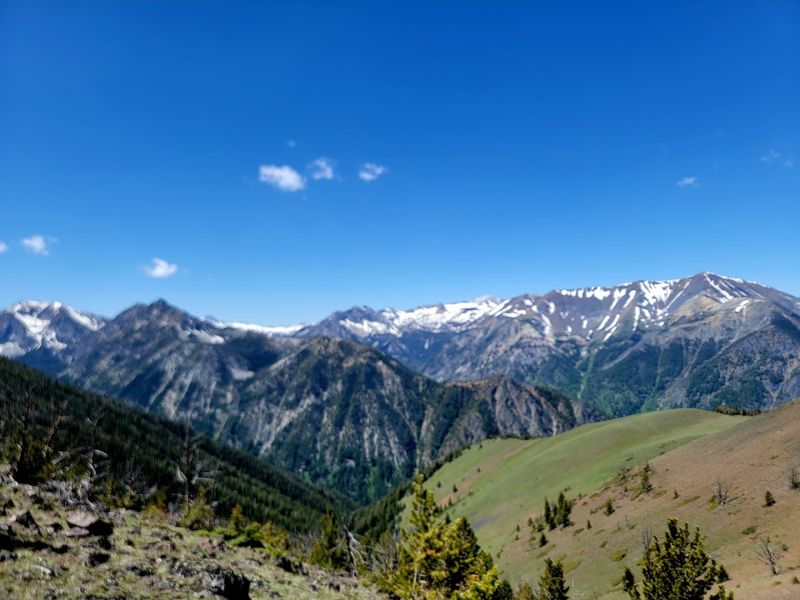
Northeastern Oregon holds a mountain range so dramatic that people actually call it the Alps of Oregon. The Wallowa Lake Tramway at 59919 Wallowa Lake Hwy., Joseph, OR 97846 lifts you from the valley floor to 8,150 feet in about fifteen minutes.
The views during the ride are legitimately dizzying in the best way possible.
From the summit, you can see across the Wallowa Mountains into Idaho and beyond. The granite peaks, the deep glacial lake below, and the open alpine meadows create a scene that feels more like Switzerland than the American West.
Eagle Cap Wilderness stretches out to the south in every shade of green and gray.
The tram runs from late spring through early fall, weather permitting. At the top, short hiking trails let you explore the summit ridge at your own pace.
The elevation change is dramatic, so bring a layer even on warm valley days. Wildflowers peak in July across the summit meadows.
The tramway itself is one of the steepest gondola rides in North America, which adds a small thrill to the whole experience.
7. Kiger Gorge Overlook
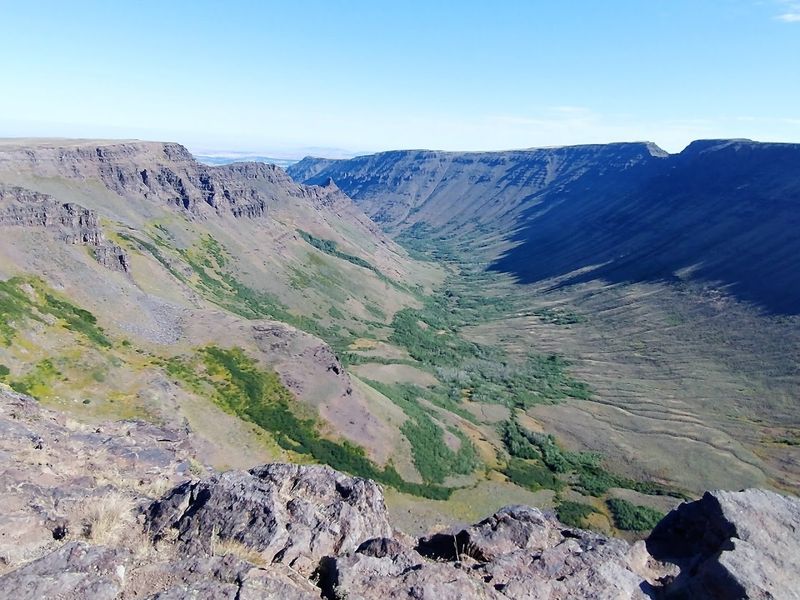
Nothing prepares you for suddenly standing at the edge of a canyon this massive in the middle of the high desert. Kiger Gorge Overlook on Steens Mountain Loop Rd., Frenchglen, OR 97736 sits above one of the most dramatic glacially carved gorges in the American West.
The drop is sudden, steep, and absolutely breathtaking.
Steens Mountain itself is a fault block mountain, not a volcano. That geological distinction means the western face drops sharply into deep glacial canyons while the eastern slope descends more gradually toward the Alvord Desert.
Kiger Gorge is the most visually striking of the four main canyons here.
The Kiger Mustang, a wild horse breed descended from Spanish colonial horses, roams this area and was actually named after this gorge. Spotting a small herd near the overlook is entirely possible.
The road to reach here is long and unpaved in sections, so a high-clearance vehicle is recommended. Plan for a full day at minimum.
The remoteness is part of the reward, and the silence up here is unlike anything near a city.
8. Mount Scott Trail
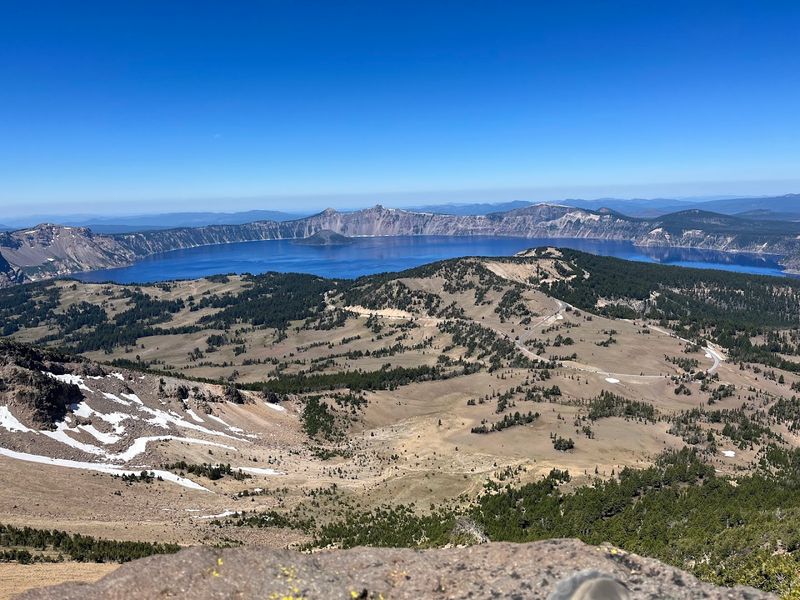
Crater Lake is already famous, but most visitors never leave the rim road. Mount Scott Trail on East Rim Dr., Crater Lake National Park, OR 97604 takes you higher than any other point accessible by trail in the park.
The summit sits at 8,929 feet, and the payoff is worth the roughly 4.4-mile round-trip hike.
From the top, the entire caldera opens up below you. The lake looks impossibly blue from this elevation, surrounded by volcanic walls on all sides.
You can see into the crater clearly, spot Wizard Island, and look out across layers of forested ridges in every direction.
The trail gains about 1,150 feet of elevation, making it a moderate to strenuous hike. Snow can linger on the upper section well into July.
Start early to catch the morning light on the lake surface, which shifts from silver to deep sapphire as the sun rises. The park sits at high elevation, so the air is noticeably thinner.
Take your time on the ascent. The views from the summit are genuinely different from anything you see from the rim drive below.
9. East Rim Overlook
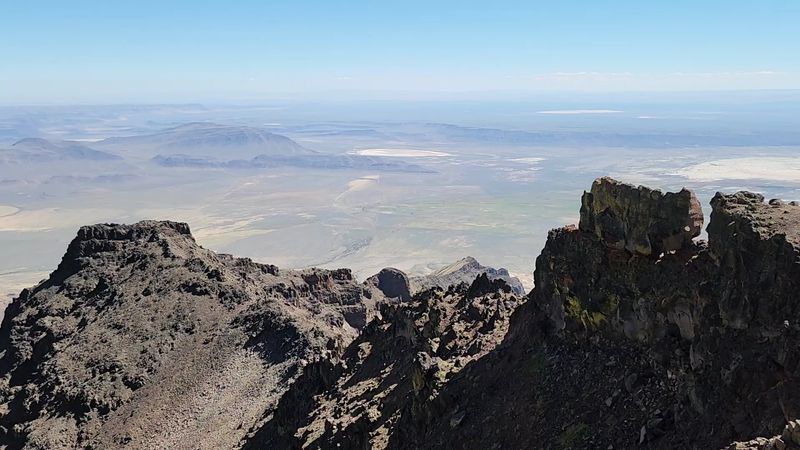
Very few places in the lower 48 states let you look down nearly 5,000 vertical feet in a single glance. East Rim Overlook on Steens Mountain Loop Rd., Frenchglen, OR 97736 does exactly that, with the Alvord Desert playa shimmering white far below.
The scale of this view is genuinely hard to process at first.
Steens Mountain rises to 9,733 feet, and the eastern escarpment drops almost straight down to the desert floor. The contrast between the lush alpine environment at the summit and the bone-dry desert below is one of the most dramatic landscape transitions in the entire state.
On clear days, you can see well into Nevada.
The road to the summit is gravel and requires a high-clearance vehicle, especially above 8,000 feet. Summer is the primary window, as snow blocks the upper road from fall through late spring.
The summit area has multiple overlooks, and East Rim is the one that consistently stops people mid-sentence. Bring binoculars to scan the Alvord Desert for detail.
The sheer openness of this view is something that photographs genuinely struggle to communicate.
10. Watchman Peak Trail
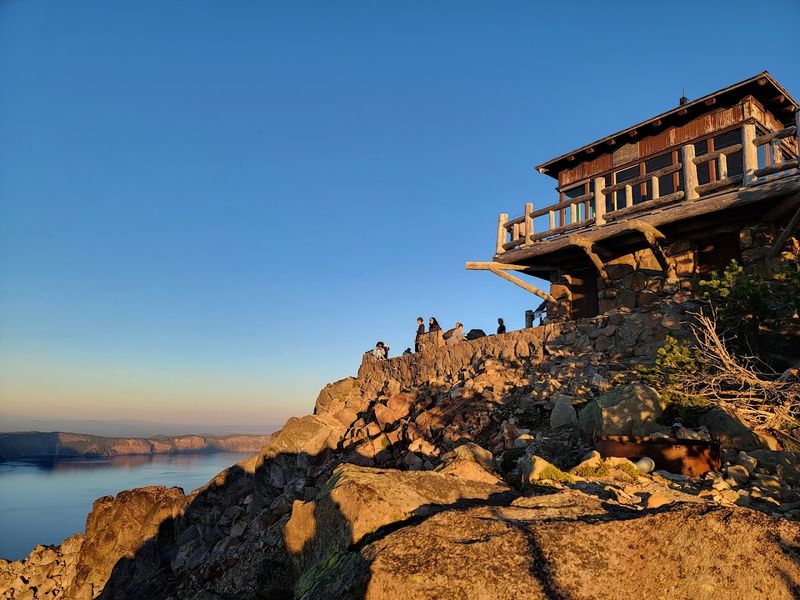
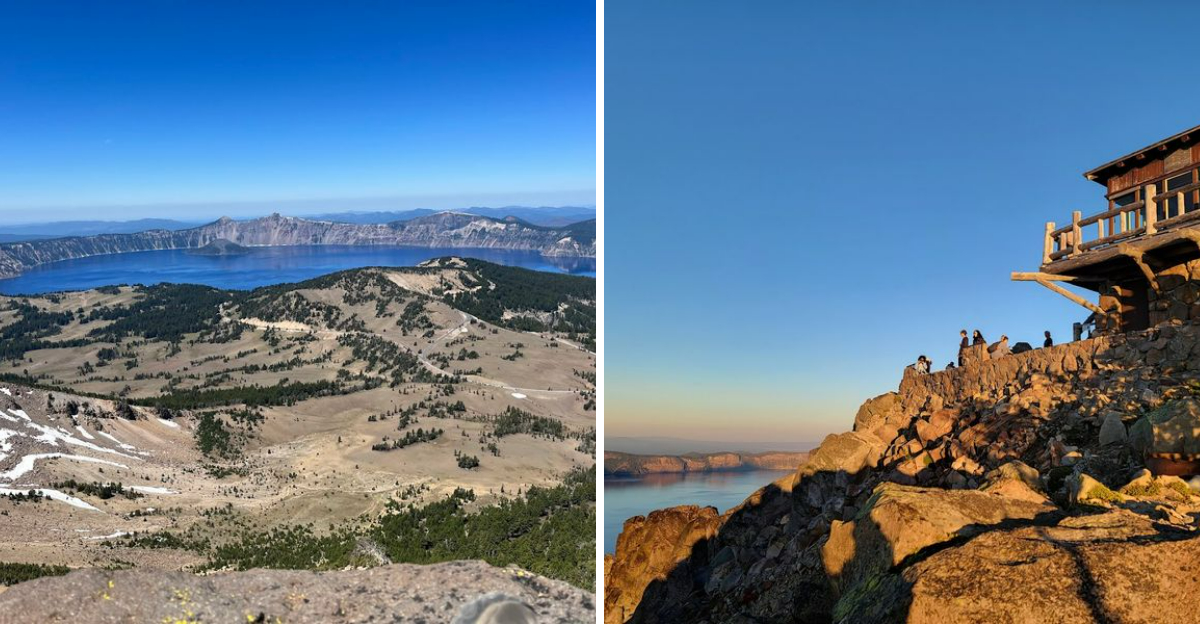
There is a stone fire lookout tower at the top of this trail that has been watching over Crater Lake since 1932. Watchman Peak Trail on West Rim Dr., Crater Lake National Park, OR 97604 is one of the most rewarding short hikes in the park.
The summit sits at 8,013 feet, and the climb is only about 1.6 miles round trip.
The view from the lookout tower frames Wizard Island almost perfectly in the center of the caldera. The western angle gives you a different perspective than most visitors ever see.
Late afternoon light turns the lake surface into something almost metallic before softening into deep blue at dusk.
The trail gains about 420 feet of elevation, making it accessible to most reasonably fit hikers. Crowds are lighter here than at popular overlooks like Discovery Point.
The lookout tower is still staffed by rangers during summer months, and they are usually happy to answer questions about the geology. Bring a wide-angle lens if you can.
The combination of the historic stone structure and the caldera below creates a photograph that looks almost too composed to be real.
11. Steens Mountain Summit Trailhead
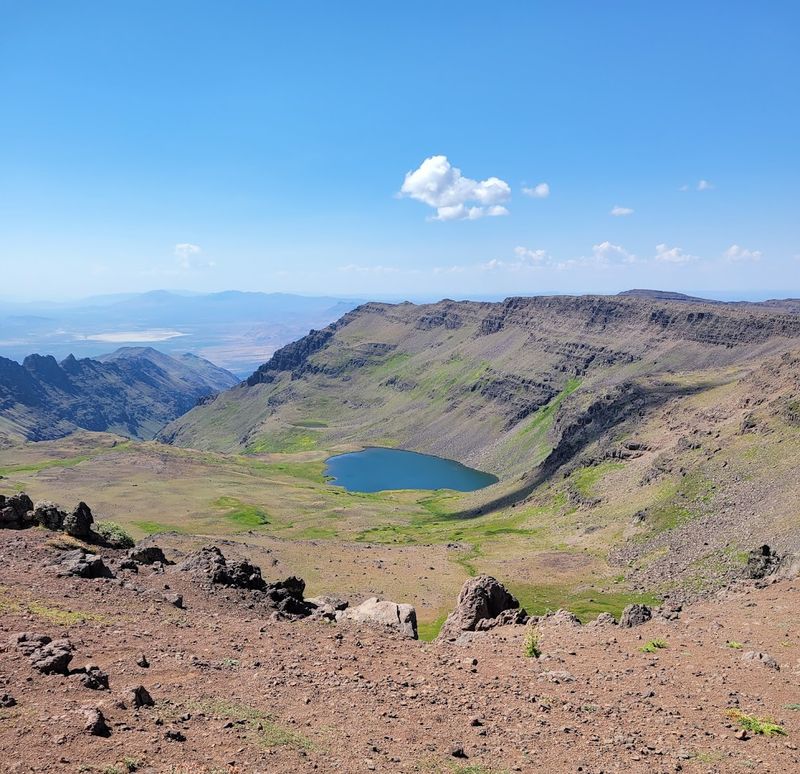
Reaching the highest point in southeastern Oregon by road feels like a genuine achievement, even if you drove most of the way.
The Steens Mountain Summit Trailhead on Steens Mountain Loop Rd., Frenchglen, OR 97736 sits near the 9,733-foot summit, accessible by a long but passable gravel road in summer.
On especially clear days, the views can stretch toward three other states and even Mount Shasta.
The summit plateau is wide open alpine tundra, windswept and surprisingly cold even in August. From here, all four of the major glacial canyons on the western slope are visible at once.
Kiger Gorge, Wildhorse Canyon, Big Indian Gorge, and Little Blitzen Gorge all fan out below you in a geological display that took thousands of years to carve.
The road opens in late June or July depending on snowpack and closes again by October. Cell service is essentially nonexistent out here.
Fuel up before leaving Burns or Fields, the nearest towns. Sunrise from the summit is a special experience, with light spreading across the Alvord Desert playa far below.
This is one of those places that earns its remoteness completely and rewards every mile of the drive.