These New Mexico National Parks And Monuments Are The Ones Visitors Can’t Stop Talking About
New Mexico can make you feel underprepared, and somehow that is the highest compliment you can pay a place.
You arrive expecting scenic drives and end up standing inside a cave the size of a cathedral, wondering how you nearly skipped this entirely.
The parks and monuments here do not traffic in subtlety.
They deal in ancient ruins older than most countries, dune fields that glow like fresh snow in July, and volcanic craters you can actually walk down into on a Wednesday morning with nobody else around.
What makes New Mexico’s protected landscapes genuinely special is the variety. No two sites here ask anything close to the same thing from you.
One demands silence and patience, the next demands sturdy shoes and a willingness to climb, and the one after that simply demands that you stop talking and look up.
These are the places visitors describe badly because the right words keep escaping them, and then immediately start planning to revisit.
1. Carlsbad Caverns National Park
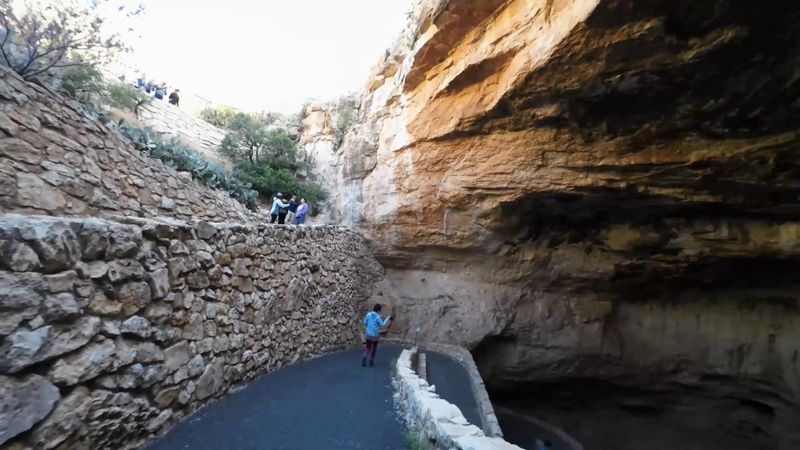
Nothing prepares you for the moment you step off the elevator and realize you are standing inside a room so enormous it could swallow a skyscraper whole.
Carlsbad Caverns National Park, located at 727 Carlsbad Caverns Hwy, Carlsbad, is one of those places that makes your brain short-circuit in the best way possible.
The Big Room is the star attraction, stretching over 4,000 feet long and reaching 255 feet high at its peak. Stalactites hang like chandeliers above you, and the silence is so complete you can hear your own heartbeat.
The self-guided tour takes about an hour, and the lighting along the path makes every formation look like something from a fantasy novel.
Every evening from late spring through fall, hundreds of thousands of Brazilian free-tailed bats spiral out of the cave entrance at sunset.
It sounds chaotic, but watching that living tornado rise into the sky is genuinely one of the most spectacular natural shows in America.
Arrive early for a good seat. Rangers give a short talk before the flight begins, and it adds real context to what you are about to witness.
Bring a light jacket because the cave stays at 56 degrees year-round.
2. White Sands National Park
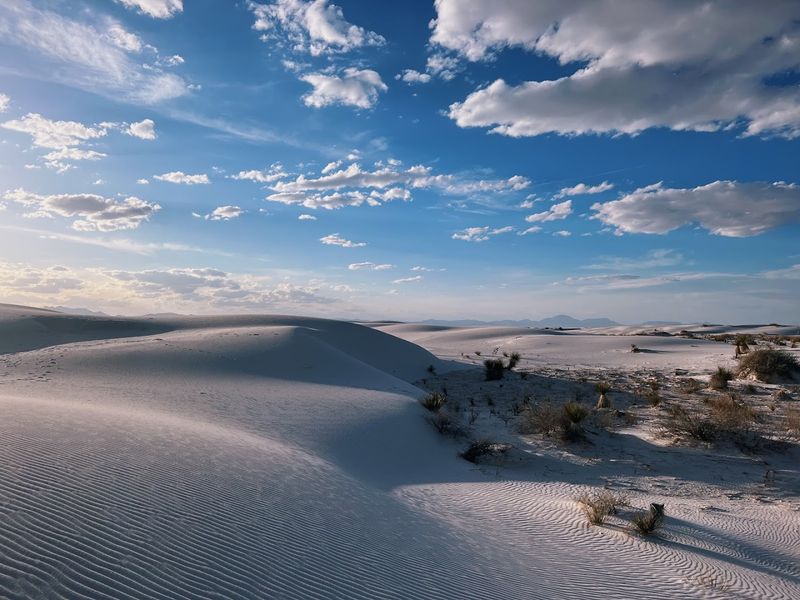
Standing at the edge of White Sands feels like landing on another planet, except this one is in southern New Mexico and the sand squeaks under your feet.
The dunes here are made entirely of gypsum crystals, which means they stay cool even in summer heat, which is a small miracle when temperatures climb past 100 degrees outside the park.
White Sands National Park sits at 19955 US-70, Alamogordo, and covers 275 square miles of these blinding white dunes.
Sledding down the slopes on plastic discs sold at the visitor center is absolutely something adults are allowed to do, and honestly encouraged.
The park offers five different trails ranging from a short half-mile boardwalk to a five-miles backcountry loop for people who want real solitude.
Sunrise and sunset are the magic hours here. The light turns the dunes soft shades of pink and gold that no camera fully captures, though you will absolutely try.
The Alkali Flat Trail is the most dramatic, leading you deep into the dunes where all landmarks disappear and the landscape becomes purely abstract.
Carry more water than you think you need. The dryness here is serious, and the park sits within a missile testing range, so check the schedule before you visit.
3. Bandelier National Monument
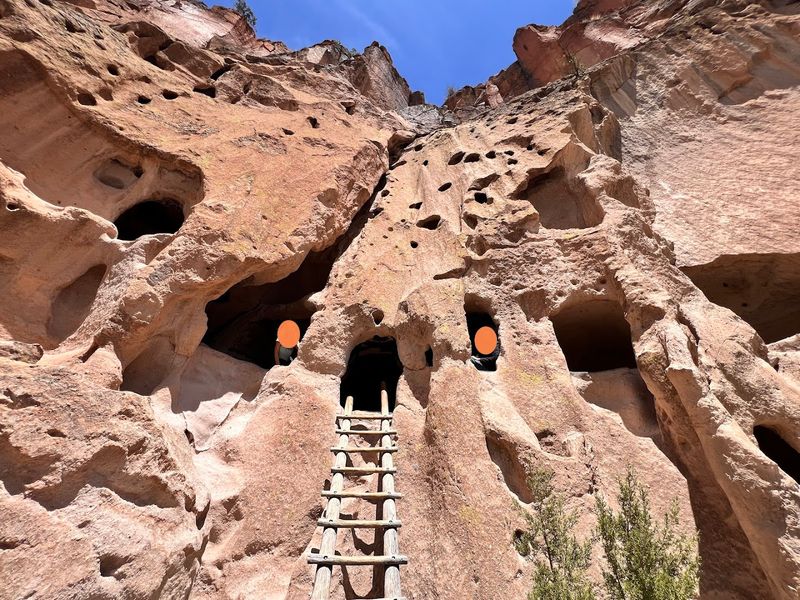
Somewhere around the second wooden ladder climb, gripping rungs bolted into ancient volcanic rock with a canyon dropping away behind you, the thought hits: people actually lived up here.
Bandelier National Monument preserves the homes and ceremonial spaces of Ancestral Pueblo people who carved their dwellings directly into the soft tuff cliffs of Frijoles Canyon.
Located at 15 Entrance Rd, Los Alamos, Bandelier sits on the Pajarito Plateau and covers over 33,000 acres of canyon and mesa country.
The Main Loop Trail is about 1.2 miles and takes you past hundreds of cavate rooms, which are hand-carved cave dwellings you can actually enter.
The Alcove House, perched 140 feet above the canyon floor, requires climbing four separate ladders and rewards you with a stunning kiva and panoramic views.
The monument is not just ancient history sitting behind a rope. You are encouraged to climb, explore, and touch the walls that people carved by hand over 800 years ago.
That kind of access is rare.
The visitor center has excellent exhibits explaining Pueblo culture and the geology of the canyon.
Spring wildflowers along the trail are genuinely beautiful, and fall brings golden cottonwood trees lining the creek below. Go on a weekday if you can.
4. Chaco Culture National Historical Park
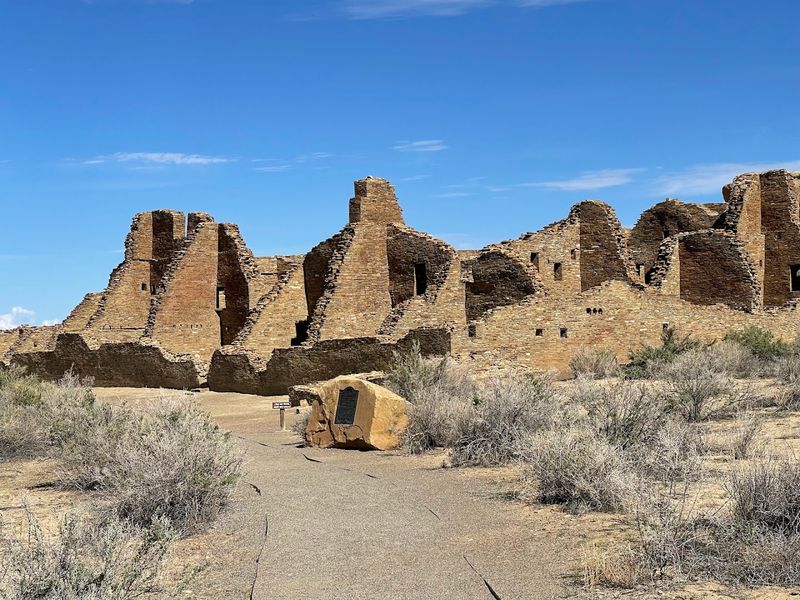
Chaco makes you feel small in a way that has nothing to do with the landscape and everything to do with the scale of human ambition behind it.
This was the center of the ancient Pueblo world for over 300 years, and the engineering here is so precise that some doorways align perfectly with solar and lunar cycles.
Getting to Chaco Culture National Historical Park at 1808 County Rd 7950, Nageezi, requires driving several miles on unpaved road, and that barrier is part of what keeps the crowds away.
The reward is one of the most significant archaeological sites in North America, largely to yourself. Pueblo Bonito alone contains over 600 rooms and 40 kivas, all built without metal tools or wheeled vehicles.
The night sky here is extraordinary. Chaco is a certified International Dark Sky Park, and the ancient inhabitants were serious astronomers, so it feels appropriate that the stars still perform above the ruins.
Ranger-led tours run on weekends and add incredible depth to what you are seeing. The road conditions change with weather, so call ahead before making the drive.
Bring everything you need because there are no services inside the park. This is one of those places that stays with you.
5. Aztec Ruins National Monument
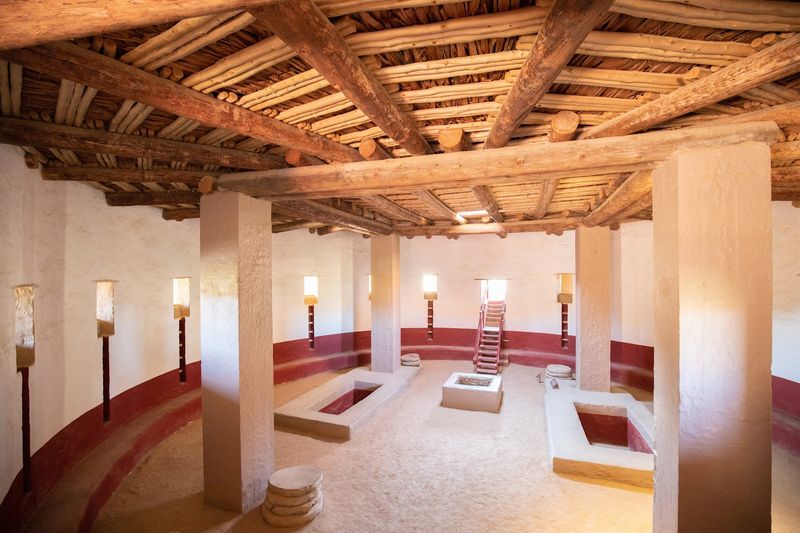
The name is a bit misleading, and the site is quick to clear that up. Aztec Ruins National Monument has nothing to do with the Aztec civilization of Mexico.
Early settlers named it incorrectly, and the label stuck. What you actually find here is a remarkably well-preserved Ancestral Pueblo community built in the 1100s along the Animas River.
At 725 Ruins Rd, Aztec, the monument sits in a small town in northwestern New Mexico and is often skipped by visitors rushing between larger parks. That is genuinely their loss.
The self-guided trail winds through the West Ruin, where original masonry walls still stand two and three stories high, and green stones called verdite are embedded decoratively throughout the construction.
The highlight is the reconstructed Great Kiva, a circular ceremonial chamber that archaeologist Earl Morris rebuilt in 1934 using original materials and ancient construction methods.
Stepping inside feels like entering a living space rather than a ruin.
The acoustics are remarkable, the ceiling is supported by four massive wooden columns, and the whole room carries a quiet energy that is hard to describe but easy to feel.
The visit takes about an hour, and the monument pairs perfectly with a stop at nearby Mesa Verde on a multi-day road trip through the Four Corners region.
6. Capulin Volcano National Monument
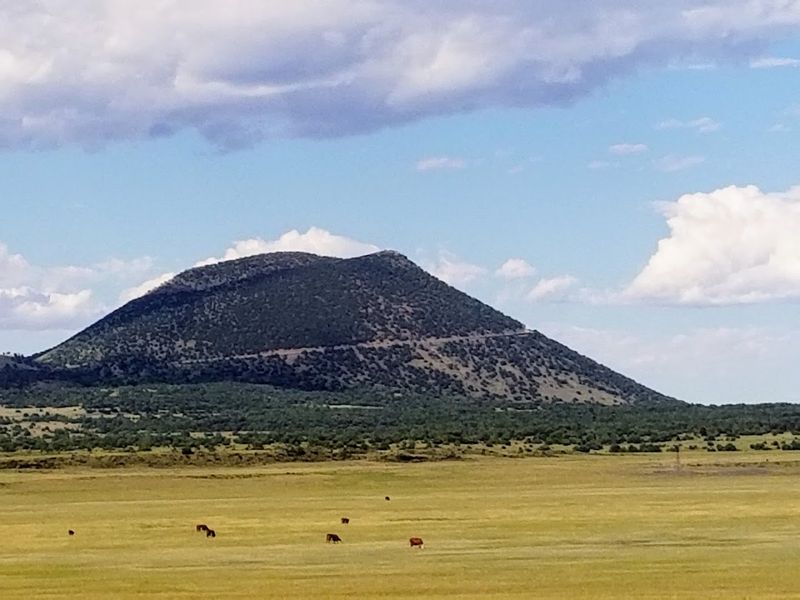
You can walk around the rim of a volcano here. That sentence should be enough, but there is more.
Capulin Volcano National Monument preserves a nearly perfect cinder cone volcano that erupted roughly 56,000 years ago and has been sitting here looking dramatic ever since.
The monument sits at 46 Volcano Hwy, Capulin, in the northeastern corner of New Mexico, and the drive up the two-mile paved road to the crater rim is already worth the trip.
From the top, on a clear day, you can see into four states. The Rim Trail circles the crater in about a mile and gives you constantly changing views of the surrounding volcanic field and the high plains stretching east toward Texas.
The Crater Vent Trail descends into the volcano itself, which is a sentence most people never get to say about their weekend plans.
The inside of the crater is lush with scrub oak and wildflowers, which feels almost absurd given where you are standing.
The visitor center at the base has a great exhibit on the geology of the Raton-Clayton Volcanic Field, which contains over 100 volcanic features across the region.
Capulin is small and often visited in under two hours, making it an ideal stop on a longer road trip through the northeast corner of New Mexico.
7. El Morro National Monument
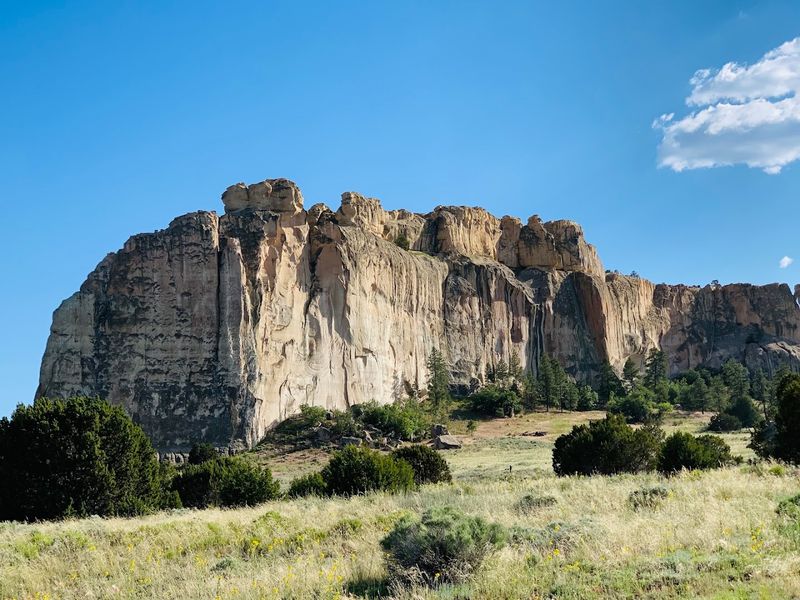
Imagine a giant sandstone bluff rising out of the desert, and at its base, a natural pool of water that never dries up.
For centuries, every traveler crossing this stretch of western New Mexico stopped here to drink, rest, and apparently carve their name into the rock. That is El Morro in a nutshell, and it is far more fascinating than it sounds.
El Morro National Monument on NM-53, Ramah, preserves over 2,000 inscriptions on what is called Inscription Rock. The oldest are petroglyphs made by Ancestral Pueblo people.
Then come Spanish colonial inscriptions from the 1600s, including one left by Don Juan de Onate in 1605, which predates the Plymouth Rock landing by 15 years.
American soldiers, surveyors, and emigrants added their names through the 1800s.
Reading the inscriptions feels like flipping through a guest book that spans 700 years of human travel across the same patch of desert.
The two-mile loop trail climbs to the top of the mesa where the ruins of Atsinna Pueblo sit, offering sweeping views of the surrounding valley.
The site is quiet, unhurried, and genuinely moving in a way that big famous parks sometimes are not. Rangers here are passionate about the history and worth every minute of conversation you give them.
8. Kasha-Katuwe Tent Rocks National Monument
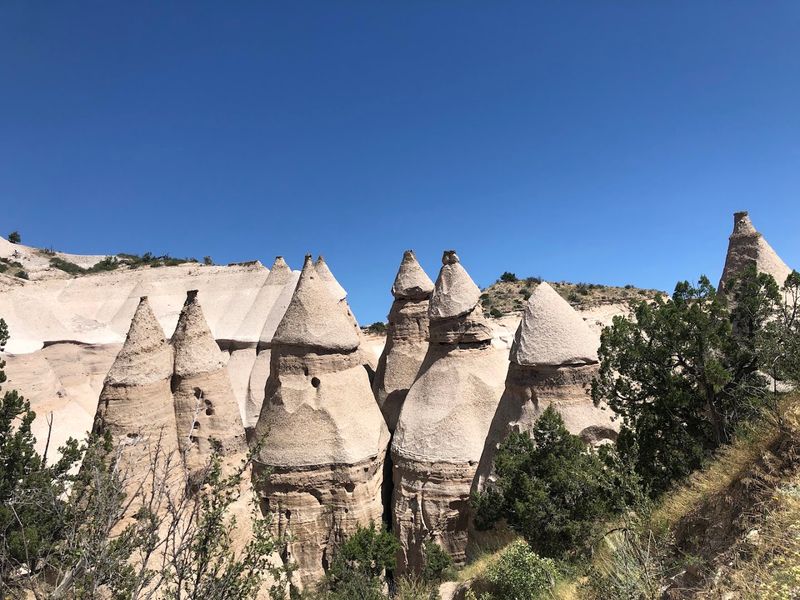
Someone looked at these formations and thought they resembled tents, and once you see them, you cannot unsee it.
Kasha-Katuwe Tent Rocks National Monument is one of those places that looks completely unreal in photographs and then looks even more unreal in person.
Located on NM-22, Cochiti Pueblo, the monument features cone-shaped formations made from volcanic pumice, ash, and tuff deposited by eruptions six to seven million years ago.
Erosion carved them into these perfectly tapered spires, some topped with harder boulder caps that protected the softer rock beneath. The trail system offers two options that connect into a loop of about three miles total.
The slot canyon section is the part people talk about most. The walls close to just a few feet wide in places, and the light filters down in soft columns between the pale rock.
After the canyon, the trail climbs steeply to a mesa viewpoint where the tent rocks spread out below you like a field of stone sculptures.
The contrast between the narrow canyon and the open summit view is genuinely thrilling.
The monument is managed jointly by the Bureau of Land Management and the Pueblo de Cochiti, and advance reservations are required during peak season.
Check the recreation.gov site before heading out to avoid disappointment.
9. Rio Grande Del Norte National Monument
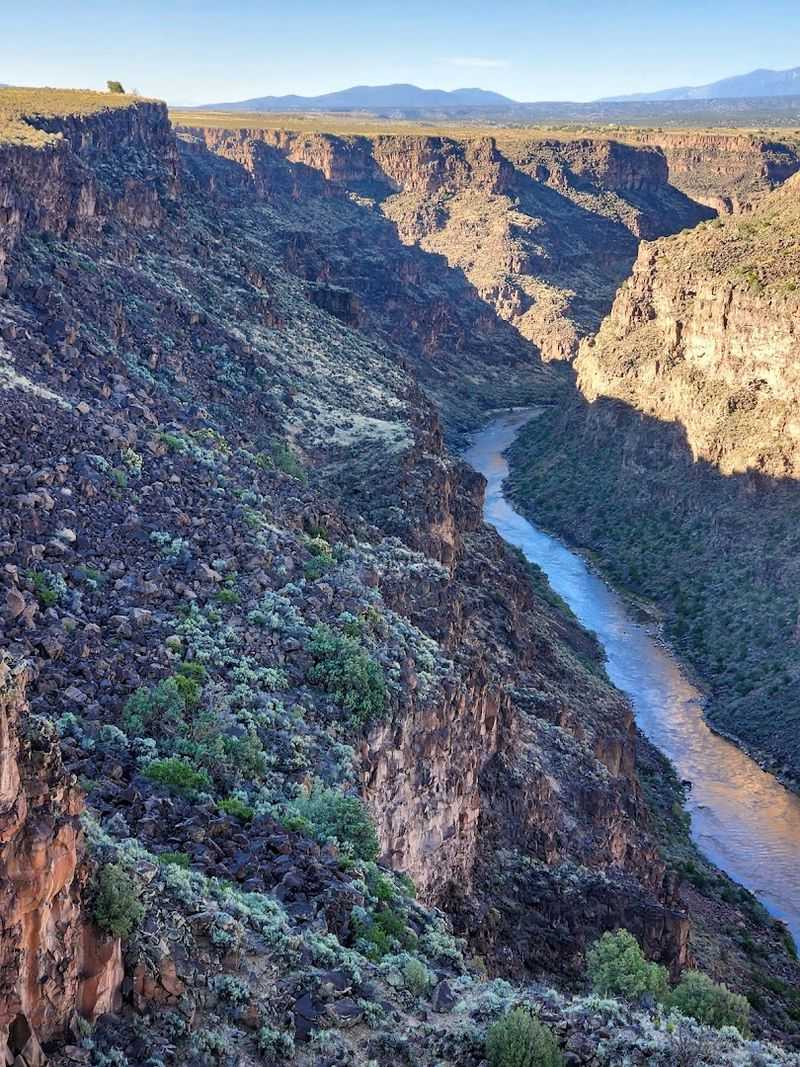
Most people picture a wide, lazy river when they hear Rio Grande.
What you actually find at Rio Grande del Norte is the river buried 800 feet down inside a volcanic gorge so dramatic it looks like the earth just split open one afternoon and never bothered to close back up.
Because essentially, that is what happened.
Rio Grande del Norte National Monument is covering nearly 243,000 acres of high desert plateau and deep river canyon in northern New Mexico.
The West Rim Trail offers the most accessible views of the gorge, running along the canyon edge with overlooks that drop straight down to the water far below.
The Big Arsenic Springs Trail descends into the canyon itself, following a path to natural springs and excellent fishing spots along the river.
The monument is also serious wildlife territory. Pronghorn antelope, mule deer, golden eagles, and black bears all live here.
The Orilla Verde Recreation Area along the river bottom is popular with kayakers and anglers, and the campgrounds there put you right on the water.
Taos is only about 20 miles north, making this an easy add-on to any visit to that area.
The overlooks near the Rio Grande Gorge Bridge, just outside the monument boundary, get crowded, but the monument trails stay refreshingly quiet.
10. Petroglyph National Monument
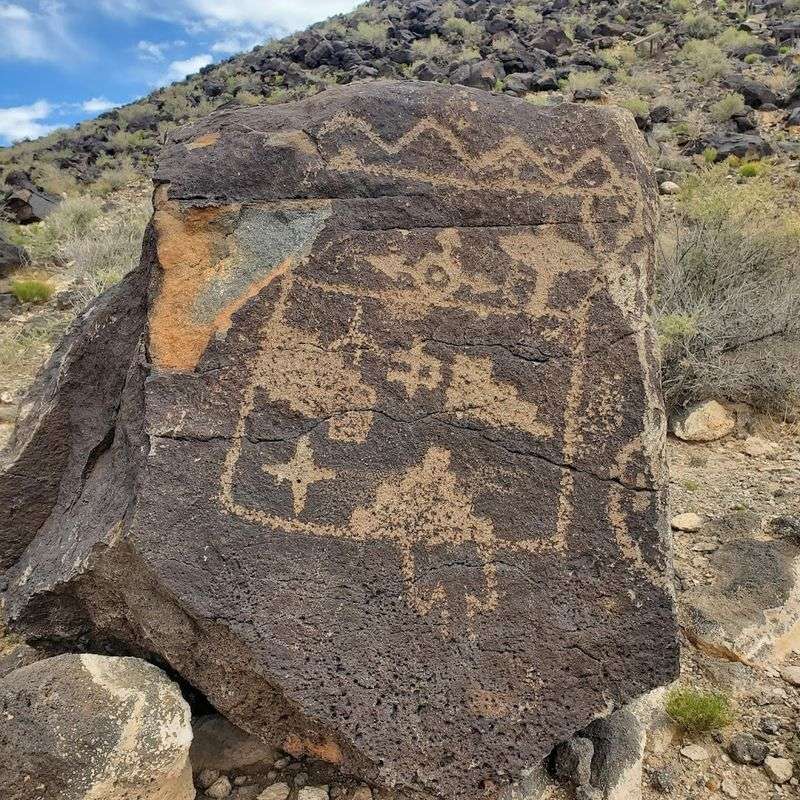
Right on the western edge of Albuquerque, where the city meets a long ridge of dark volcanic rock, there are over 24,000 images carved into the basalt.
That number is almost impossible to process until you are walking along a trail and the carvings just keep appearing, one after another, on every boulder you pass.
Petroglyph National Monument on Western Trail NW, Albuquerque, protects one of the largest petroglyph sites in North America.
Most of the images were carved by ancestral Pueblo people between 400 and 700 years ago, though some are significantly older.
Spirals, birds, masks, hands, and figures that researchers are still working to interpret cover the dark rock faces throughout the monument.
The Boca Negra Canyon section has paved trails and is the easiest place to see a high concentration of petroglyphs in a short walk.
Rinconada Canyon offers a longer, wilder experience with fewer visitors and a more open desert feel.
The monument also includes five dormant volcanoes on the western mesa that you can hike to for panoramic city views.
Because it sits inside a major city, Petroglyph is one of the most accessible ancient sites in the Southwest.
You can spend a full morning here and still feel like you only scratched the surface of what the rock walls are trying to say.