California’s 13 Wildest Geologic Wonders Feel Almost Too Strange To Be Real
Nature can get weird fast.
One minute, the landscape makes sense.
The next, rocks look melted, dunes seem alive, a lake appears where the ground feels like it changed its mind.
Geologic wonders are fun because they do not need much explanation at first. They simply look impossible. Then the science makes them even better.
Volcanic eruptions, ancient seas, and millions of years of pressure all leave behind places that feel built for double takes.
California does not just do scenery. It does scenery with plot twists.
That is why these spots feel so thrilling.
You can stand in front of a crater or a lava tube and feel your brain trying to catch up.
The views are beautiful, yes. But beauty is not the only point. These wonders are strange and real enough to make the whole state feel a little more unreal.
1. Lassen Volcanic National Park
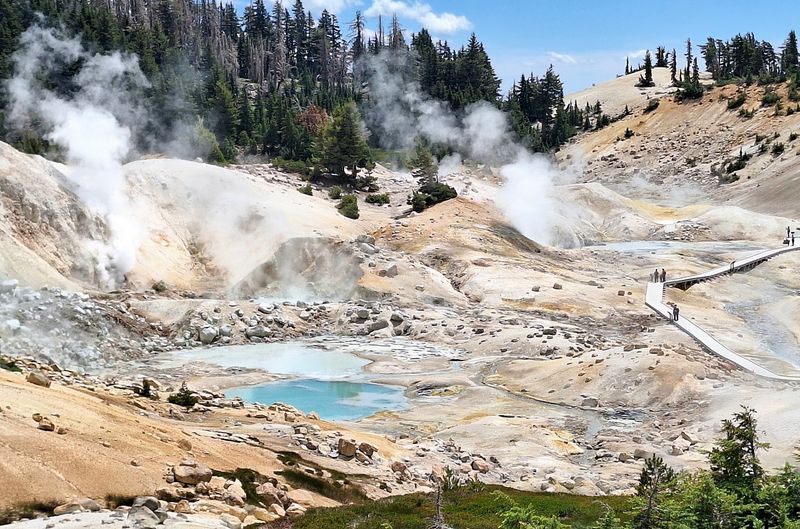
Steaming vents, boiling mudpots, and a landscape that smells faintly of sulfur – Lassen Volcanic National Park near Mineral, California is one of the most geologically active places in the entire country.
The park sits within a region shaped by thousands of years of volcanic activity, and that energy is still very much alive beneath the surface. B
umpass Hell, the park’s largest hydrothermal area, features a boardwalk trail that winds past bubbling pools and hissing fumaroles.
Cinder Cone offers a steep but rewarding hike to the rim of a near-perfect volcanic crater, with the Painted Dunes spreading out in vivid orange and red below.
The Fantastic Lava Beds nearby are a chaotic jumble of hardened lava that looks frozen mid-pour.
Mount Lassen itself last erupted between 1914 and 1921, making it one of the few recently active volcanoes in the contiguous United States.
Visiting in summer gives the best trail access, though snowpack can linger into June at higher elevations.
2. Lava Beds National Monument
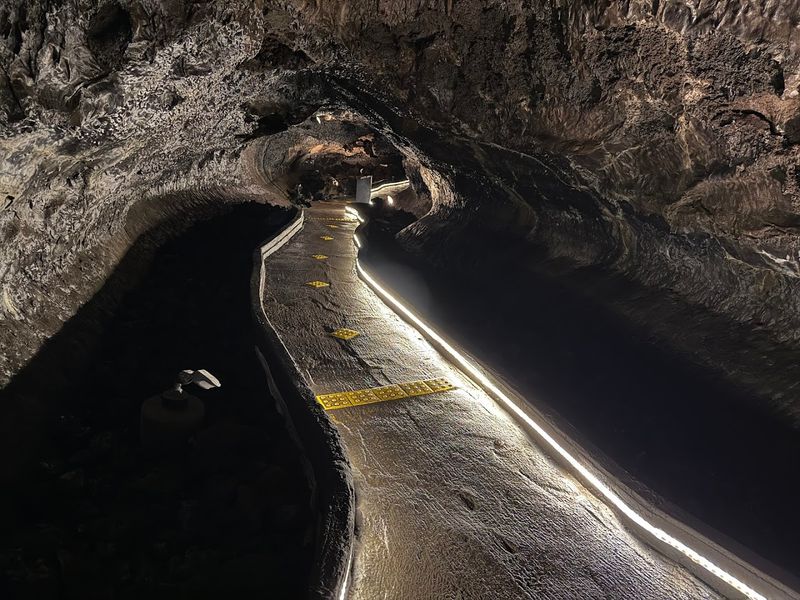
Underground is where Lava Beds National Monument really earns its reputation.
Located near Tulelake in Northern California, the monument sits on the Medicine Lake Volcano shield and contains more than 800 lava tube caves – the highest concentration of any place in North America.
Lava tubes form when the outer shell of a flowing lava stream cools and hardens while molten rock continues to drain out beneath it, leaving a hollow tunnel behind.
Many of the tubes at Lava Beds are open to self-guided exploration, and the difficulty levels range from short, well-lit walking passages to tight crawlways that require helmets and knee pads.
Mushpot Cave near the visitor center is fully lit and an excellent starting point for first-time visitors.
The high desert setting above ground adds another layer of visual interest, with cinder cones, spatter cones, and rugged basalt fields stretching across the landscape.
Temperatures inside the caves stay cool year-round, hovering around 55 degrees Fahrenheit, so bringing a jacket is always a good idea.
3. Amboy Crater National Natural Landmark
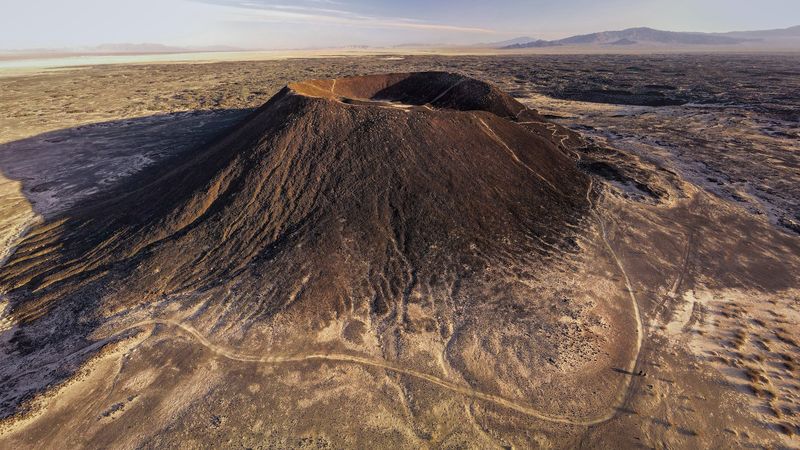
Rising from the flat Mojave Desert floor like something dropped from orbit, Amboy Crater is a nearly symmetrical cinder cone that sits just off historic Route 66 near the tiny desert town of Amboy.
The crater stands about 250 feet tall and is surrounded by dark basalt lava flows that spread outward across the desert in every direction, creating a stark black-and-tan contrast against the sandy terrain.
The whole scene has an almost cinematic quality to it.
A round-trip hiking trail of roughly 3 miles leads from the parking area up to the crater rim and back, offering a close look at the volcanic rock textures and the wide, open desert views from above.
The lava fields themselves show off fascinating surface patterns – ropy pahoehoe lava and rougher aa lava can both be spotted along the trail.
Geologists estimate the volcano last erupted somewhere between 500 and 10,000 years ago, though the exact date is still debated.
Early morning visits are strongly recommended, especially in warmer months, since temperatures on the exposed lava fields can climb quickly.
There are no facilities at the site, so bringing plenty of water is essential before heading out.
4. Kelso Dunes, Mojave National Preserve
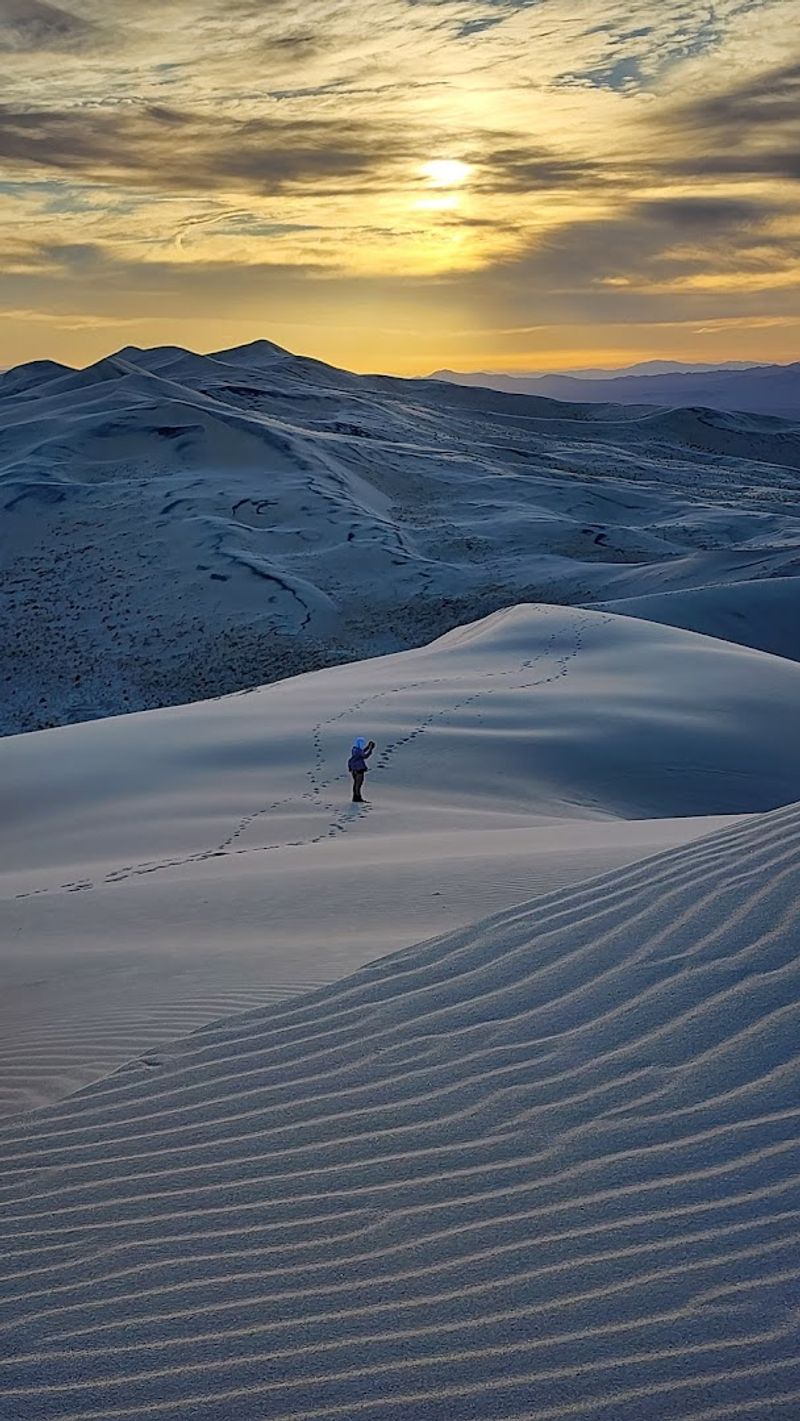
Some dunes just sit there quietly, but Kelso Dunes occasionally hum.
Located within Mojave National Preserve, the Kelso Dunes reach heights of up to 650 feet, making them among the tallest in the western United States.
The sand grains here are composed mostly of quartz and feldspar, carried by wind from the dry Mojave River bed and deposited over thousands of years into these massive, sweeping forms.
The acoustic phenomenon known as “booming” or “singing” occurs when dry sand avalanches down the slip face of a dune, creating a low, resonant vibration that some people describe as a distant engine or a droning hum.
Conditions need to be just right for it to happen, and not every visit produces the sound, but the possibility alone makes the hike up the dunes feel a little more adventurous.
The 3-mile round-trip trail to the top is loose and steep in places but manageable for most hikers.
Spring wildflower blooms around the base of the dunes can be impressive in years with adequate winter rainfall.
The preserve has no entry fee, and the parking area off Kelso Dunes Road provides a straightforward access point.
5. Mojave Lava Tube., Mojave National Preserve
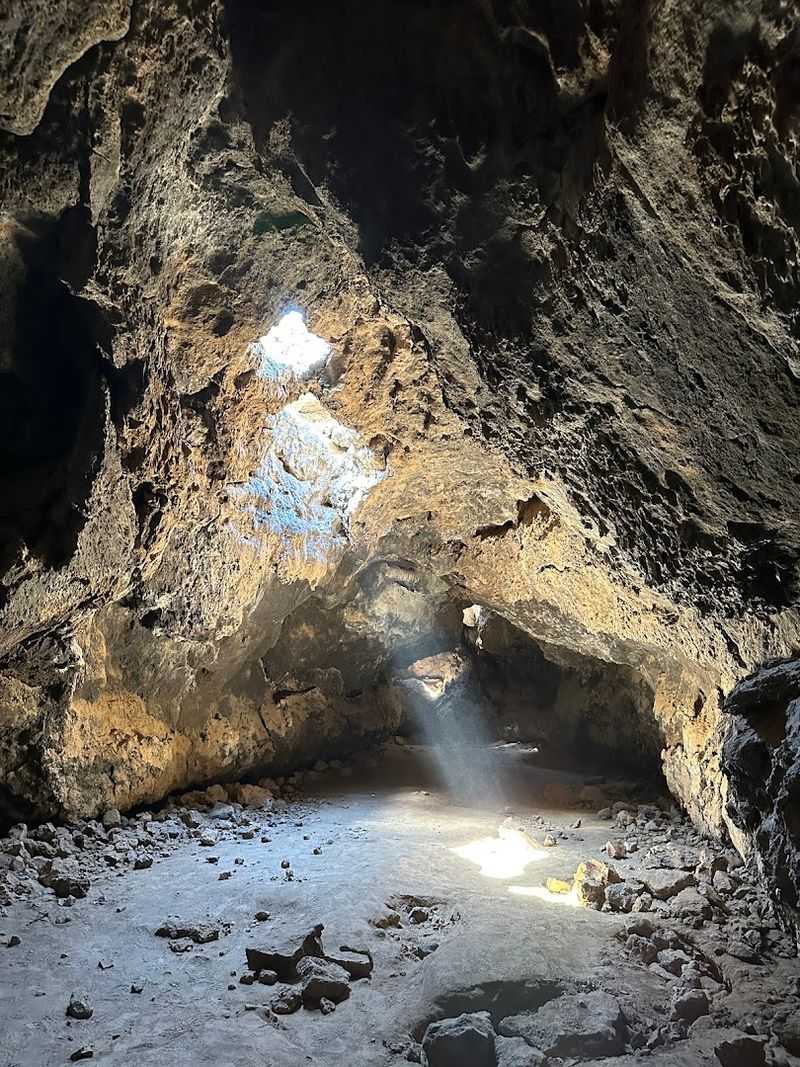
Hidden away off Aiken Mine Road in Mojave National Preserve, the Mojave Lava Tube is a compact but genuinely memorable underground experience.
The tube formed the same way most lava tubes do – molten lava drained out from beneath a hardened crust, leaving a hollow passage through the volcanic rock.
Visiting requires a short walk from the parking area across a rugged lava field, which sets the mood before you even reach the entrance.
The tube itself descends steeply at first, requiring careful footing on the uneven basalt floor. A flashlight or headlamp is absolutely necessary since there is no artificial lighting inside.
The interior opens up into a small chamber with interesting rock textures on the walls and ceiling, including lava drips that hardened in place mid-formation.
The total passable length is relatively short compared to the tubes at Lava Beds National Monument, but it offers a much more solitary and raw experience.
Cell service is limited in this area of the preserve, so downloading offline maps beforehand is a practical step.
Visiting on a weekday tends to mean fewer other explorers around, which makes the underground quiet feel even more pronounced.
6. Trona Pinnacles National Natural Landmark
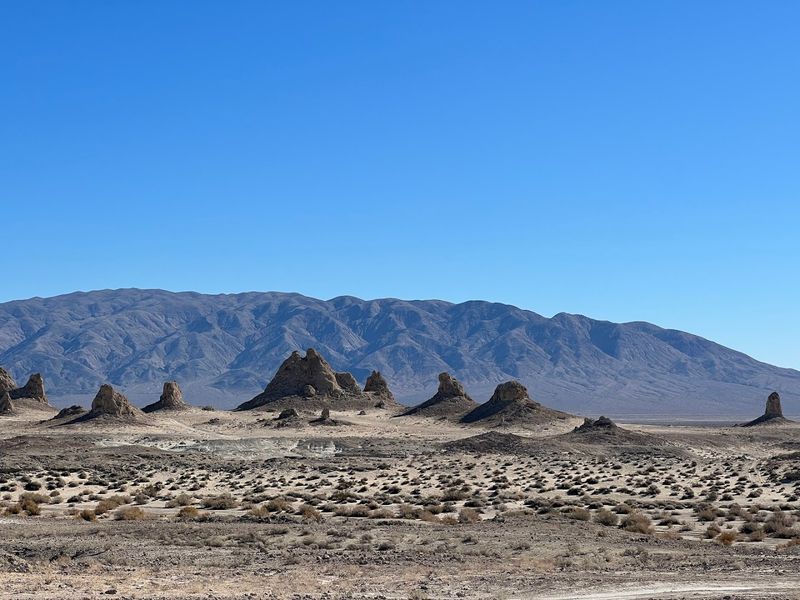
More than 500 tufa spires jut upward from the dry bed of Searles Lake near the small town of Trona, and the effect is unlike anything else in California.
The tallest of these formations reach about 140 feet, and they cluster in groups across the pale, cracked lakebed in a way that feels genuinely prehistoric.
Tufa forms when calcium-rich groundwater mixes with carbonate-rich lake water, causing calcium carbonate to slowly build up over time into irregular towers and knobby columns.
The Trona Pinnacles were formed during a period when Searles Lake held actual water, roughly 10,000 to 100,000 years ago, and the tufa grew submerged beneath the surface.
When the lake dried up, the spires were left standing on the exposed lakebed.
The site has been used as a filming location numerous times due to its otherworldly visual character, appearing in science fiction films and commercials over the decades.
Access is via an unpaved road that can become impassable after heavy rain, so checking conditions before visiting is a smart precaution.
7. Mono Lake Tufa State Natural Reserve
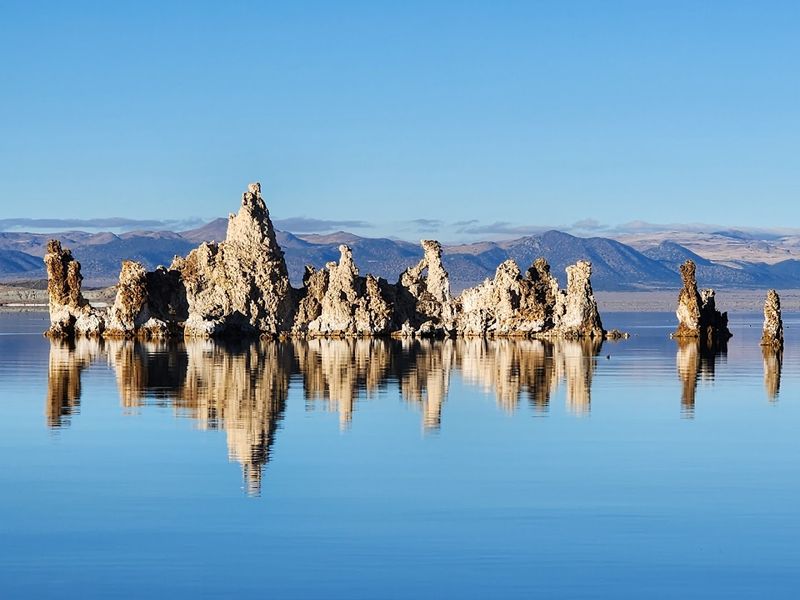
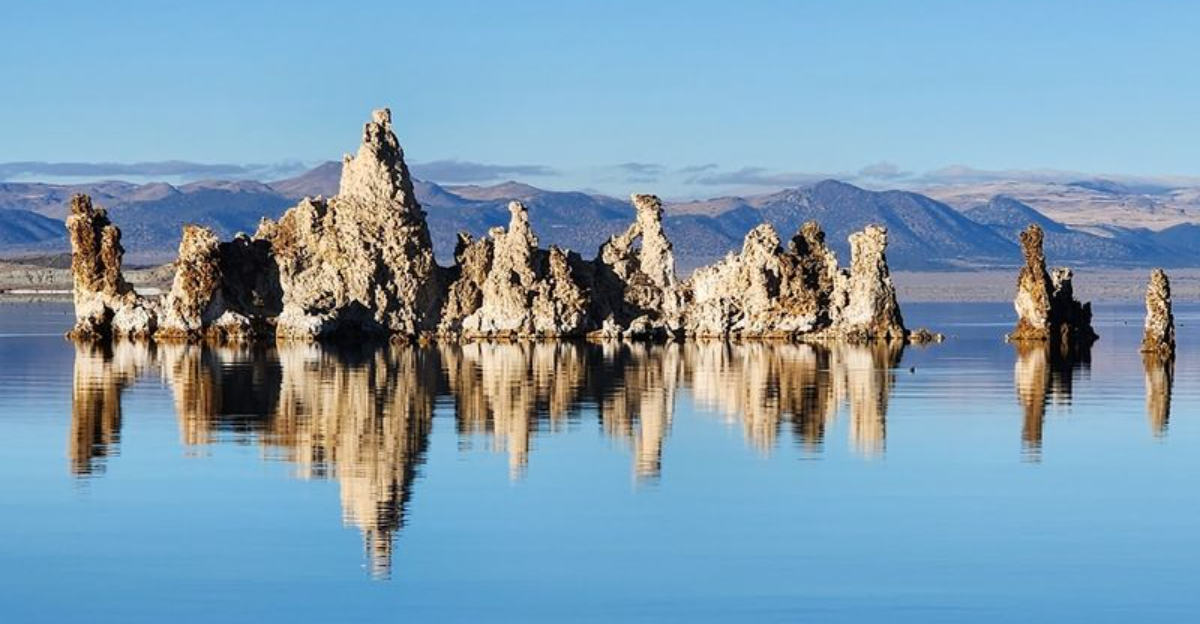
Ancient and strangely beautiful, Mono Lake sits in a volcanically active basin east of the Sierra Nevada near Lee Vining, and its shoreline is studded with knobby limestone towers called tufa.
Unlike the Trona Pinnacles which formed in a now-dry lake, the tufa at Mono Lake grew underwater where calcium-rich freshwater springs bubbled up through the carbonate-rich lakebed.
As the two water types mixed, calcium carbonate precipitated out and slowly built the towers over decades to centuries.
The lake itself is estimated to be around 760,000 years old, making it one of the oldest lakes in North America.
Water diversions to Los Angeles beginning in the 1940s caused the lake level to drop significantly, exposing the tufa columns and dramatically altering the ecosystem.
Legal protections established in the 1990s have helped stabilize water levels, and the lake is now recovering gradually.
The state reserve includes several access points with boardwalk trails along the south shore.
Early morning light makes for particularly striking views of the tufa against the still water.
8. Devils Postpile National Monument
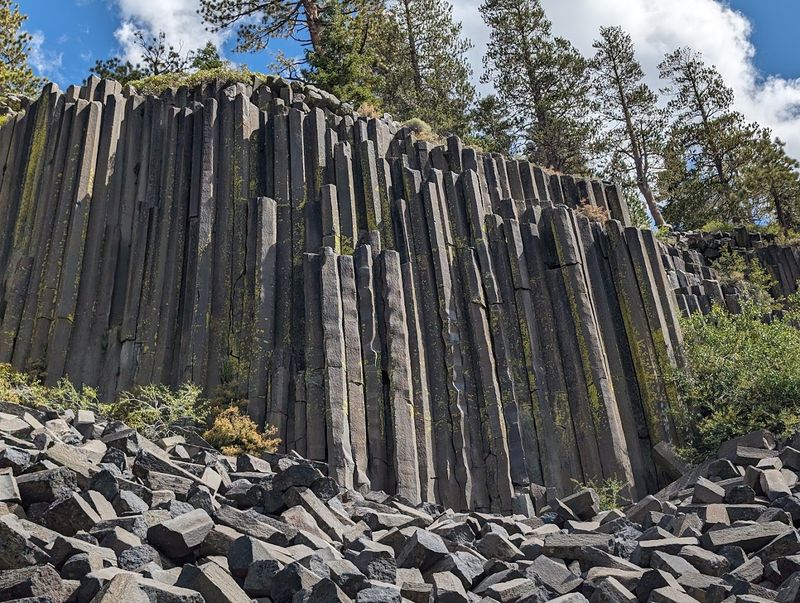
Geometry in nature rarely looks this deliberate.
At Devils Postpile National Monument near Mammoth Lakes, a wall of basalt columns rises 40 to 60 feet from the valley floor, each post roughly 2 to 3 feet in diameter and shaped into multi-sided forms – most commonly hexagonal.
The columns formed less than 100,000 years ago when a deep lava lake cooled slowly and evenly, causing the rock to contract and crack in a regular geometric pattern from the top down.
The exceptional depth of that original lava pool, estimated at up to 400 feet, is what allowed the columns to grow so tall and well-defined.
Glaciers during the Upper Pleistocene period later scraped across the top of the formation, polishing the column tops into smooth, tile-like surfaces where glacial striations are still clearly visible.
A short, well-maintained trail leads from the shuttle drop-off point directly to the base of the columns and then up to the top for the overhead view.
Access to the monument during peak summer season requires taking a mandatory shuttle from the Mammoth Mountain Ski Area.
The monument sits at about 7,600 feet elevation, so afternoons can bring afternoon thunderstorms during summer months.
9. Ubehebe Crater, Death Valley National Park
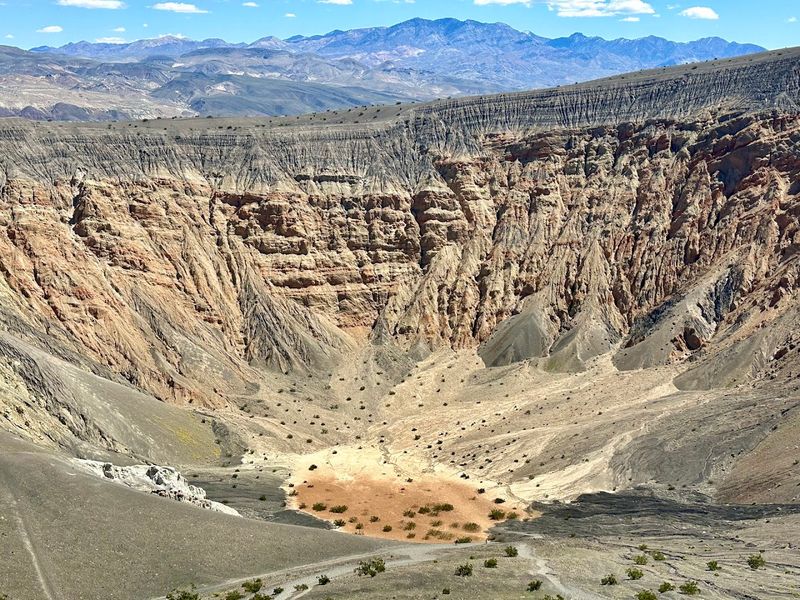
Standing at the rim of Ubehebe Crater and looking down into a bowl roughly 600 feet deep and half a mile across is a genuinely humbling experience.
Located in the northern section of Death Valley National Park, the crater is classified as a maar volcano – a type of volcanic feature that forms when rising magma meets groundwater, triggering a massive steam explosion rather than a slow lava flow.
That explosive origin is part of what makes the crater’s walls so visually dramatic.
The colorful layers visible in the crater walls represent different volcanic deposits and older sedimentary rock disturbed by the blast.
Geologists estimate the eruption occurred roughly 2,100 years ago, which is relatively recent in geologic terms.
A trail runs around the full rim of the crater and connects to several smaller craters nearby, including Little Hebe, which offers a slightly more intimate look at maar geology.
The access road to Ubehebe Crater is paved and open year-round, though summer temperatures in Death Valley can be extreme and life-threatening.
Visiting in fall, winter, or early spring is far more comfortable and safe. No special permits are required beyond the standard Death Valley entrance fee.
10. Eureka Dunes — Death Valley National Park
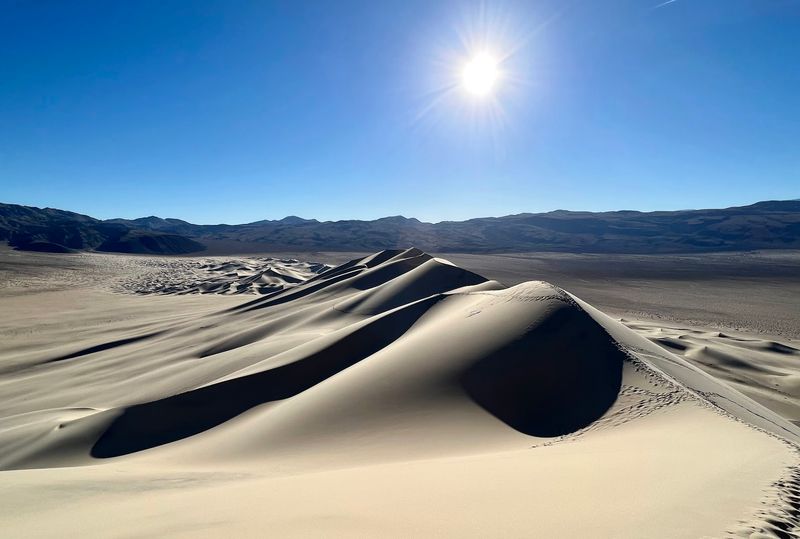
At more than 680 feet above the surrounding dry lakebed, the Eureka Dunes are the tallest sand dunes in California and among the tallest in the entire country.
They rise in the remote northwestern corner of Death Valley National Park, far from the more frequently visited central areas of the park, which means the experience here tends to feel quieter and more isolated.
The dunes are made primarily of quartz and feldspar sand that has been accumulating in the Eureka Valley for thousands of years.
Like Kelso Dunes, the Eureka Dunes are known to produce a low booming sound when sand avalanches down the steep slip face under the right dry conditions.
The phenomenon is relatively rare and depends on sand moisture levels and grain size, but it adds a layer of mystery to an already striking landscape.
The surrounding valley floor is flat and pale, making the dunes look even more dramatic by contrast.
The access road is unpaved and can be rough, requiring a high-clearance vehicle in some conditions.
A primitive campground is available near the dunes for those who want to experience sunrise or sunset light on the sand, which is when the dunes look most spectacular.
11. Mesquite Flat Sand Dunes, Death Valley National Park
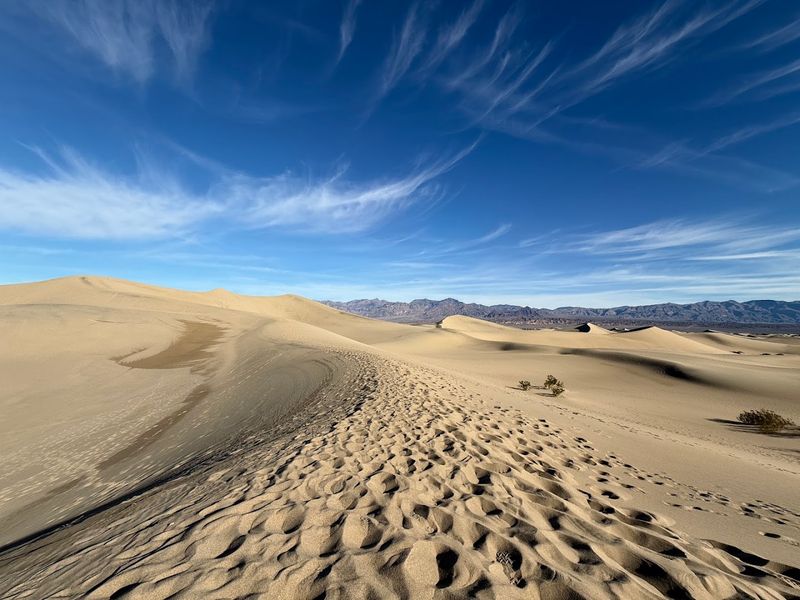
Accessible and visually iconic, the Mesquite Flat Sand Dunes are often the first thing people picture when they think of Death Valley.
Found near Stovepipe Wells, the dunes are relatively easy to reach from the main park road, and there is no defined trail – visitors simply walk out into the sand in whatever direction looks most interesting.
The dunes shift and reshape constantly with the wind, so the landscape never looks exactly the same twice.
Scattered across the dune field are mesquite trees in various states of burial, with some completely swallowed by sand and others still visible from the tops of their branches.
The contrast between the organic shapes of the trees and the smooth geometric ripples in the sand makes for a particularly interesting visual texture.
At the tallest point, the dunes reach about 100 feet, which is modest compared to Eureka Dunes but still offers a solid elevated view of the surrounding valley and mountain ranges.
Early morning visits reward photographers and hikers with cooler temperatures and undisturbed sand surfaces before foot traffic begins.
The parking area off Highway 190 fills up quickly on weekends during the peak fall and spring visiting seasons.
12. Anza-Borrego Badlands, Borrego Springs
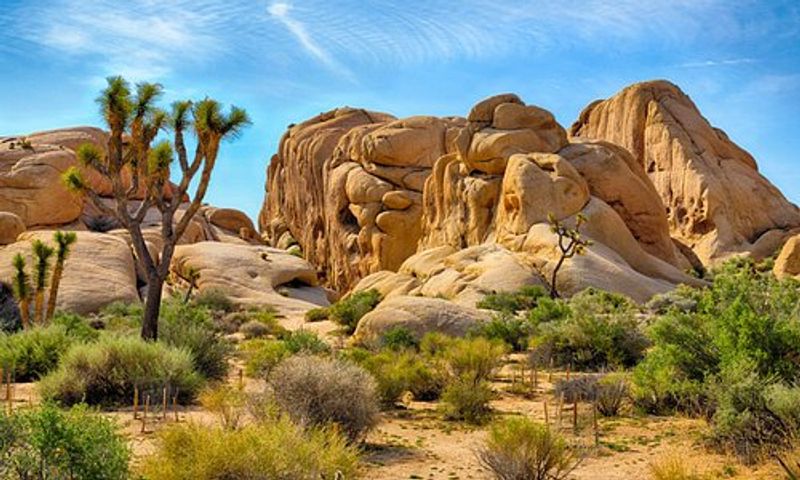
Layers of ancient sediment tell a long and detailed story at the Anza-Borrego Desert badlands in Anza-Borrego Desert State Park near Borrego Springs.
The badlands formed through millions of years of sediment deposition from ancient lake basins and the ancestral Colorado River, followed by rapid erosion driven primarily by seasonal rain.
The result is a deeply carved, wrinkled landscape of exposed rock that shifts in color from pale tan to rust red depending on the mineral content of each layer.
The area holds one of the most continuous fossil records in the American Southwest, spanning roughly the past seven million years.
Fossils of ancient horses, camels, mastodons, and a wide variety of plant and marine life have been discovered here, offering a remarkably detailed window into what the region looked like before it became desert.
The park sits along the western edge of the Salton Trough, an active rift valley that continues to experience seismic activity today.
The Font’s Point overlook is one of the most dramatic vantage points in the badlands and requires a short drive on a sandy unpaved road.
Wildflower season in late February through March can transform the desert floor around the badlands into a vivid seasonal display.
13. Crowley Lake Columns, near Mammoth Lakes
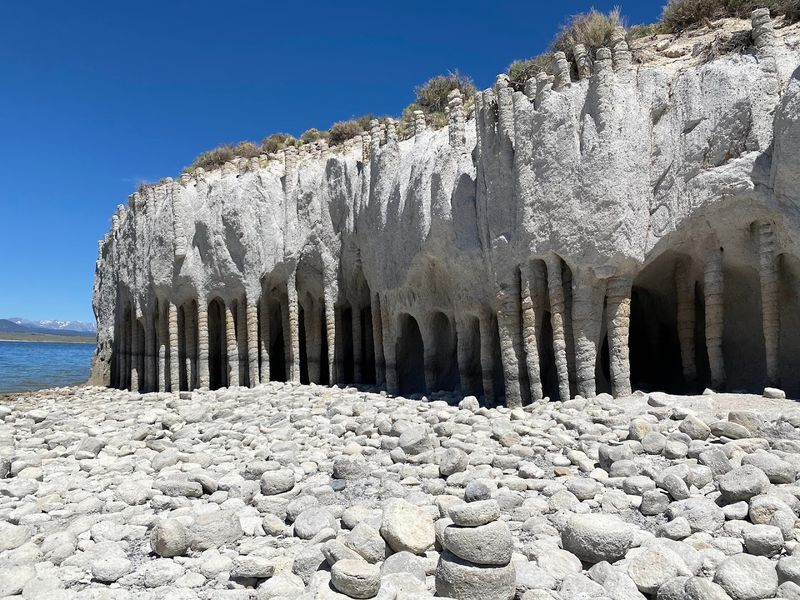
For decades, the strange columns rising along the shoreline of Crowley Lake went largely unnoticed outside of local fishing circles.
Then researchers began studying them more closely and found that the formations were created by a catastrophic volcanic explosion 760,000 years ago.
The same Long Valley Caldera eruption that deposited volcanic ash across a huge swath of the western United States.
When snowmelt seeped down through the still-hot ash layers, the resulting steam carved and sculpted the soft pumice into thousands of segmented columns.
Some of the columns reach up to 20 feet tall and are interconnected by natural arches, giving the shoreline a sculptural, almost architectural appearance.
The formations are made primarily of compacted volcanic ash and pumice, known as caliche, which is softer than the basalt seen at Devils Postpile but still surprisingly durable given its origin.
The columns are only accessible when the lake level is low enough to expose the shoreline, typically in late summer or early fall after water releases from the reservoir.
Access requires a hike of about 2 miles round trip from the nearest trailhead.
The site sits on land managed by the Los Angeles Department of Water and Power, and conditions can vary significantly by season and water management schedules.