The Haunted California Bridge With A Past That Feels Even Heavier After Dark
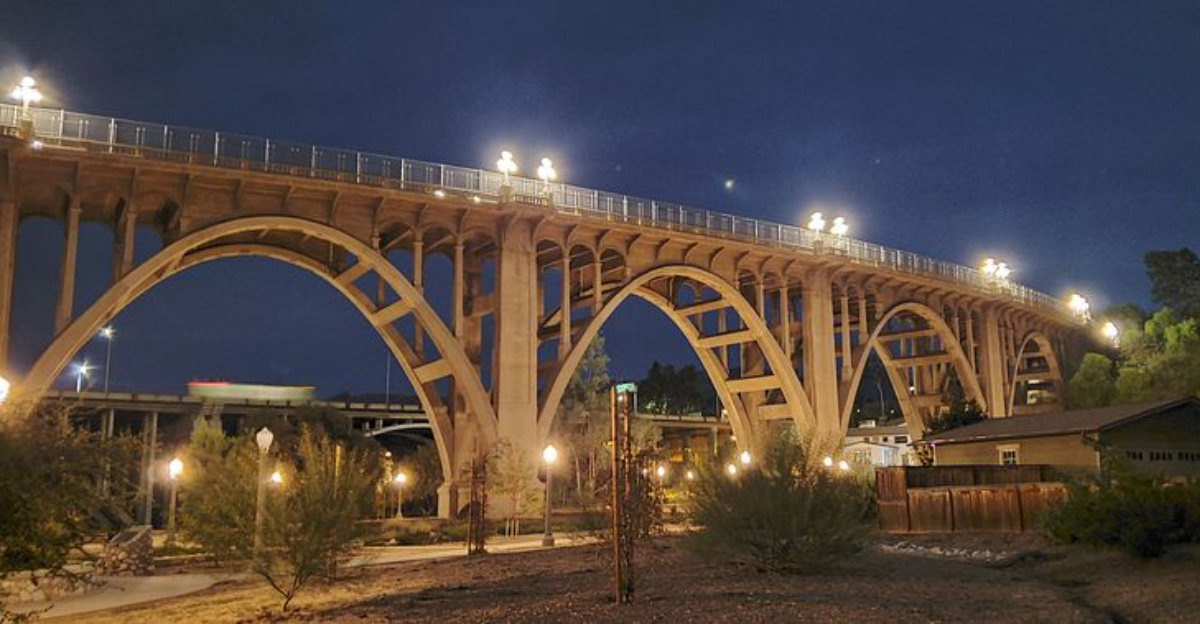
Old bridges can feel strange before you know a single story about them.
The height alone does something. So do the arches and the way the lights start to glow when evening settles in.
Then the history catches up. That is when a beautiful landmark begins to feel much heavier.
California has bridges that look cinematic in daylight yet unsettling after dark. This one carries both moods at once.
By day, it is graceful, historic, and instantly recognizable.
After sunset, the atmosphere changes. The past feels closer. The quiet feels thicker.
Even people who do not usually believe in haunted places can understand why stories gather here.
A bridge like this does not need jump scares or cheap drama. Its reputation comes from memory and the uneasy feeling that some places hold more to them.
You can admire the design. You can notice the view.
Still, once the light fades, the whole crossing feels harder to treat like just another road.
The Arches Give Pasadena One Of Its Most Dramatic Landmarks
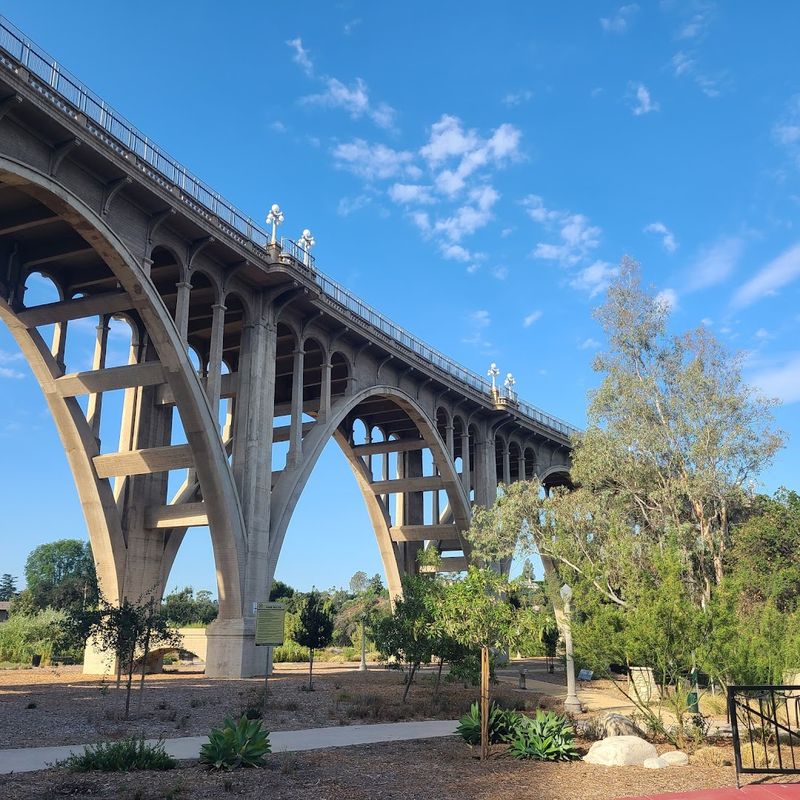
Few road crossings in California stop people in their tracks the way this one does.
Completed in 1913, the Colorado Street Bridge was designed in the Beaux-Arts style, a tradition that prioritized grandeur, symmetry, and ornamental detail over plain utility.
The result is a structure that feels more like a civic monument than a commuter route.
Spanning 1,467 feet across the Arroyo Seco canyon, the bridge features a series of sweeping concrete arches that rise dramatically from the canyon floor.
From certain vantage points along the lower trails, the full row of arches frames the sky in a way that genuinely takes a moment to absorb. Photographers and architecture enthusiasts have been drawn to those angles for decades.
The scale of the construction was ambitious for its era, requiring techniques and materials that were considered cutting-edge at the time.
Pasadena invested in a bridge that would define the city’s visual identity, and that investment still shows.
Even visitors who know nothing about the bridge’s troubled history tend to pause when they first see the arches, because the design earns that pause entirely on its own.
The Arroyo Seco Adds A Shadowy Drop Below
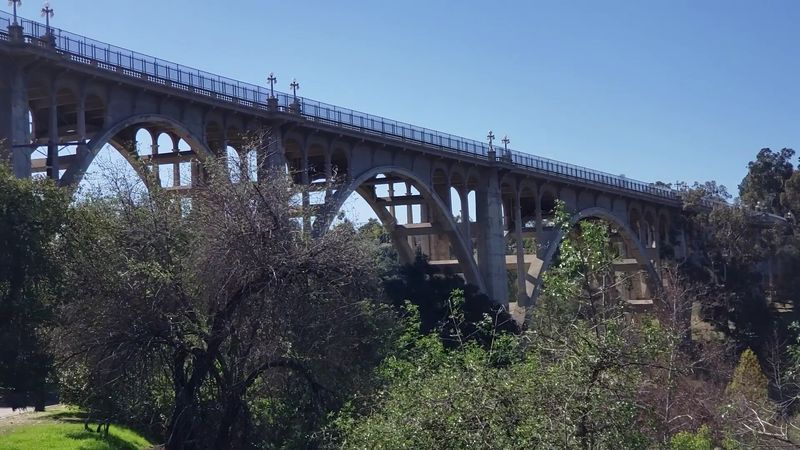
The canyon beneath the bridge is not a small dip in the landscape.
At roughly 150 feet below the roadway, the Arroyo Seco creates a drop that feels genuinely vertiginous when viewed from the sidewalk railing.
That height changes the emotional weight of standing near the bridge in ways that are hard to articulate but easy to feel.
Even on a bright afternoon, the canyon floor tends to sit in shadow while the bridge deck catches full sun above.
That contrast between light and darkness gives the whole setting an unsettled quality that has nothing to do with ghost stories. The geography alone creates tension.
The Arroyo Seco itself is a seasonal waterway that runs dry for much of the year, leaving exposed rock and scrubby vegetation visible far below.
Trails wind through that lower landscape, offering a completely different perspective on the bridge’s scale.
Hikers walking those paths often stop to look up at the arches and find the view far more imposing than anything seen from the road above.
The canyon is a significant part of why this landmark carries the atmosphere it does.
Old Lamp Posts Make The Scene Feel Frozen In Time
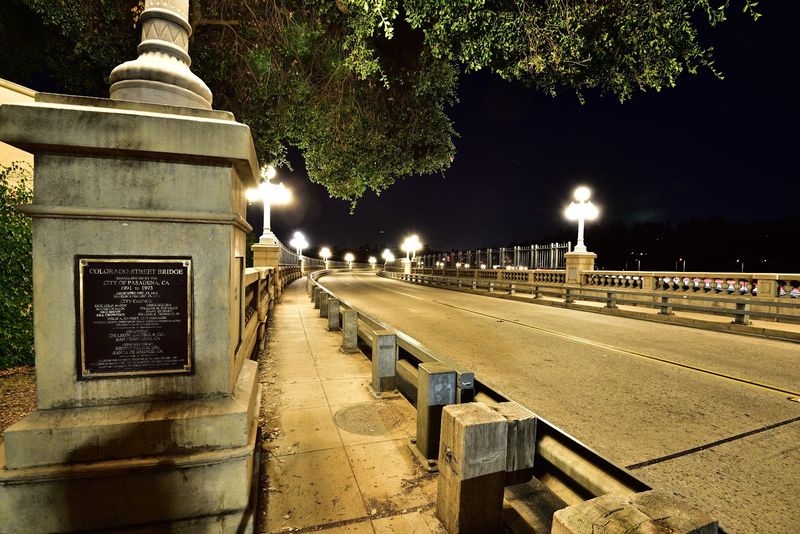
The lamp posts lining the Colorado Street Bridge are not modern additions.
They are period-appropriate fixtures that match the Beaux-Arts sensibility of the original 1913 design, featuring ornamental detailing that fits the bridge’s overall aesthetic rather than clashing with it the way contemporary street lighting does.
During the day, those lamp posts read as charming architectural accents. After sunset, they take on a different character entirely.
The warm glow they cast across the concrete railings and sidewalk creates a pool of amber light that makes the bridge feel genuinely old, as though the surrounding city has moved on but the bridge has stayed exactly where it was.
That frozen-in-time quality intensifies after dark, when foot traffic thins and the sound of passing cars fades between gaps in traffic.
Standing near one of those lamp posts at dusk, with the canyon dropping away below and the ornamental ironwork glowing beside the railing, produces a mood that is difficult to shake.
The lighting was designed to be beautiful, and it succeeds at that completely. The fact that it also makes the bridge feel slightly eerie is more a product of its effectiveness than any intent.
Its Beauty Comes With A Heavy Past
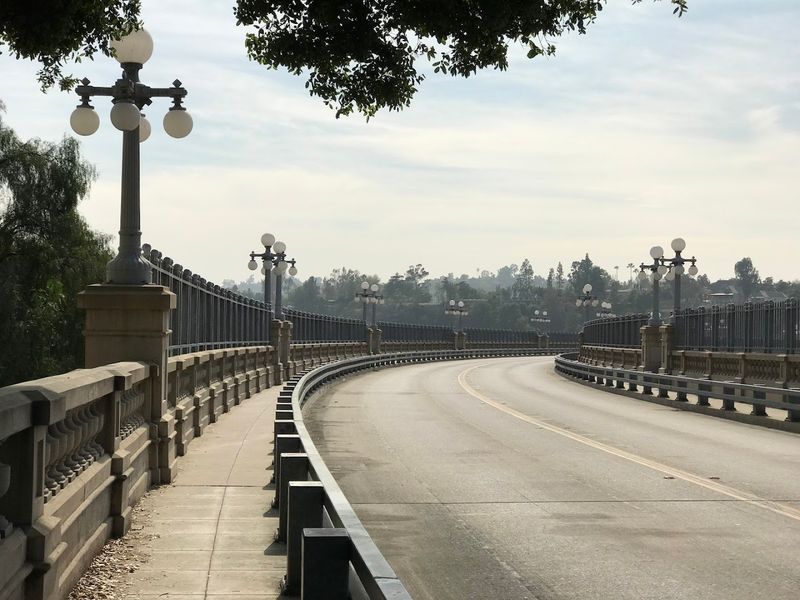
California’s Colorado Street Bridge gained a grim informal nickname within a decade of its opening, and that reputation has never fully faded from local memory.
The first recorded loss of life connected to the bridge occurred on November 16, 1919, and the numbers rose through the following years.
The Great Depression brought a particularly heartbreaking surge, with more than 50 fatal incidents recorded between 1929 and 1933.
Over the full span of the bridge’s history, more than 100 people have lost their lives there.
That number is not a rumor or an exaggeration, but a documented reality that Pasadena has addressed through multiple rounds of prevention measures.
An 8-foot barrier was installed during a 1993 renovation, and additional fencing was added in 2016 and 2017 after a renewed increase in incidents.
Signs carrying messages of encouragement and crisis hotline numbers now line the sidewalk as part of Pasadena’s ongoing effort to respond to the bridge’s troubling legacy.
Those signs are a visible reminder that the beauty of the architecture exists alongside genuine human sorrow.
The Route 66 Connection Adds Another Layer Of Mystery
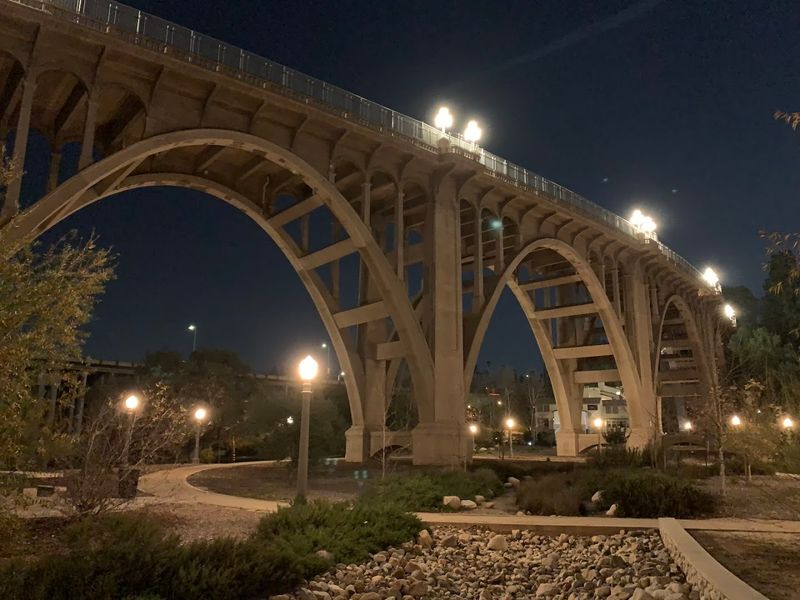
Colorado Street was once part of the original alignment of Route 66, the famous American highway that stretched from Chicago to Santa Monica.
That connection places the Colorado Street Bridge squarely inside one of the most mythologized travel corridors in the country, adding a layer of cultural weight that sits alongside its architectural and historical significance.
Travelers heading west toward the Pacific coast would have crossed this bridge as part of their journey along Route 66 during the mid-twentieth century.
The bridge was already carrying its grim reputation by that time, which means countless road-trippers passed over it without necessarily knowing the history beneath their wheels.
That combination of open-road optimism and quiet local tragedy is a striking contrast.
Route 66 has always attracted a certain kind of traveler drawn to the romance of American movement and history.
Finding that a key section of that route passes over a bridge with such a complicated legacy tends to reframe the whole experience of the road.
The Colorado Street Bridge is not a detour from Route 66 lore but a genuine chapter in it, one that adds depth and complexity to a highway already full of layered American stories.
Daylight Shows Off The Design But Dusk Changes The Mood
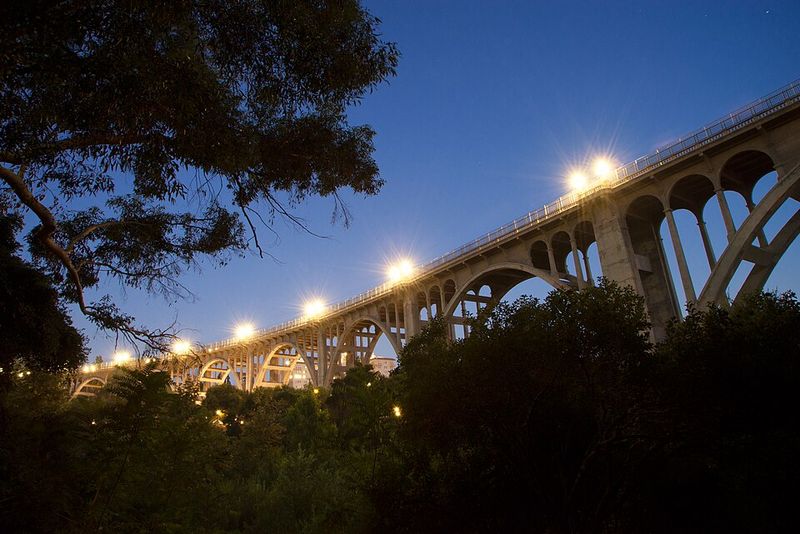
Daytime visits to the Colorado Street Bridge tend to highlight the architectural excellence of the structure.
Sunlight catches the texture of the concrete, the ornamental detailing on the lamp posts stands out clearly, and the full length of the bridge is easy to appreciate without any atmospheric interference.
Photographers working in daylight have access to clean lines and strong contrasts.
As the light fades, the same details begin to read differently. Shadows fill the spaces between the arches faster than they fill the roadway above, and the canyon below darkens well before the sky does.
That transition period between late afternoon and full dark is when the bridge feels most weighted by its own history, without any deliberate theatrical effect.
The shift in mood is not dramatic in the way of a horror film but quiet in the way of a very old building that has absorbed a great deal over many years.
The concrete does not change color, the lamp posts do not flicker, and the canyon does not make unusual sounds at dusk any more than at noon.
But the combination of fading light, historical knowledge, and the sheer height of the drop below creates an atmosphere that many visitors describe as noticeably solemn once the sun clears the ridge.
The Lower Arroyo Makes The Landmark Feel More Isolated
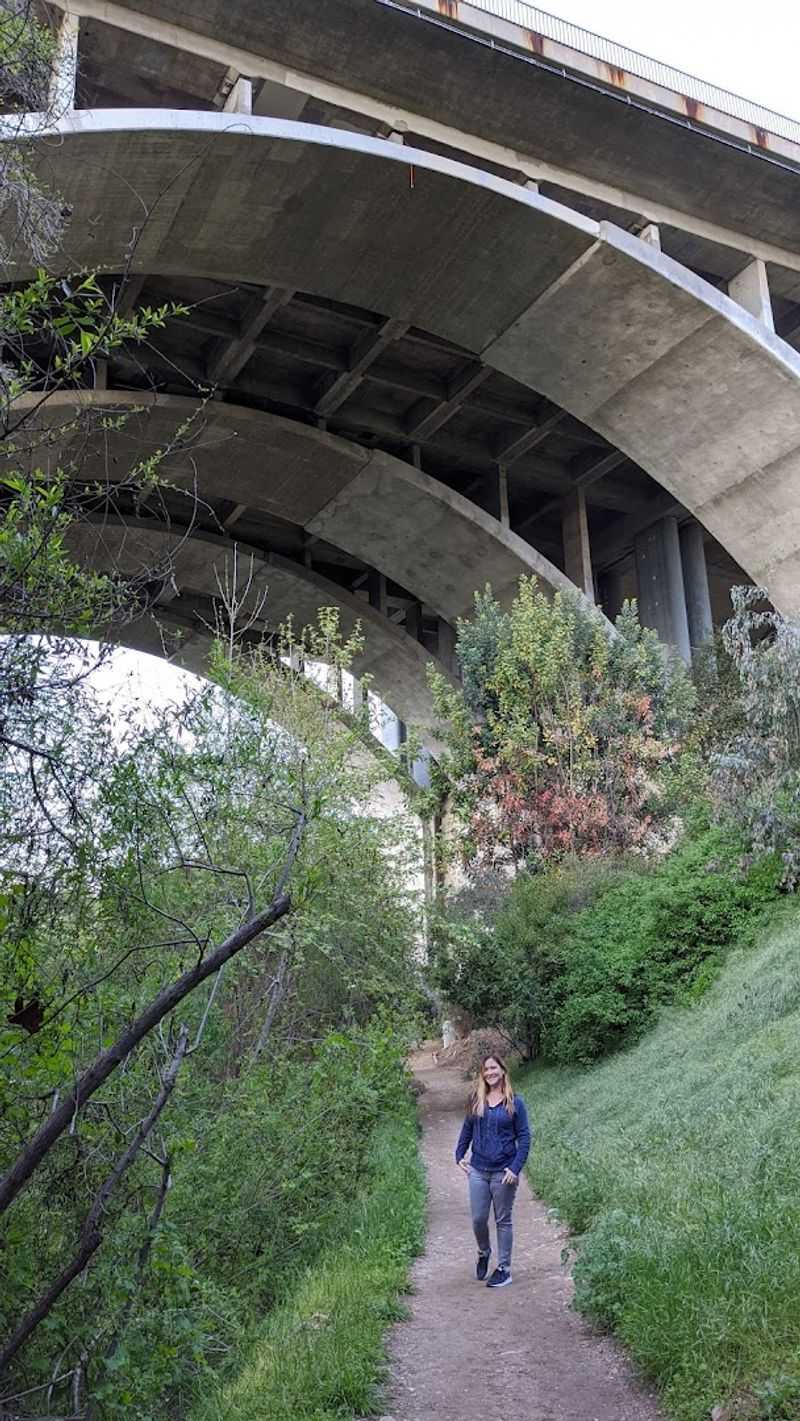
The area directly beneath California’s Colorado Street Bridge belongs to the Lower Arroyo Seco, a stretch of natural open space that feels surprisingly removed from the urban grid surrounding it.
Trees, dry creek beds, and open meadow areas create a setting that reads more like a regional park than a city greenway, and the bridge arches overhead as a constant reminder of the human-made structure above.
That combination of natural isolation and looming architecture gives the lower Arroyo a quality that is hard to match elsewhere in Pasadena.
Trails pass close to the base of the bridge’s support columns, and the quiet of the canyon contrasts sharply with the sounds of traffic crossing above.
On weekdays especially, the lower Arroyo can feel genuinely empty, with long stretches of trail where no other visitors are visible.
The isolation is not threatening in any straightforward way, but it does heighten the awareness of being in a place with a complicated history.
The bridge feels more present from down there than it does from the road, partly because the scale is more visible and partly because the quiet gives the mind room to reflect.
Visitors who take the lower trail tend to come away with a more layered sense of what the landmark actually is.
Its Reputation Still Follows It Today
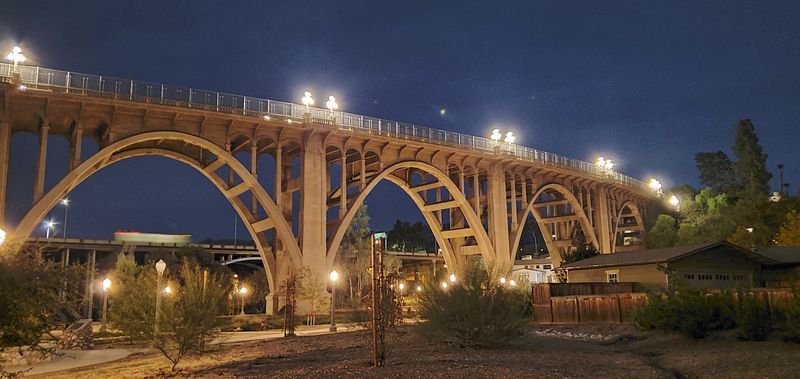
Paranormal accounts tied to the Colorado Street Bridge have circulated in Pasadena for decades, and they tend to follow consistent patterns rather than the random variation typical of invented folklore.
Reported apparitions include a woman in a long robe seen standing on a parapet before vanishing, a figure described as wearing wire-rimmed glasses, and a construction worker in boots who appears near the base of the structure.
A persistent legend holds that a worker fell into wet concrete during the original 1913 construction and was never recovered, leaving him entombed within the bridge itself.
That story has never been officially confirmed but has never been fully dismissed either, and it contributes to the specific texture of the bridge’s haunted reputation.
Unexplained sounds described as cries or echoes rising from the canyon below have been reported by enough independent sources to remain a recurring element of the bridge’s story.
The Colorado Street Bridge does not need embellishment to carry weight. Its documented history, its architectural drama, and its physical setting do that work on their own.
But the paranormal layer persists because the place genuinely produces experiences in visitors that are difficult to explain away with purely rational accounts.