10 Idaho Churches With Architecture That Feels Straight Out Of Europe
The first reaction is usually the same:
“Wait… this is Idaho?” That question makes sense.
Some of these churches look like they were accidentally dropped into the American West after taking a very wrong turn somewhere in Europe. The stonework feels centuries old, the towers seem built for a medieval skyline, and the details are far too impressive for a quick glance from the street.
The funny part is that many people drive past without realizing what they are seeing. They expect Idaho scenery to steal the show.
Then a church quietly walks in and says, “Actually, I brought the architecture.”
These buildings are more than beautiful backdrops. They hold generations of stories and craftsmanship that have survived long after the people who built them first stepped inside.
So yes, keep your eyes on the mountains. But maybe look up once in a while too.
Because Idaho has a few architectural surprises waiting.
10. Cathedral Of St. John The Evangelist
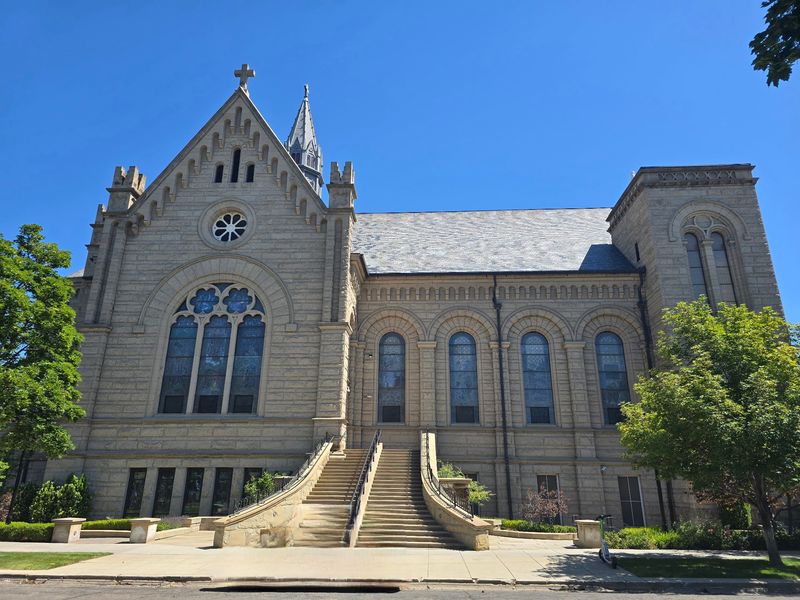
Germany and France both played a role in shaping one of Boise’s most recognizable landmarks.
Tourtellotte and Hummel designed the Cathedral of St. John the Evangelist in the Romanesque Revival style, taking inspiration from Mainz Cathedral in Germany and the Basilica of Saint-Sernin in Toulouse, France.
Construction began after the cornerstone was laid in 1906, and the completed cathedral was dedicated in 1921. Table Rock sandstone covers the exterior, giving the building a warm color that changes subtly with the light.
Broad rounded arches are among the clearest Romanesque features, while the cruciform floor plan follows a church-building tradition used for centuries in Europe.
A large rose window adds another focal point to the front facade.
Inside, thick walls, wide arches, stained glass, and ornamental painting continue the architectural story. The cathedral stands at 775 N 8th Street and remains the principal Catholic cathedral for Idaho.
Boise has plenty of handsome historic buildings, but few make their European references this explicit. Here, the inspiration can actually be traced to two famous churches on the other side of the Atlantic.
9. Mission Of The Sacred Heart
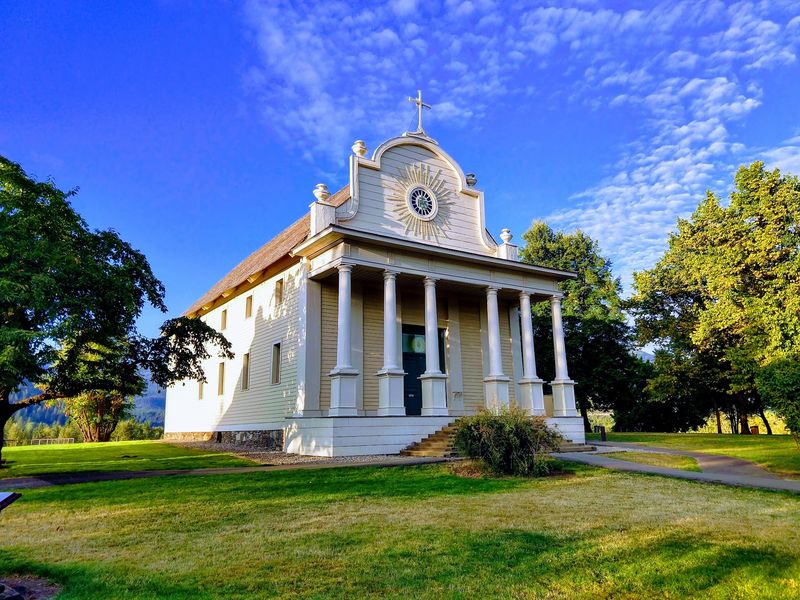
Nothing else on this list tells its architectural story quite like the Mission of the Sacred Heart. Built in the early 1850s through the work of Jesuit missionaries and members of the Coeur d’Alene Tribe, the mission is recognized as Idaho’s oldest standing building.
Father Antonio Ravalli directed much of the design and construction despite the limited tools and materials available at the site.
The finished structure nevertheless reflects Ravalli’s European background through its symmetry, proportions, decorative treatment, and church form.
Clever craftsmanship mattered as much as style. Materials were shaped locally, and decorative elements were created without the resources available to urban churches farther east.
Today, the structure is preserved within Old Mission State Park near Cataldo. The setting makes the building even more striking.
Instead of standing on an old European square, it rises above a northern Idaho landscape of forested hills. The architectural influence traveled a very long way before taking this distinctly regional form. 31732 S Mission Rd, Cataldo, is the location.
8. St. Stanislaus Catholic Church
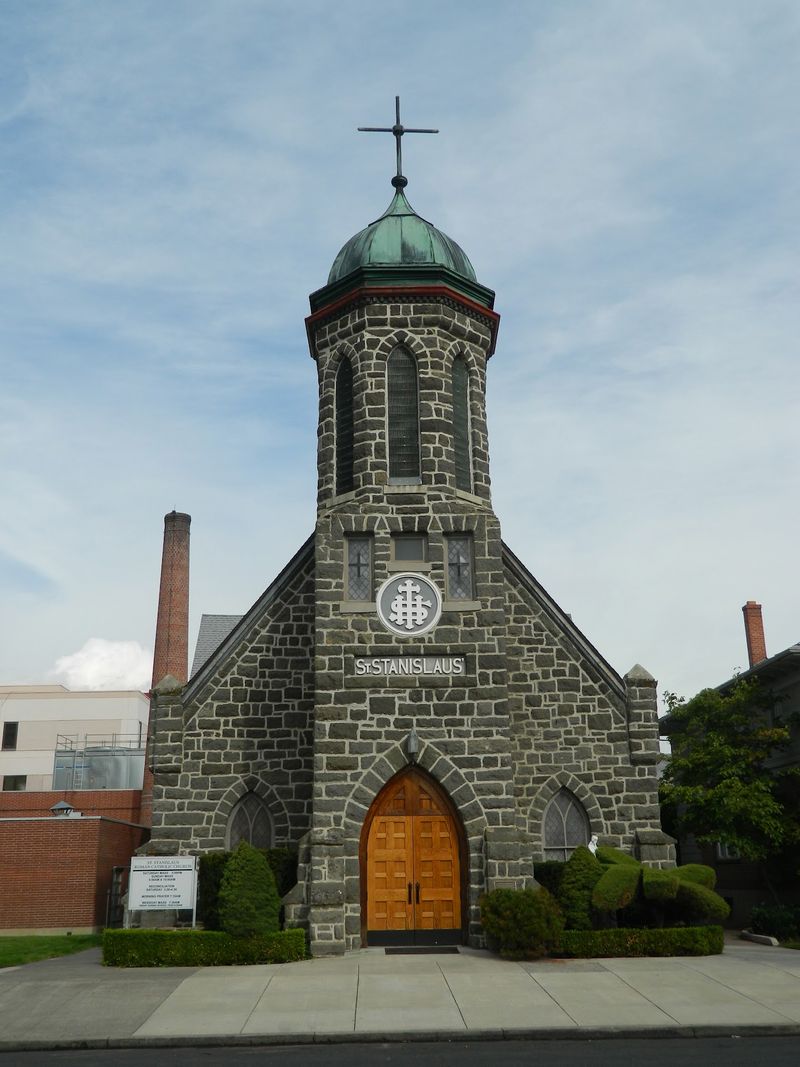
Dark basalt gives St. Stanislaus a completely different presence from Boise’s pale sandstone churches. Built in 1905 at 633 Fifth Avenue in Lewiston, the historic church was designed in the Gothic style by local architect James H.
Nave. Its walls use basalt quarried in the area, creating a heavy, textured exterior that immediately separates it from lighter brick and wooden buildings nearby.
Then the Gothic details begin pulling the eye upward. Pointed openings soften the weight of the stone, while a 48-foot octagonal bell tower rises from the composition.
National Register documentation specifically highlights both that tower and the local basalt construction as defining features.
The result feels closer to a compact European stone church than the stereotypical wooden church often associated with the early American West.
St. Stanislaus is also valuable because the materials and architecture work in opposite directions. Rugged volcanic rock keeps the building firmly tied to Idaho, while Gothic forms connect it with a much older architectural vocabulary.
More than a century of weather has only made that contrast easier to appreciate. This is a building worth viewing slowly from across the street before moving closer to the stonework.
7. Christ Chapel
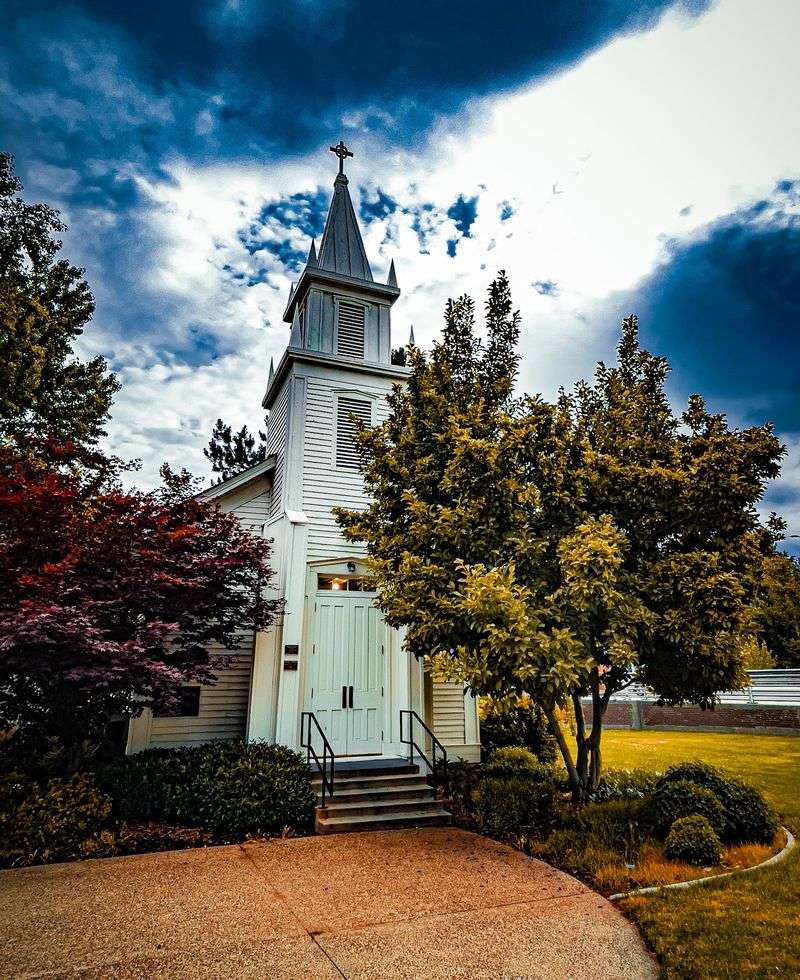
Small scale gives Christ Chapel much of its charm. The white Gothic Revival building was constructed in 1866 as St. Michael’s Episcopal Church, making it Idaho’s first Protestant church.
Its design relies on pointed forms, a central tower, clapboard siding, and a compact vertical silhouette rather than grand stone walls. That simplicity gives it the feel of a modest rural chapel that could easily fit into an English village.
The building has also traveled more than most historic churches. It originally stood at Seventh and Bannock streets, later moved to another Boise location, and eventually found a permanent home on the Boise State University campus.
Today it stands at 1010 Cesar Chavez Lane, surrounded by much newer university buildings. That contrast makes the chapel especially noticeable.
A structure from 1866 suddenly appears amid modern campus architecture without losing its visual identity. Boise State still recognizes it as a historic event space, and the building is listed on the National Register of Historic Places.
There are much larger churches elsewhere on this list, but Christ Chapel proves that Gothic Revival architecture does not need enormous windows or a massive tower to make its historical influences obvious.
6. Cathedral Of The Rockies
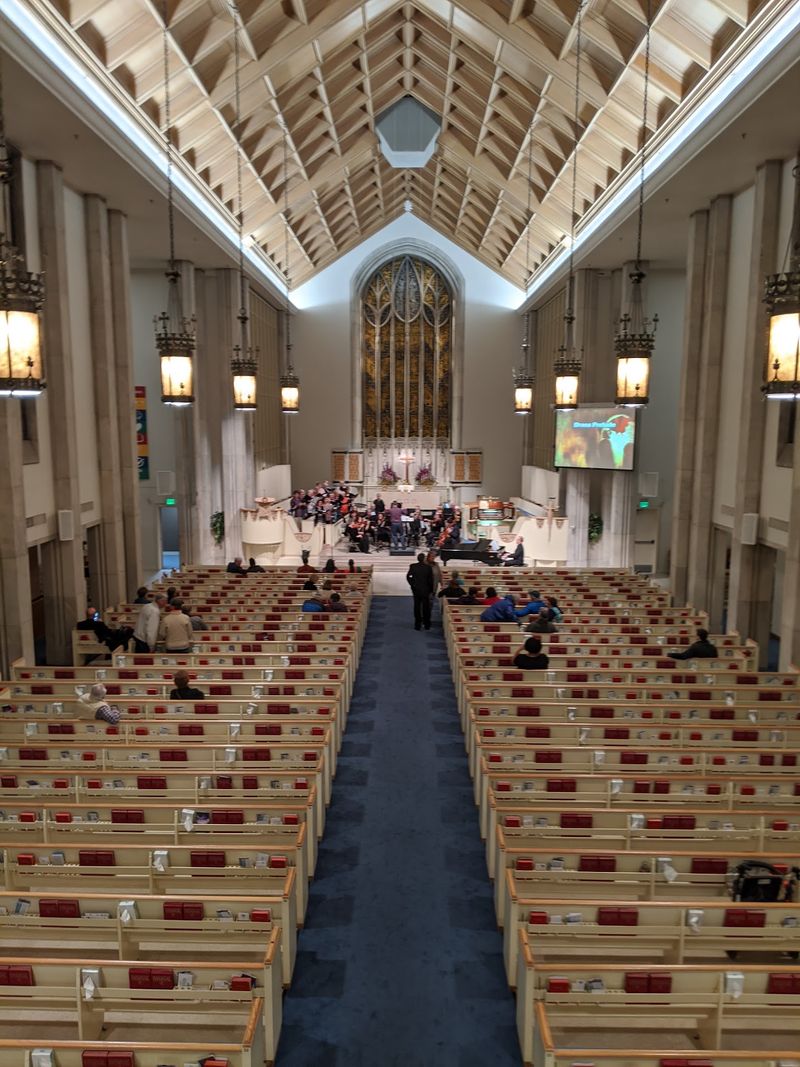
Mid-century construction rarely enters a conversation about Old World-looking churches, which makes Cathedral of the Rockies an interesting exception.
Boise First United Methodist Church opened the doors of its present cathedral in 1960 after decades of growth forced the congregation to seek a larger home.
Architect Harold E. Wagoner designed the building in the Gothic Revival tradition, adapting historical church forms for a congregation building in the middle of the 20th century.
The exterior uses Arizona flagstone, while pointed forms and a strong vertical profile connect the structure with Gothic precedents much older than the building itself.
Its location at 717 N 11th Street places it in Boise’s North End, only a short distance from several other architecturally significant churches.
That proximity makes it particularly useful for comparing revival styles across different generations. St. Michael’s and St. John’s belong to an earlier era of stone cathedral building.
Cathedral of the Rockies shows how designers were still borrowing from European ecclesiastical architecture decades later. The building does not pretend to be medieval.
Instead, it demonstrates how Gothic ideas could be reinterpreted for an American church completed in 1960 and still feel immediately recognizable.
5. St. Michael’s Episcopal Cathedral
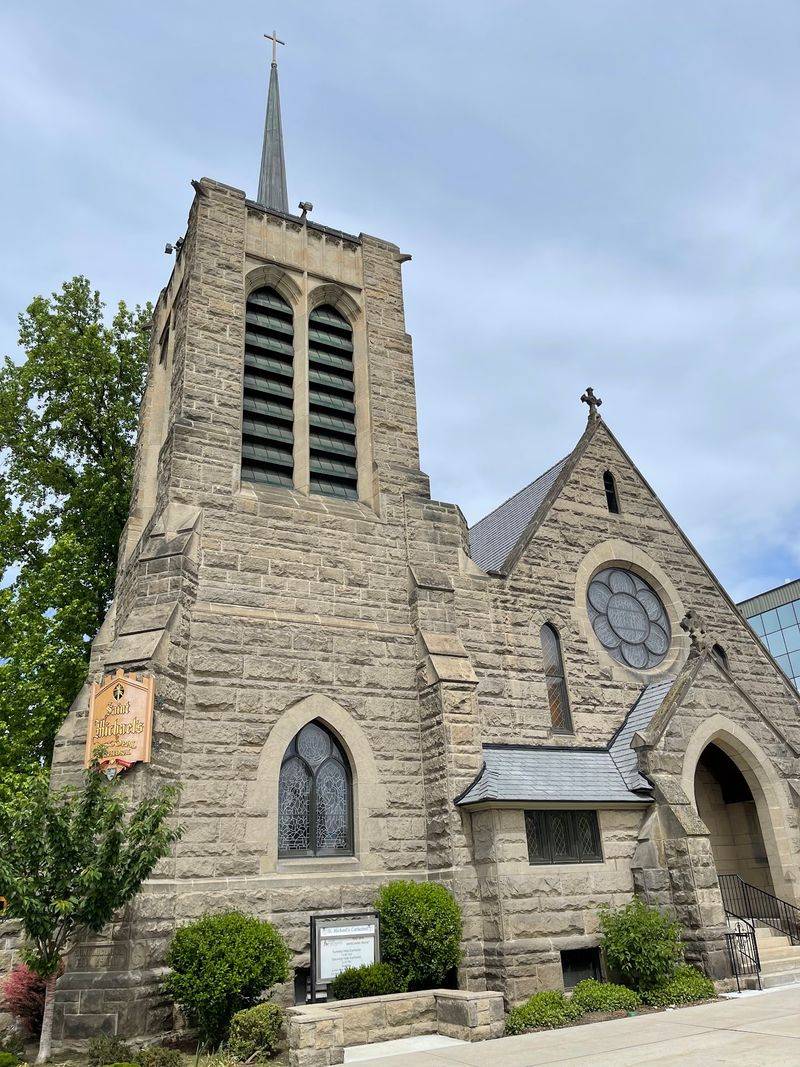
English Gothic architecture has a particularly convincing Idaho interpretation at St. Michael’s Episcopal Cathedral. New York church architect Henry Martyn Congdon designed the building, while Boise architect John E.
Tourtellotte supervised the work locally. Construction began in 1899, and the cathedral was dedicated in 1902.
Table Rock sandstone gives the exterior the warm, substantial appearance shared by several important Boise buildings from the period. The European influence becomes even clearer inside.
Hammerbeam roof trusses span the nave, recalling a structural and decorative form closely associated with medieval English architecture.
The cathedral also features Gothic pointed forms and a prominent rose window, although some familiar elements arrived later.
The front rose window was installed in 1945, the tower was completed in 1949, and its spire followed in 1980. Those additions help explain why the building visible today developed over many decades rather than appearing all at once in 1902.
St. Michael’s remains an active cathedral at 518 N 8th Street. Its locally quarried stone keeps it grounded in Boise, while its English Gothic vocabulary makes the building feel connected to a much older architectural tradition.
4. St. Mary’s Catholic Church
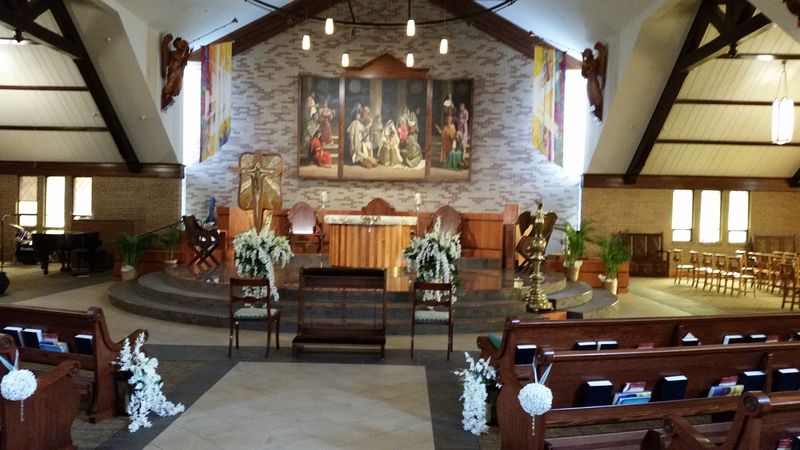
Brick rather than stone gives St. Mary’s a warmer and more textured Gothic presence. The current church was constructed in 1937 and designed by Frank Hummel of Tourtellotte and Hummel, one of the architectural firms that left an enormous mark on Idaho.
National Register documentation identifies a combination of Classical Revival and Neo-Gothic or Tudor influences within the larger church complex. Those styles do not compete as much as the names might suggest.
The Gothic character is immediately visible in the church building, while the associated parish house brings a more Classical Revival approach into the property. That pairing makes St. Mary’s unusually interesting to study from outside.
Instead of offering one pure architectural style, the site shows how revival traditions could be mixed during the 1930s. The historic church stands along State Street at 26th Street in Boise and remains part of an active Catholic parish.
Its red brick also separates it visually from St. John’s and St. Michael’s, where pale sandstone dominates. All three borrow heavily from European church architecture, yet none looks interchangeable.
St. Mary’s proves how much material choice can change the personality of familiar Gothic forms.
3. Holy Rosary Catholic Church
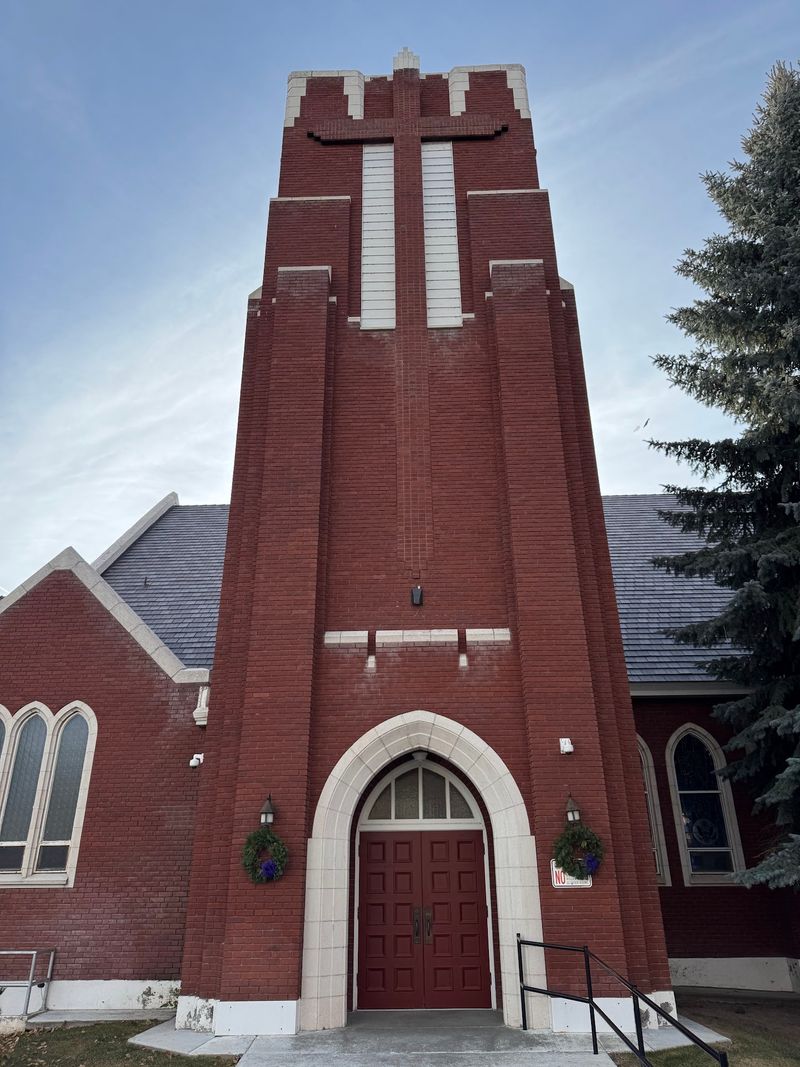
English Gothic was not merely a vague inspiration when Holy Rosary took shape in Idaho Falls. City historic materials state that Hummel, Hummel, and Jones prepared plans in 1947 for the present English-Gothic-style church.
The building was completed around the following year, giving Idaho Falls a substantial example of Gothic church design from the postwar period. Red brick forms much of the exterior, with contrasting trim defining architectural details and openings.
Inside, Gothic forms continue rather than disappearing behind a modern shell. National Register documentation highlights the building as an important example of the long relationship between the Hummel architectural firms and the Roman Catholic Diocese of Boise.
That connection links Holy Rosary with several other Idaho churches designed by related generations of the same architectural family.
The church stands at 288 E 9th Street, where its vertical lines and traditional proportions make it one of the neighborhood’s most noticeable historic buildings.
Its age is also slightly deceptive. Someone seeing the church without knowing the date could reasonably assume it predates the late 1940s.
That effect comes from deliberate architectural revival rather than actual medieval age, which is exactly why it fits this list so comfortably.
2. St. Charles Borromeo Catholic Church
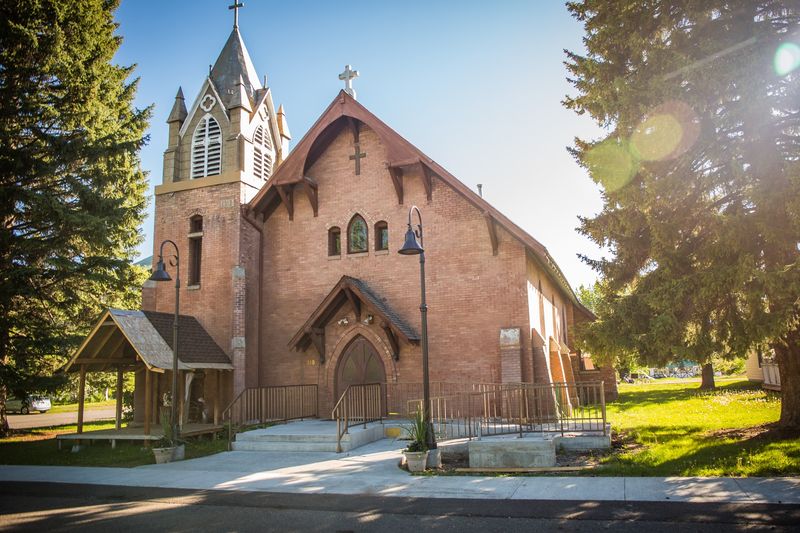
Look toward the steeple first at St. Charles Borromeo, because its most unusual architectural detail is waiting there. Tourtellotte and Hummel designed the historic Hailey church in the Gothic Revival style, and the structure dates to 1914.
Unlike the heavy stone Gothic buildings elsewhere on this list, St. Charles uses frame construction with brick veneer. That lighter structural approach did not stop the architects from giving the church a strong vertical identity.
The steeple is clad in decorative metal sheathing, a feature the Idaho Heritage Trust describes as one of the state’s most remarkable examples of this treatment. It catches light differently from stone, brick, or wood and gives the tower a distinctive finish.
The church and its neighboring rectory are listed on the National Register of Historic Places. You can find the church at 315 First Avenue South in Hailey, surrounded by the mountain scenery of the Wood River Valley.
Its scale is modest compared with Boise’s cathedrals, which suits the town. What connects it with European revival architecture is not size but proportion, pointed Gothic forms, the tower, and the deliberate emphasis on height.
More than a century later, that steeple still does its job beautifully.
1. St. Joseph’s Catholic Church
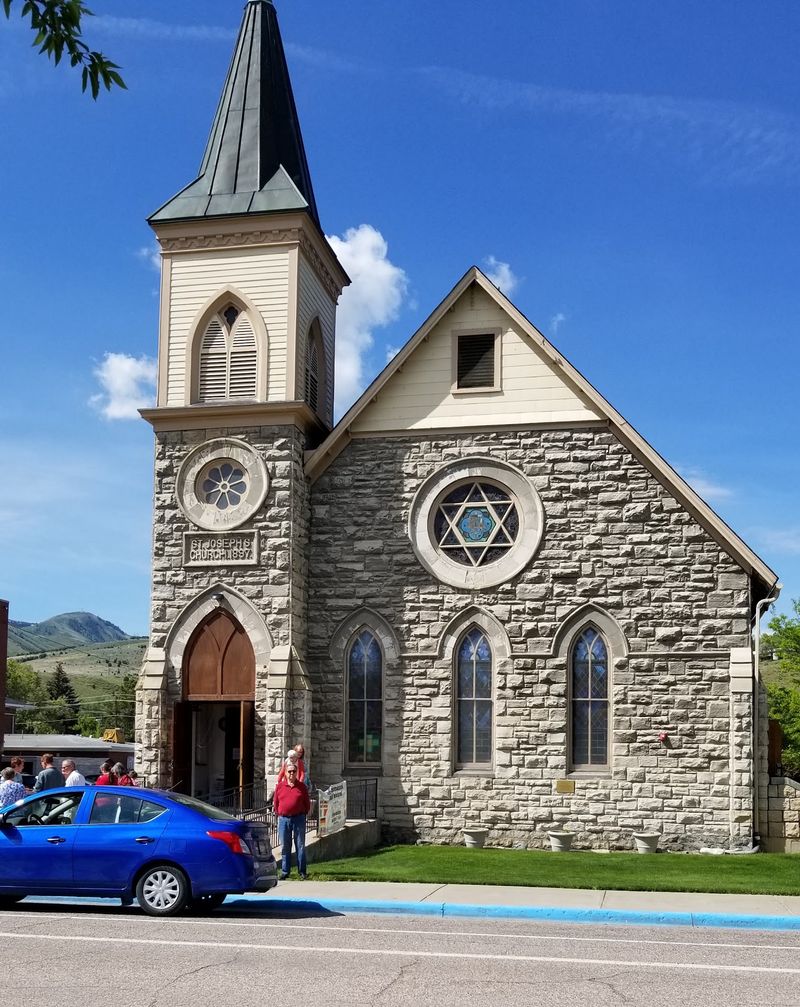
Local stone gives St. Joseph’s the kind of permanence usually associated with buildings much older than Pocatello itself. The Gothic Revival church was constructed in 1897 and consecrated that December.
The Diocese of Boise identifies it as the oldest standing Catholic church in Idaho that remains in operation.
Rusticated white sandstone from the Fort Hall area forms most of the exterior, while pointed Gothic openings bring a lighter vertical rhythm to the heavy walls.
Above them, a wooden belfry and octagonal copper spire create an especially distinctive silhouette. The building stands at 455 N Hayes Avenue and has survived well over a century of change around it.
Preservation work has been important because old stone churches require continuing attention rather than surviving automatically. Architecturally, St. Joseph’s works because its materials and style reinforce each other.
Rough stone suggests weight and age. Gothic arches pull upward.
The slender upper tower gives the whole structure a finish that would not feel out of place on a small European church.
Pocatello has another remarkable Gothic church only a short distance away, making this corner of southeastern Idaho unexpectedly rewarding for anyone interested in late-19th-century ecclesiastical architecture.