This Quirky Pennsylvania Museum Uses Tiny Cat Soldiers To Retell Civil War Battles
I know how this sounds. Thousands of miniature cats fighting Civil War battles should not make historical sense, yet somehow it does.
Pennsylvania has a wonderfully unusual museum where tiny clay soldiers turn serious battlefield history into something you will probably tell people about later.
The cats are not simply scattered around for laughs.
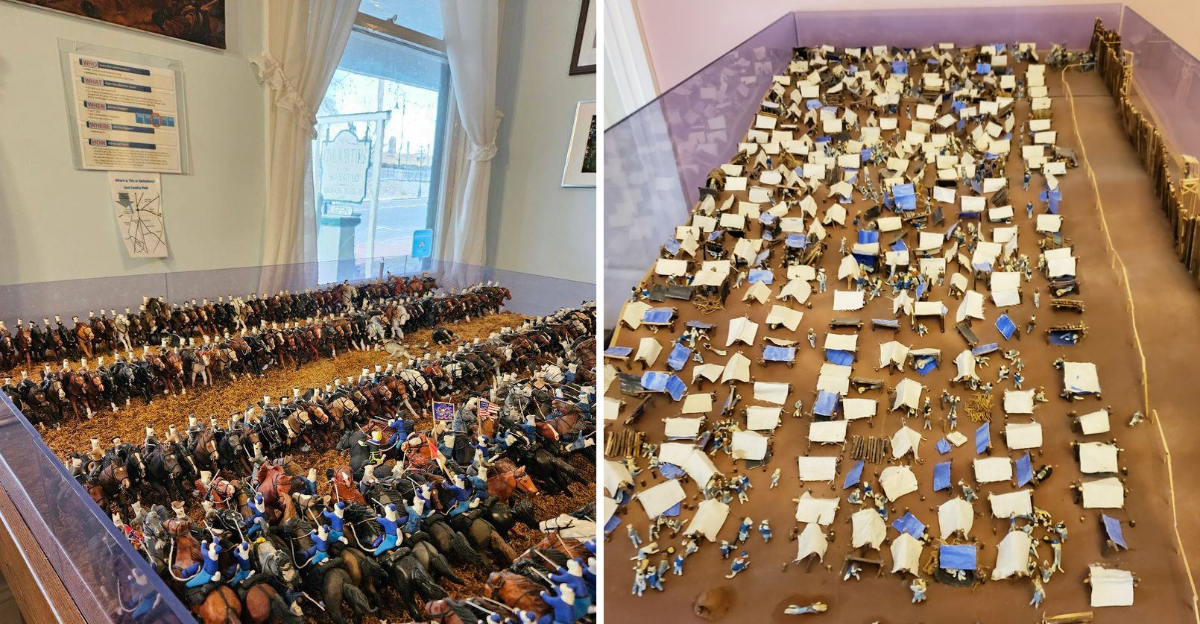
Hand-built dioramas recreate landscapes and battles with remarkable attention to detail, giving visitors different perspectives on what happened.
That combination got me. It is strange enough to spark curiosity, then detailed enough to keep you studying each scene.
Even the building has connections to Civil War history. Gettysburg already offers plenty to explore, but this might be its quirkiest history lesson.
Two Sisters, One Clay Dream
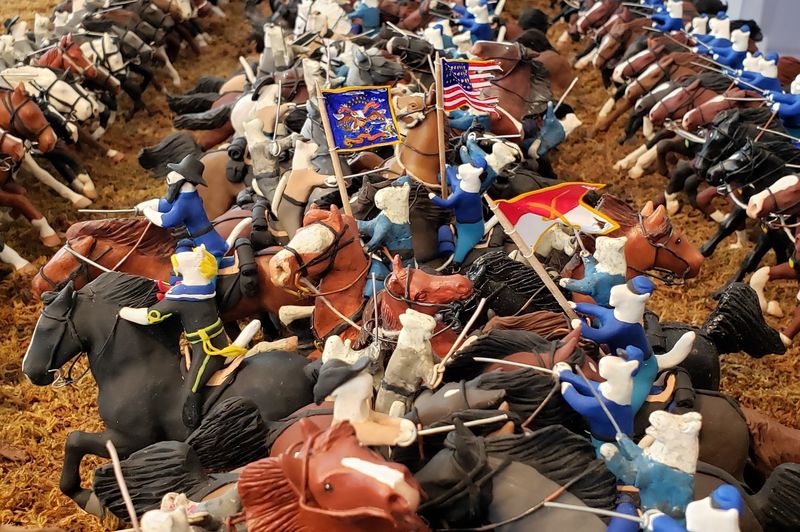
It all started with two eleven-year-old twins, modeling clay, and a stubborn idea. Rebecca and Ruth Brown loved history and cats in equal measure.
Sculpting realistic human figures proved frustrating, so they shaped cats instead. That accidental choice became their trademark, and hundreds of little soldiers piled up over the years.
Rebecca’s fascination began with biographies of generals like Robert E. Lee and Ulysses S. Grant.
The reading fed the research, and the research fed the clay.
By middle school, the sisters were already dreaming of a museum in Gettysburg. In 2011 they began building full-size dioramas, aiming for one major battle scene each year.
That schedule lined up with the 150th anniversary of the war, starting with the Bombardment of Fort Sumter. Their doors finally opened in September 2015, decades after the first cat was baked.
Standing in front of thousands of figures, I kept thinking about patience as an art form. You can meet the sisters and their handiwork at 785 Baltimore St in Gettysburg.
A Building With Its Own Story
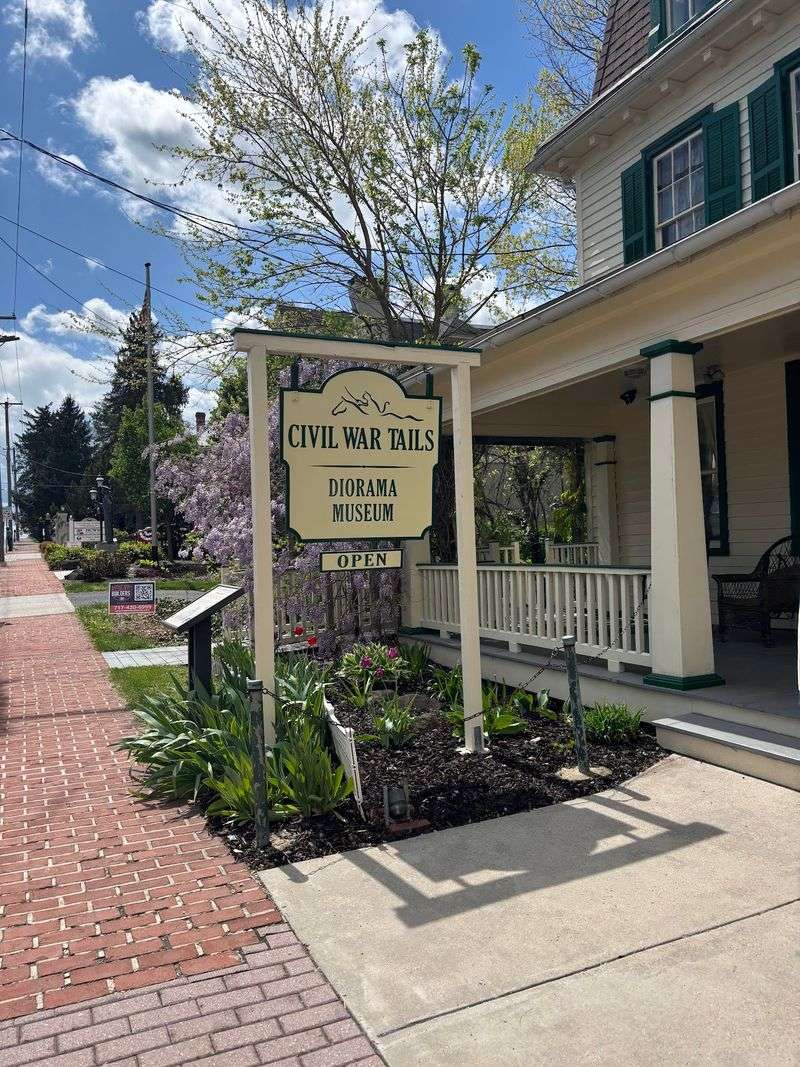
Before the cats moved in, this address held a very different purpose. The structure went up in 1869 as part of The National Homestead.
That institution, founded in 1866, cared for children orphaned by the war. Its origin traces to Sergeant Amos Humiston, found after the battle holding a photograph of his three children.
The first orphanage sat in a brick building nearby. As the number of children grew toward seventy, this addition became the girls’ dormitory.
Porches once connected the two buildings in an L shape, set slightly back from the street. The orphanage closed in 1878, and the property changed hands and uses.
By the 1880s it served as a boarding house. In 1903 the building was moved south and closer to the street, then converted into a two-family home with furnaces and running water.
For roughly a century it operated as the first bed and breakfast in town. The Brown sisters bought it in 2013 and reworked it into the museum.
Accuracy Down To Every Pebble
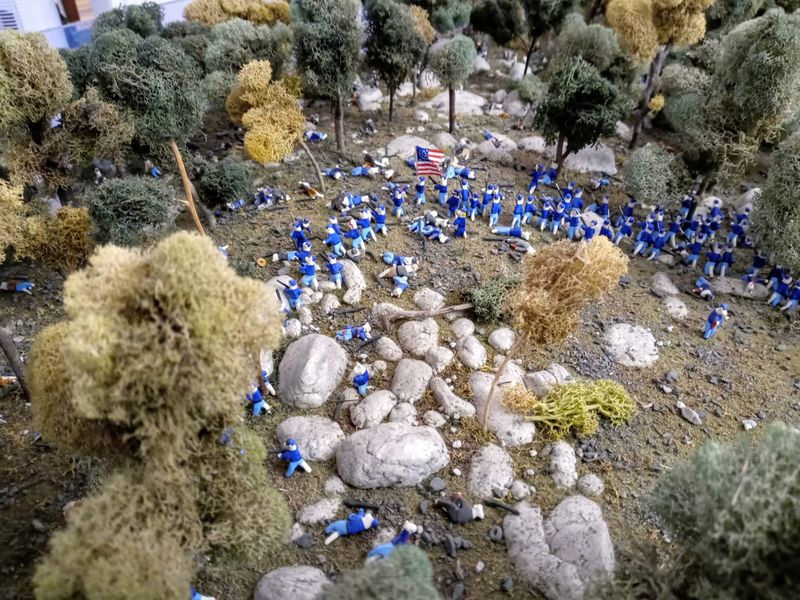
Here is the fact that made my jaw drop: the figures use a one-to-one ratio. Each clay cat stands in for one real soldier who fought in that battle.
Suddenly the scale of these engagements becomes something you can actually see. Thousands of tiny bodies fill a hillside, and the numbers stop being abstract.
The terrain follows the same rule. If a slope looks brutally steep in miniature, it was brutally steep for the men climbing it.
Cardboard, twigs, fake moss, and layered gels create hills, trees, and water. Stone walls are stacked from countless individual miniature stones, and fences are built rail by rail.
Rocks on the Little Round Top scene were modeled from period and modern photographs of the actual ground. Uniforms are correct for Union and Confederate units.
Some cats even wear the right corps badges, the shapes General Joseph Hooker introduced to lift morale. Horses, cannons, ambulances, and locomotives are handmade too.
Careful research turns a whimsical idea into serious teaching, and that balance is the real achievement of this Pennsylvania museum.
Battles Big And Little Known
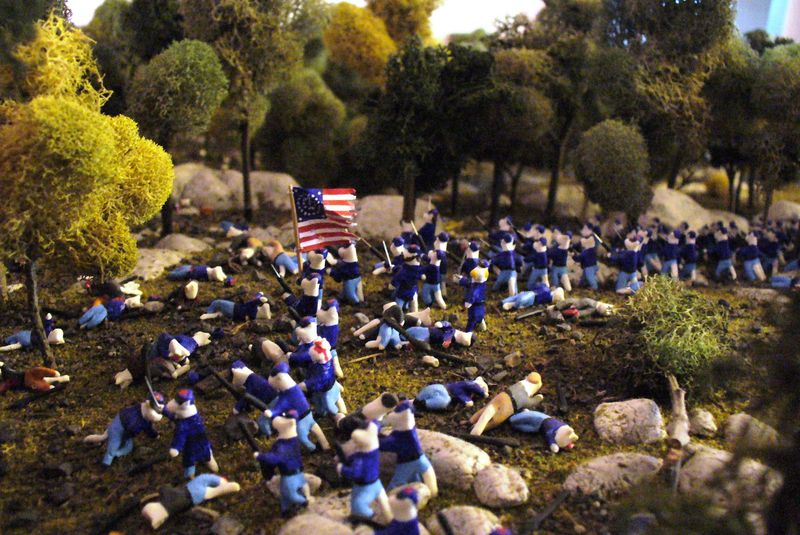
Gettysburg naturally takes center stage inside these rooms. Several of the battle’s turning points appear in separate scenes.
Little Round Top shows the defense of the Union left flank across rocky ground packed with feline figures. The Angle and Pickett’s Charge capture the Confederate assault on the Union center and the High Water Mark.
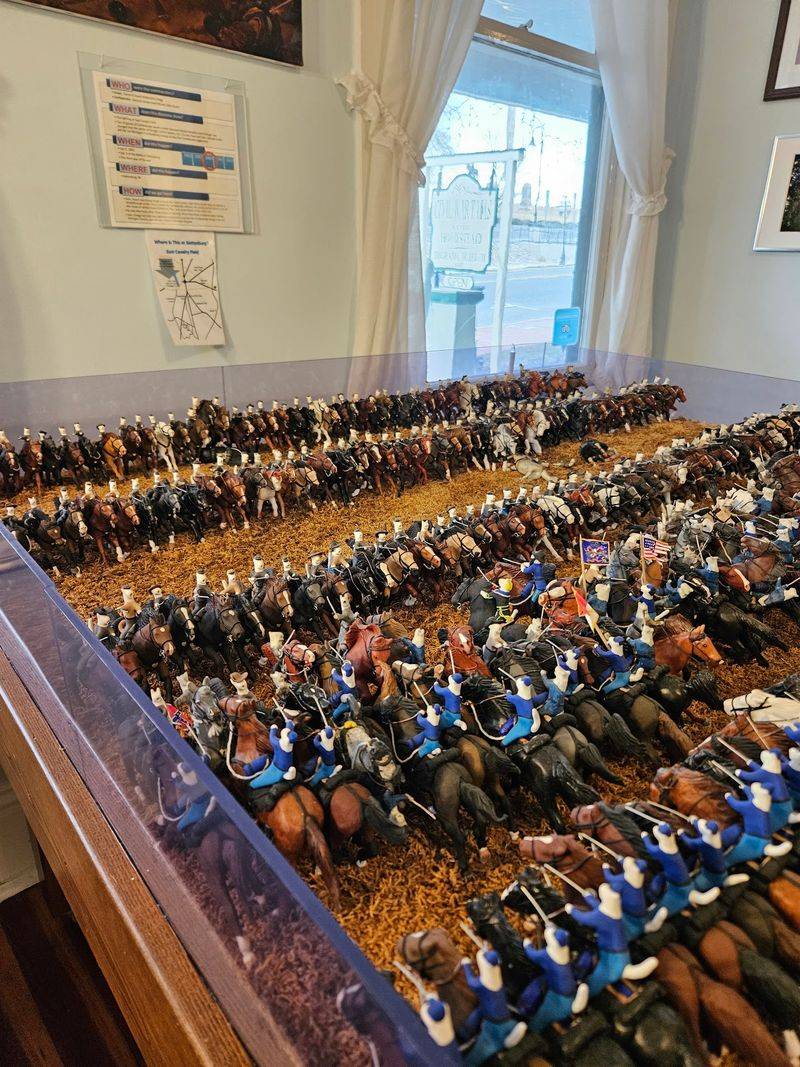
Even East Cavalry Field, often skipped by casual visitors, gets its moment. Culp’s Hill appears as well, and comparing it to other local exhibits shows how careful the research was.
The story stretches far beyond Adams County. Fort Sumter’s bombardment in South Carolina marks the opening shots of the conflict.
The ironclads USS Monitor and CSS Virginia clash in a scene you view from above. Shiloh, Antietam, and the winter fighting at Fredericksburg all appear in miniature.
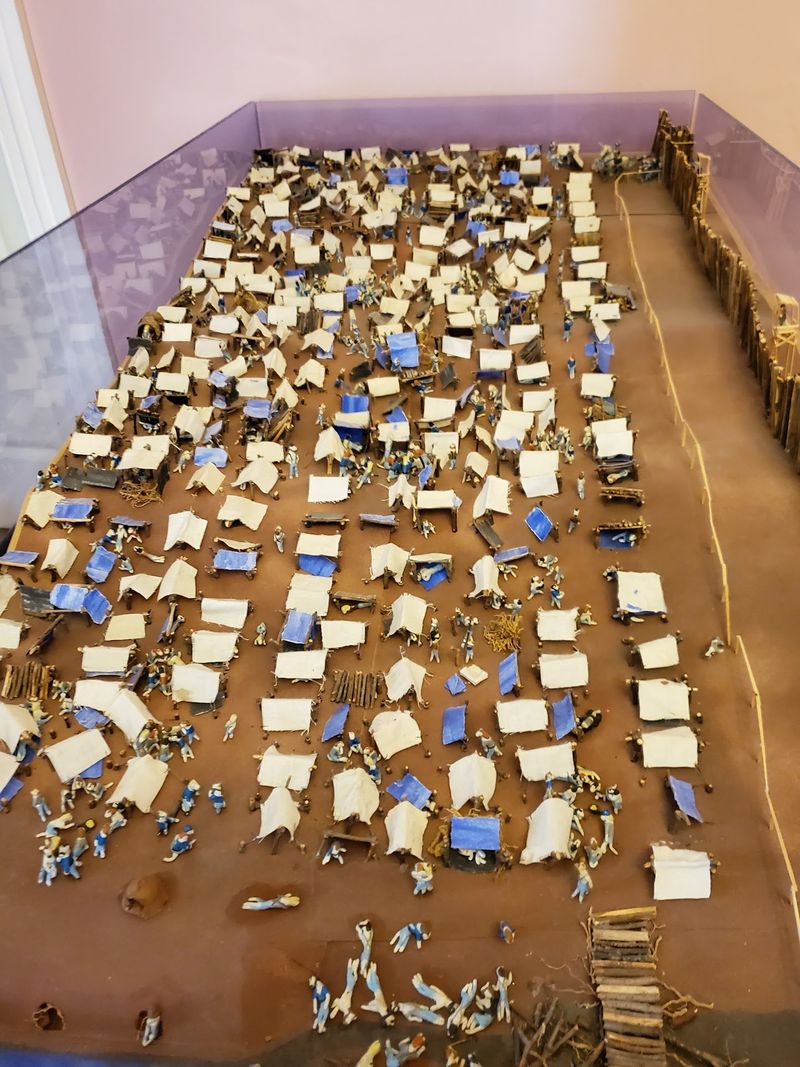
The Great Locomotive Chase races along, and the Andersonville prison camp offers a sober contrast. A diorama honoring the 54th Massachusetts Regiment, a celebrated African American unit, began construction in the late 1990s.
I found something new in every corner, which is why repeat visitors keep coming back. One trip simply cannot cover all these tiny campaigns.
Bird’s Eye Or Whisker Level
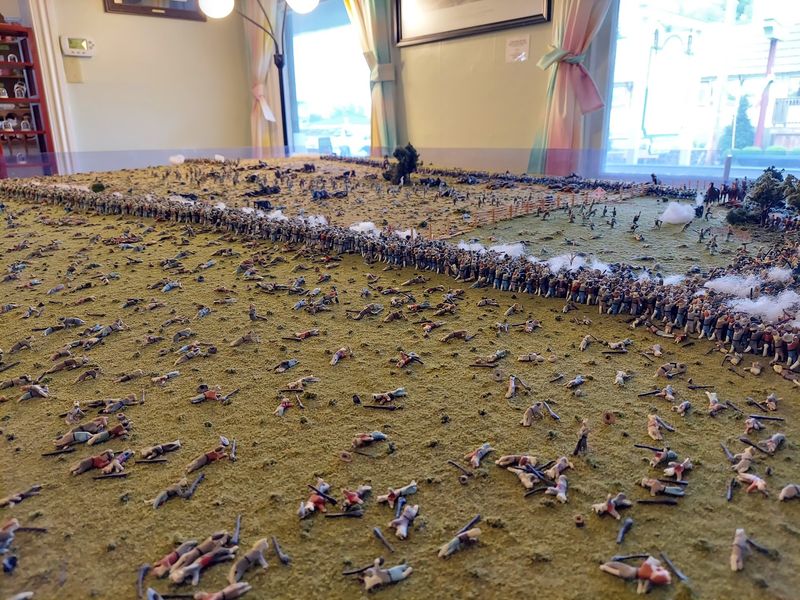
Most exhibits give you one viewpoint. Civil War Tails at the Homestead Diorama Museum hands you two.
Stand tall and you see the whole field like a commander reading troop movements. Crouch to table height and you join the ranks, nose to nose with the cats.
That shift changes everything about how the story lands. Strategy becomes personal, and the little figures start feeling like individuals.
Information cards sit beside the displays, so you can read at your own pace. Nobody rushes you along, and lingering is encouraged.
Families do well here because the cats lower the intimidation factor. Children who might tune out a lecture will happily hunt for a drummer or a flag bearer.
One gentle warning from my visit: the displays are fragile and not meant for touching. Younger kids may need a reminder to keep curious hands in pockets.
Photography is welcome, so bring a camera and get low for the best angles. History buffs get fresh perspective, and casual visitors get charm.
Years Of Patient Handwork
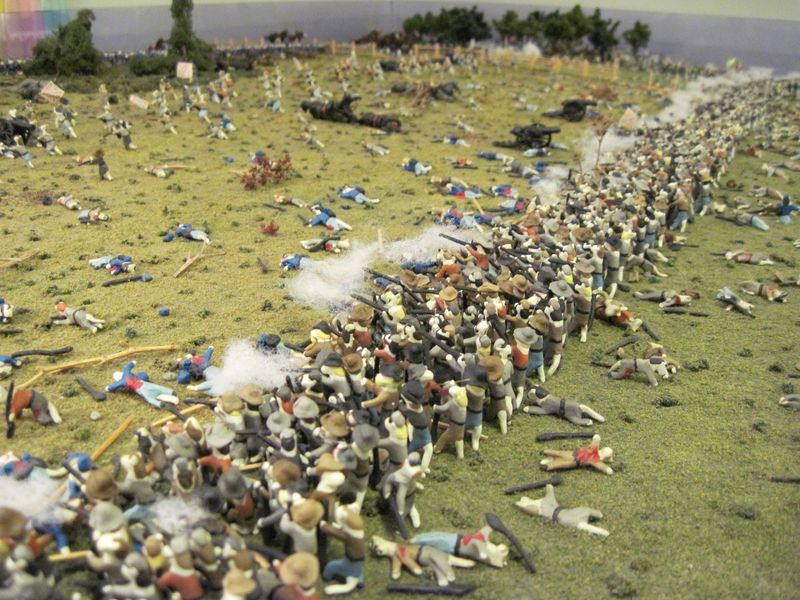
Count the hours and the numbers get almost unbelievable. Pickett’s Charge alone took five years to finish.
Little Round Top, holding roughly 3,000 cat soldiers, required eleven years of steady work. That is a decade of evenings spent shaping clay.
Every one of the 10,000 plus figures is sculpted by hand, none larger than an inch. Each gets baked in a 225-degree oven before joining the ranks.
The commitment extends to the animals. As of early 2021, about 88 percent of the miniature horses on display were made by the sisters themselves.
Landscapes rise from cardboard, twigs, moss, and gel for water effects. Artillery pieces, ambulances, and locomotives named the General and the Texas were built for the Great Locomotive Chase scene.
Some details are almost invisible until pointed out, like accurate facial hair or battle wounds. That level of care explains why guests describe the place as a labor of love.
Watching the ongoing projects, I realized this Pennsylvania museum is never truly finished.
Samurai Cats And Sister Cities
Just when I thought I understood the theme, samurai showed up. A dedicated exhibit connects Gettysburg with its sister city, Sekigahara, Japan.
The Battle of Sekigahara was fought in the year 1600 between armies of eastern and western Japan. Like the fighting of 1863, it reshaped a nation’s future.
Placing the two side by side widens the lens considerably. Different centuries, different continents, similar stakes and sacrifice.
The samurai cats wear armor and carry banners with the same attention given to Union and Confederate uniforms. Seeing them beside the battlefield scenes was an unexpected treat.
The sisters also wrote a book, Civil War Tails: 8,000 Cat Soldiers Tell the Panoramic Story, published by Stackpole Books. It digs into how the dioramas came together and the real people behind them.
Copies are available online, including Kindle editions, if you want the story after your visit. A selection of small souvenirs and figures is offered on site as well. Taking home a tiny cat felt like the natural ending to my tour.
Smart Tips Before You Go
A little planning makes this visit smoother. The museum sits about two buildings from the cemetery, with street parking nearby and a lot across the road by the bus tour building.
Hours run late, which is unusual for a small attraction. Doors typically open at 11 a.m. Monday, Tuesday, Thursday, and Friday, and at 10 a.m.
Saturday, staying open until 8 p.m.
Wednesdays and Sundays are closed days, so plan around them. Winter months shift slightly earlier, so a quick check of the website saves disappointment.
Children five and under enter free, and kids aged six to twelve get a reduced rate. Group rates exist for parties of ten or more, which suits school trips nicely.
The entrance and facilities are handicap accessible. Allow more time than you expect, since conversations with the artists tend to stretch happily.
Civil War Tails at the Homestead Diorama Museum rewards slow visitors, so do not squeeze it between tours. Pair it with a battlefield drive and your Pennsylvania weekend feels complete.