This Tiny California Community Was Built On An Abandoned Military Base And Still Lives Completely Off The Grid
A town without power lines sounds like a thought experiment. Here, it is everyday life.
What began on the remains of a former military site slowly turned into a desert community with homemade structures and residents who have learned to live far outside the usual systems.
This California outpost feels like a place assembled one workaround at a time. That is what makes it so fascinating.
You notice the absence of normal infrastructure first. Then the creativity.
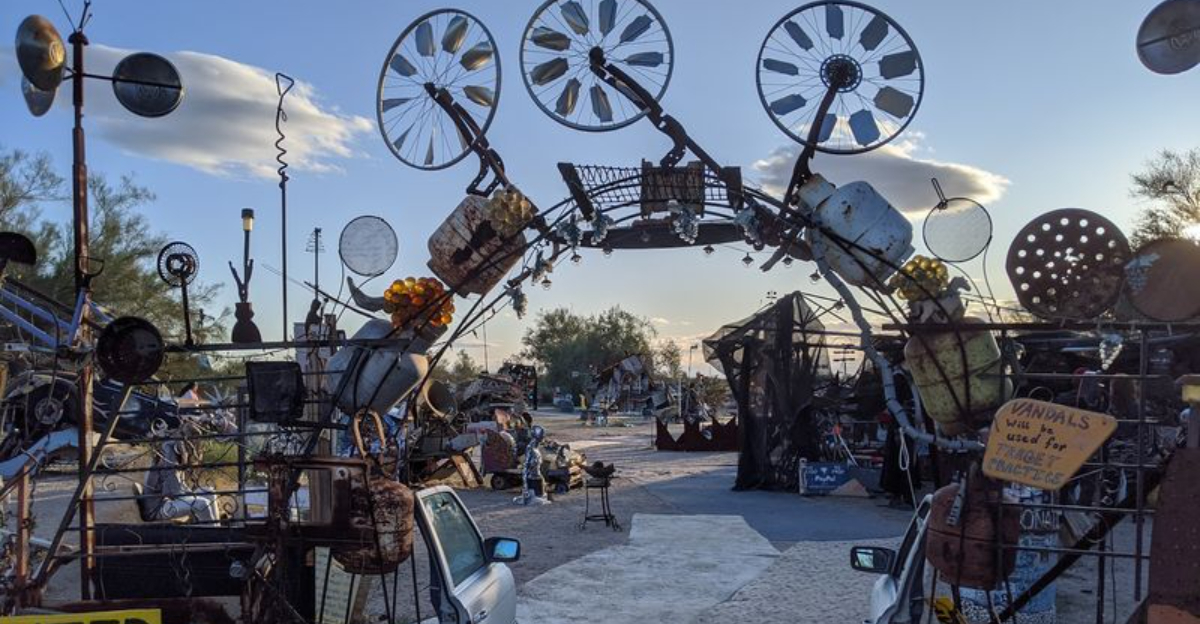
Solar panels, water tanks, hand-built spaces, art, and unexpected pockets of personality make the landscape feel improvised but lived-in.
Nothing about the place is polished. That’s exactly why it sticks with you.
It does not look like a town that should exist. And yet, somehow, it does.
It Sits On The Remains Of A World War II Marine Base
Long before anyone parked a trailer out here, the land belonged to the United States Marine Corps.
Camp Dunlap was commissioned on October 15, 1942, and served as a training facility for artillery and anti-aircraft units during World War II.
The camp operated for about three years at full strength, teaching gunners how to handle heavy weapons in wide open desert terrain.
Military activity dropped off sharply by 1949, and the base was gradually taken apart rather than kept in service.
By 1956 every building had been removed from the site, leaving flat ground and a scattering of concrete.
Walking the area today gives a strange sense of double history, since the desert floor still carries the outline of a place that no longer exists.
Understanding that military beginning helps explain why the layout feels so unusual, with straight edges and rectangular pads sitting in the middle of open scrub.
Nothing here was designed for permanent housing, and that fact shapes almost every detail of daily life on the slabs.
Visitors interested in the history should keep expectations realistic, because there is no museum, no visitor center, and no plaque explaining what stood where.
The story lives in the ground itself, in old pads and broken curbs half buried by blown sand.
Reading up before arriving makes the empty spaces far easier to interpret.
Those Abandoned Concrete Foundations Gave Slab City Its Name
Names do not get much more literal than this one. When the military dismantled Camp Dunlap, crews hauled away the buildings but left the concrete foundations sitting in the sand.
Those flat pads became free, level, ready made platforms in a place where level ground is genuinely useful.
Travelers and desert dwellers started pulling campers and trailers onto the slabs, and the nickname stuck.
Some residents built directly on top of the old foundations, using them as floors for homemade structures made from plywood, salvaged doors, tarps, and metal siding.
Others parked beside them and used the concrete as a patio or workspace.
Driving through, the pattern becomes easy to spot once someone knows to look for it. A rectangle of pale concrete peeking out from under a shaded porch is almost always a piece of the old base.
The community is also called The Slabs by people who live there and by longtime winter visitors.
Photographers tend to appreciate the contrast between the rigid military geometry and the loose, improvised buildings sitting on top of it.
Respect matters here, since many of those slabs are somebody’s home rather than a scenic backdrop. Asking before photographing a lived-in structure is the simplest courtesy a visitor can offer.
There Is Still No Public Power Grid
Flip a switch out here and nothing happens unless somebody built the system behind it. No conventional electrical service reaches the community, so every watt used has to be produced on site.
Solar panels are the most common answer, which makes sense in a place with relentless sunshine for most of the year. Generators fill the gaps, especially when air conditioning or power tools are involved.
Battery banks, salvaged inverters, and homemade wiring setups round out the picture, and the quality varies enormously from one camp to the next.
Some residents run refrigerators and laptops without much trouble, while others get by with a single light and a phone charger.
Anyone visiting should plan as though there will be no place to plug in, because there generally is not.
Charging devices in a vehicle, carrying a power bank, and downloading maps ahead of time all remove a lot of stress. Cell service can be inconsistent in the area, so offline directions are worth having.
The sound of the place shifts after dark, when generators hum in pockets and the rest of the desert stays quiet.
Light pollution is minimal, which means the night sky can be remarkably clear on cloudless evenings.
Running Water And Sewer Service Are Missing Too
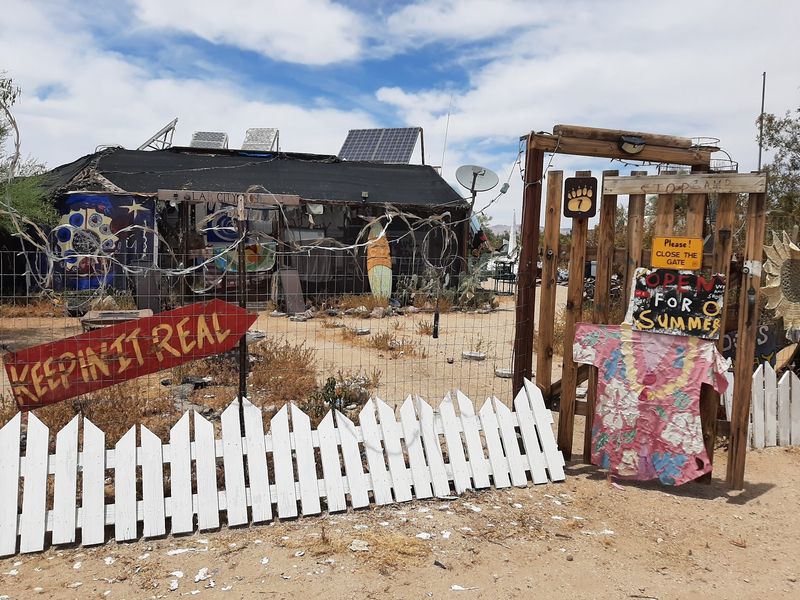
Water becomes a daily project rather than a background convenience. There is no municipal sewer system and no public running water anywhere in the community.
Residents haul what they need, often filling containers from a tank kept at a community church or driving to Niland, roughly four miles away.
Storage tanks, five gallon jugs, and repurposed containers show up in almost every camp.
Ironically, the original Camp Dunlap did have functioning water and sewage collection systems, all of which disappeared with the base.
Waste handling now falls to individuals, using portable toilets, composting setups, or their own arrangements.
For visitors, the practical takeaway is simple and important. Bring far more drinking water than seems necessary, especially between spring and fall when temperatures climb well past comfortable.
Summer highs in this part of the Sonoran Desert can be dangerous, and there is no shop on site to bail anyone out. Sun protection, a hat, and closed shoes make a walk around the area much easier on the body.
Restrooms are not something to count on, so planning a stop in Niland before and after the visit helps. Treating water as the limiting factor of the day is the honest way to approach a trip here.
The Community Covers Roughly 640 Acres Of Desert
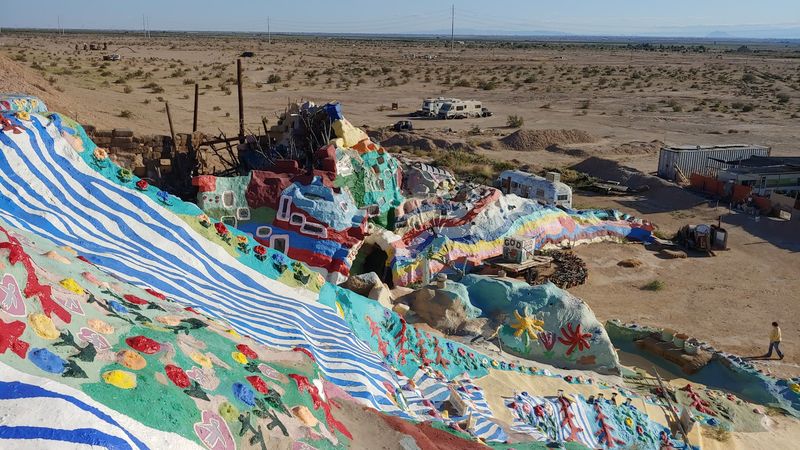
The footprint is bigger than most first-time visitors expect. Slab City developed across a roughly 640-acre state school-land parcel, although East Jesus purchased its 30-acre portion from California in 2016.
Slab City sits near the eastern shore of the Salton Sea in Imperial County, and community addresses use Niland, CA 92257.
Camps are scattered rather than clustered, so distances between neighborhoods add up quickly on foot.
Driving in makes far more sense than walking the whole area, though the interior roads are unpaved and rough in places.
A vehicle with decent clearance handles the washboard surfaces and soft sand better than a low sedan.
Pacing a visit matters more than covering every corner.
Choosing two or three specific stops, then walking short distances at each one, tends to feel much better than trying to see everything in an afternoon.
Shade is scarce, so timing visits for morning or late afternoon helps enormously outside of winter.
Accessibility is limited by the terrain itself, since surfaces are uneven, sandy, and largely unimproved.
Wheelchair users and anyone with mobility concerns should plan around that reality and expect to see much of the area from a vehicle.
Salvation Mountain Marks The Entrance
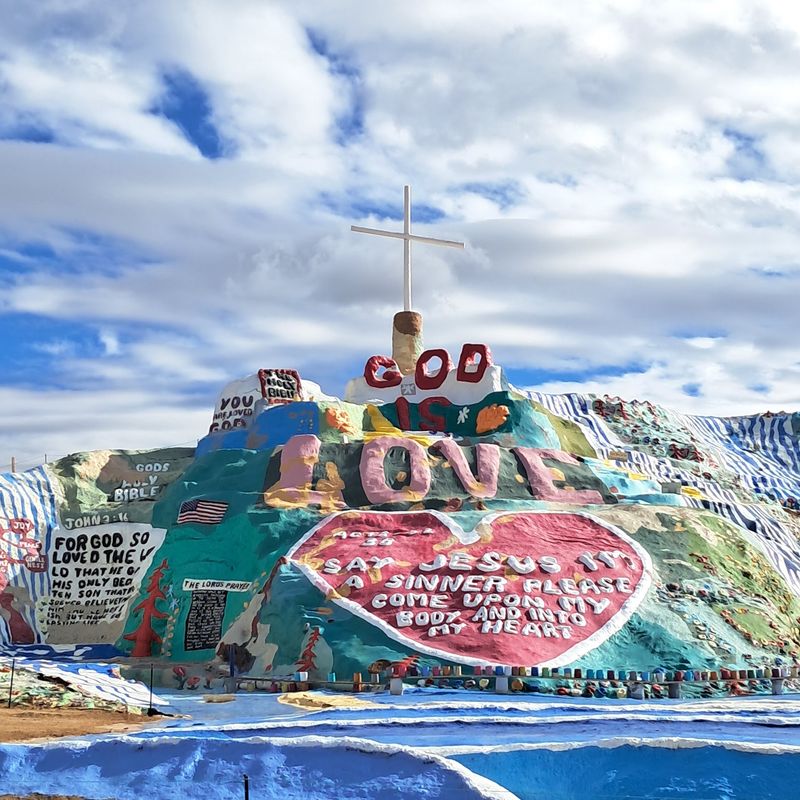
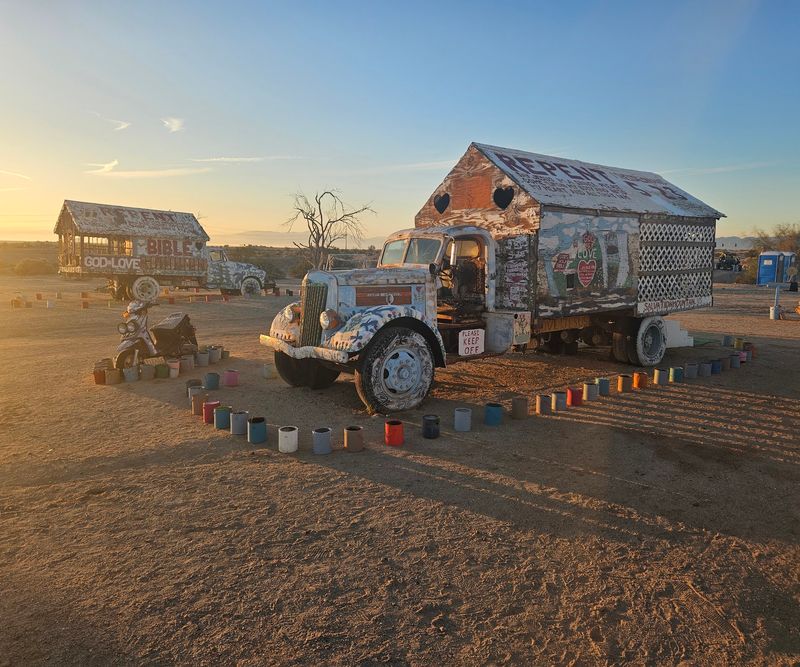
Bright pink, yellow, and sky blue paint rise straight out of the sand at the entrance road.
Salvation Mountain stands at Beal Road, Niland, CA 92257, right where visitors turn in toward the slabs.
Leonard Knight spent 28 years developing the site.
The current mountain was built largely from adobe clay and straw, while surrounding structures incorporated hay bales, tires, wood, and other salvaged materials beneath layers of donated paint.
The current landmark stands about three stories high and roughly 100 feet across, covered in painted religious messages and flowers.
Up close the surface feels chalky and slightly rough, and the layered paint has an almost frosted texture.
A marked path lets visitors walk up part of the mountain, and staying on that designated route protects the fragile adobe underneath.
The site sits out in full sun with essentially no shade, so a hat and water are practical rather than optional.
Volunteers help care for the landmark, and paint donations have long been part of keeping it standing.
An Entire Outdoor Art World Called East Jesus Grew Here
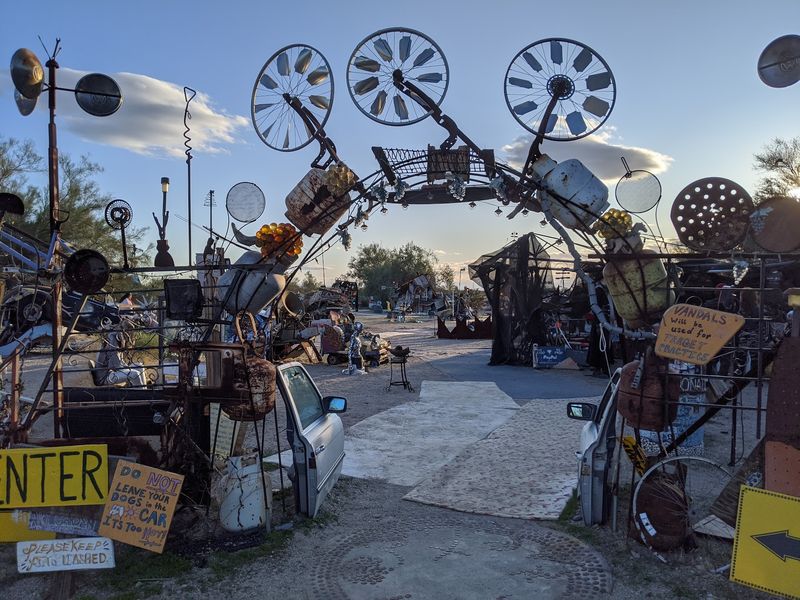
A trash-strewn patch of desert turned into one of the most photographed art sites in the region.
East Jesus began in 2007 when artist Charlie Russell started clearing and reshaping the area into an experimental installation.
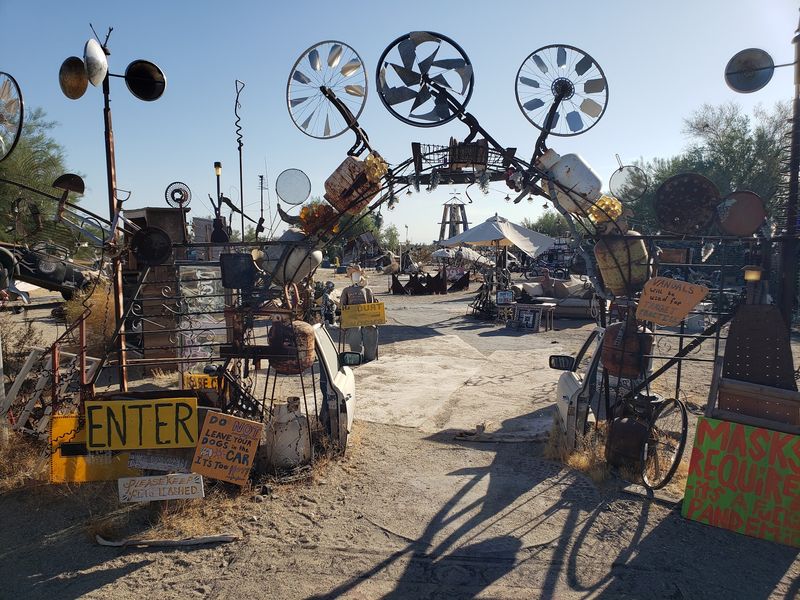
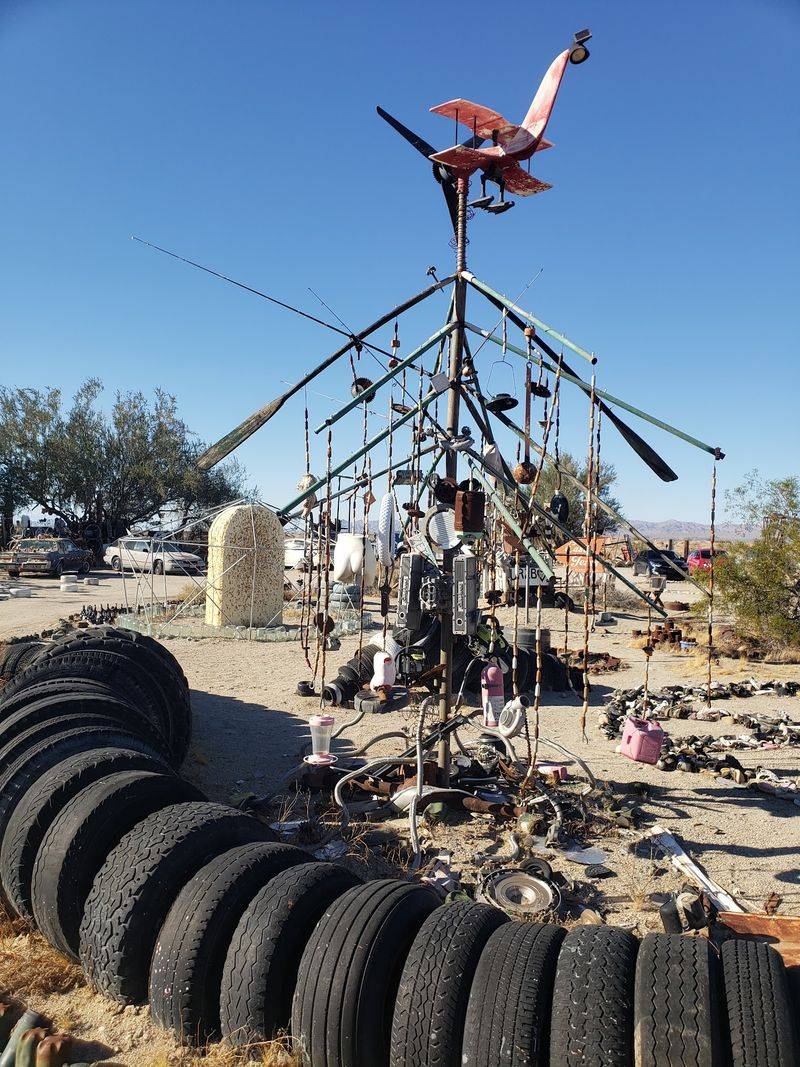
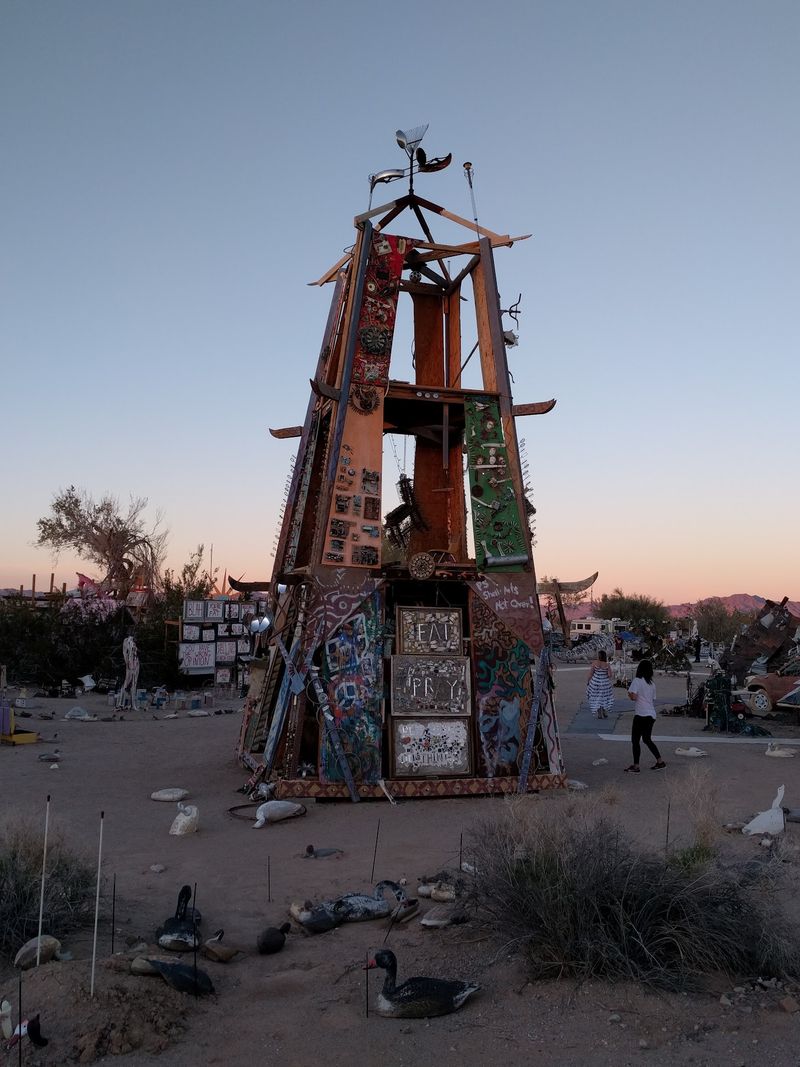
Sculptures here are built largely from discarded and repurposed materials, following a straightforward philosophy that waste can become something worth looking at.
Walls of stacked television sets, painted bottles, tires, and welded scrap fill the grounds. Pieces change over time as artists add, rebuild, or let the sun and wind do their work.
Walking the paths takes maybe thirty to sixty minutes, and the ground is sandy and uneven throughout.
Donations support the site, and there is generally someone around who can answer questions about what visitors are seeing.
Touching or climbing the artwork is discouraged, partly for safety and partly because much of it is genuinely fragile.
Sharp edges and rusted metal are common, so closed shoes are the sensible choice.
Anyone who enjoys folk art, assemblage, or the idea of building beauty from castoffs will likely find this the most memorable stop on the slabs.
Photography is popular, though asking first is always polite.
Its Population Changes Dramatically With The Seasons
Head count here swings more than in almost any other California community.
Year-round residents number somewhere between 150 and 350 people, and they stay through summers that push temperatures to punishing levels.
Winter brings a completely different scene, with thousands of snowbirds and campers rolling in. Estimates put the cool season population somewhere around 2,000 to 4,000.
The seasonal shift changes the whole feel of the place.
Winter months bring more activity, more vehicles, more music, and more informal gatherings, while summer leaves long stretches of quiet and empty ground. Planning around that rhythm makes a real difference for visitors.
Late fall through early spring offers manageable daytime temperatures and the fullest version of the community, though nights in the desert can turn surprisingly cold.
Summer visits carry genuine heat risk and very little in the way of services or shade.
Weekdays tend to feel calmer than weekends even during peak season.
Anyone hoping to see art sites and community spaces active rather than shuttered should aim for the winter window.
An Old Military Swimming Pool Became A Skatepark
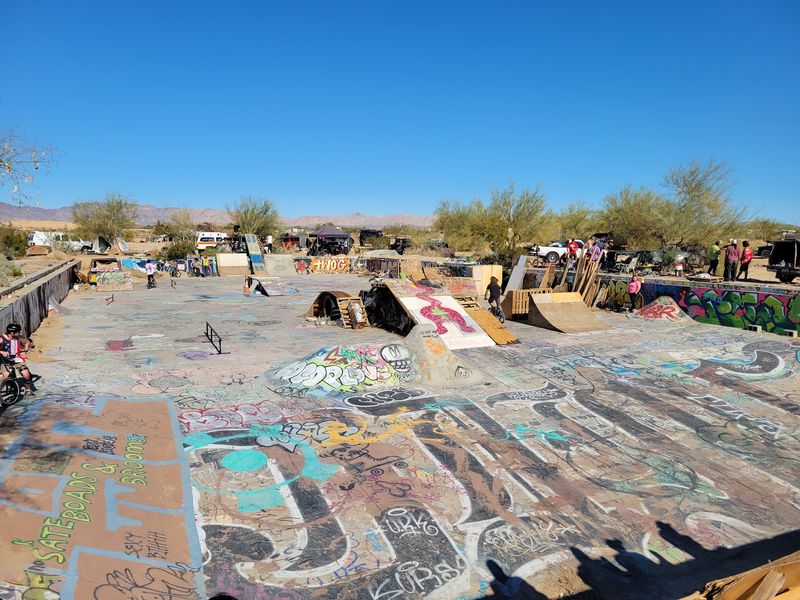
Few pieces of military leftovers get a second act quite this fun. Camp Dunlap included a swimming pool measuring 76 by 165 feet, built to cool off Marines training in brutal desert heat.
The water disappeared long ago, but the concrete shell stayed put.
Skaters eventually turned the remains into a skatepark, adding ramps and transitions inside the old basin.
Graffiti covers much of the surrounding concrete, layered and repainted over the years.
The result is part sports facility, part accidental monument to the base that used to be here.
Surfaces can be cracked, sandy, or littered with debris, so a quick inspection before dropping in is wise. Pads and a helmet make obvious sense in a spot this far from medical help.
Non-skaters often stop by simply to look, since the contrast between military engineering and street art is striking.
Heat radiating off bare concrete makes midday visits uncomfortable for much of the year. Early morning or the cooler winter months work far better for both skating and photos.
Bringing water is not negotiable out here.