Driving over Florida’s Tallest Bridge Hands You the Best View of Tampa Bay
I planned on a boring highway drive and got something closer to a small roller coaster with a water view. Somewhere in Florida, a stretch of interstate lifts you hundreds of feet above open bay, and for about four miles the road turns into the main attraction.
Blue water spreads out in every direction, sailboats look like scattered confetti, and the skyline sits far off in the haze. Pack a camera, pick a clear afternoon, and give yourself time to pull over.
A Four-Mile Crossing over Lower Tampa Bay
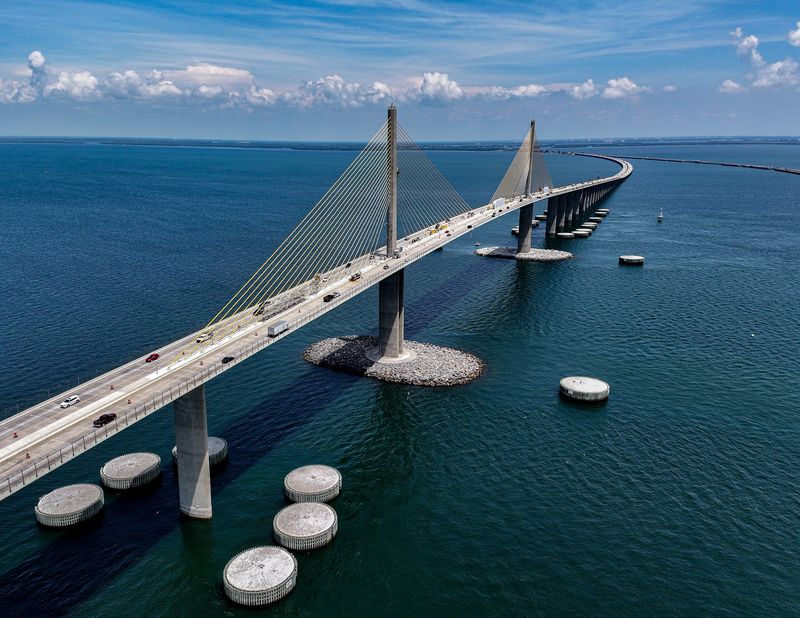
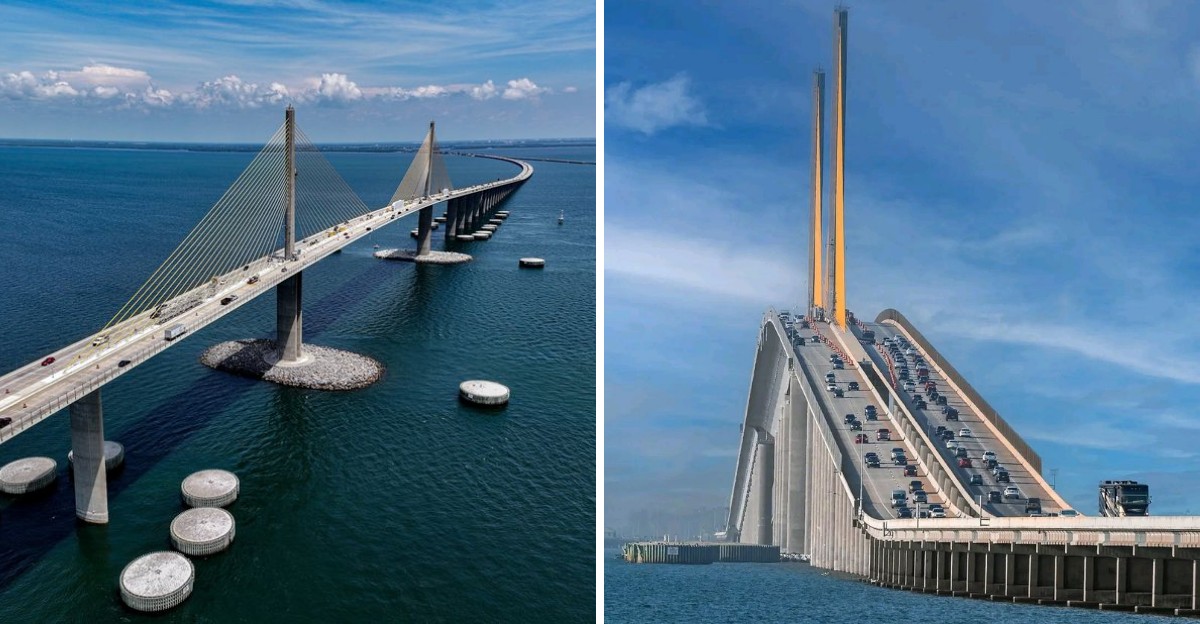
Interstate 275 leaves the mainland and suddenly there is nothing on either side but water. The Sunshine Skyway Bridge, officially the Bob Graham Sunshine Skyway Bridge, carries traffic more than four miles across Lower Tampa Bay, linking St. Petersburg in Pinellas County with Terra Ceia down in Manatee County.
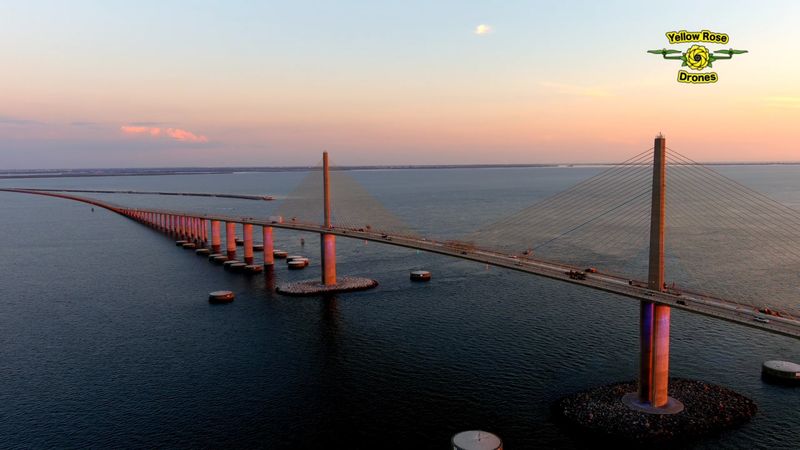
Its main span climbs to a peak height of 430 feet, which makes it the tallest bridge in Florida. Underneath, the roadway leaves 190 feet of vertical clearance so cargo ships and cruise vessels can slide through without slowing down.
The northern access point sits at 7508-7534 Sunshine Skyway Lane South in St. Petersburg, where the approach roads, parking areas, and fishing piers cluster together. From that side, the bridge looks like a pale ribbon disappearing into open bay.
Google lists it simply as a bridge, open 24 hours, every day of the week. That plain description undersells what happens when you actually crest the top and the horizon opens in all directions.
Give yourself a few extra minutes. Rushing across is possible, but it wastes the whole point of the drive.
Yellow Cables and a Record-Setting Design
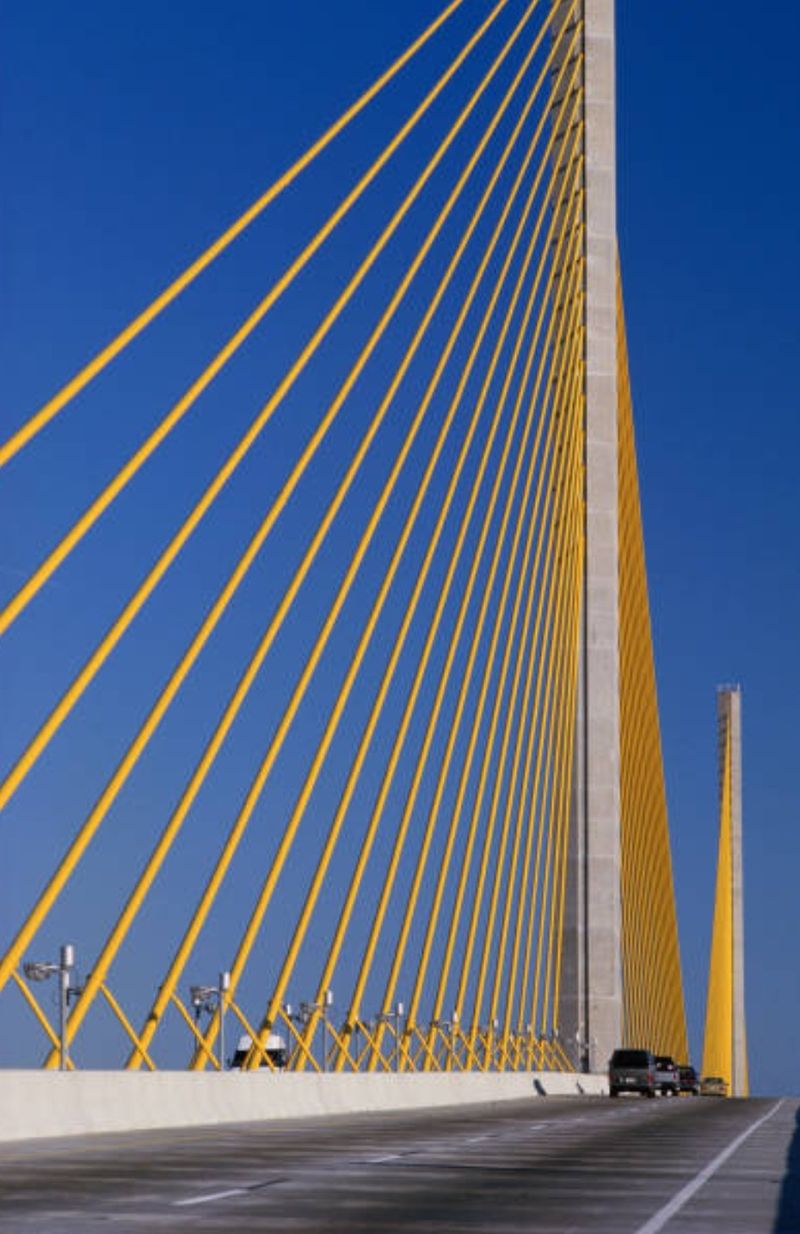
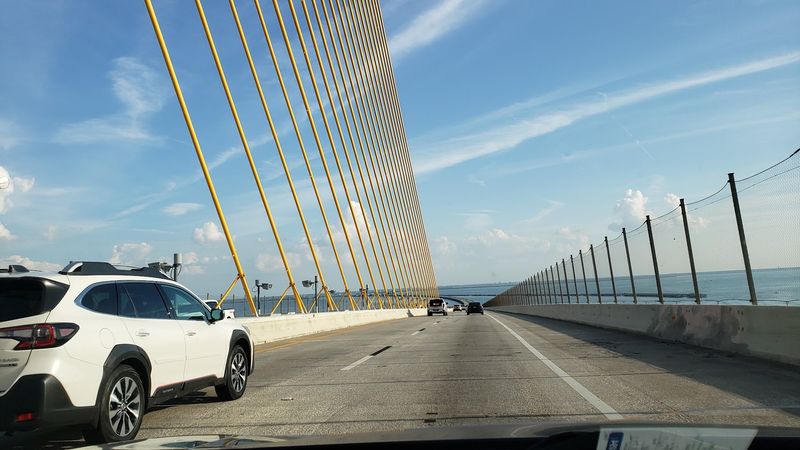
Those bright yellow cables are the first thing anyone notices from a distance. Fanning down from tall concrete pylons, they catch sunlight in a way that suits the Sunshine State nickname perfectly, and they turn an ordinary interstate span into something people photograph on purpose.
Engineers Eugene C. Figg, Jr., and Jean Muller designed the structure, and when it was finished it held the title of the world’s longest cable-stayed concrete bridge.
Concrete and steel do all the heavy lifting, but the cable-stayed layout is what gives the span its clean, uncluttered profile.
Because the cables run down the center of the roadway rather than along both edges, sightlines stay open. Nothing blocks the water view as you climb, which is exactly why the drive feels so unusual compared to older truss bridges elsewhere in the state.
Counting the beams as they flick past is a habit plenty of Florida drivers pick up as children and never quite drop.
Architecture comes up constantly in conversations about this crossing, and one look at the golden cables shimmering above the deck explains why.
The Story behind the Span
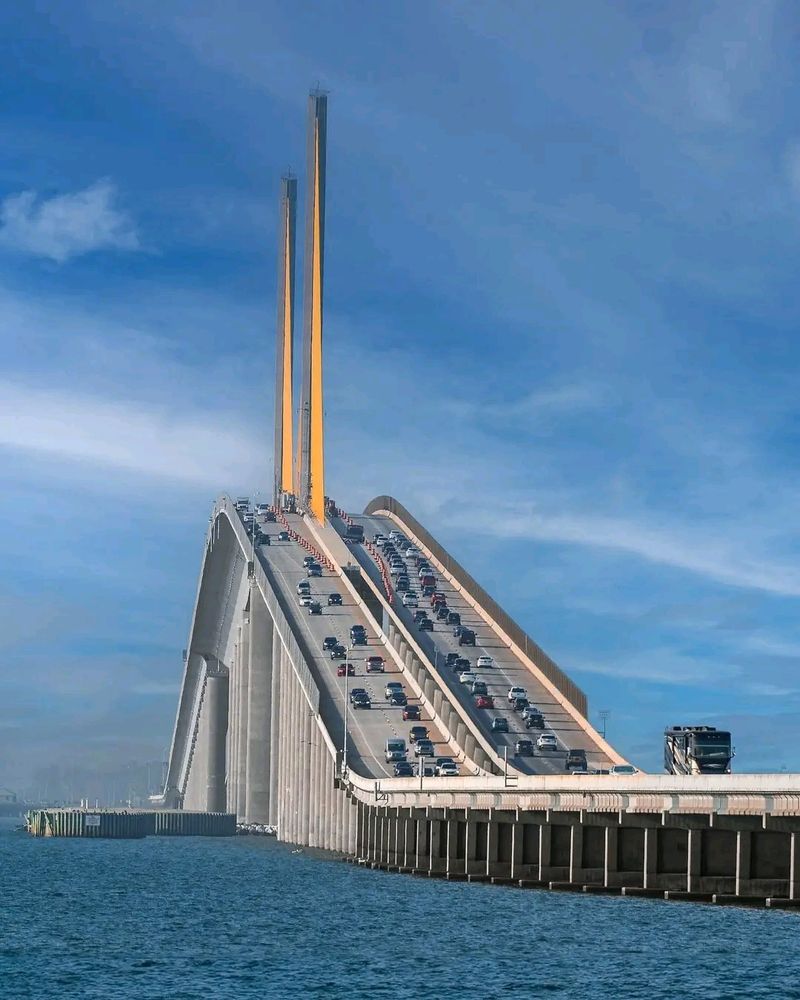
Before the current bridge existed, an older crossing carried traffic over the same water. It was partially lost in a 1980 accident, and the replacement that opened in 1987 was built with substantially stronger protective measures around its supports.
Those safeguards are part of why the modern structure looks the way it does. Massive concrete bumpers ring the main piers, guarding the span from anything drifting off course in the shipping channel below.
Remnants of the original bridge did not go to waste. The approaches were converted into two long fishing piers, one at each end, which is why drivers spot what appear to be roads running out into open bay and then simply stopping.
The bridge carries the name of Bob Graham, a former Florida governor and senator, though almost everyone just calls it the Skyway.
Knowing the backstory changes the drive a little. What reads as pure engineering showmanship from the highway is also a rebuilt link that reconnected two counties and became one of the most recognizable landmarks anywhere along the Gulf Coast.
What You See from the Top
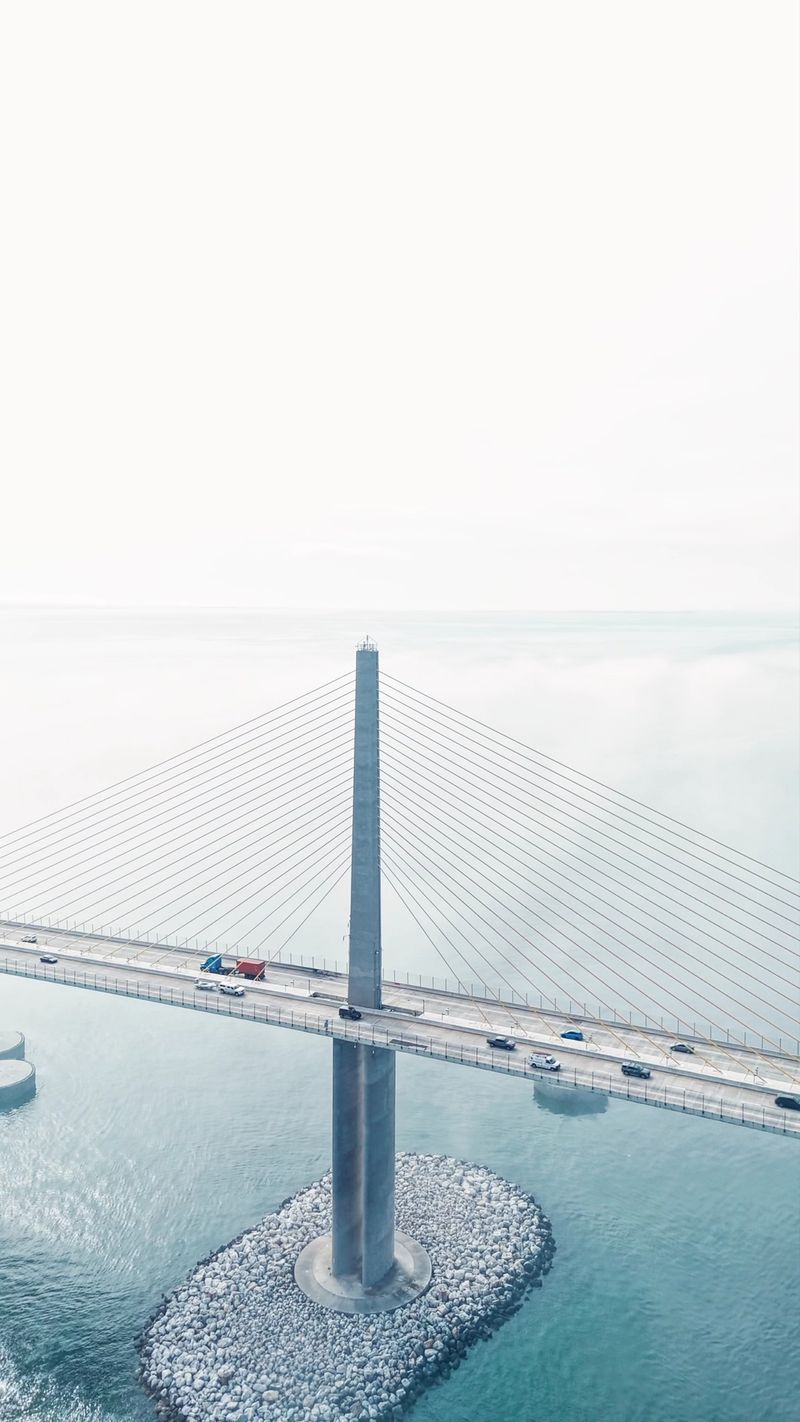
Reaching the summit feels a bit like leveling off in a small plane. The road tilts up on a long, steady grade, and then the whole bay unrolls at once, water stretching to the horizon on both sides of the windshield.
Color is the surprise. Shallow flats glow pale turquoise, deeper channels turn a heavy navy, and the shifting patchwork between them keeps changing as clouds move overhead.
Downtown St. Petersburg sits visible in the distance to the north, with downtown Tampa even farther beyond it, a faint cluster of towers on a clear day. Sailboats, shrimp boats, freighters, and small fishing skiffs scatter across the water underneath.
Dolphins turn up regularly in the channel below, and pelicans coast alongside the guardrails at eye level.
Passengers get the better deal here. Drivers should keep their attention on the road, since traffic moves quickly and the climb takes concentration, but anyone in the other seats can stare straight down at boats that look like toys.
It is the kind of view that makes a routine commute feel briefly ridiculous in the best possible way.
Fishing Piers at Both Ends
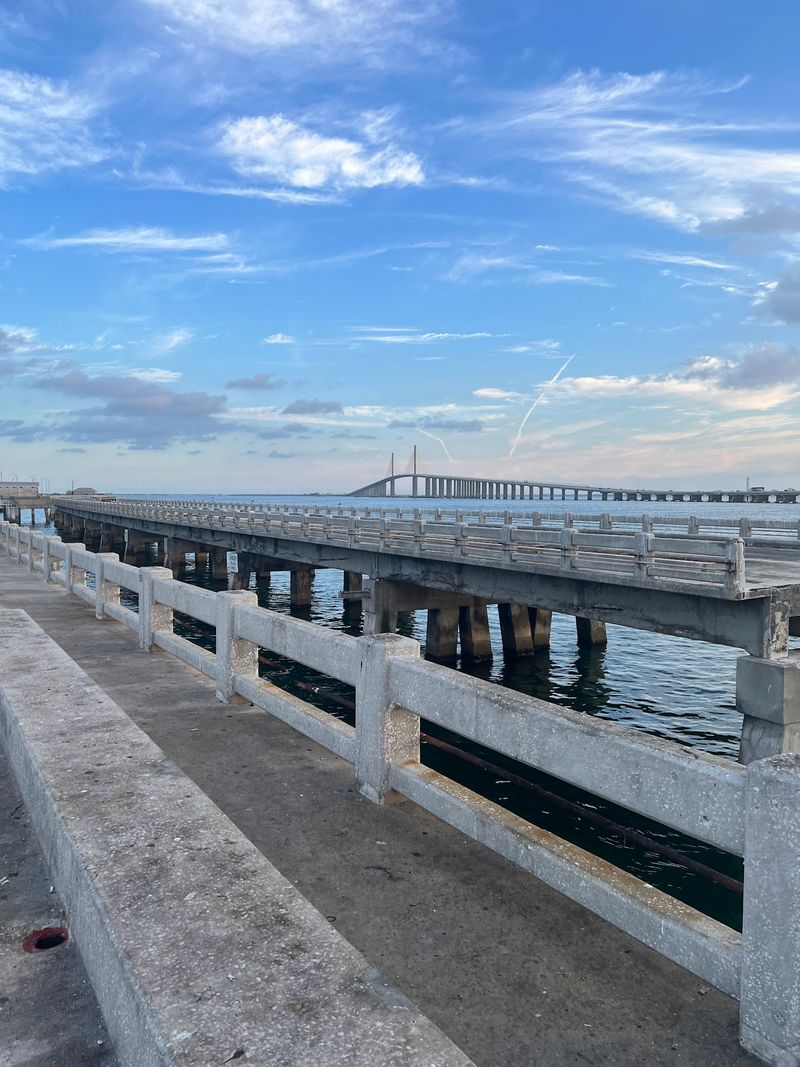
Fishing dominates the conversation around this bridge more than any other activity, with hundreds of mentions attached to the place. The two piers built from the old bridge approaches let anglers drive right out over the bay and park beside their chosen spot.
Spanish mackerel come off these rails regularly, and the flavor of one iced down and cooked within a day of being caught is closer to yellowtail than anything from a supermarket case. Catch-and-release days are common too, especially when the bite is fast and the cooler is already full.
Both piers charge to enter, and the gate staff tend to set a relaxed, friendly tone from the moment you roll up.
Holiday weekends fill the rails quickly. Memorial Day and similar stretches pack the piers, though parking generally remains available for people who came only to look at the water and the towering span overhead.
Bring shade, bring water, and bring a friend. Time on the pier passes strangely fast, and the bridge looming above makes even a slow afternoon of casting feel like an event.
Florida’s Nighttime Light Show above the Water
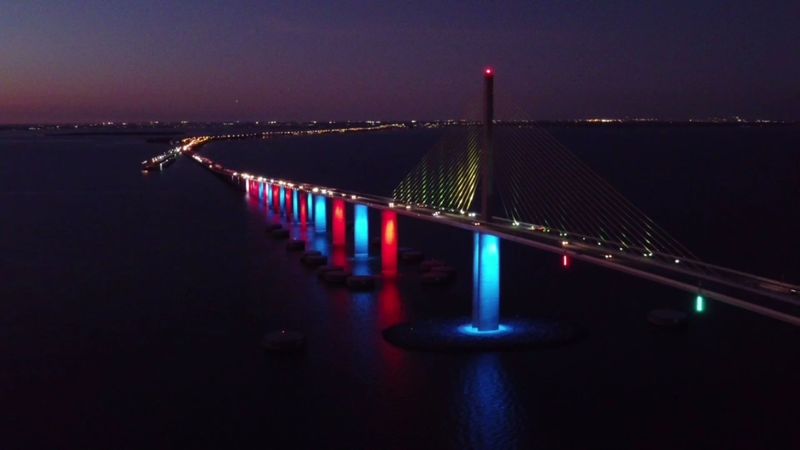
After dark the bridge becomes something else entirely. The cables and pylons light up in shifting color patterns that ripple across the span, visible from miles away along both shorelines.
Reflections stretch out across the black water underneath, doubling the effect. Boats passing beneath get the best angle of all, looking straight up through a canopy of illuminated cables.
Evening drives across take on a completely different mood than daytime crossings. The bay disappears into darkness, the roadway glows, and the climb feels even more dramatic without a horizon line to orient you.
Plenty of people who cross during the day make a point of coming back specifically to see it lit. It ranks high on the list of things that make the Gulf Coast stretch of Florida memorable after sunset.
Lights and sunset views both come up frequently among the topics attached to this landmark, and the two often overlap on the same trip. Time your arrival for golden hour, watch the colors fade over the water, then wait twenty minutes for the second show to start.
Beaches, Breezes, and Kite Surfers
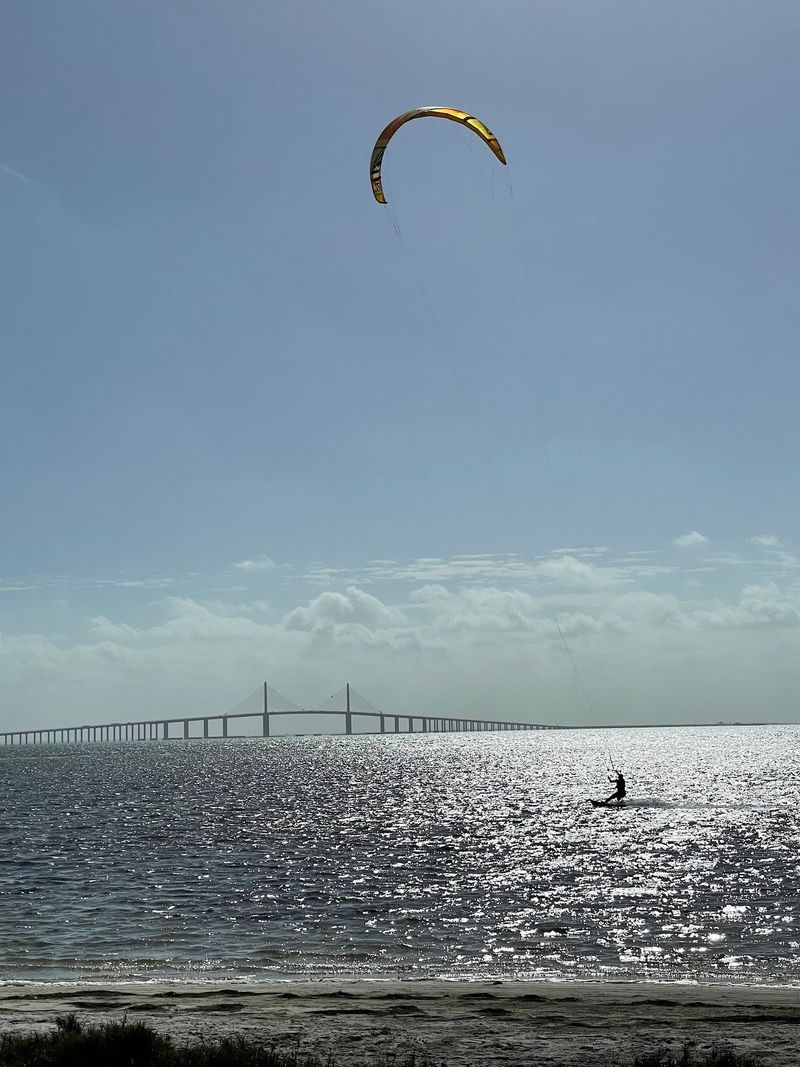
Down at water level, a quiet beach runs along the base of the northern approach. Sand, shallow water, and a steady breeze off the bay make it a favorite launch area for kite surfers and e-foilers who need consistent wind more than big waves.
The setting is calmer than most Pinellas County shorelines. There is no boardwalk, no rows of umbrellas, just open sand with a colossal bridge arcing overhead.
Two pull-out areas along the causeway include restrooms plus wading and fishing beaches, which makes the crossing far more practical for families than a typical stretch of interstate. Swimming, grilling, and casting a line all happen in the same afternoon here.
Kids run in the shallows while parents watch container ships slide through the channel beyond the sandbar.
Wind is the constant. That reliable breeze keeps the heat manageable during Florida summers and keeps the kites in the air, so the beach rarely feels empty even on ordinary weekdays.
Pack a cooler, a towel, and something to shade yourself with, because natural cover is in short supply.
The Climb That Tests Nervous Drivers
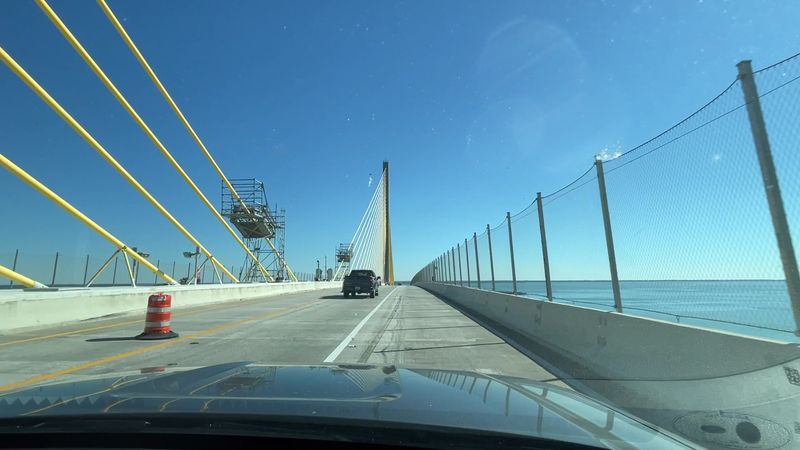
Not everyone loves the ascent. The grade is long and steep enough that the first climb feels like the lift hill on a roller coaster, and the open water on both sides removes every familiar visual reference.
People with a fear of heights or bridges often find this one demanding. Traffic moves at highway speed, the shoulders feel narrow at altitude, and there is no gradual easing into it.
The good news is that most drivers adjust quickly. Living around Tampa Bay means crossing water constantly, and the Skyway tends to lose its intimidation factor after a handful of trips.
Practical advice helps: stay in the right lane, keep your eyes on the vehicle ahead rather than the drop, and let a passenger handle photographs. Crossing during daylight in calm weather makes a first attempt considerably easier.
Compared with the inland alternative, this route is simpler in one specific way. There are no rapid-fire interchanges or multi-lane merges to navigate, just one straight shot across the bay with a single pay-in-person toll booth.
Anxious drivers who push through usually end up describing the crossing as a thrill rather than an ordeal.
Planning the Drive: Tolls, Timing, and Parking
Access runs around the clock. The bridge and its approaches stay open 24 hours a day, seven days a week, so sunrise photographers and late-night drivers are equally welcome.
A toll applies to the crossing, collected at a single in-person booth rather than through a maze of electronic gantries. Pier entry carries its own separate charge, paid at the gate before you drive out over the water.
Rest stops sit at both pull-outs along the route, complete with restrooms, parking, and direct beach access. Parking is generally plentiful for people who came for the scenery, even when the fishing rails are shoulder to shoulder on a holiday weekend.
Coming from the north, follow Interstate 275 south out of St. Petersburg toward the address on Sunshine Skyway Lane South. From Manatee County, head north on the same highway and the pylons appear long before the on-ramp does.
Sunrise and sunset deliver the strongest color, and clear days give you the deepest water tones.
The route also works as a scenic alternative between Manatee County and Tampa International Airport, often faster than the inland option.
Why the Skyway Earns Its Reputation
Four miles of pavement should not be this memorable. Yet the combination of height, color, and open water turns an ordinary interstate segment into one of the most striking drives on the Gulf Coast.
It holds a 4.8-star rating across roughly 2,400 reviews, which is unusual territory for a piece of highway infrastructure. Scenic drives, architecture, water views, and sunsets all cluster in the topics attached to it.
Cross-country road trippers rank it among the best sights of an entire journey. Commuters between Bradenton and St. Pete built their daily routine around it and still pulled off at the rest stops just to watch the light change.
What makes it stick is that the payoff arrives whether you planned for it or not. Nobody has to buy a ticket or book ahead; you drive, you climb, and Tampa Bay does the rest.
Go once during the day for the water colors, then come back after dark for the illuminated cables. Two crossings, two completely different experiences, and one bridge that keeps surprising Florida drivers who thought they already knew it.