This New Mexico Festival Turns Sunrise Into A Sky Full Of Color Every October
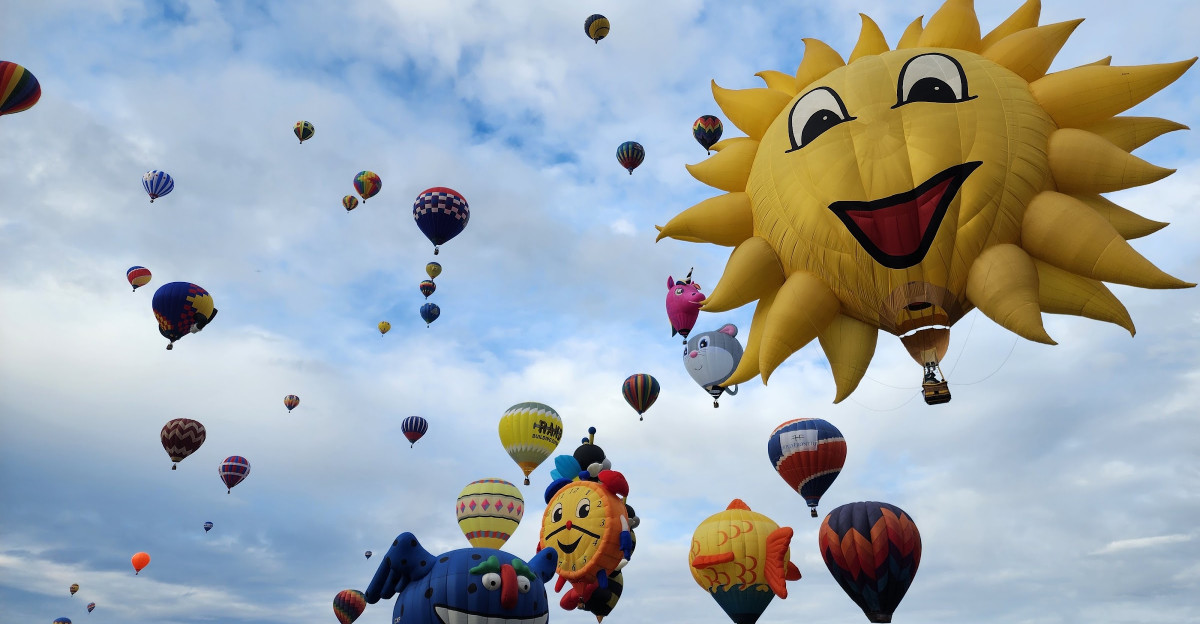
5:00 a.m. feels unreasonable until the burners ignite. Then New Mexico turns the darkness into something electric.
Giant balloons begin taking shape across the field, glowing from within before sunrise reaches the horizon.
The transformation happens slowly, then all at once. Crews move. Crowds gather. Color starts lifting into the sky.
What makes the morning unforgettable is how close visitors can get to the action.
You are not watching from far away. You are standing inside the spectacle as it wakes up.
Dress warmly, arrive early, and accept the lost sleep. By breakfast, the sky has already delivered the best part of the day.
Born From A Radio Birthday
Back in 1972, a radio station in Albuquerque wanted a splashy way to mark its 50th birthday.
Someone suggested hot air balloons, and thirteen of them lifted off from a shopping mall parking lot.
That small stunt caught fire, though not literally. Within a single year, the city hosted the first World Hot-Air Balloon Championships, and the event went international almost overnight.
Organizers moved the event from February to October in 1975 as the Fiesta shifted to a new launch site. That decision shaped everything that followed, including the crisp autumn mornings visitors love today.
The gathering eventually settled at Balloon Fiesta Park, a more than 360-acre site on the city’s north side.
Today the Albuquerque International Balloon Fiesta welcomes hundreds of thousands of guests across nine days each fall. It holds the title of the largest balloon event anywhere in the world, and New Mexico wears that crown proudly.
History here is not locked behind glass. Many traditions introduced over the Fiesta’s five-decade history remain part of the modern event. You will find it all at 4401 Alameda Blvd NE in Albuquerque.
The Famous Albuquerque Box
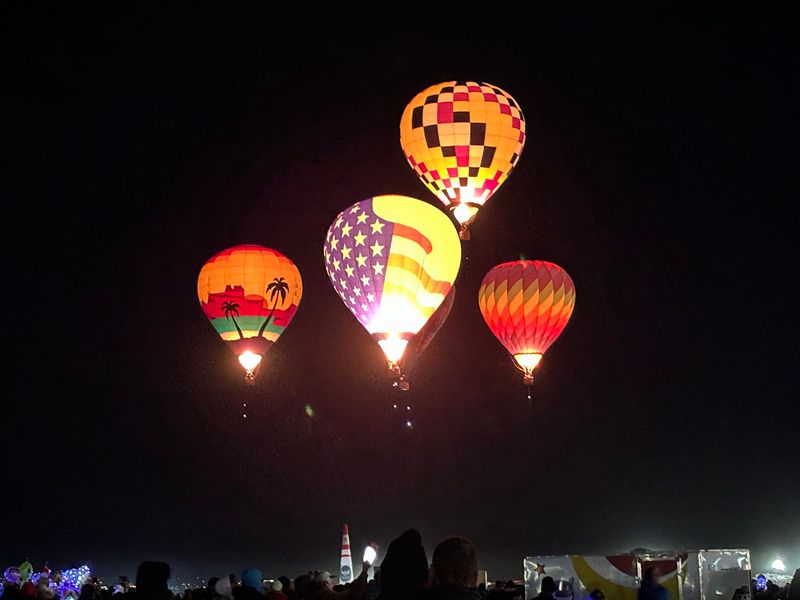
Pilots talk about the wind here with real affection. There is a local weather pattern nicknamed the Albuquerque box, and it borders on magical.
Near the ground, breezes tend to push south along the river valley. Higher up, the flow reverses and carries balloons back north.
Skilled pilots use those two layers like an elevator. They climb, drift one way, descend, and return close to where they started.
When the box develops, the changing wind directions can keep balloons unusually close to the launch area. The pattern can allow balloons to retrace part of their route, although it does not develop every morning.
Under an especially well-defined box pattern, a skilled pilot may return surprisingly close to the original launch area. That outcome depends on the wind layers available during that particular flight.
Cool October air, low humidity, and clear desert skies add to the recipe. Those stable conditions help the shallow early-morning wind pattern develop.
This natural advantage is a big reason pilots travel from across the globe to fly in New Mexico. Few places on Earth offer such reliable, repeatable flying weather.
Dawn Patrol Lights The Dark
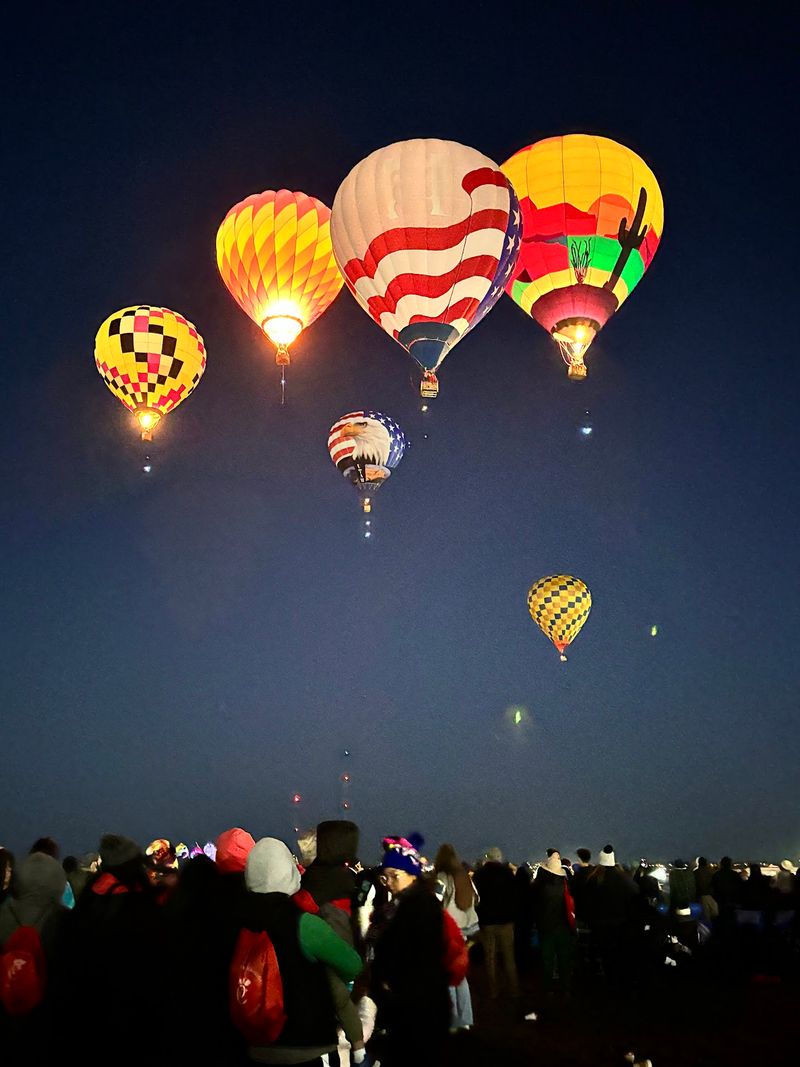
Morning sessions begin long before sunrise, with visitors arriving while the launch field is still dark.
The first balloon activity gradually brings light and movement to the field.
Dawn Patrol inflation begins around 5:45 a.m., with launch scheduled for about 6 a.m., weather permitting. About a dozen Dawn Patrol balloons participate in the coordinated show on Mass Ascension mornings.
Their envelopes light up from the inside, floating like enormous paper lanterns. The crowd goes quiet, which almost never happens at a festival this size.
Beauty is only half the point. These early flyers act as scouts, testing wind speed and direction at different heights.
Pilots on the field watch Dawn Patrol to get an early sense of wind speed and direction at different altitudes.
Bring gloves and a warm hat. Fiesta guidance says early-morning temperatures can range from roughly 20 to 40 degrees Fahrenheit.
The pre-dawn inflation gives visitors time to watch the illuminated envelopes before the main morning launch. It is the calmest twenty minutes of the entire day.
Mass Ascension Fills The Sky
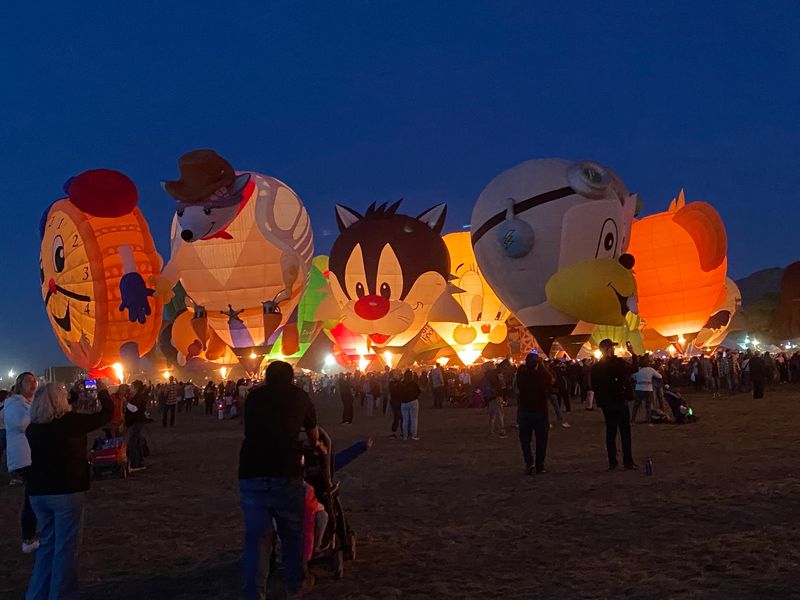
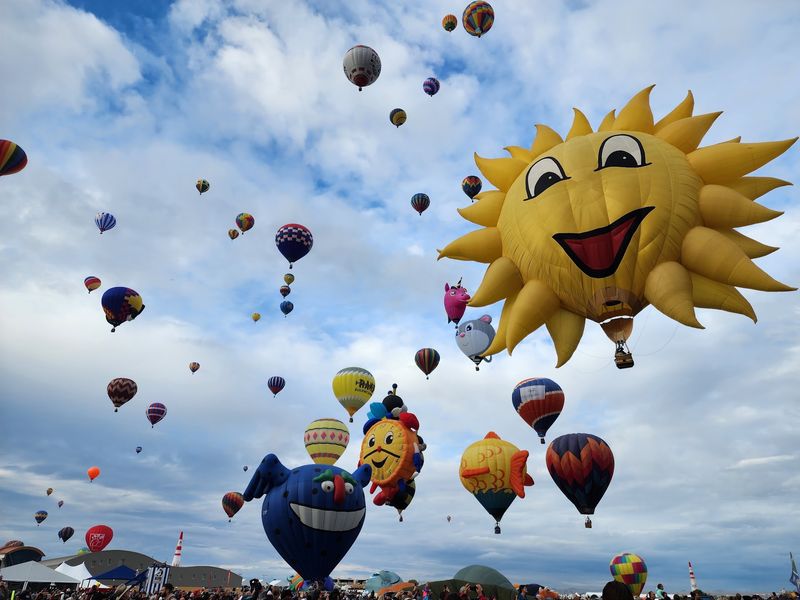
Around 7 a.m., the field turns into controlled chaos in the best way. Hundreds of balloons inflate in waves, and the sky fills faster than your eyes can track.
Mass Ascension is the image most people picture when they hear about this festival. Seeing it live is a different experience entirely.
The launch area covers more than 78 acres, and visitors can walk right through it. You pass crews unrolling fabric, fans blasting air, and burners roaring overhead.
Launch directors wear black-and-white striped shirts, so everyone calls them zebras. They wave balloons up one group at a time, like traffic officers of the sky.
Flags tell the story before anything moves. Red means no flying, yellow means wait, and green means go.
Guests are allowed remarkably close to inflation activity as long as they stay clear of balloon fabric and crew equipment. Once cleared by the launch directors, balloons rise directly from the same field where spectators are standing.
Mass ascensions run on weekend mornings plus a midweek day, giving you several chances. The sun rising over the Sandias behind hundreds of balloons is pure New Mexico.
Special Shapes Steal Attention
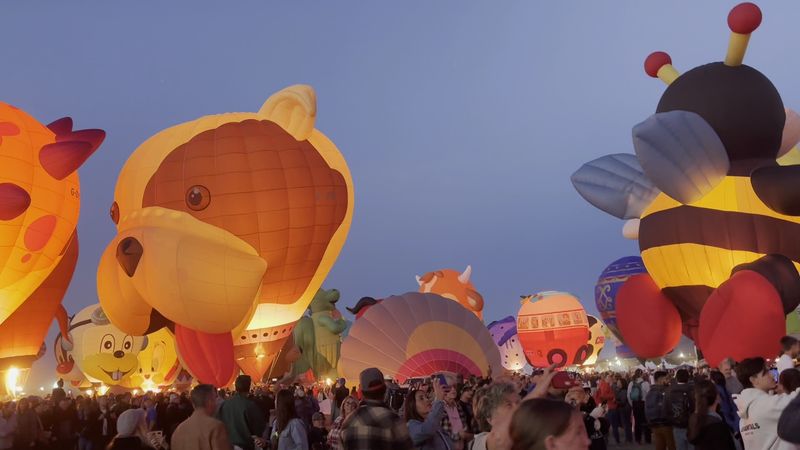
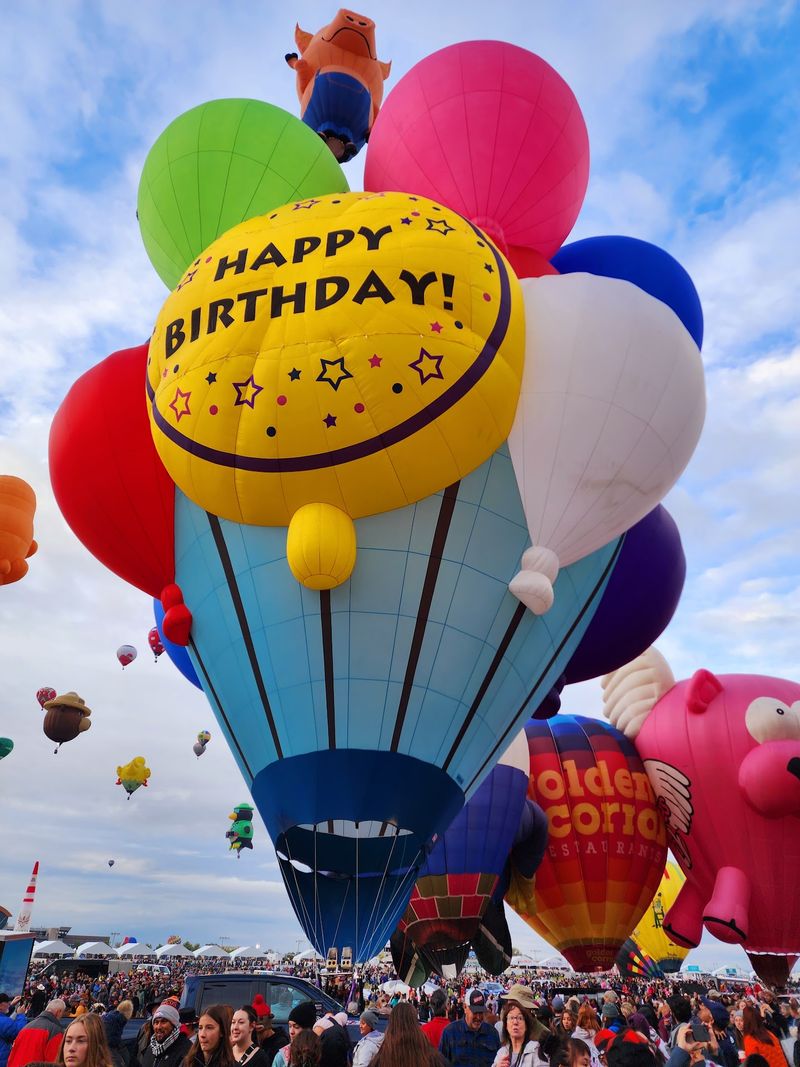
Picture a giant bumblebee rising next to a soda can and a smiling bear. Nobody keeps a straight face during the Special Shape Rodeo.
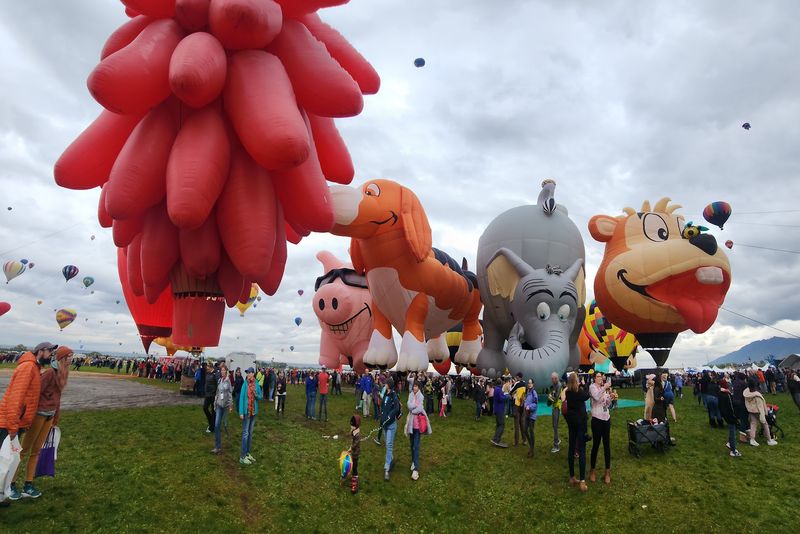
These custom balloons ditch the classic teardrop form completely. Animals, cartoon figures, vehicles, and oddball objects all take to the air together.
The Special Shape Rodeo fills Thursday and Friday mornings with an unusually large collection of shaped balloons, weather permitting.
Building one of these takes serious engineering. Odd shapes handle heat and wind differently, so pilots need extra skill to fly them well.
Evenings bring the Special Shape Glowdeo, when the same balloons stay tethered and light up after dark. Music plays, and the field becomes a glowing cartoon parade.
Smokey Bear has been among the recurring special-shape favorites in recent Fiesta lineups. The exact group of shapes changes from one year to the next.
Balloon trading cards are an established part of Fiesta culture. Availability varies among pilots and balloon teams.
Kids trade them like baseball cards, and honestly, so do plenty of grown-ups. Silliness at this scale turns out to be surprisingly moving.
Evening Glows And Fireworks
Sunset flips the whole mood. Balloons stay anchored to the ground, but they come alive with light.
During a Balloon Glow, pilots fire their burners on cue. Envelopes pulse from within, turning the field into rows of huge glowing lamps.
The synchronized roar is loud, warm, and weirdly comforting. You feel the heat on your cheeks from several feet away.
Guests can walk the launch field during the glow and see the illuminated balloons at close range.
Photographers adore these sessions. Slow shutter speeds capture the flare of burners and the soft halo around each balloon.
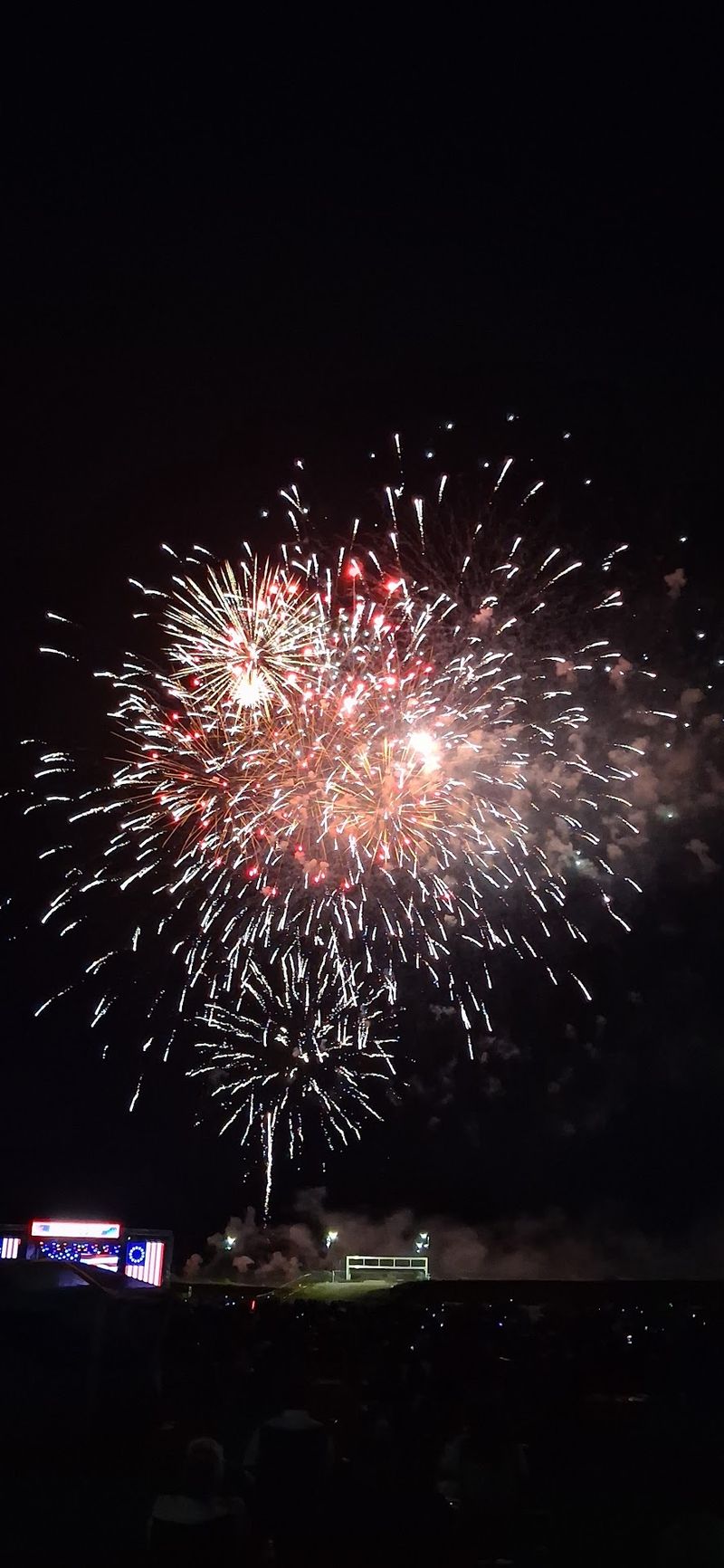
Many evenings finish with fireworks, and recent years have added drone light shows. Drone light shows are scheduled alongside several morning and evening sessions in the 2026 program.
Evening sessions typically run into the night, so pack a jacket and a small blanket. Temperatures drop quickly once the sun disappears.
Remember that glows depend on wind, just like morning flights. Calm air means inflation, gusty air means a delay.
When conditions cooperate, the night here glows brighter than anything else in the state.
Races, Targets And Flags
Competition hides inside all this beauty, and it is seriously impressive. Pilots here are not just floating around for fun.
Current competitive tasks include Fly-In, Judge Declared Goal, Multiple Judge Declared Goal, and other marker-drop challenges built around designated targets.
In Fly-In competition, pilots choose a launch location away from the field and navigate toward a designated target. Scoring is based on how closely their marker lands to the goal rather than how quickly they arrive.
The America’s Challenge Gas Balloon Race is not part of the 2026 program. Organizers canceled it this year because hydrogen availability is limited and costs have risen.
When the race is held, teams compete to travel the greatest great-circle distance from Balloon Fiesta Park. Past flights have lasted more than two days and reached Canada.
Flight of the Nations adds ceremony to the morning. International pilots launch together during the Flight of the Nations Mass Ascension while displaying their countries’ flags.
The Flight of the Nations highlights the international reach of the Fiesta. Recent editions have drawn pilots from roughly a dozen to sixteen countries.
Smart Planning Beats Long Lines
Here is the honest truth: preparation decides whether you love this trip or grumble through it. The crowds are enormous, and the logistics reward planning.
Booking lodging well ahead of the October event gives visitors the widest choice of locations and accommodations.
Park and Ride provides scheduled bus service from remote lots directly to Balloon Fiesta Park. Traffic near the park slows to a crawl in the final hour before launch.
For busy weekend mornings, Fiesta guidance recommends reaching the park around 4:00 to 4:30 a.m. Mass Ascension is scheduled to begin at 7 a.m., so that early arrival leaves time for entry and pre-launch events.
Dress in layers you can peel off. Typical Fiesta guidance puts early-morning temperatures around 20 to 40 degrees Fahrenheit, warming to roughly 50 to 70 by noon.
Wear waterproof shoes, since dew soaks the grass field overnight. Bring sunscreen and water too, because the city sits above 5,000 feet.
You can carry in your own snacks, which helps a lot. Vendors are plentiful, but lines get long.