This Free Missouri Shrine Is Filled With Remarkable Stone Grottos Built By One Monk
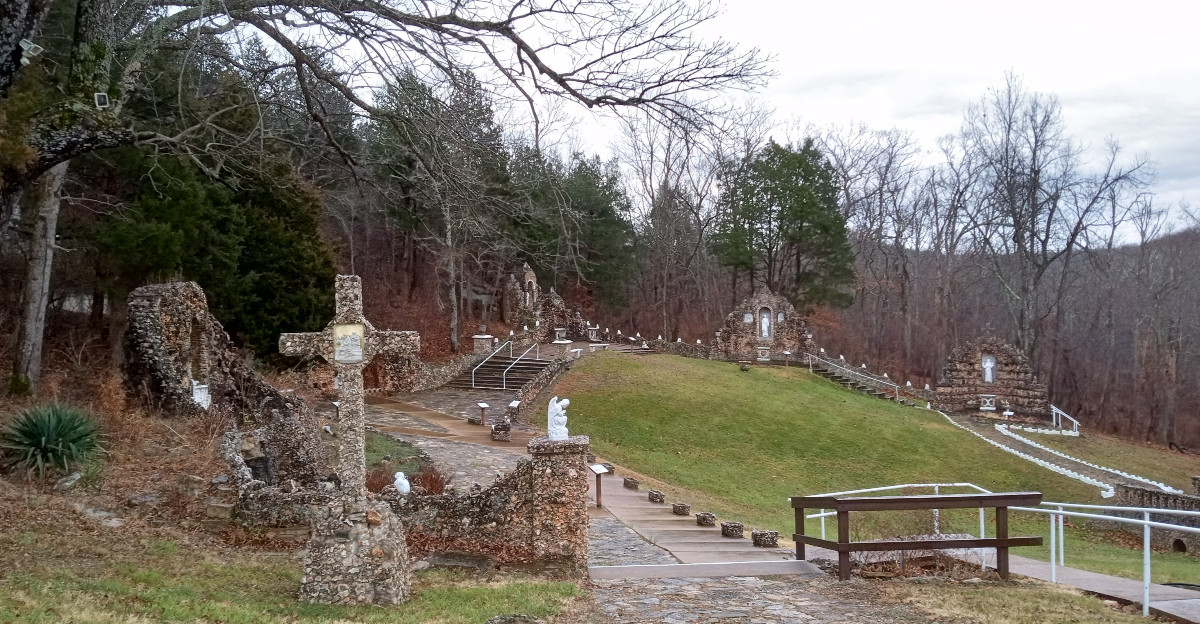
How does one person look at a rocky hillside and imagine all of this?
In Missouri, a monk spent years turning stone, shells, glass, and other materials into elaborate grottos shaped by faith and patience.
The result feels deeply personal because nothing looks rushed or mass-produced.
Every path seems to reveal another detail, and the longer you look, the more work becomes visible. That is where the wow factor comes from.
It is not about size alone. It is knowing one person kept building, piece by piece, until an ordinary hillside became something extraordinary.
And yes, you can explore the grounds for free!
A Hillside Worth Finding
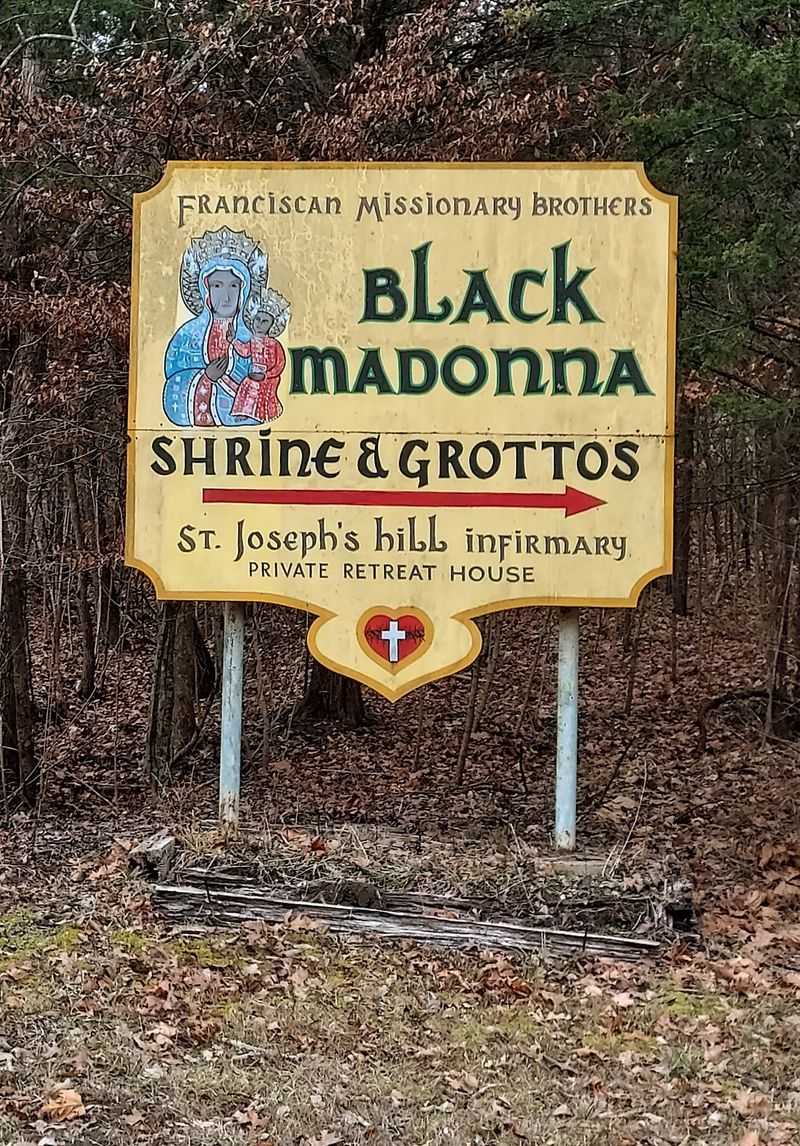
Black Madonna Shrine and Grottos sits in the countryside near Pacific among the wooded foothills of the Ozarks.
Outdoor paths connect the chapel, handmade grottos, memorial areas, and other religious features open to visitors.
The public portion is part of a much larger Franciscan property. The wider mission covers about 300 acres, although the monastery, former nursing home, and several other structures are not open to visitors.
The setting gives the stonework room to breathe. Trees and open spaces separate the larger displays, while the walking route moves between both natural and constructed features.
This is still a working religious site rather than simply an outdoor art attraction. Quiet reflection fits naturally near the chapel and prayer areas.
Missouri tourism lists the attraction as partially wheelchair accessible, so visitors with mobility concerns should expect that not every outdoor section will offer the same access.
Free admission makes it easy to take the grounds at a comfortable pace without turning the visit into a race through the grottos.
The physical address for GPS is 100 St. Joseph Hill Rd, Pacific.
One Monk’s Patient Work
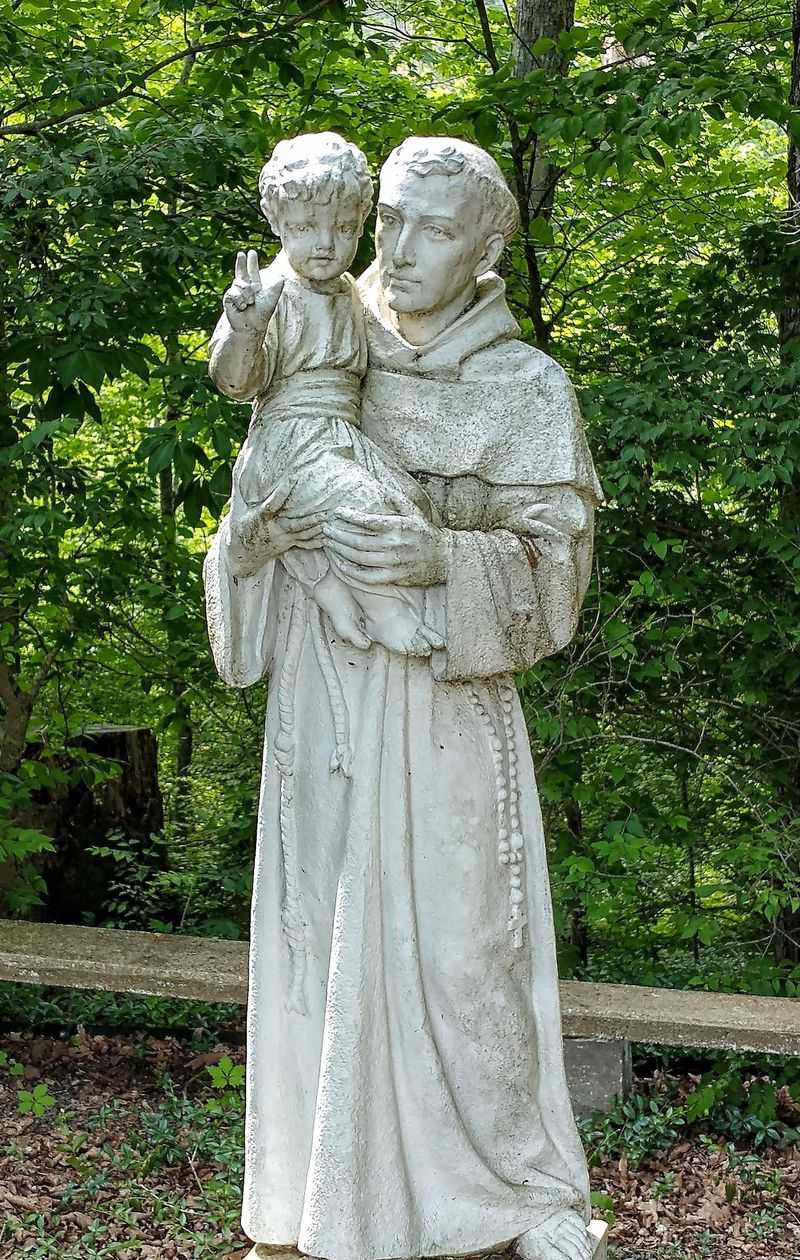
The story begins in 1937, when Franciscan Missionary Brother Bronislaus Luszcz began clearing the heavily wooded property and built a cedar chapel dedicated to Our Lady of Czestochowa.
After completing the chapel, he turned his attention to the hillside.
Over roughly 23 years, he created the grottos by hand without power tools, continuing the project until his death in 1960.
The structures use native Missouri tiff rock brought from Old Mines, a mining community about 30 miles southwest of the shrine. Concrete helped shape artificial cave-like forms around the stone.
No two stops look exactly alike. The changing shapes, textures, religious figures, and embedded ornaments give each grotto its own character.
The labor becomes easier to understand when the construction method is considered. Clearing wooded ground, moving rock, shaping walls, and decorating the surfaces all required sustained manual work.
His project was rooted in Catholic devotion, particularly his attachment to the Black Madonna of Czestochowa from his native Poland. Even visitors approaching the grounds primarily as folk art can see how that devotion shaped the overall plan.
Little Treasures In Stone
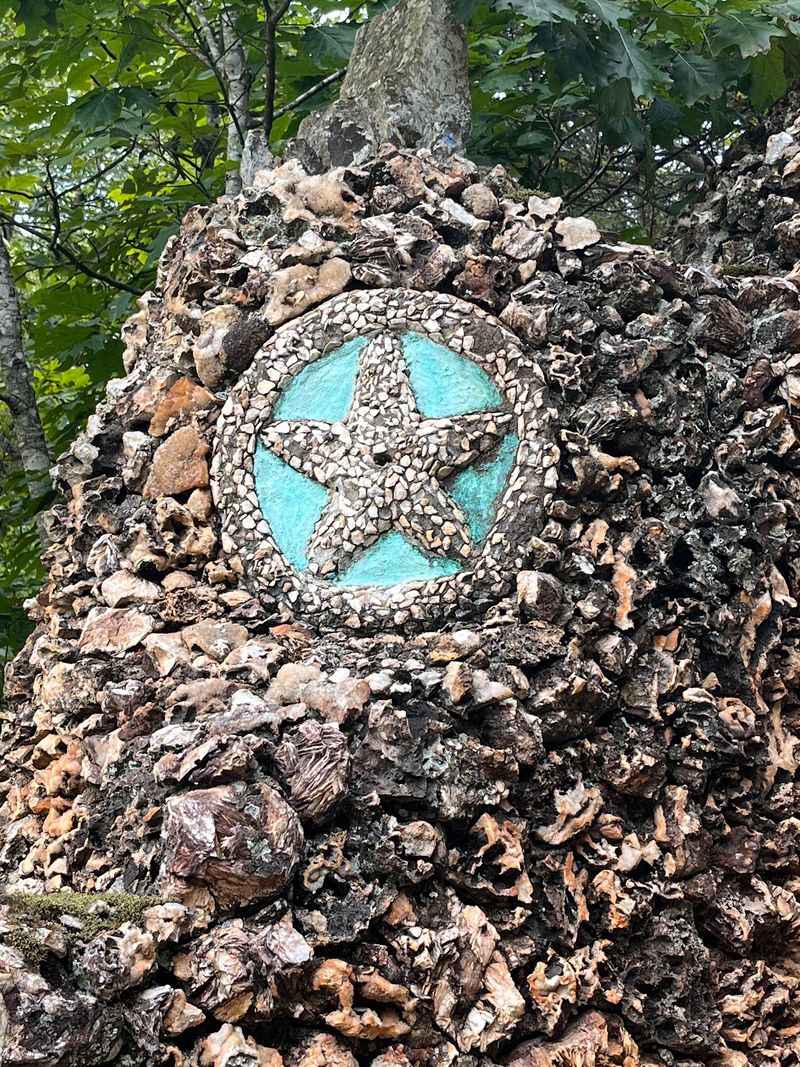
The grottos reward close attention because the stone is only part of the material story.
Shells, costume jewelry, ceramic figures, colored glass, and other decorative pieces appear throughout the structures.
Many of those materials were contributed by visitors or sent from foreign missions.
Ordinary household forms were reused in inventive ways. At the St. Francis Grotto, rabbits and lambs were made by pouring concrete into cupcake molds.
The St. Joseph Grotto adds a different mix. Costume jewelry forms patterns across the surface, while colored glass jars were positioned so light could pass through them.
Old monastery light fixtures were even reused as flower-like decorations.
Jell-O molds and paper cupcake forms appear in details around the Our Lady of Perpetual Help Grotto.
Those choices give the shrine a folk-art quality that would be difficult to reproduce with standard building materials. Small reused objects sit beside heavy stone without looking out of place.
The shrine asks visitors not to climb on the grottos or remove rocks or decorations. Looking closely is encouraged; disturbing the handmade surfaces is not.
The First Grotto’s Story
Our Lady of Sorrows was the first grotto built on the hillside.
The shrine’s own walking-tour history explains that the brother returned to it repeatedly, tearing down and rebuilding sections as he refined the design.
It remains less ornate than some later grottos, but several details connect it directly to the property’s earlier religious life.
A white altar stone from the original monastery chapel was incorporated into the structure. Before the present statue was installed, a religious image occupied the same place.
The grotto also includes a depiction known as the Vision of St. Francis. The original figure was lost to vandalism, and the current statue was donated in 1997.
Starting here helps establish how the project developed.
Later grottos become larger and more elaborate, but this earlier work shows the basic combination of rock, concrete, religious imagery, and careful hand construction that continued across the property.
It is a useful point of comparison before moving toward the more complex displays farther along the route.
A Path Of Sacred Scenes
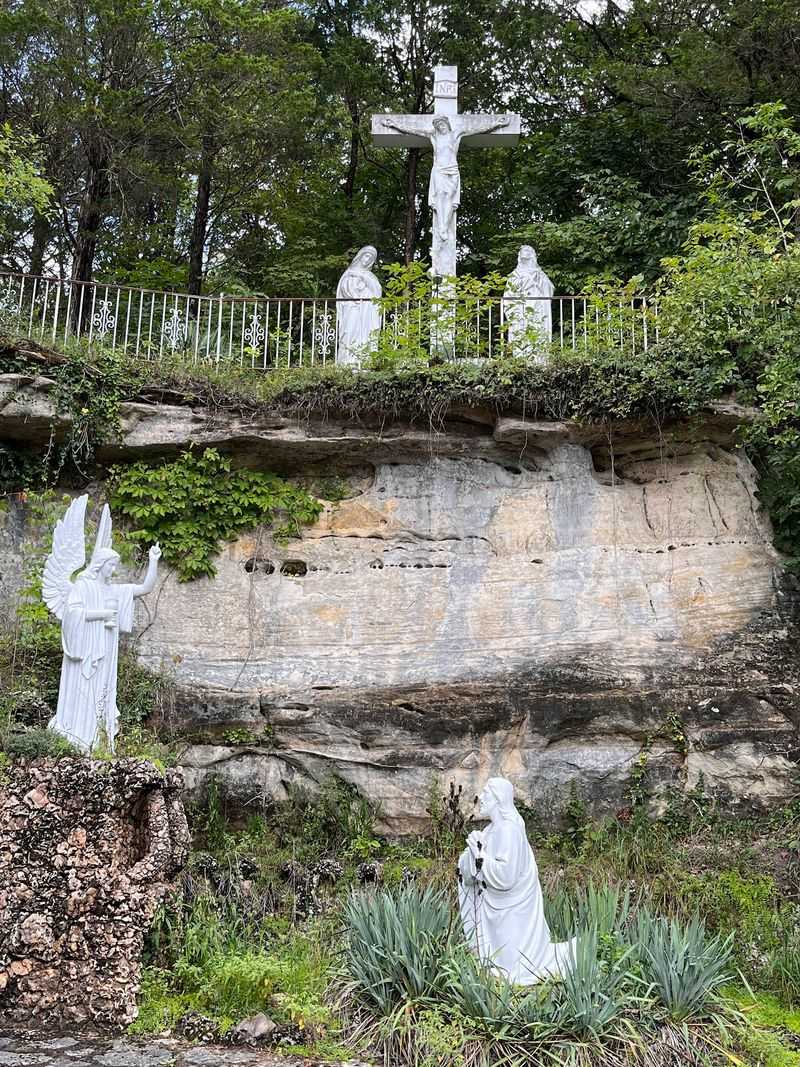
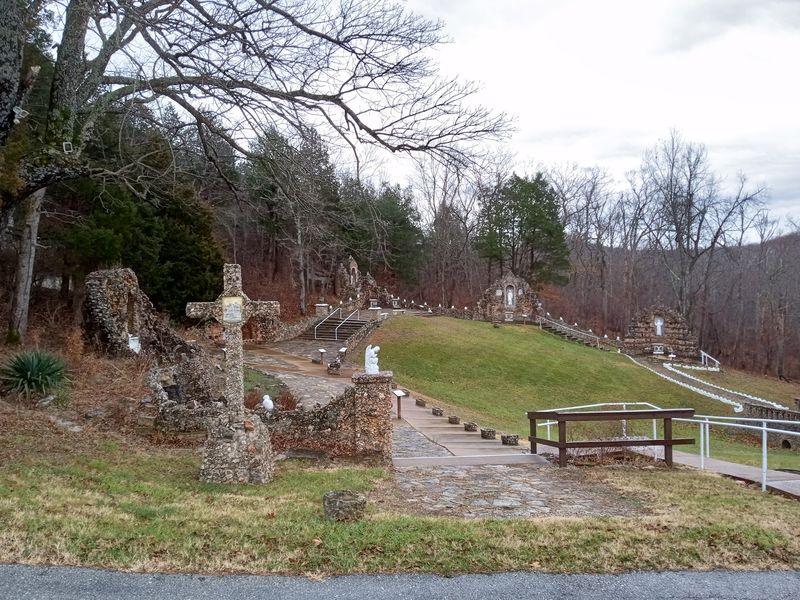
The official self-guided walking tour contains eight principal stops, with additional features along the way.
One of the most ambitious sections is Assumption Hill. Six smaller grottos line the approach to the Assumption Grotto, and together the sequence represents the Seven Joys of Mary, also known as the Franciscan Crown Rosary.
The smaller scenes represent the Annunciation, Visitation, Nativity, Adoration of the Magi, Finding of Jesus in the Temple, and Resurrection. The Assumption Grotto completes the sequence.
It is also the largest grotto on the property. The structure once marked the entrance to a two-mile Way of the Cross route through the woods.
Elsewhere, the walking tour passes the bridge, St. Francis Grotto, St. Joseph Grotto, Our Lady of Perpetual Help Grotto, Gethsemane Grotto, Our Lady of Sorrows, and the natural Nativity Grotto.
The route includes outdoor paths, stairs, grass, and changing terrain, so comfortable footwear makes sense.
A free walking-tour brochure is available to help identify the individual scenes and explain details that are easy to miss.
Animals, Glass, And Light
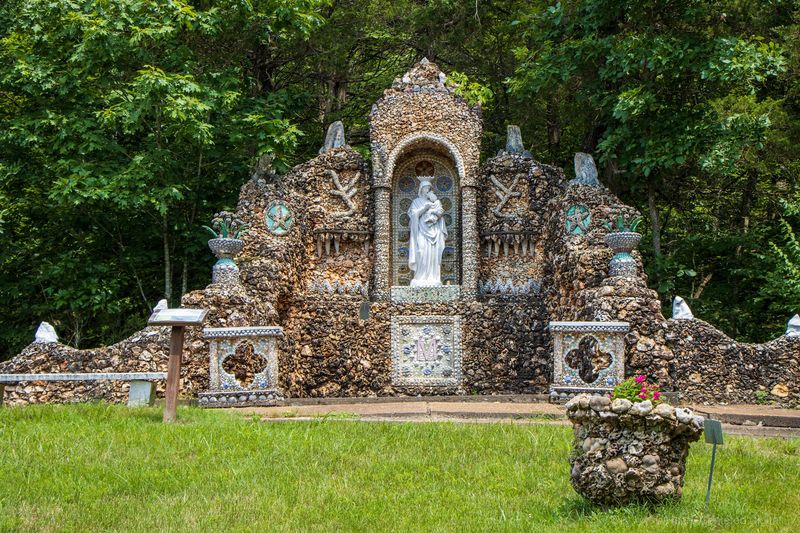
The St. Francis and St. Joseph grottos show just how varied the decoration became.
At St. Francis, porcelain birds and small animal figures reflect the saint’s traditional association with living creatures.
Concrete rabbits and lambs were formed with cupcake molds, turning ordinary kitchen shapes into permanent parts of the scene.
The St. Joseph Grotto uses brighter ornamentation. Costume jewelry creates patterns, and colored glass jars were embedded so sunlight could pass through the walls.
A statue of a boy playing with a dog stands nearby and was identified by the builder as a favorite.
Colored glass also appears at the Gethsemane Grotto, where jars originally filtered light onto figures representing the sleeping apostles.
These details are easy to overlook from a distance. A broad view shows the overall shape of each grotto, while a closer look reveals how many small objects were worked into the surface.
The combination of heavy rock and delicate ornament is one of the shrine’s most unusual visual features.
The Image Behind It All
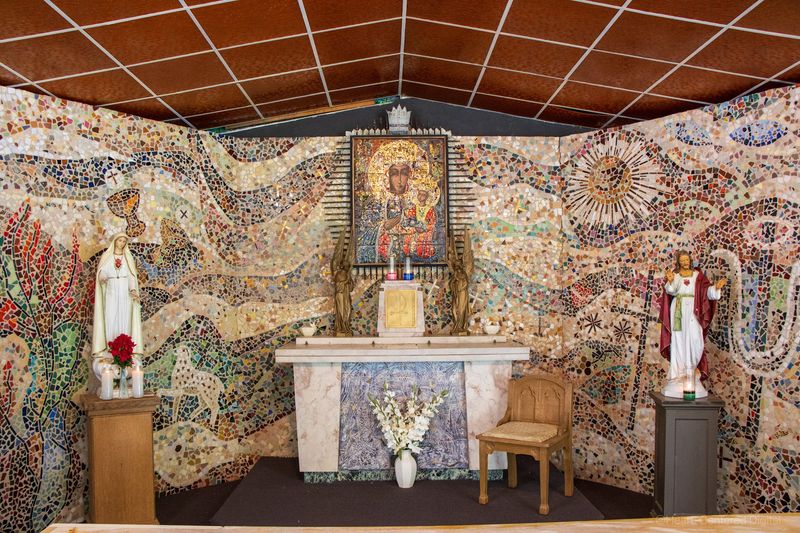
The shrine’s name refers to Our Lady of Czestochowa, the Black Madonna, one of the most important images in Polish Catholic tradition.
That devotion shaped the property from the beginning. The first cedar chapel built in 1937 held a portrait above its altar and became a place for pilgrimages, prayer services, and Mass.
The original chapel did not survive. In 1958, an arson fire that began at the altar destroyed the wooden building.
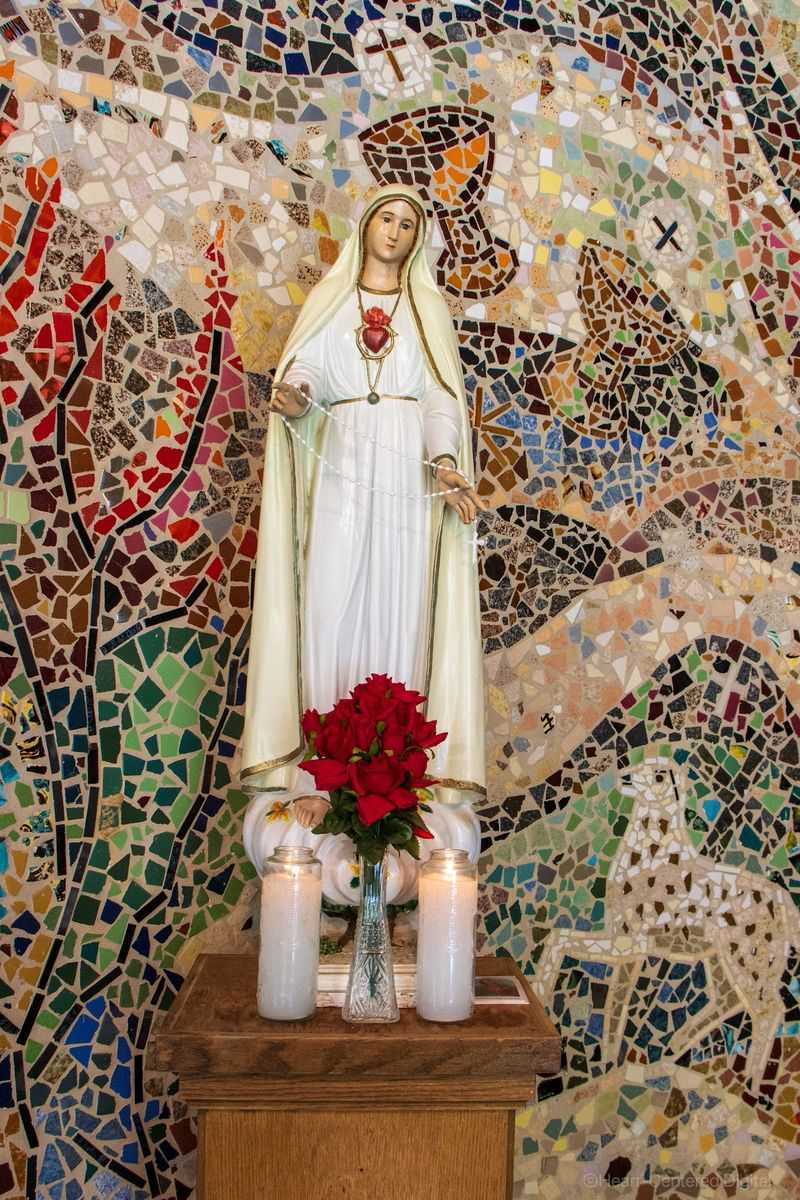
The current open-air Chapel of the Hills was built in the mid-1960s to replace it. Its mosaic wall and religious artwork continue the site’s connection to the Black Madonna.
A replacement painting was commissioned in Poland and sent to the Franciscan community after being associated with prayers at Jasna Gora. A separate glass-encased icon that once hung in a St. Louis church is also displayed in the chapel.
The space remains intended for prayer and reflection, not simply sightseeing. Public Masses are offered on selected feast days when a priest is available, but there is no regular daily Mass schedule.
This Missouri chapel and grottos together explain why the property remains both a religious destination and an unusual handmade landmark.
Plan A Thoughtful Visit
A visit requires little advance planning, but the current seasonal schedule is worth noting.
From April through October, the grounds are open from 9 a.m. to 5 p.m., while the gift shop and museum are listed from 9 a.m. to 4 p.m.
From November through March, the grounds are open from 9 a.m. to 4 p.m. Holiday closures and special events can affect access.
Admission is free, and individual visitors do not need reservations. Registered groups can arrange guided tours or pilgrimage programs in advance.
Self-guided tour brochures are available at no charge. The picnic pavilion also gives visitors a designated place to stop for a simple break after walking the grounds.
Leashed pets are allowed outdoors, according to Missouri tourism information. The attraction is listed as partially wheelchair accessible, so visitors who need step-free access may want to confirm current conditions before traveling.
The gift shop and museum provide additional background on the shrine and its history.
Most importantly, the grottos should be left exactly as found. The shrine specifically asks visitors not to climb on the structures or remove stone and decorative pieces.