This 1800s Church In Louisiana Feels Like A Piece Of Europe Hidden In The South
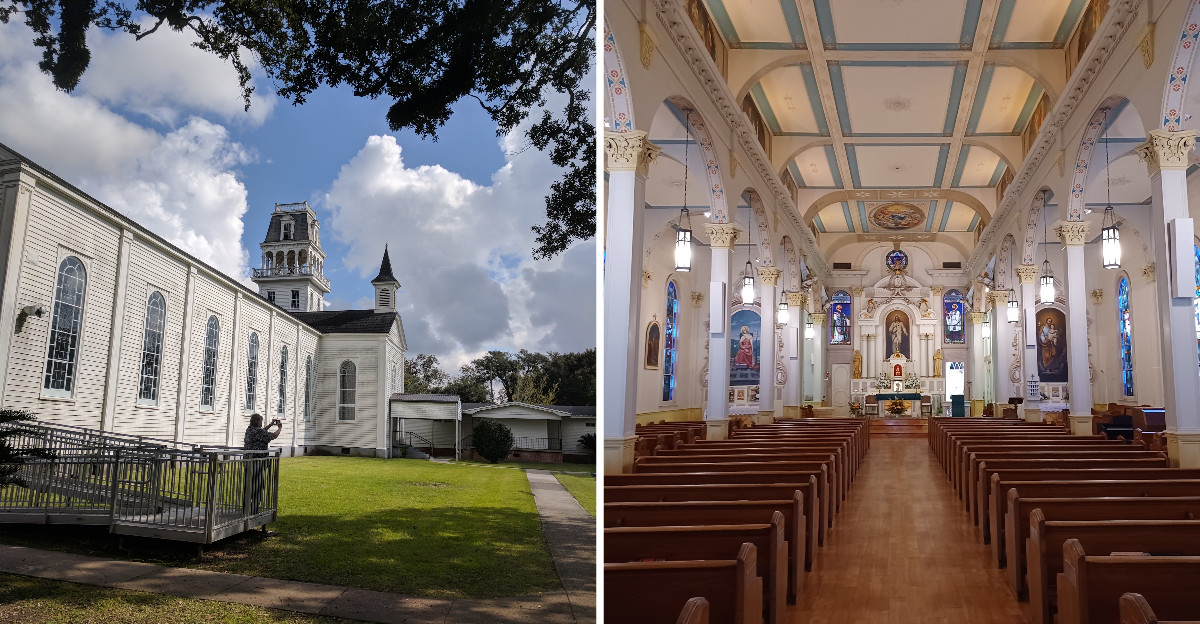
Look up. Seriously, that is the best advice here.
A Louisiana church from the 1800s draws the eye upward with its tall bell tower, painted ceilings, stained glass, and elegant architecture that feels more European than Deep South.
The exterior already makes a strong first impression beneath the oaks. Inside gets even better.
Details unfold slowly, from the windows to the decorative scenes overhead, while the parish’s much longer history adds another layer beneath all that beauty.
It is easy to photograph the building and move on. Do not.
The real pleasure comes from standing still long enough to notice how much is happening above you.
A Paris Look In Cajun Country
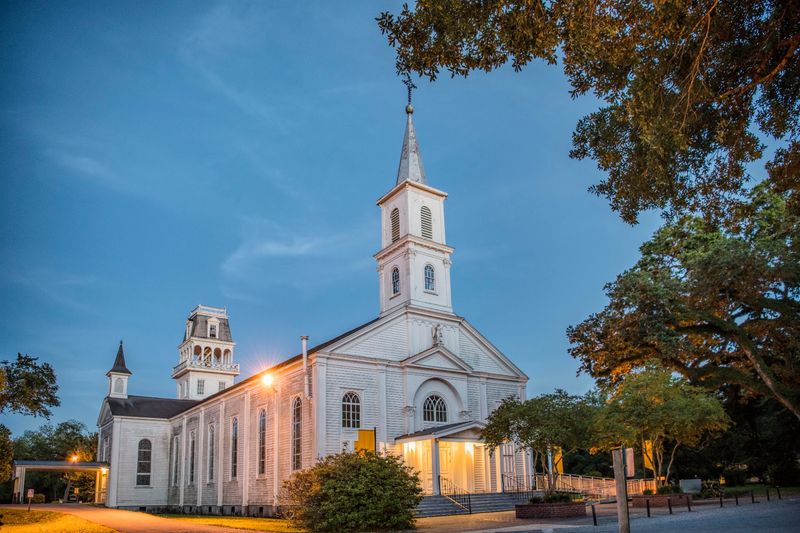
The rear belfry is the feature that gives the church its strongest Second Empire character.
Its tall, dormered mansard roof looks more closely connected to nineteenth-century French design than to a typical rural church.
That contrast is especially striking in rural Louisiana.
The design is attributed to New Orleans architect James Freret, who completed drawings in 1875 after studying at the École des Beaux-Arts in Paris and traveling through France, England, and Italy.
Construction did not follow every detail of his drawings. The planned brick structure became a predominantly wooden church, and other features changed before work began in 1879.
The front combines a pedimented gable with a square tower rising toward a steeple. Behind it, the later belfry creates a second, much broader vertical landmark.
Saint Charles Borromeo Church stands at 174 Church St in Grand Coteau.
Roots Reaching Back To 1819
The parish itself was established in 1819, making it the third-oldest parish in the Catholic Diocese of Lafayette. Only the parishes in St. Martinville and Opelousas predate it.
Plans for a larger church were taking shape by the 1870s as the congregation needed more space.
Freret completed drawings in 1875, and the cornerstone of the present church was blessed and placed on March 19, 1879.
The building was consecrated the following year under the title Sacred Heart. The Religious of the Sacred Heart and the Jesuits each contributed roughly one-third of the construction funding, with parishioners providing another major share.
The Sacred Heart title reflected a period of especially strong devotion within the parish and the close relationship between the congregation, Jesuits, and nearby Sacred Heart community.
The church later returned to its original Saint Charles Borromeo name.
Its story connects an 1819 parish, an ambitious 1870s building campaign, and religious communities that have shaped Grand Coteau for generations.
A Belfry Built For Big Sound
The rear belfry was added in 1886, several years after the main church opened. Inside hangs a 3,104-pound bell that remains in use.
Its architecture is as memorable as its scale. A tall mansard roof with dormers caps the two-story structure, while a narrow balcony and balustrade wrap the upper level.
An open arcade exposes the bell rather than hiding it completely behind walls. That design gives the belfry a lighter appearance despite its considerable size.
The front of the church offers a different silhouette. A square tower rises in stages from the pedimented gable before narrowing into the steeple.
The present front spire dates to 1950 and replicates the form of the version that preceded it. It also differs from Freret’s 1875 drawing, which showed a more continuous spire rising from the roofline.
The two towers make the building’s evolution easy to read. The larger mansard-roofed belfry arrived later and gives the exterior its most unusual profile.
Painted Ceilings And Rosary Art
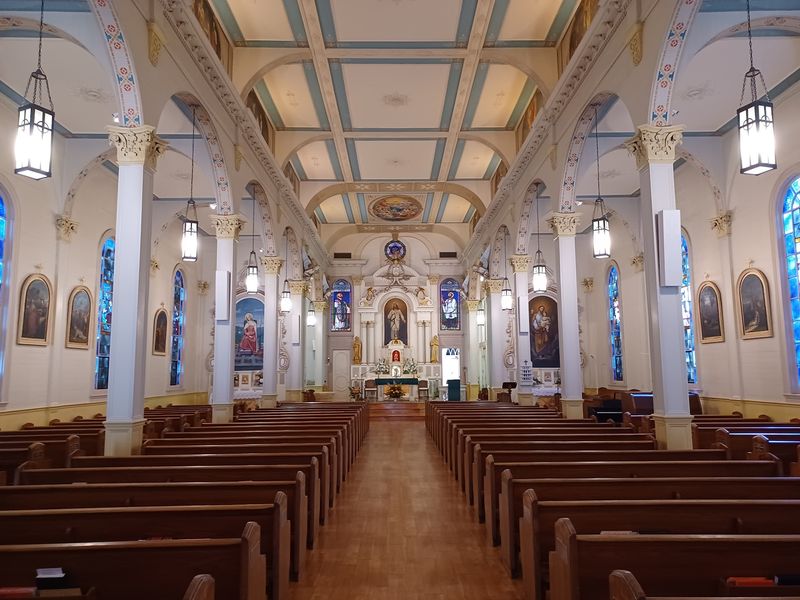
Inside, the architecture becomes more restrained, which gives the artwork room to stand out.
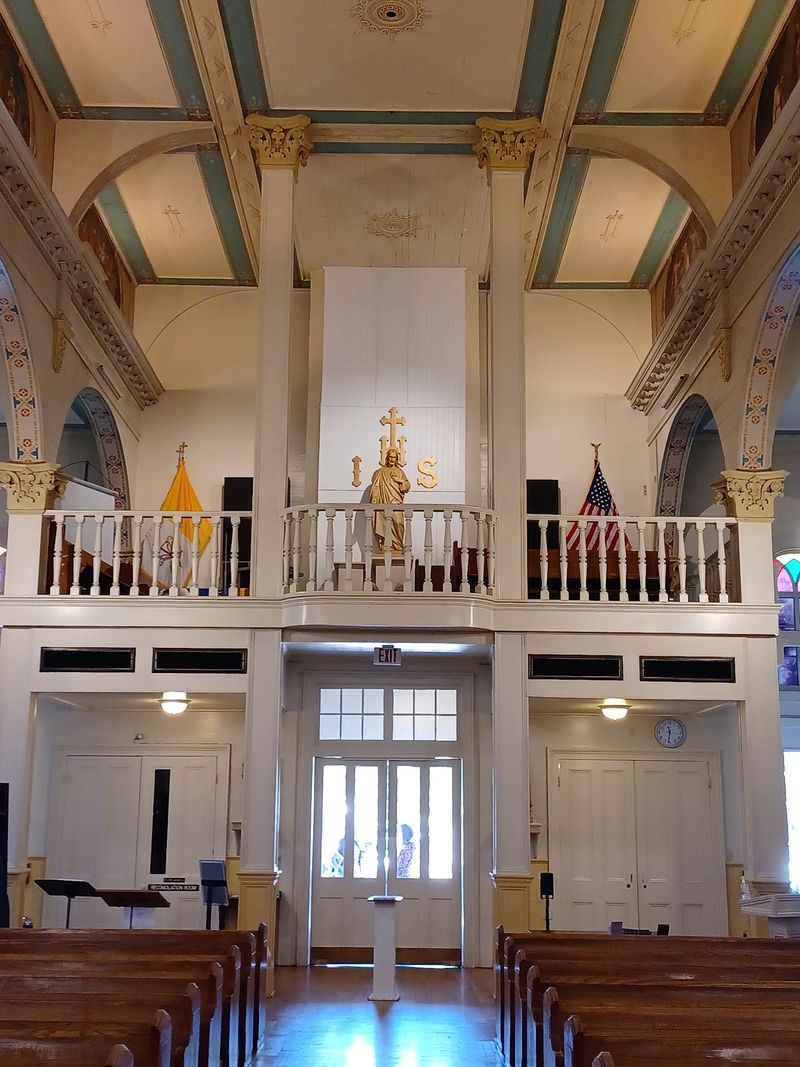
Slender square piers with Composite capitals form an arcade along the nave. A small balcony sits at the rear, and stenciled decoration spreads across the flat ceiling.
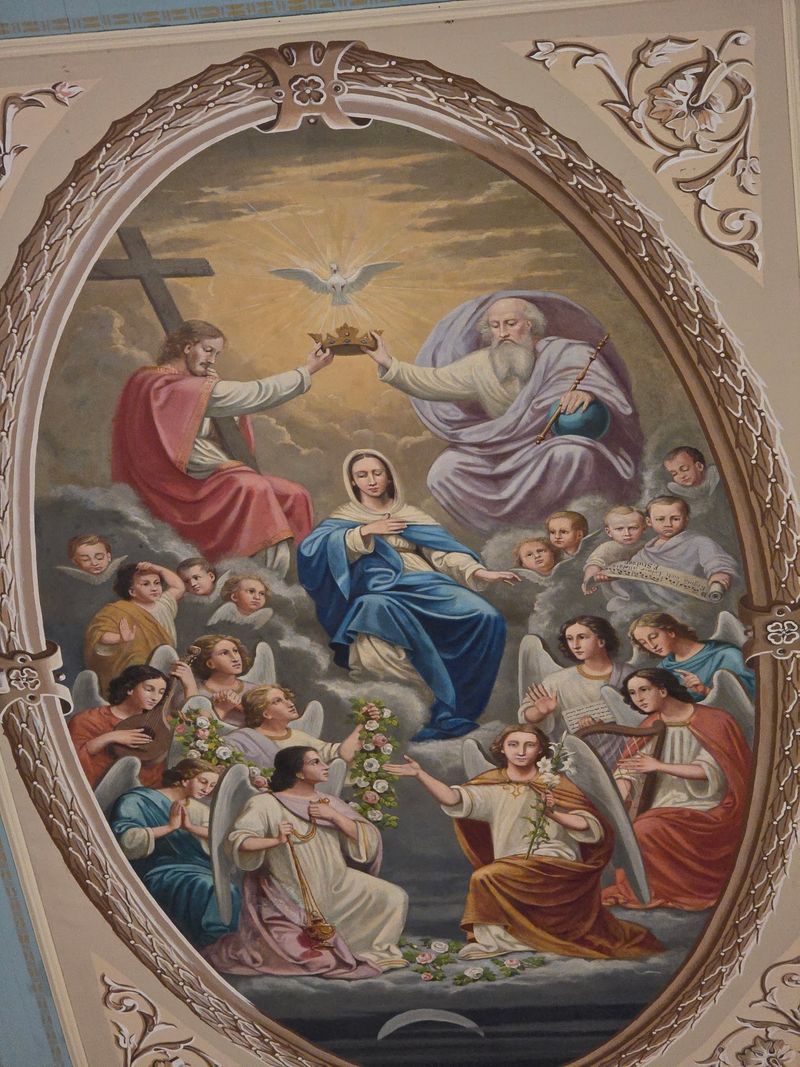
Much of the historic painting is connected to artist Erasmus Humbrecht, who also worked at St. Louis Cathedral in New Orleans. His most important contribution here is a cycle illustrating the fifteen Mysteries of the Rosary.
Fourteen oval scenes occupy niches along the aisle walls, with seven on each side. The final scene, the Coronation of Mary, appears in a large oval above the sanctuary.
The paintings reveal themselves gradually as the eye moves from the side walls toward the front.
Additional artwork includes paintings above the side altars and representations of the four Evangelists on the transept walls. Statues and ornate altars add still more detail without changing the simple structural rhythm of the nave.
The result is one of those interiors that rewards looking upward as much as looking ahead.
Stained Glass With Hidden Symbols
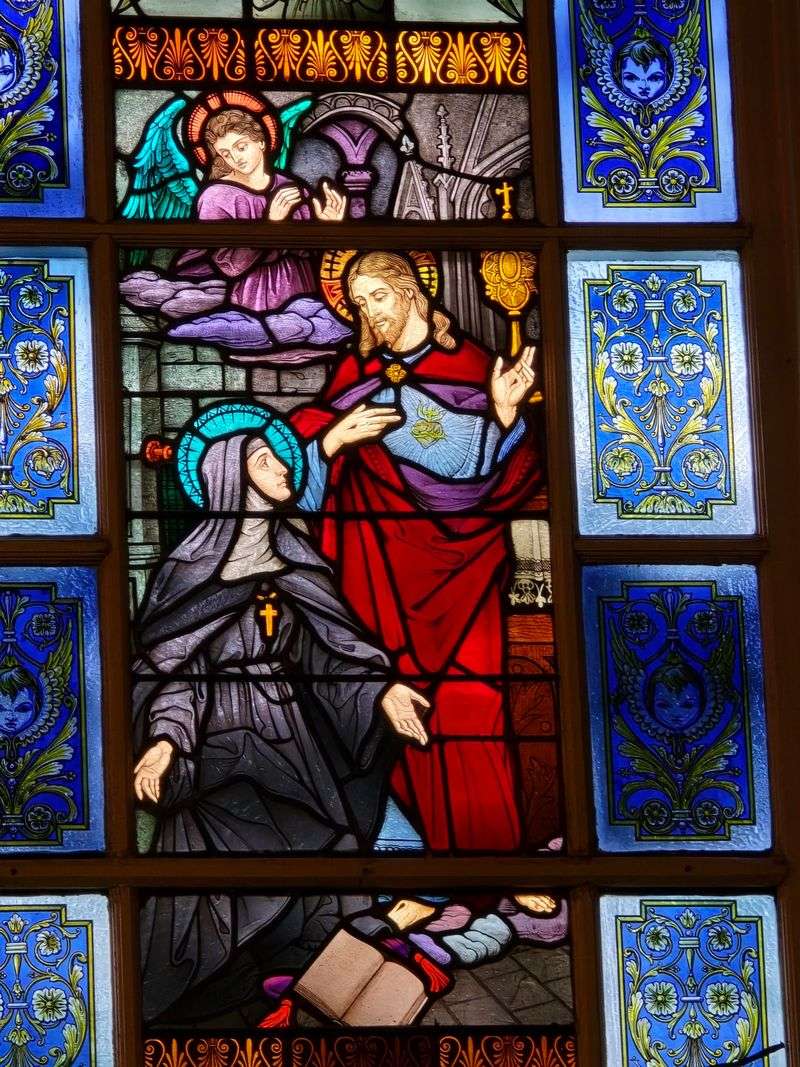
The stained glass did not all arrive at once. Three groups of windows represent different periods in the church’s history.
The oldest set dates to the construction era. High above the main altar is a round window known as the Star of David Window, with a pelican motif at its center that carries longstanding Christian symbolism.
Two other original windows near the main altar depict St. Ignatius Loyola and St. Francis Xavier, linking the decorative program to the Jesuit tradition associated with the parish.
A second group was installed in the 1920s in the transepts. Later windows from the Emil Frei studio date from the 1920s and 1940s, while the large nave windows installed in the late 1940s illustrate the Twelve Promises of the Sacred Heart.
Their placement adds color without overwhelming the paintings and stenciling nearby. Light changes the windows throughout the day, so the interior can look different depending on weather and time.
Together, the glass, painted scenes, and ceiling decoration make the sanctuary feel layered rather than designed in a single moment.
Oaks, Grotto, And A Dairy Barn
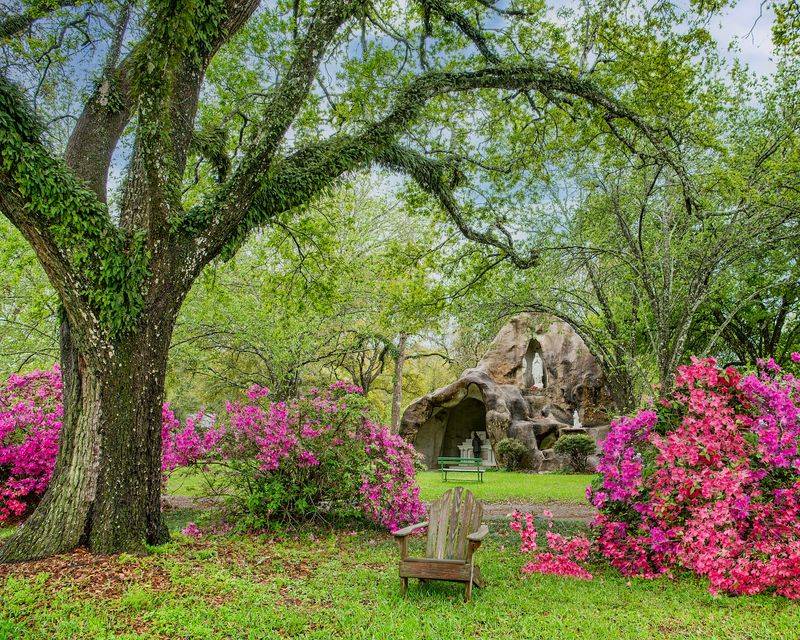
Grand Coteau’s historic landscape is known for mature trees, shaded lanes, and religious institutions spread across a largely rural district.
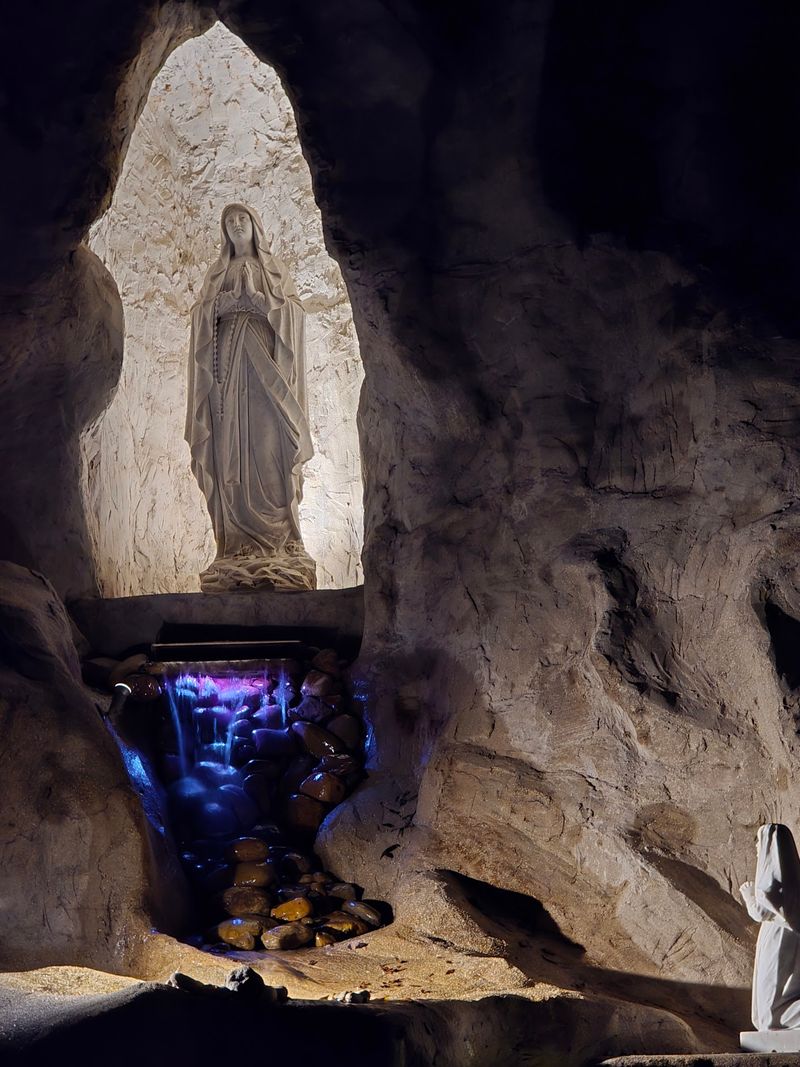
Near the church is a replica of the Our Lady of Lourdes grotto in France. The surrounding town belongs to the Grand Coteau Historic District, which entered the National Register of Historic Places in 1980.
It is one of the relatively few primarily rural historic districts on the register, with more than 70 architecturally significant structures representing Creole, French, Acadian, Anglo-American, and Victorian traditions.
Across Louisiana, Grand Coteau stands out for this mix of architectural traditions and mature landscapes. Large oaks form alleys and groves between buildings that developed over different periods.
Another landmark nearby is the Jesuit Dairy Barn, built in 1925 when the St. Charles College complex maintained agricultural operations that helped supply its residents.
The former college grounds now form part of the Jesuit Spirituality Center. Those grounds are private except for registered guests or arranged visits, so they should not be treated as an open extension of the church grounds.
The church and nearby historic sites work best as separate stops with their own access rules.
Jesuits And A Town Of Miracles
Jesuit priests arrived in Grand Coteau in 1837 and established St. Charles College. Their presence became closely connected with the parish, education, and spiritual life of the town.
Today the former college complex serves as a Jesuit spirituality and formation center.
A separate historic story unfolds at the nearby Academy of the Sacred Heart, founded in 1821 and still operating.
In 1866, a young postulant named Mary Wilson experienced a recovery that the Catholic Church later accepted as a miracle connected with Blessed John Berchmans.
That event became part of the evidence used for his canonization in 1888. The room associated with the event is now the Shrine of St. John Berchmans.
Grand Coteau formally named St. John Berchmans its patron saint in 2016. The shrine and the Academy’s small history museum can be visited through tours arranged in advance.
The Academy and church are separate institutions, but seeing both helps explain why such a small town holds an unusually dense concentration of architecture, education, and religious history.
Smart Tips For Your Visit
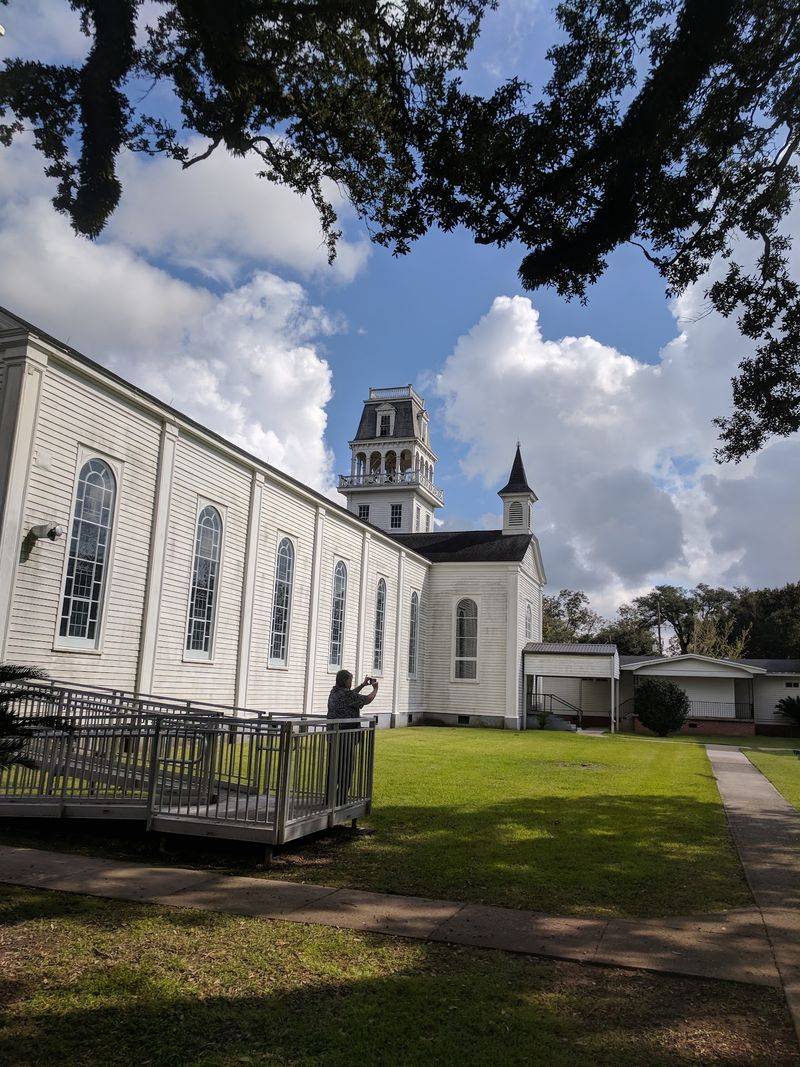
Planning ahead matters because Saint Charles Borromeo is an active parish rather than a museum with fixed sightseeing hours.
The parish office is currently open Monday through Thursday from 8 a.m. to 5 p.m. It is closed Friday and Saturday, while the church continues to hold regular weekday and weekend services.
For an architecture-focused visit or guided tour, contact the parish in advance rather than assuming the interior will be open for casual sightseeing.
Admission is free, accessible facilities are available, and group tours can be arranged. Visitors should avoid interrupting services or scheduled parish activities.
Spring and fall usually make outdoor exploring more comfortable, while summer afternoons can be warm. The shaded streets and mature trees still make the historic district pleasant to explore at an unhurried pace.
The strongest impression comes from how many eras overlap here: an 1819 parish, an 1879 wooden church, an 1886 Second Empire belfry, later stained glass, and a surrounding town shaped by nearly two centuries of religious and educational history.
This corner of Louisiana can feel unexpectedly European, but its character comes from a very local story that has been building for generations.