This Small Kentucky Church Was Once Called The Most Perfect Gothic Building Of Its Size In The State
Some buildings try too hard to impress you. This little Kentucky church never had to.
A noted historian once looked it over and called it the most perfect Gothic building of its size in the state. That is a bold compliment for a church that fits on a small town corner.
Its story starts with a bishop who skipped the blueprints. He whittled a wooden model by hand and built the real thing from it.
You have to admire that kind of confidence. The stained glass windows have their own dramatic backstory.
During the Civil War, a soldier posted a guard just to keep them safe. Then there is a quirky detail that is easy to miss.
Only one window inside is perfectly centered, and the reason is surprisingly thoughtful. So grab your camera and your curiosity.
This church has plenty to show you, and every detail tells a story.
A Bishop Designed It And Then Grabbed His Carving Tools
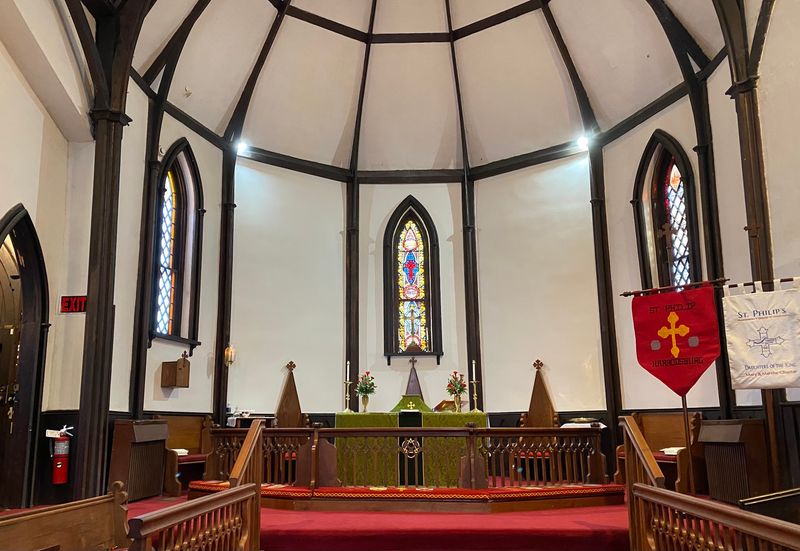
Most church leaders sign off on plans and let builders handle the rest. Bishop Benjamin Bosworth Smith supervised every step of St. Philip’s Episcopal Church himself.
The story goes that he worked from a wooden model he made. That model was said to be a small copy of a church in England he knew as a young man.
Think about that for a second. He carried a memory across an ocean and decades, then rebuilt it in brick in Kentucky.
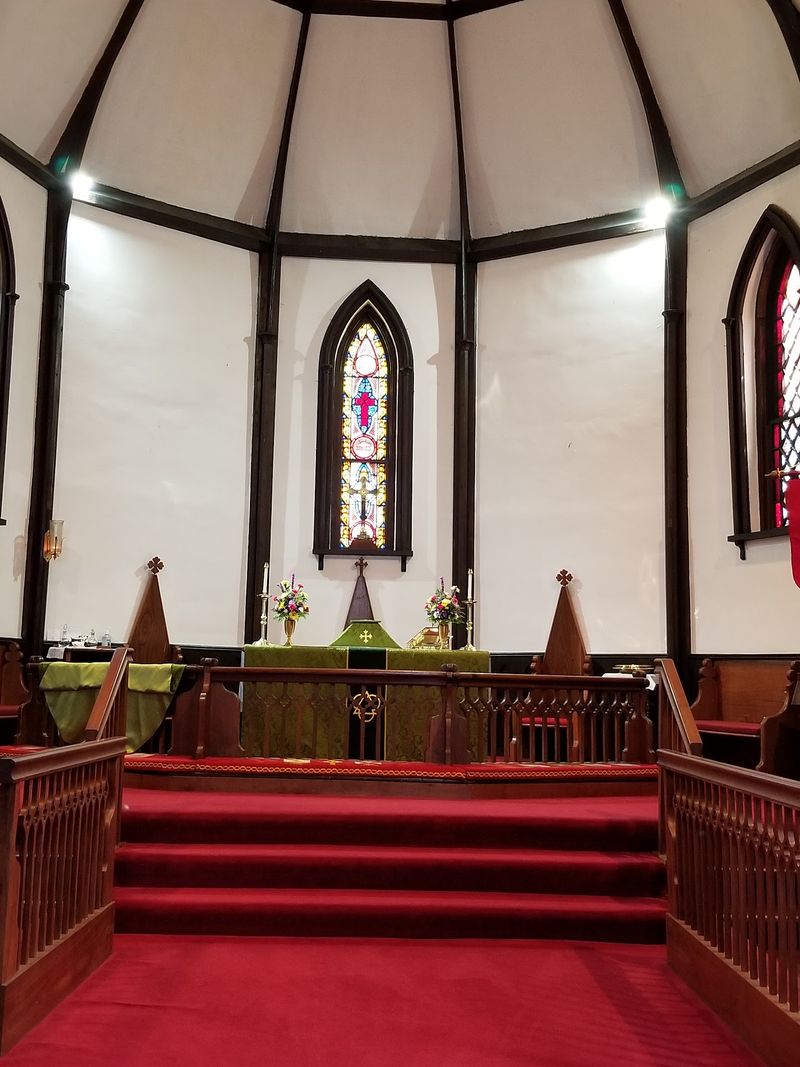
His involvement didn’t end with the walls. Smith personally carved three chairs for the chancel, the area near the altar.
He also carved the communion rail where worshippers kneel. On top of that, he made a tripod that holds up the baptismal font.
That’s a lot of woodworking for one bishop. It also explains why the church feels so carefully pieced together.
St. Philip’s is considered a noted example of Smith’s Gothic churches in the state. That’s a big title for a building of such modest size.
When you visit, look closely at the chancel furniture. You’re seeing the bishop’s own handiwork, still doing its job more than 160 years later.
The Cornerstone Went Down Just Before The Country Split Apart
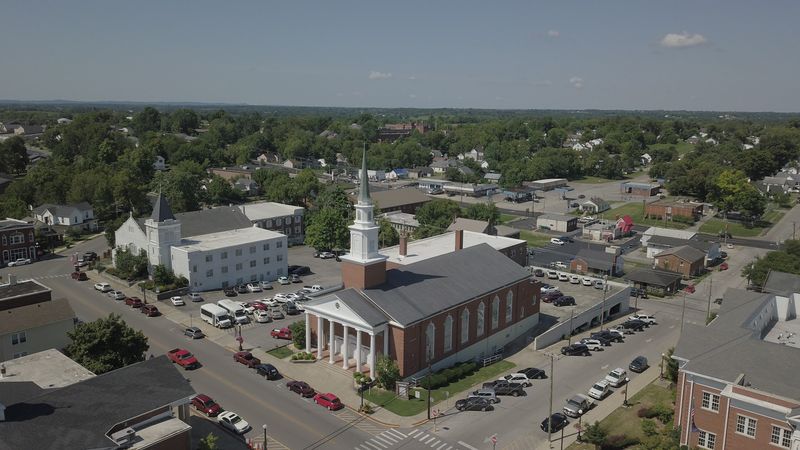
April 17, 1860, was the big day. That’s when workers laid the cornerstone for this little Gothic church in Harrodsburg.
The building opened for services on September 12, 1861. That timing is remarkable, since the nation was falling into deep turmoil during those very months.
Construction kept going anyway. The congregation got its church, and that church is still standing and still in use today.
Much later, in 1978, St. Philip’s earned a spot on the National Register of Historic Places. It was added on January 31 of that year.
That listing is a federal way of saying a place matters. It recognizes buildings with real historic and architectural value.
The church’s past also includes hard truths. Pews for enslaved people once lined the western wall of the sanctuary.
I appreciate that this part of the story is remembered rather than hidden. Honest history makes a place more meaningful, not less.
So when you stand outside, you’re looking at more than pretty brickwork. You’re looking at a building that has seen over a century and a half of Kentucky life roll by its doors.
Your Neck Will Get A Workout Admiring That Spire
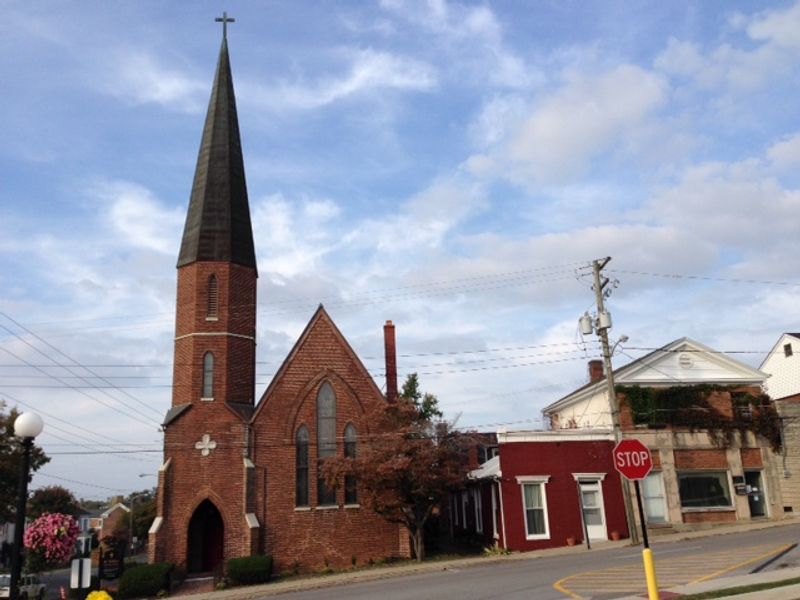
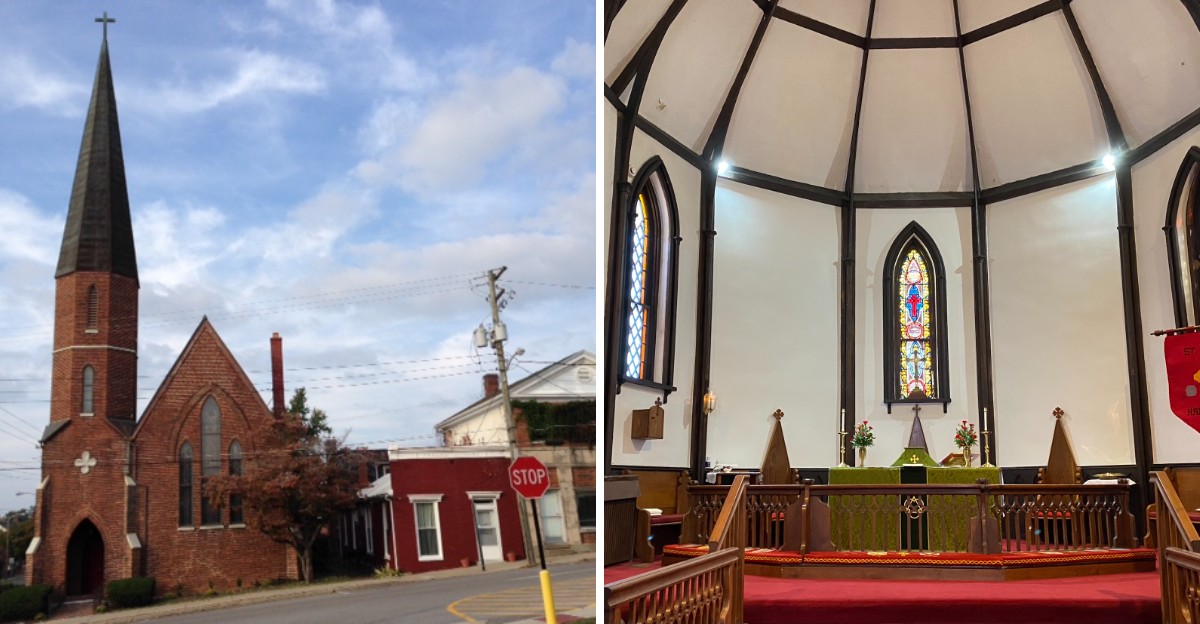
Eight sides. That’s how many the spire has, sitting on top of a square bell tower at the northwest corner.
The tower isn’t just for looks. It holds the main entrance, framed by a Tudor arch doorway.
A Tudor arch is flatter and wider than a sharp Gothic point. It gives the doorway a sturdy, welcoming shape, like the building is opening its arms a little.
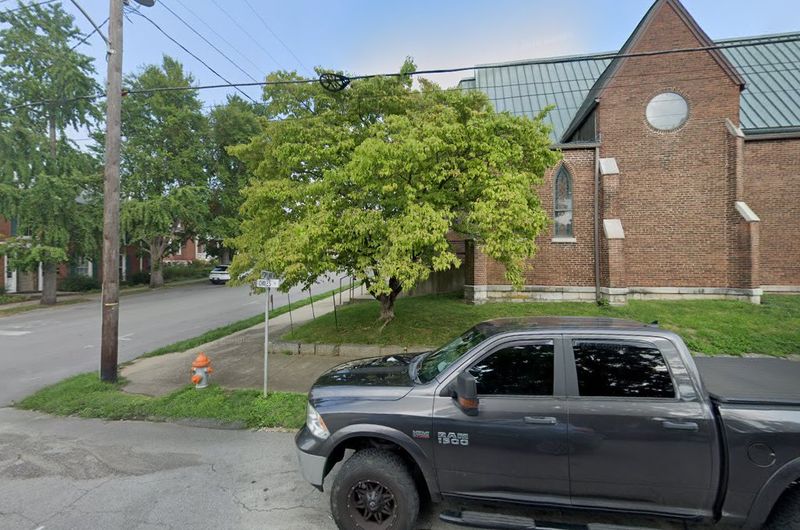
The walls are brick with granite trim. That mix of warm red and cool gray makes the details pop.
Now look at the main gable, which faces northeast. You’ll spot an equilateral arch window topped by a low-relief stone hood mold.
A hood mold is basically a stone eyebrow over a window. It helps shed rainwater, and it looks sharp doing it.
Lancet windows run along the building too. Each tall, narrow one wears its own stone hood mold.
There’s even a second Tudor arch doorway on the east side wall. It leads into the rear of the nave.
Bring your camera. This is textbook Gothic Revival, packed into a footprint of roughly 90 feet long.
Original Pews And A Walnut Ceiling Set The Mood Inside
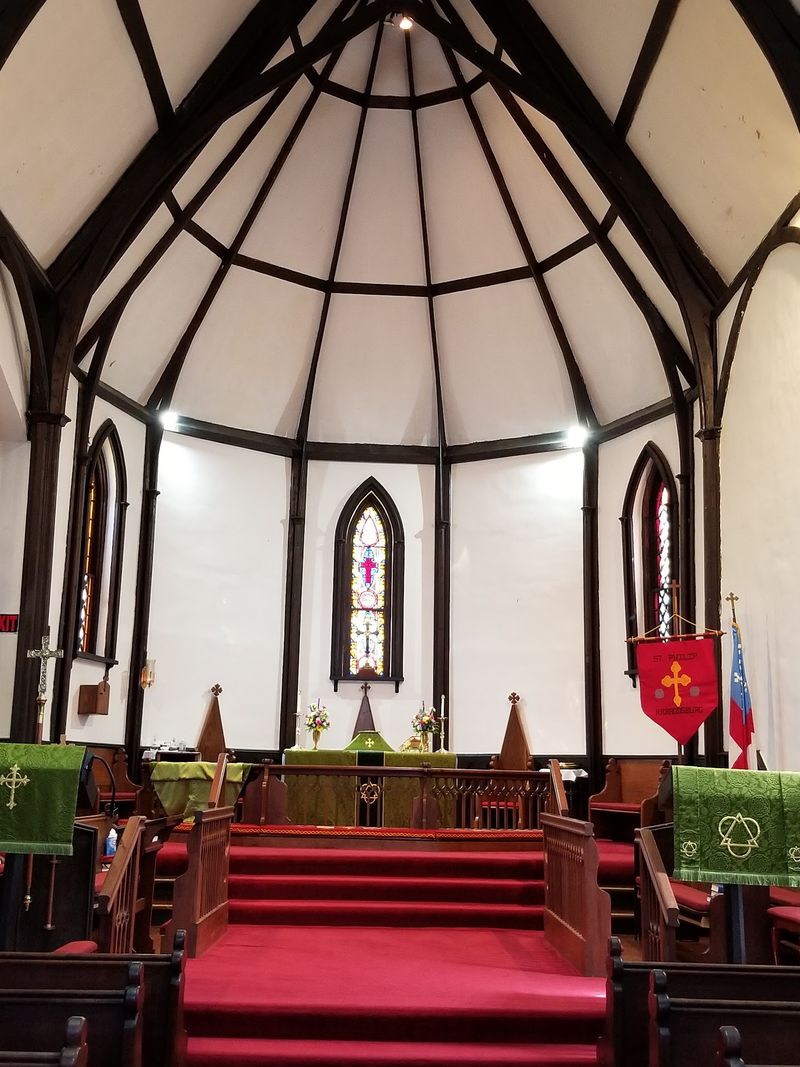
Old buildings often lose their original furniture over time. St. Philip’s Episcopal Church kept its pews.
Those are the same seats that greeted worshippers back in the 1860s. Sitting in one is a pretty easy way to time travel.
Then there’s the ceiling. It’s made of dark walnut with exposed beams running overhead.
Walnut is a rich, deep wood. Overhead, it gives the narrow nave a cozy, sheltered feeling rather than a cold, echoing one.
The building stretches about 90 feet long and roughly 30 to 35 feet wide. That long, slim shape is classic for Gothic churches.
It also pulls your eye forward toward the chancel. That’s where Bishop Smith’s hand-carved chairs and communion rail wait.
I like how the scale keeps things human. You won’t feel lost in a giant cathedral here.
Instead, the room feels close and calm. It’s the sort of space where you notice small details, like grain in the wood or light shifting across the pews.
Take your time looking up. That ceiling deserves more than a quick glance on your way to a seat.
English Stained Glass Steals The Show On Sunny Days
Sunlight plus stained glass is a winning combination. At this church, every stained glass window appears to be English-made.
That fits the whole story nicely. Bishop Smith modeled the building on an English church, so English glass feels right at home.
The lancet windows are tall and slender. When light pours through, color spills across the walls and pews.
Here’s a fun bonus for glass fans. St. Philip’s is part of the Harrodsburg Downtown Churches Stained-Glass Tour.
That tour connects several historic churches in the downtown area. It’s a smart way to compare styles and see how different congregations chose to tell stories in glass.
My tip is simple. Visit on a bright morning if you can.
The windows look their best when the sun is doing the heavy lifting. Cloudy days still work, but the colors glow differently.
Also, step back a bit. Some details only make sense when you see the whole window at once.
Kentucky has plenty of old churches. Few get to pair Gothic Revival lines with glass that traveled all the way from England.
The Building Kept Growing Without Losing Its Charm
Churches, like families, sometimes need more room. St. Philip’s handled that gracefully over the years.
In 1881, a parish house was added, extending the west transept. A transept is the arm that crosses the main body of a church.
Then came a two-story stone wing in 1958. It gave the congregation even more space for gatherings and activities.
The Parish House now holds the church offices. It sits at 118 W.
Poplar St., right near the historic sanctuary.
Downstairs, you’ll find Michaud Hall in the parish hall. That’s where the after-service coffee hour happens.
Caring for a building from 1861 takes steady work. Recent preservation efforts have included exterior tuck-pointing, which means repairing the mortar between bricks.
The church also added new guttering. Inside, crews tackled wall and plaster repairs.
None of that is glamorous. But it’s exactly the kind of care that keeps old beauty standing.
I respect a small congregation that invests in its building this way. It shows the people here see the church as a treasure worth protecting for whoever comes next.
Wear Your Comfy Shoes Because Nobody Is Checking Outfits
Good news for anyone who dislikes dressing up. There’s no dress code at this church.
Visitors are encouraged to wear whatever feels comfortable. That’s a refreshing invitation for a building this historic.
The congregation aims for an informal and friendly atmosphere. Everyone is welcome, and the church says so plainly.
Its welcome covers race, culture, age, ability, gender, sexual identity or orientation, education, and economic status. That’s a wide door, and it’s meant to be.
Holy Eucharist services happen Sunday mornings at 9:30 and Wednesdays at noon. Sunday services run about 60 minutes.
Worship follows the Book of Common Prayer. If you’ve never used it, don’t worry, since the order of service guides you along.
Can’t make it in person? Sunday services are also shared online through the church’s Facebook page.
Families have options too. Nursery care for infants through age four is typically offered on Sundays.
Christian education is available for both kids and adults. So whether you’re curious, faithful, or just fond of old buildings, you’ll find a seat waiting at St. Philip’s Episcopal Church.
Stick Around After Church For Coffee And Conversation
The final hymn isn’t really the end of a Sunday here. A coffee hour follows the service.
It takes place in Michaud Hall, down in the parish hall. That’s where the small congregation catches up and greets newcomers.
I think coffee hours are underrated. They turn a room full of strangers into neighbors pretty quickly.
It’s also your best chance to ask questions. Curious about Bishop Smith’s carvings or the English glass?
This is a natural moment to bring it up.
Small congregations often make visitors feel noticed in a good way. You won’t get swallowed up by a crowd of thousands.
Instead, you’ll likely meet people who know the building’s story well. Many care deeply about keeping it standing and welcoming.
Don’t feel pressure to stay long. Even a few minutes with a cup in hand can make a visit feel warmer.
Honestly, it’s a sweet way to wrap up an hour of worship. Old walnut beams above you during the service, then friendly chatter below you afterward.
That mix of history and hospitality is what gives this Kentucky church its heart.
Finding It Is Easy Once You Know The Right Corner
Downtown Harrodsburg makes this church a simple stop. St. Philip’s Episcopal Church sits at 131 Short St., Harrodsburg, KY 40330.
The church entrance is on the corner of Short and Chiles Streets. Look for the square bell tower and its eight-sided spire.
Parking shouldn’t be a headache. Public spaces are available on Short, Chiles, and Poplar Streets.
The Parish House, with the church offices, is close by on Poplar Street. So everything stays within a short stroll.
Planning a trip around the stained glass? Pair your visit with the Harrodsburg Downtown Churches Stained-Glass Tour.
That way, you can see several historic sanctuaries in one outing. Your camera roll will thank you.
Keep in mind this is an active church first. Sunday mornings and Wednesday at noon are service times, so plan quiet visits with respect.
Arriving a little early is smart if you want to admire the exterior. The granite trim and hood molds reward a slow walk around the building.
For a church this small, it packs a lot of Kentucky history onto one quiet corner. Not bad for a building inspired by a little wooden model.