Only 11 Historic Covered Bridges Still Stand In Kentucky And We Ranked Every One Worth The Drive
Kentucky once had hundreds of covered bridges, and most of them have quietly vanished. The ones still standing deserve a little road trip love.
You probably drive over a dozen bridges a week without noticing a single one. These are different, and they practically beg you to slow down.
Picture weathered wooden walls, a peaked roof, and sunlight sneaking through the gaps. Folks used to call them kissing bridges, so bring someone you like.
Each one has outlasted storms, time, and plenty of modern road crews. That alone earns them a spot on your weekend plans.
Most of them sit along quiet country roads where the drive is half the fun. You will pass horse farms, small towns, and maybe a curious cow or two.
We lined them up and ranked every single one. Grab your camera, fill up the tank, and let’s see which bridge takes the top spot.
1. Bennett’s Mill Covered Bridge
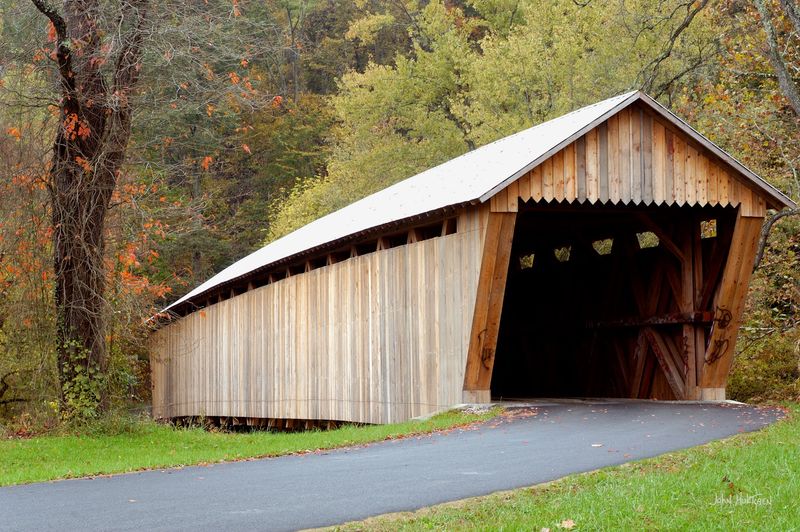
Two cannons once hid near this bridge during the Civil War, ready to defend it. That’s serious loyalty for a pile of wood over Tygart Creek.
Brothers B.F. and Parmaly Bennett built it in 1855 to serve their mill. They even reused stone from their old Globe iron furnace for the foundations.
Here’s the part that earned the top spot. In 1874, the bridge got a Wheeler truss, and it’s the only one of its kind still standing in the world.
The bridge stretches 155 feet and has never been painted. That weathered, natural wood look is the real deal, not a design choice from a catalog.
You can still drive across it, which makes the visit feel like a tiny time-travel trip. Roll slowly, listen to the boards, and pretend your car is a horse.
It joined the National Register of Historic Places in 1976 and was restored in 2002. Each June, the bridge hosts a Dinner on the Bridge event, so check the date before you go.
Park safely nearby and walk the creek bank for photos. The side view shows off that long, plain wooden body best.
Greenup County sits in the far northeast corner of Kentucky, near the Ohio River. It pairs nicely with another stop on this list in the same county.
Bring a friend who loves trivia. A one-of-a-kind truss is the kind of fact that wins arguments at the dinner table.
Address: Brown Covered Bridge Road, Greenup, KY 41144
2. Goddard Covered Bridge
Postcard alert. From the east side, the bridge frames the tiny Goddard United Methodist Church like a picture hanging on a wall.
Its exact build date is unknown, but it traces back to an 1820 patent design. It’s the only surviving Ithiel Town Lattice bridge in Kentucky.
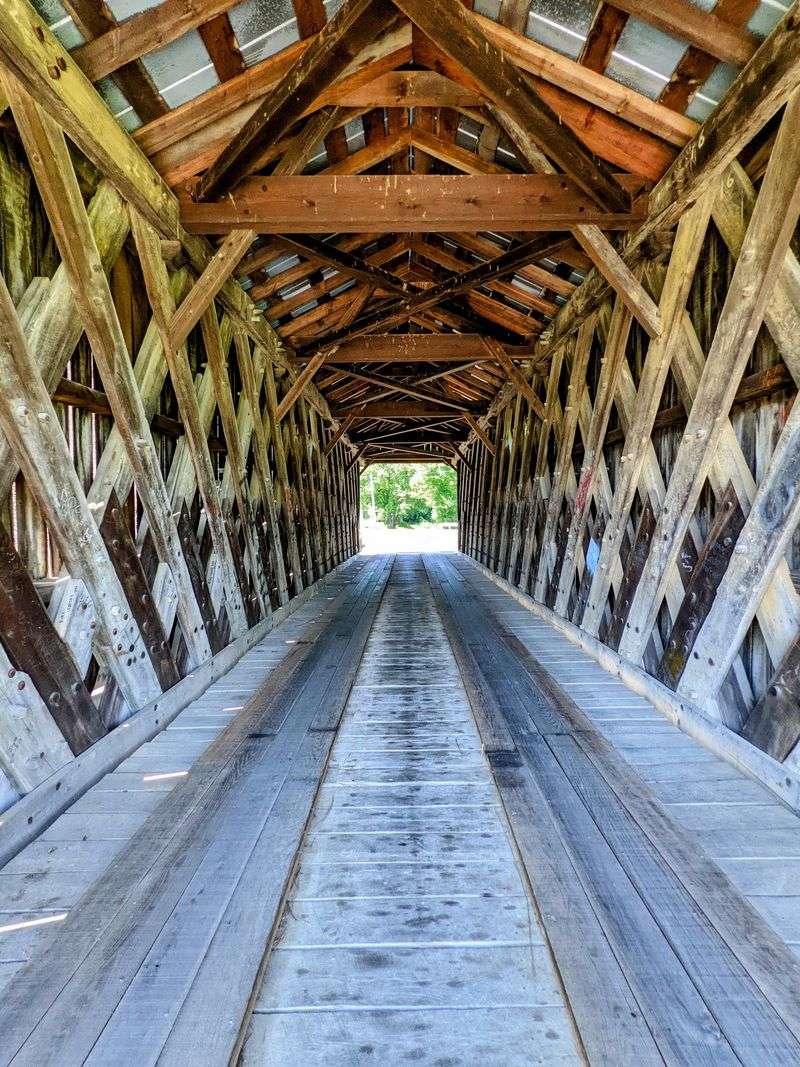
That crisscross lattice is held together with wooden pegs. No fancy bolts, just smart old-school carpentry.
At 60 feet, it’s short and sweet. You can drive or walk through, and it was recently restored right on site.
Step inside and check the walls. Names like T.D.
Hutton 1898 are inscribed in the wood, so people have been leaving their mark for a long time.
Please don’t add your own signature, though. Your camera is a much better souvenir collector.
The bridge spans Sand Lick Creek about nine miles southeast of Flemingsburg. Look for it just off KY 32 in Fleming County.
Mark your calendar for the fourth Saturday in August. That’s when the Covered Bridge Festival takes place here.
So why rank it so high? A rare design, a church view, and a festival make one small bridge feel like a full day.
Photographers, stand on the east end for the classic shot. Morning or evening light can make the church and bridge look extra sharp.
Fleming County has more than one covered bridge, so you can stack several stops in one drive. Two more appear later on this list.
Address: Off KY 32, Goddard, KY 41041
3. Cabin Creek Covered Bridge
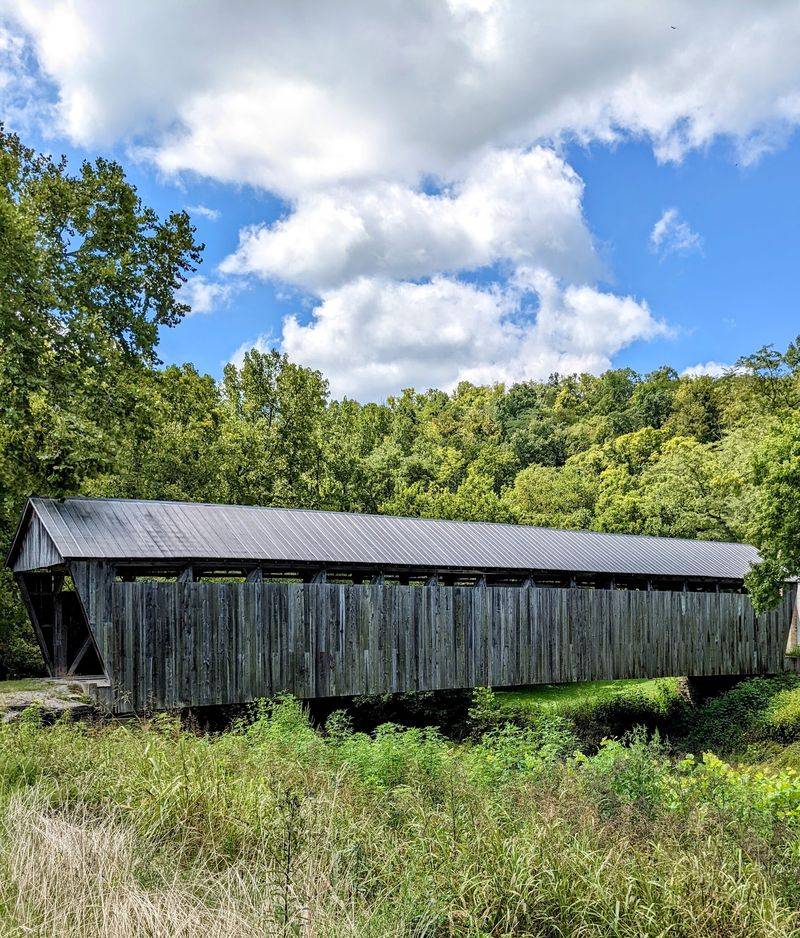
A pioneer log cabin nearby likely gave this creek, and its bridge, their name. Pretty fitting for a structure built around 1867.
The 114-foot Burr truss bridge crosses Cabin Creek in Lewis County. Around 1907 to 1914, Louis Bower added an arch to each side for extra strength.
Look up when you visit. There’s no siding right under the eaves, so a strip of light slips in like a clerestory window.
Cars have stayed off since 1983. After a restoration from 2012 to 2014, the bridge reopened to foot traffic in May 2014.
That means you can stroll right through it. Walking slowly lets you notice the arches and old beams up close.
A small park with picnic benches sits at the site. Pack lunch, grab a bench, and let the creek do the talking.
It joined the National Register of Historic Places in 1976. Also known as the Rectorville Bridge or Mackey-Hughes Bridge, it has more nicknames than your uncle.
Finding it is simple enough. Head about 4.5 miles northwest of Tollesboro and look for the corner of KY 984 and Cabin Creek Road.
Why does it rank so high? Walkable, restored, and picnic-ready is a winning combo for families and history fans alike.
Bring a hat on sunny days, since the benches sit outside the bridge. Then duck inside the covered span when you want shade.
Address: KY 984 and Cabin Creek Road, Tollesboro, KY 41189
4. Colville Covered Bridge
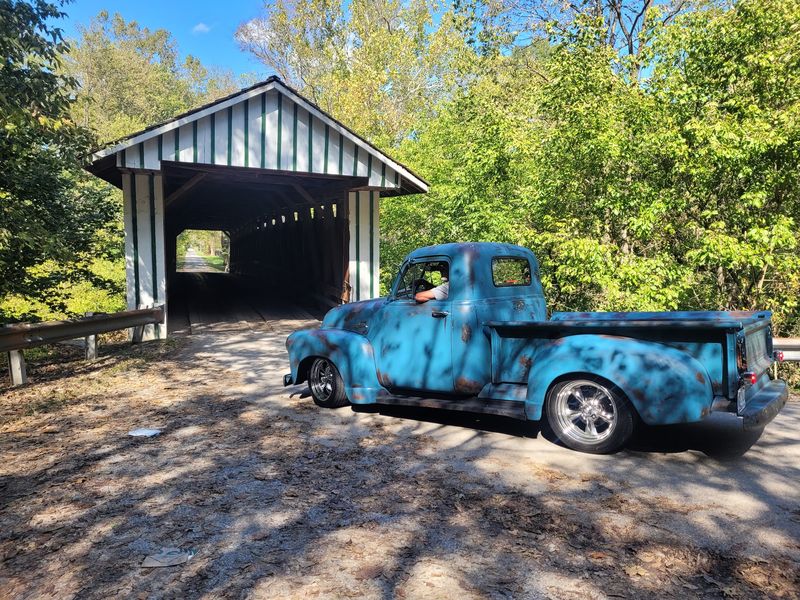
Floods, repairs, and more than a century of traffic, and you can still drive across this one. Built around 1877, it’s the last covered bridge left in its county.
The Burr truss bridge runs 124 feet long and 18 feet wide over Hinkston Creek. That width gives it a roomy feel compared to some skinnier cousins.
Family teamwork kept it going. Louis Bower restored it in 1913, and his son, known as Stock, did the same in 1937.
A flood damaged the bridge in 1997. Crews restored it in 2001, and it has carried on ever since.
It landed on the National Register of Historic Places in 1974. That’s a solid badge for a farm-country crossing.
Getting there is part of the fun. From US 68 just south of Millersburg, take KY 1893 west about 3.1 miles, then head north on KY 3118 for 1.2 miles.
Drive through slowly and roll your window down. Hearing tires thump across the deck is oddly satisfying.
Lexington is close enough for an easy side trip. Make it a morning drive and you could be back in town by lunch.
It ranks high because you get the full experience here. Size, history, and the chance to cross by car make it a Kentucky classic.
Pull fully off the road before taking photos. Cars still use the crossing, so watch for traffic as you snap pictures.
The Bower name pops up on several bridges in this list. That family left fingerprints on many of the state’s survivors.
Address: Colville Road, Millersburg, KY 40348
5. Dover Covered Bridge
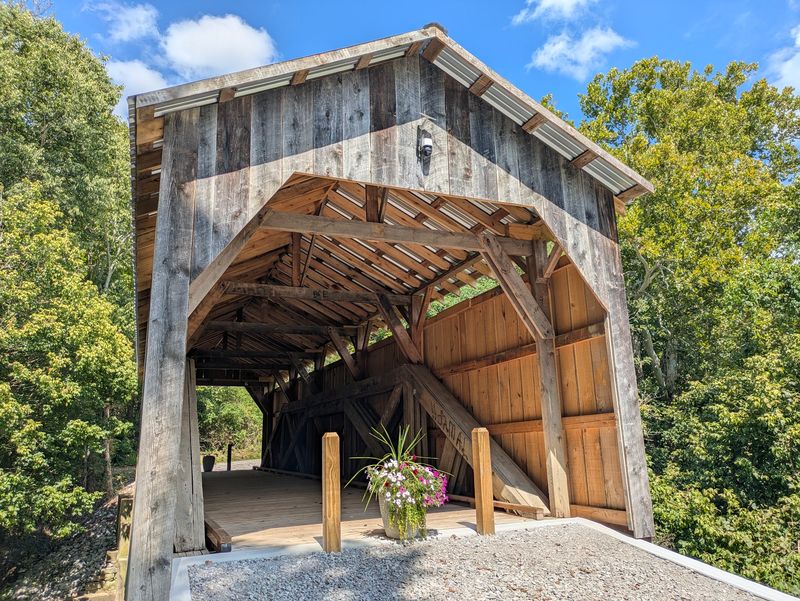
Age before beauty? Here you get both, since this bridge dates to around 1835 and ranks as the oldest covered bridge in Kentucky.
It started life as a toll bridge. Travelers once paid to cross Lees Creek, and now you can see it for free.
The span runs about 63 feet, though some sources list 62. Either way, it’s a quick crossing with a long story.
Inside, a modified queen-post truss carries the load. That’s a simpler design than the long Burr trusses elsewhere on this list.
The Dover Covered Bridge was closed to vehicles and pedestrians after severe flood damage in 2017, so visitors should check its current access restrictions before traveling.
Finding it is easy. Head about 200 yards south of KY 8 on Lees Creek Road, also called Tuckahoe Road.
Dover sits in Mason County, near the Ohio River. It makes a nice stop on a scenic drive along KY 8.
Bring kids who think old means the 1990s. This bridge will reset their idea of vintage pretty fast.
Why not number one? It’s small, and the ones above offer a bit more to explore.
Still, bragging rights count. Few people can say they crossed Kentucky’s oldest covered bridge on a random afternoon.
Short bridges make great photo frames. Stand back at a safe spot to fit the whole thing, roof and all, in one shot.
Watch for local traffic when you stop. A working bridge means neighbors still count on it.
Address: Lees Creek Road, Dover, KY 41034
6. Switzer Covered Bridge
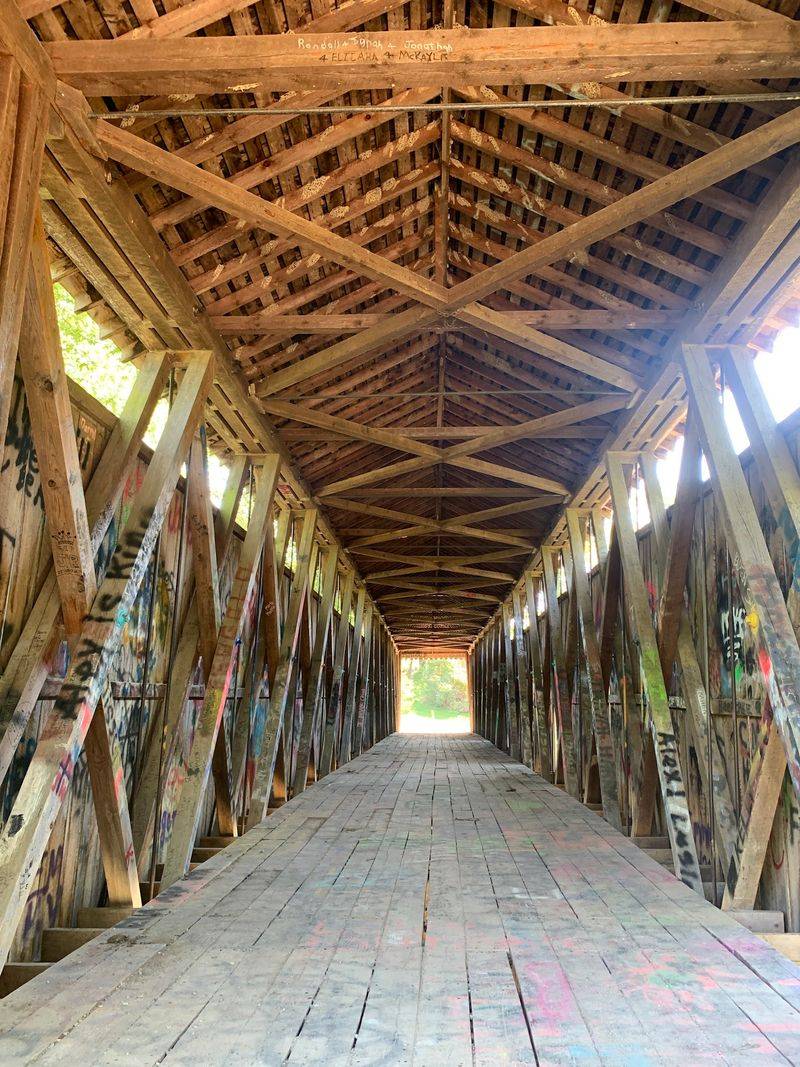
In March 1997, a flood swept this bridge right off its base. Kentuckians wouldn’t let it go, and it was rebuilt and restored in 1998.
George Hockensmith built the original around 1855. It’s 120 feet long, 11 feet wide, and the only covered bridge in Franklin County.
Look at the entrance openings. A sawtooth pattern runs along them, giving the bridge a fun, jagged edge.
The Howe truss design sets it apart from many others on this list. Louis Bower restored it back in 1906.
Cars stopped crossing in 1954. Walkers are still welcome, so you can explore inside at your own pace.
It spans North Elkhorn Creek and joined the National Register of Historic Places in 1974. Creek views from the bridge add a nice bonus.
Here’s a big perk. Frankfort, the state capital, is close by, so you can mix bridge time with a city day.
It ranks mid-list because so much was rebuilt after the flood. Still, the comeback story is part of the charm.
Bring good shoes for poking around the banks. Then snap that sawtooth entrance, which looks great in photos.
Kids might enjoy guessing how much water it takes to lift a whole bridge. Spoiler: way more than a bathtub.
A quick stop works fine, but lingering is better. Read up on the 1997 flood first, and the place will feel even more impressive.
Check the weather before heading out. High water on North Elkhorn Creek is a reminder of why this bridge needed rescuing.
Address: 3392 Jones Lane, Frankfort, KY 40601
7. Grange City Covered Bridge
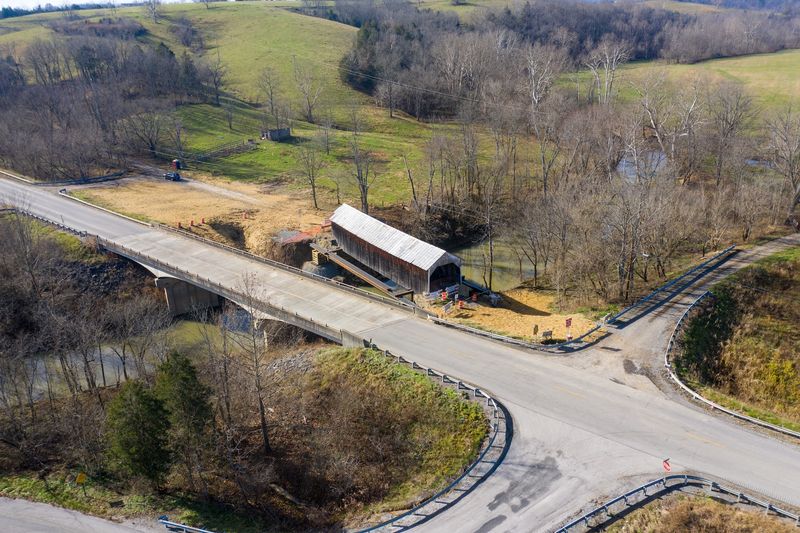
Wood bridges usually don’t wear metal coats, but this one does. Corrugated sheet metal now covers the roof and sides.
Built around 1868 to 1870, the bridge stretches 86 feet over Fox Creek. A Burr truss with multiple kingposts handles the heavy lifting.
The builders chose yellow pine timbers with double-shouldered braces. Its abutments are made of red stone, which stands out against the creek.
Originally, yellow poplar boards covered both sides. Times change, and so do bridge outfits.
Cars stopped crossing around 1968 or 1969 when a nearby concrete bridge took over. You can still walk through it today.
In 1998, the Kentucky General Assembly officially named it the Grange City Covered Bridge. Some folks still call it the Hillsboro-Grange City Covered Bridge.
It sits on KY 111 between Hillsboro and Grange City in Fleming County. That puts it close to Ringo’s Mill, so plan a two-bridge loop.
It also joined the National Register of Historic Places in 1976. That’s quite the resume for a roadside stop.
Why this spot on the list? The metal skin hides some of the old look, but the frame inside is a real treat.
Step in and let your eyes adjust. The pine beams and braces tell the story better than any sign could.
Compare it with Goddard on the same trip. Lattice versus kingpost makes a fun side-by-side lesson in old bridge building.
Bring a flashlight for a closer look at joints. Shadows inside a covered span can hide the best details.
Address: KY 111 and City Road, Hillsboro, KY 41049
8. Ringo’s Mill Covered Bridge
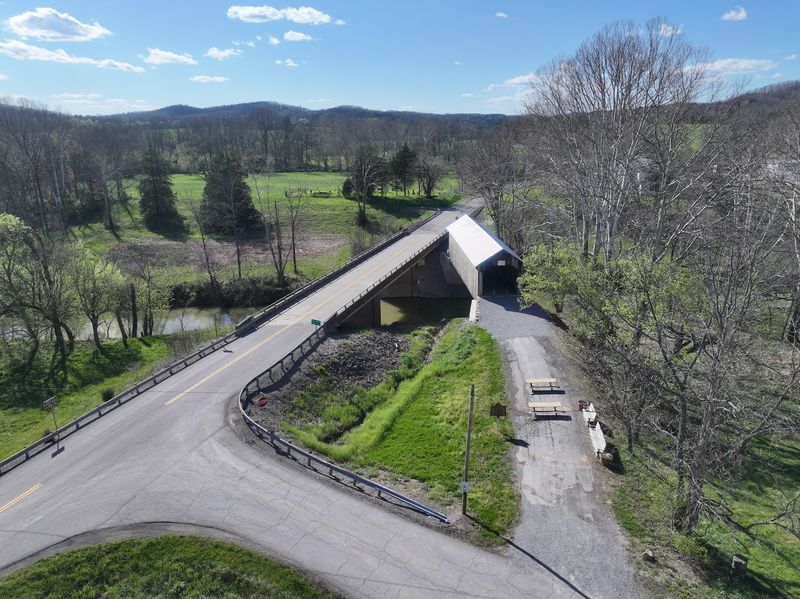
Long before smartphones, a grist mill on Fox Creek was the place to be. This bridge still carries the mill’s name from the 1880s.
Erected around 1867 to 1869, it stretches 89 feet. Its age and design look a lot like the Grange City bridge just down the road.
That likely means a multiple kingpost truss. Think of it as a twin, born only a few miles away.
Glance up at the eaves. There’s no siding right under them, so light sneaks in and brightens the inside.
Cars are no longer allowed, but you can walk across. Take your time and enjoy the creek setting.
The bridge sits where Rawlings Road meets KY 158, near Hillsboro in Fleming County. It’s an easy pairing with Grange City and Goddard.
Three bridges in one county? That’s a road trip waiting to happen.
Ranking it here was tough. It shares so much with Grange City that the two almost tie.
History buffs can picture farmers hauling grain across to the mill. Kids might just want to stomp around and hear the echo.
Snap a photo from the creek side if you can safely reach it. The long, low profile looks great against the water.
Grist mills ground corn and wheat into flour and meal. A bridge nearby made that trip much easier for local families.
Bring a small notebook if you’re bridge hunting. Jotting down lengths and dates makes comparing the Fleming County trio more fun.
Address: Rawlings Road and KY 158, Hillsboro, KY 41049
9. Walcott Covered Bridge
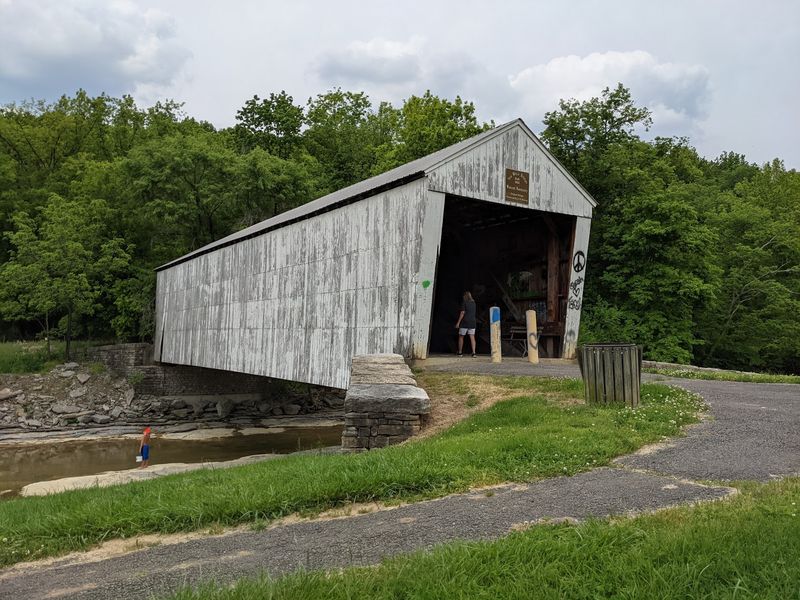
Bracken County has had exactly one covered bridge, as far as anyone knows, and this is it. Talk about an only child.
The bridge was likely built in the 1880s. It replaced an earlier 1824 bridge and may still hold some of those older timbers.
That’s a fun mystery to think about as you look it over. Some wood here could be older than many states.
It crosses Locust Creek with a 75-foot span. Recent renovation work has it looking ready for visitors.
Find it at the intersection of KY 9, also called the AA Highway, and KY 1159. That’s handy if you’re cruising northern Kentucky anyway.
The AA Highway connects plenty of bridge country. You could link this stop with Dover in nearby Mason County.
Why rank it lower? Less is known about its history, and its story has more question marks than answers.
Still, a lone survivor deserves a visit. It’s the only one of its kind in the county, after all.
Grab photos from a safe pull-off. The creek and roofline make a nice simple picture.
Bring curiosity more than a checklist. Guessing which beams might date to 1824 is half the fun.
Northern Kentucky gets busy near the cities, but this stop sits out in farm country. It’s a nice break from interstate traffic.
Check road conditions after heavy rain. Creeks in the area can rise quickly, so plan your visit on a dry day.
Address: KY 9 and KY 1159, Bracken County, KY
10. Johnson Creek Covered Bridge
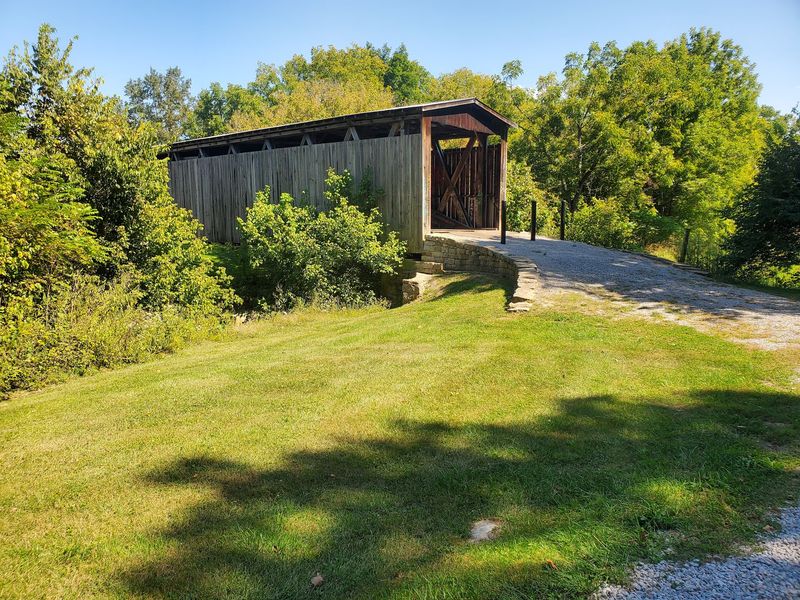
Jacob Bower built this one, and the Bower name pops up all over Kentucky bridge history. Fans of the family can add a check mark here.
The bridge was completely restored in 2009. That means you’re seeing it in fresh shape for its age.
It sits on Covered Bridge Road near Mount Olivet in Robertson County. Yes, the road name kind of gives away the surprise.
Directions are simple. Head north on US 68, turn left at KY 165, then right onto KY 1029.
Robertson County is one of the smallest counties in Kentucky. Finding a covered bridge here feels like a nice bonus.
Why does it land at number ten? Less history is easy to find, so the bridge keeps more secrets than others.
That’s not a bad thing. Mystery can make a visit more fun, especially if you like reading old wood for clues.
Bring a camera and walk around both ends. The road approach makes it easy to frame the whole bridge.
Pair it with Colville or Walcott for a longer loop. Both are within reasonable driving distance in this part of Kentucky.
Kids might enjoy spotting the road sign that matches the bridge. Small wins make long drives feel shorter.
Restorations help old bridges last longer. Visiting shows there’s still interest in keeping them around.
Take a moment to look at the roof and sides together. Fresh repairs and old design make an interesting mix.
Address: Covered Bridge Road, Mount Olivet, KY 41064
11. Oldtown Covered Bridge
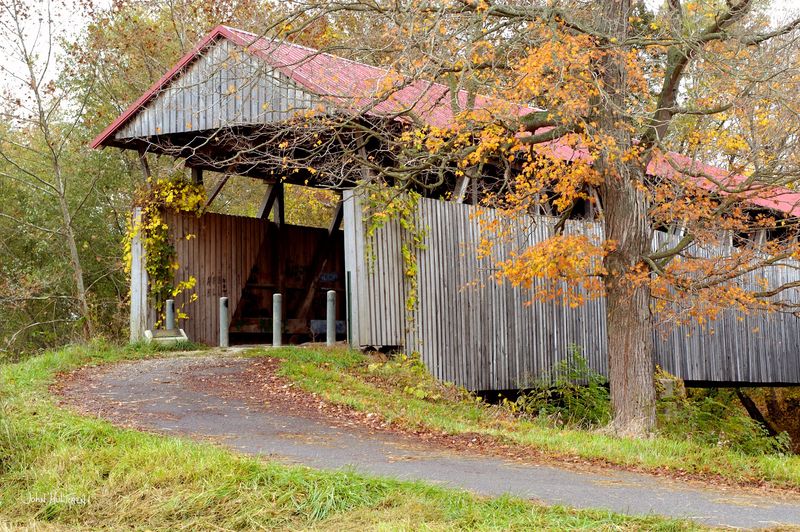
Floods tried twice to take this bridge, in 1913 and 1937, and both times it held on. Built around 1880, it’s a stubborn piece of Greenup County history.
The Burr truss design stretches 178 feet across the Little Sandy River in two spans. That makes it one of the longer survivors on this list.
Cars haven’t crossed since 1985. Access for walkers has been unclear in recent years, so plan to enjoy it from the outside.
Why rank it last? A 1999 rebuild used mostly new load-bearing parts, and that changed its original look.
Still, the story here is good. A group called the Green-Thumb Men restored it in 1972 and 1973, and it joined the National Register in 1976.
The bridge sits about 750 feet east of KY 1 on Frazer Branch Road. That makes it an easy add-on if you’re already exploring the Greenup area.
Bring a zoom lens or just a good phone camera. The two-span shape looks great from the road and riverbank.
Respect posted signs and private land around the site. A quick, careful stop keeps this old survivor in good shape for the next visitor.
Pair it with Bennett’s Mill for a Greenup County double feature. Two bridges, one afternoon, and plenty of country roads in between.
River views add to the charm, especially when the water is calm. Fall leaves can make a nice frame around the old timbers.
Address: Frazer Branch Road, Oldtown, KY 41039