A Vintage Italian Grocery Store Hides One Of California’s Most Charming Pizzerias
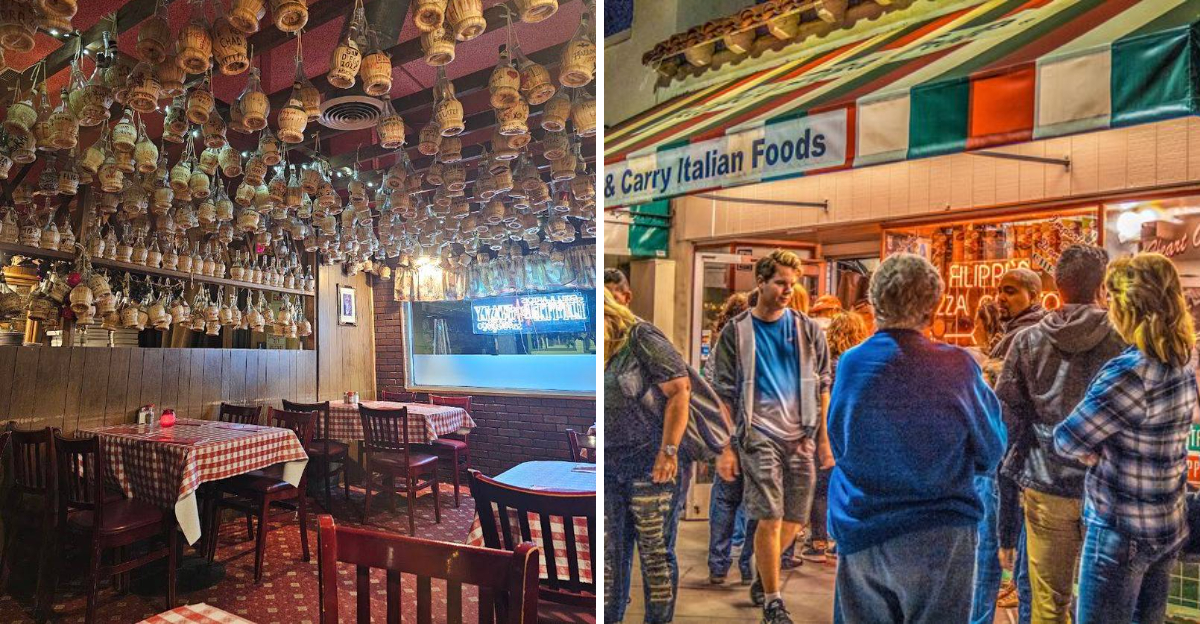
Finding the dining room is half the fun here.
First, there is the old-school Italian grocery feeling. Shelves packed with imported goods. Red sauce energy everywhere. Deli-style charm doing its thing before a pizza even hits the table.
Then the real surprise waits past all that market bustle, like dinner decided to hide behind the good olive oil.
A California pizzeria gets much harder to forget when the entrance feels like a tiny scavenger hunt.
The setup gives the whole meal personality before the first slice arrives. It is not just about cheese, crust, and sauce, though those obviously matter.
It is the feeling of walking through one experience to reach another. Suddenly, a simple meal has a little secret-door magic without trying too hard.
That kind of charm is tough to manufacture. It comes from history and the strange joy of realizing the route to your table is part of the story.
Enter Through An Old-Fashioned Italian Grocery Store
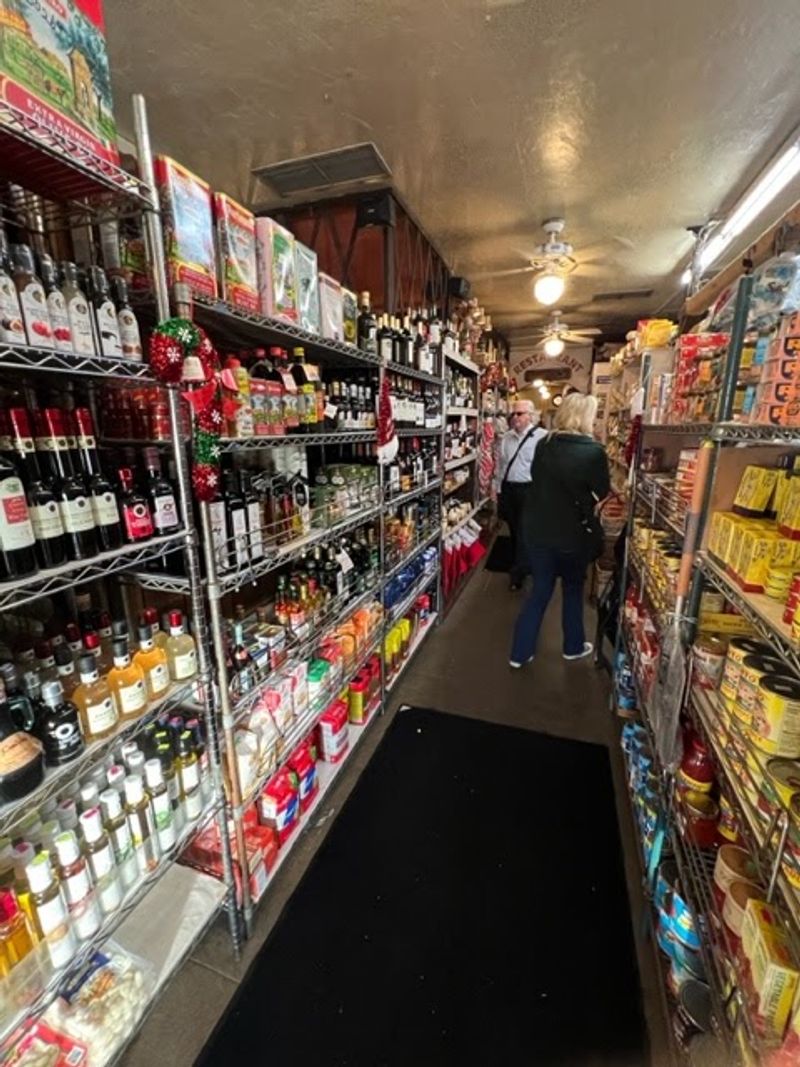
Usually once we step inside a restaurant, a restaurant is what we expect right? Well, over here, the story is a little different.
The entrance is a fully functioning Italian grocery store, stocked with imported cheeses, specialty meats, canned goods, fresh bread, and an impressive selection of olive oils.
The aroma alone is enough to sharpen any appetite before a single menu item has been considered.
This market section predates the restaurant itself, rooted in the original Cash and Carry Italian Foods shop that the founding family opened on India Street in the late 1940s.
Shelves are neatly arranged with Italian cookies, dried pastas, and deli staples that feel genuinely imported rather than mass-produced.
It is a small but meaningful detail that sets the tone for everything that follows.
Browsing the grocery section before being seated gives visitors a quiet moment to absorb the atmosphere and appreciate the layered history of the space. The transition from market to dining room happens gradually, pulling guests deeper into an experience that feels curated by decades of tradition rather than a design team.
Few restaurants in San Diego open with such a distinctive and flavorful first impression.
Follow The Narrow Passageway Into The Hidden Dining Room
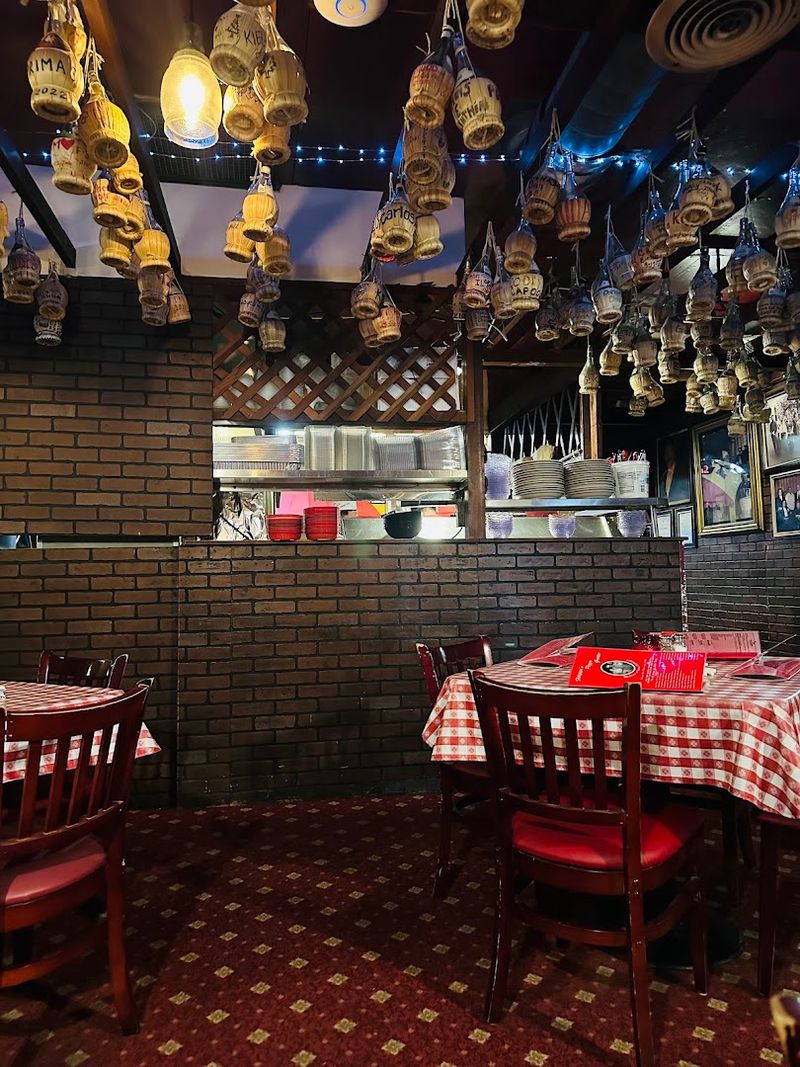
Past the shelves of imported goods and the hum of the deli counter, a narrow passageway connects the grocery store to the main dining area.
The shift feels almost theatrical, like being guided backstage before the real show begins. It is a quiet architectural quirk that has become one of the most talked-about features of the entire experience.
The transition builds a genuine sense of discovery.
Guests move from the compact, product-filled market into a dining room that opens up with booths, tables, and the unmistakable warmth of a classic Italian trattoria.
Several distinct seating areas spread through the space, offering options that range from cozy corners to slightly more open arrangements near the main floor.
The layout rewards curiosity and rewards those who take a moment to look around before settling in.
Lighting is kept dim enough to feel intimate without being difficult to navigate, and the walls carry decades of visual history.
The passageway itself is a small but memorable detail, one that makes arriving at the table feel earned rather than routine.
Not many restaurants can turn the act of walking to a seat into a moment worth remembering, but this one manages it naturally.
Look Up At The Chianti Bottles Hanging From The Ceiling
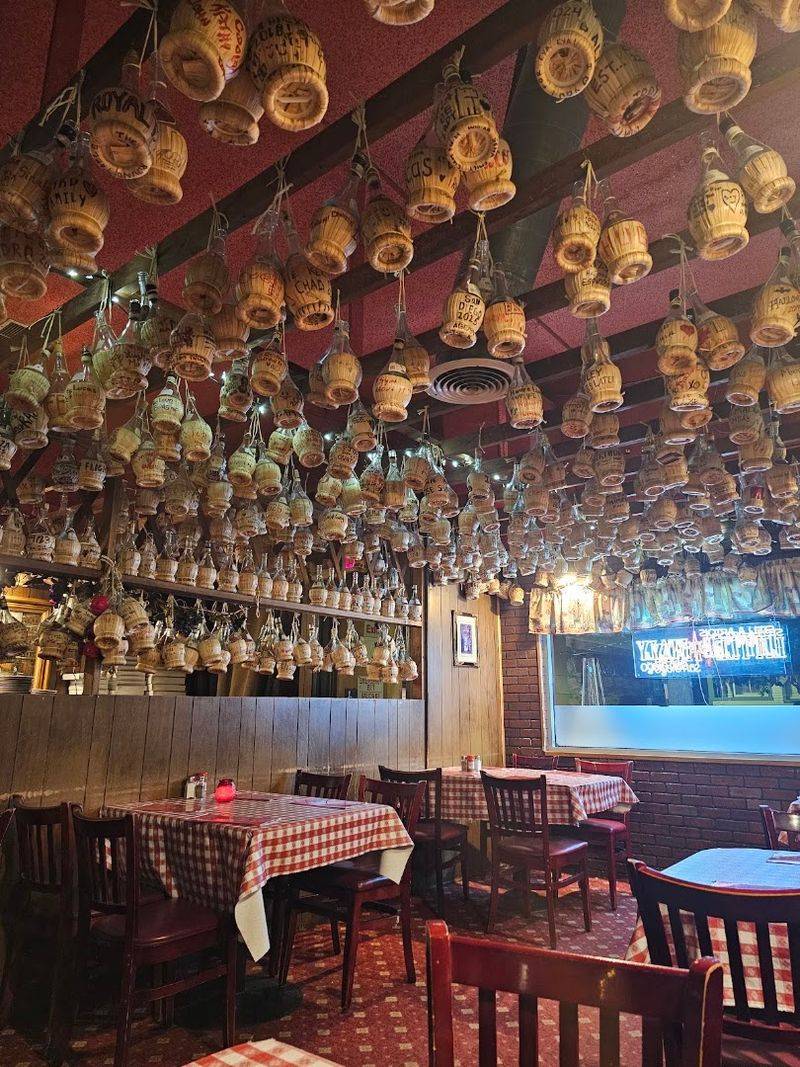
The ceiling at California’s Filippi’s Pizza Grotto is not something most first-time visitors are prepared for.
Hundreds of Chianti bottles hang from the wooden rafters above, covering nearly every inch of overhead space in a display that is equal parts art installation and living scrapbook.
The effect is visually striking and deeply nostalgic, the kind of detail that makes guests tilt their heads back and forget, briefly, that they were about to order dinner.
Many of the bottles have been signed or decorated by past guests, turning the ceiling into a decades-long record of the people who have eaten here.
It is a tradition that transforms the decor into something participatory, a quiet invitation to become part of the restaurant’s ongoing story.
The bottles catch the light in small ways that shift the mood of the room without anyone quite noticing why.
This single decorative choice defines the atmosphere more than almost anything else in the space.
It communicates longevity, personality, and a genuine commitment to keeping things exactly as they have always been.
For anyone who appreciates the kind of character that only accumulates over time, looking up at that ceiling for the first time is a genuinely memorable moment.
Slide Into A Booth Beneath Red-And-White Checkered Tablecloths
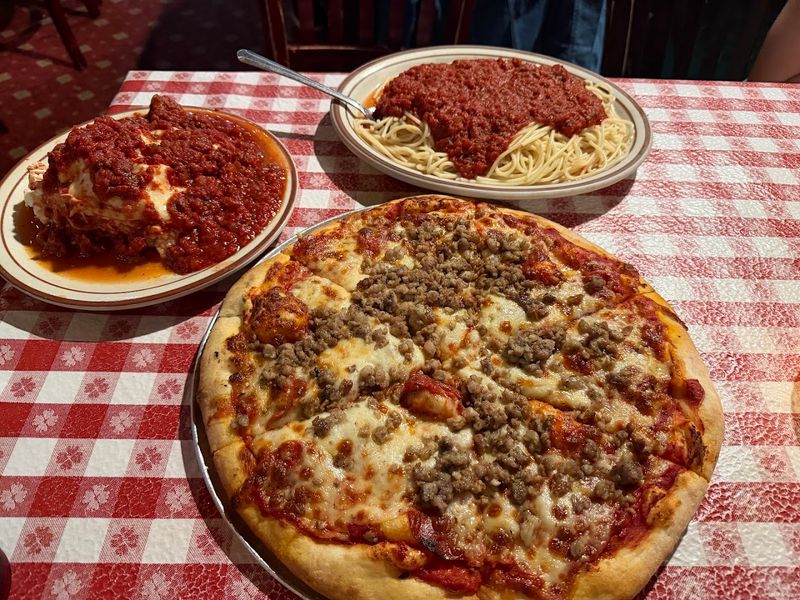
Red-and-white checkered tablecloths have been a symbol of casual Italian dining for generations, and at Filippi’s Pizza Grotto, they are not a stylistic choice so much as a deeply rooted tradition.
Every table in the dining room is dressed in this familiar pattern, creating a visual consistency that feels both timeless and immediately comforting.
Settling into one of the booths beneath these tablecloths signals that a proper, unhurried meal is about to happen.
The seating itself is designed for comfort rather than turnover. Booths line sections of the dining room with enough padding and depth to encourage guests to stay a while, which most of them do.
The combination of dim lighting, wooden furniture, and the checkered cloth underfoot in the visual field creates a sensory environment that is hard to recreate at home or in a more modern setting.
There is something psychologically grounding about eating at a table covered in that pattern.
It signals that the food is going to be generous, the service is going to be relaxed, and the expectation of perfection has been replaced by something warmer and more honest.
For families in particular, sliding into one of these booths tends to feel like returning to something familiar, even on a first visit.
Learn How The Family Business Began In 1950
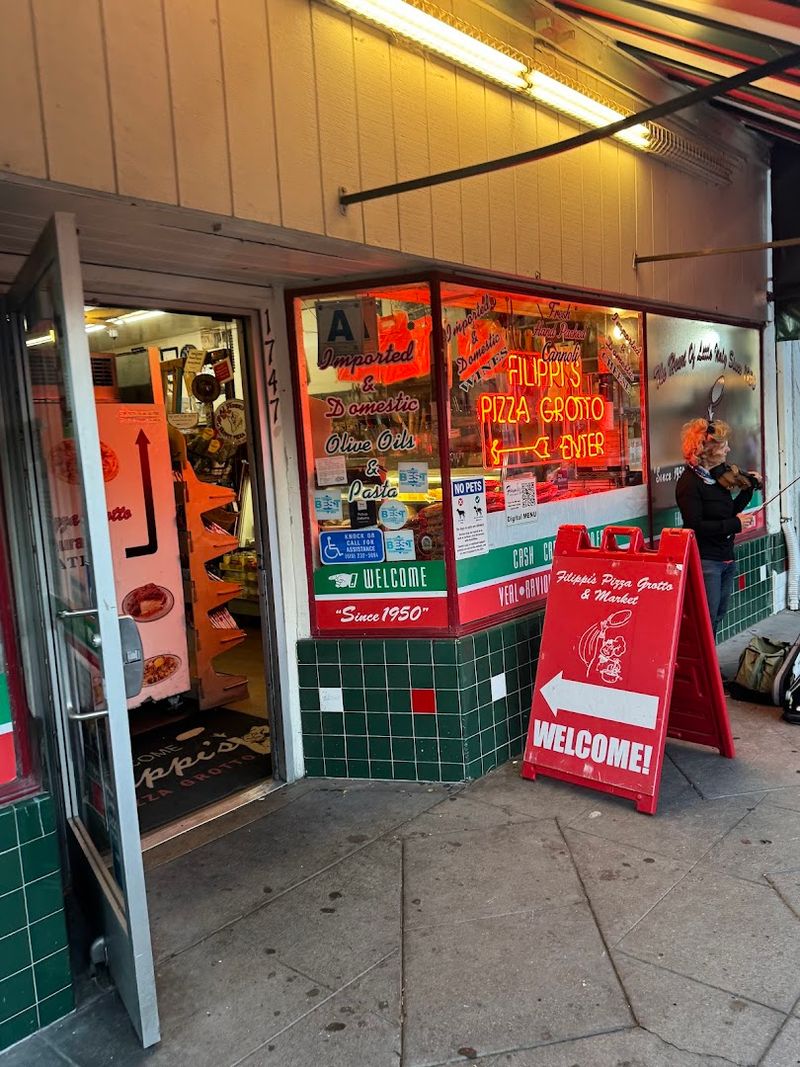
The story behind California’s Filippi’s Pizza Grotto is rooted in the kind of determination that defined mid-century immigrant entrepreneurship in America.
The founding family opened a small market on India Street in the late 1940s, originally called Cash and Carry Italian Foods.
By 1950, the operation had grown to include food service, and what began as a neighborhood grocery gradually became a full-service restaurant with a loyal following.
The original location at 1747 India St, San Diego, California 92101 remains in operation today, which is a remarkable fact in an industry where most restaurants rarely survive a single decade.
The building has changed in small ways over the years, but the core identity of the place has remained remarkably consistent.
Guests who visit today are eating in a space that has served San Diego continuously for more than seven decades.
Understanding that history changes the way the meal feels. The recipes were not developed by a corporate test kitchen or a consulting chef brought in for a relaunch.
They came from a family kitchen, refined over years and passed down with genuine care.
That context adds a layer of meaning to every plate that arrives at the table, one that no amount of interior design can manufacture from scratch.
Order A Pizza Buried Beneath A Generous Layer Of Cheese
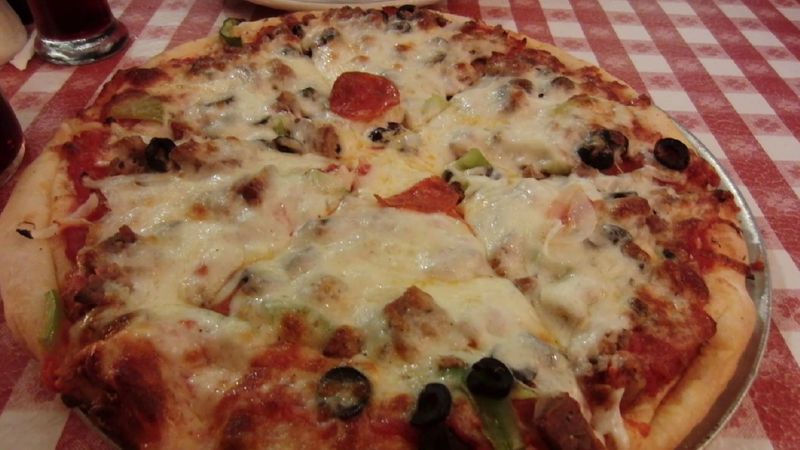
The pizza at Filippi’s Pizza Grotto has a reputation that precedes it, and the most talked-about element is consistently the cheese.
Fresh mozzarella is applied with a generosity that borders on theatrical, covering the entire surface of the pie in a thick, bubbling layer that stretches with every slice.
The dough is made in-house and baked in a traditional oven, resulting in a crust that is substantial without being dense.
Classic options like cheese and pepperoni sit alongside specialty combinations, giving first-time visitors a straightforward entry point and regulars enough variety to keep returning.
The pizza tends to be heavier than what most modern pizza spots serve, which means ordering one pie for two people is often more than enough.
Guests who underestimate the portion size tend to find out quickly that the kitchen does not hold back.
Picking up the box to carry it out, guests sometimes remark on how unexpectedly heavy it feels, which gives a fairly accurate preview of what is inside.
The pizza is not trying to be elegant or minimalist. It is trying to be satisfying in the most direct and honest way possible, and by most accounts, it succeeds at exactly that with reliable consistency across visits.
Try The Hearty Lasagna, Ravioli, And Spaghetti Dinners
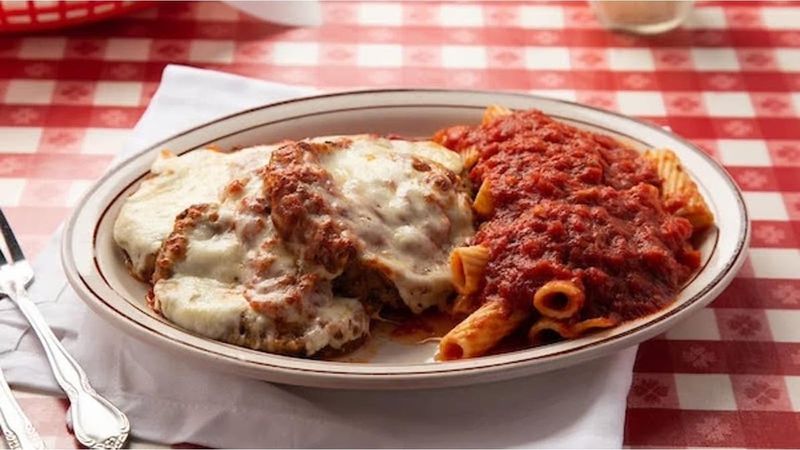
Beyond the pizzas, the pasta menu at Filippi’s Pizza Grotto carries its own considerable weight.
The lasagna is built from a layered combination of noodles, ricotta, and mozzarella, finished with either a meat or marinara sauce and baked until the top edges develop a slightly caramelized texture.
The portion is generous enough that most guests find themselves planning for leftovers before the plate even arrives.
Ravioli is another standout, particularly the spinach and cheese variety, which arrives stuffed to a satisfying fullness rather than the flat, underwhelming versions common at less careful kitchens.
Spaghetti is served with imported noodles and a choice of meat or vegetarian marinara sauce, keeping the preparation simple enough to let the quality of the ingredients carry the dish.
Other options include manicotti, eggplant parmigiana, and chicken parmigiana, each following the same principle of generous portions and straightforward execution.
The pasta menu reflects the same philosophy as the rest of the kitchen: recipes that have been made the same way for decades and have not needed significant adjustment.
For guests who arrive expecting fusion twists or modern reinterpretations, this menu will feel refreshingly traditional.
For everyone else, it delivers exactly the kind of hearty, uncomplicated Italian comfort food that the restaurant has always been known for.
Spot The Historical Marker Honoring The Restaurant’s Founders
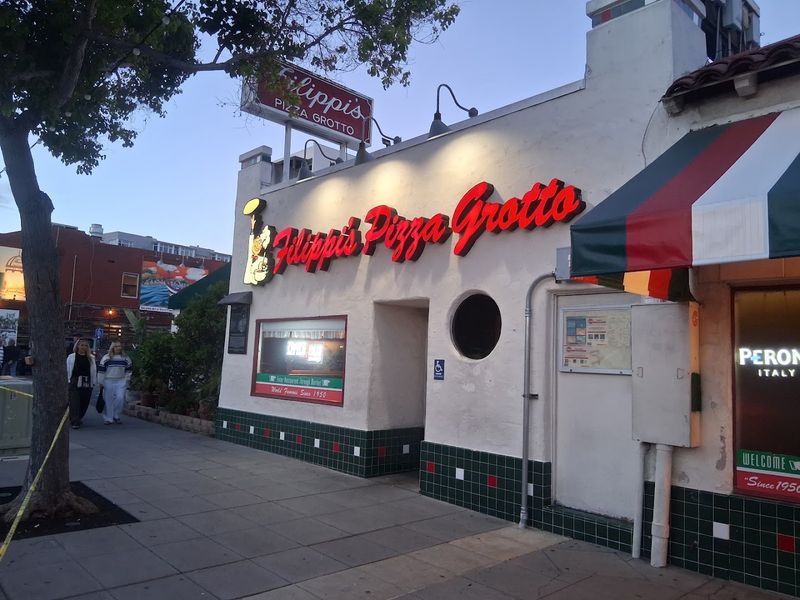
Outside the front of the building, a historical marker stands as a permanent acknowledgment of the people who built Filippi’s Pizza Grotto from a neighborhood grocery into a San Diego institution.
The marker was erected in 2011 by the Little Italy San Diego Legends organization, and it commemorates the founding couple who brought their version of the American Dream to India Street in the late 1940s.
The restaurant’s location at 1747 India St, San Diego, California 92101 is where the marker can be found, positioned directly at the entrance.
Markers like this one are not handed out casually. They represent a formal recognition by the surrounding community that a particular business or individual has contributed something lasting and meaningful to the neighborhood.
For a family-owned restaurant, receiving that kind of acknowledgment speaks to the consistency and cultural significance that Filippi’s has maintained across more than seven decades of operation.
Pausing to read the marker before walking inside adds a brief but grounding moment to the visit.
It reframes the meal ahead as something more than a dining experience and positions the restaurant within the broader story of Little Italy as a neighborhood shaped by immigrant ambition and family dedication.
The marker is easy to miss if guests are moving quickly, so slowing down at the entrance is worth the extra moment.
Prepare for A Line During The Busiest Dining Hours
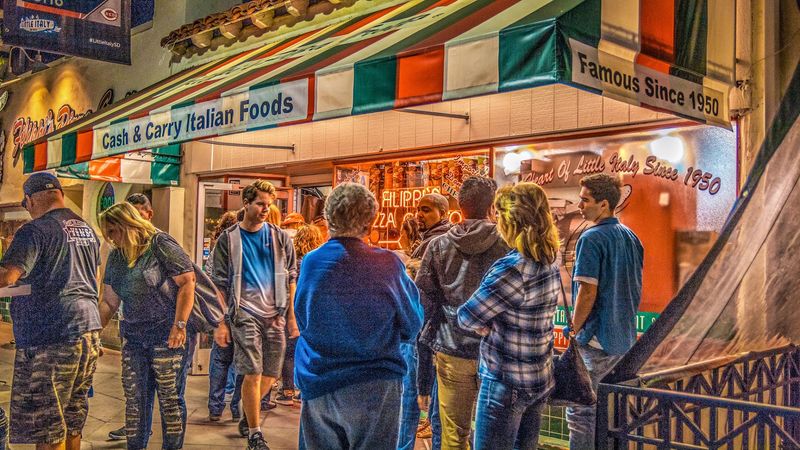
Popularity at a restaurant with limited seating tends to produce a predictable outcome: a line out the door during peak hours.
Filippi’s Pizza Grotto is no exception, and evenings along with weekend lunch service regularly draw enough guests to create waits that can stretch to around 50 minutes on busier nights.
The restaurant does not take reservations in the traditional sense, so arriving with some flexibility in the schedule is genuinely helpful.
The dining room fills quickly once it opens, partly because the space is intimate enough that a handful of large groups can occupy most of the available tables.
Guests who arrive closer to the opening time of 11 AM on any day of the week tend to have a smoother experience with seating.
On weekdays, the restaurant closes at 9 PM, while Fridays and Saturdays extend service to 10 PM, giving guests a slightly longer window on the busiest nights of the week.
Waiting in line is not an unpleasant experience for most visitors, partly because the neighborhood itself offers enough to look at and the energy outside the restaurant tends to be lively.
The grocery store section also gives early arrivals something to browse while the dining room clears.