California Has A McDonald’s So Retro It Looks More Like A 1950s Movie Set Than A Drive-Thru
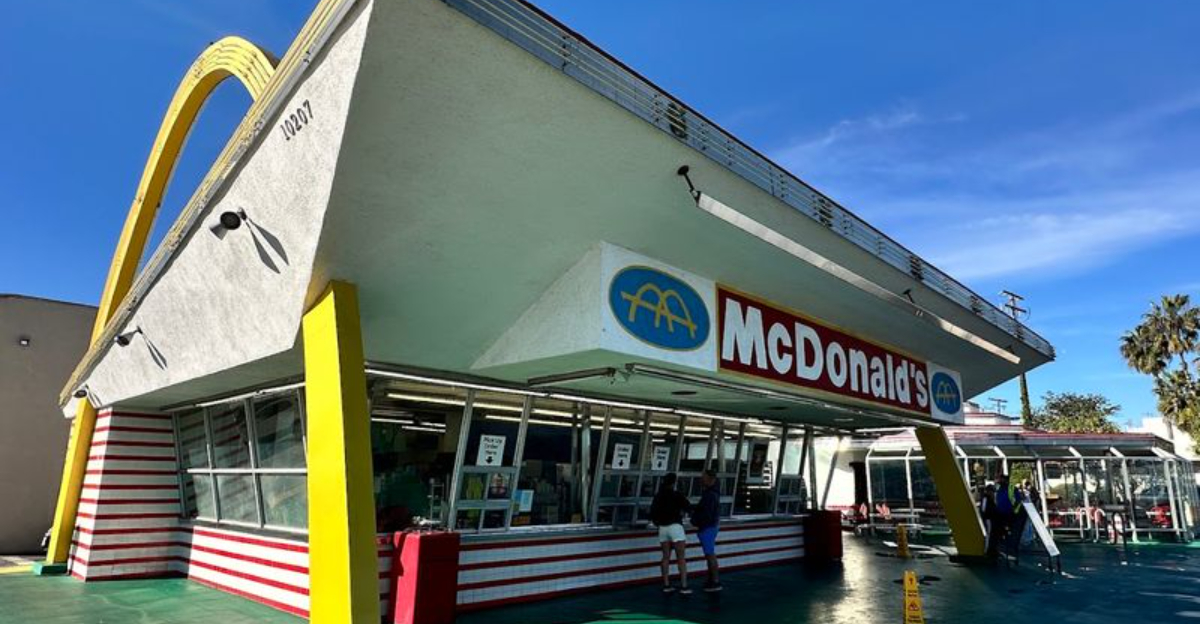
Fast food usually asks you to eat, leave, and forget what the building looked like. Not here.
Bright red-and-white tiles, sweeping golden arches, and a towering roadside sign make this restaurant look ready for teenagers in letterman jackets to pull up in shiny convertibles.
Opened in 1953, it remains the oldest operating McDonald’s built in the chain’s original red-and-white style.
Roadside history in California gets delightfully strange when a regular burger stop still looks almost unchanged from the early days of the Golden Arches.
The walk-up design feels wonderfully different from the familiar boxy restaurants found along modern highways.
You can still order recognizable menu staples, but the surroundings are doing most of the heavy lifting.
Even people who rarely get excited about fast food may end up circling the building for photos.
See The World’s Oldest Operating McDonald’s
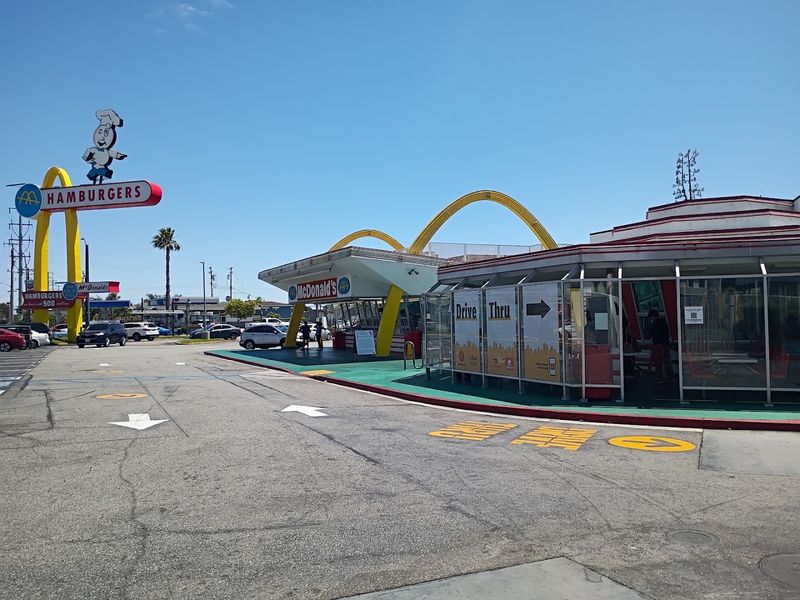
How often do you see a fast food restaurant claiming a spot in the history books? The one in Downey holds a record that no other location can touch.
Opening its doors on August 18, 1953, it stands as the oldest continuously operating McDonald’s restaurant in the world.
The venue at 10207 Lakewood Blvd, Downey, CA 90240 was the third McDonald’s ever built and one of the earliest franchised by the original McDonald brothers before Ray Kroc entered the picture.
Because this location predates the corporate buyout by the McDonald’s Corporation, it was never required to follow the modernization standards that reshaped every other franchise across the country.
That legal quirk is a big reason why so much of the original building survives today. Visitors arriving here for the first time tend to stop and stare before even thinking about ordering food.
The sense of stepping onto a mid-century movie set is immediate and hard to shake.
Everything from the tilted roof to the walk-up ordering windows signals that this place operates by its own rules.
It is open daily from 6 AM to 10 PM, making it accessible for both early risers and late afternoon visitors looking for a side of history with their meal.
Admire The Original 1953 Googie Architecture
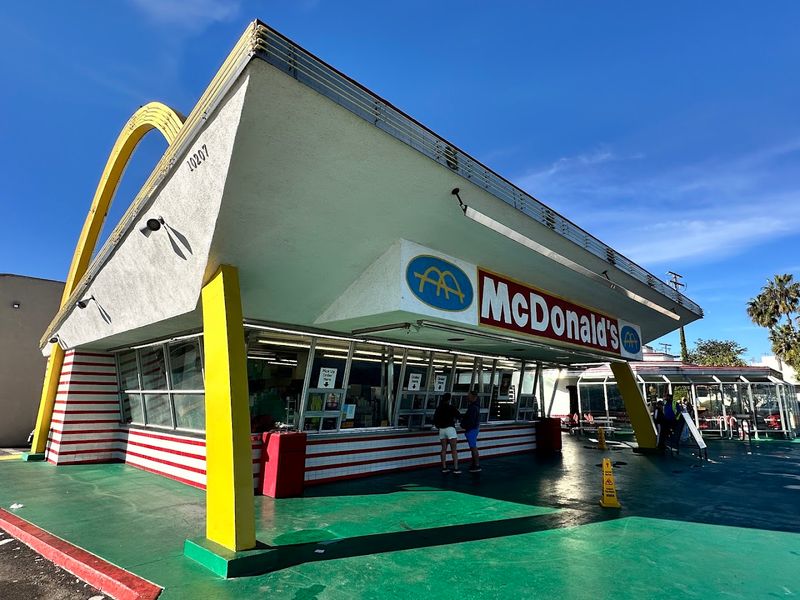
Googie architecture was born from the optimism of postwar America, a design style that celebrated speed, space travel, and the open road.
The Downey McDonald’s is one of the most intact surviving examples of this aesthetic, designed by architect Stanley Clark Meston with draftsman Charles Fish.
Together they translated Richard McDonald’s vision of a fishbowl-style restaurant into something bold, angular, and impossible to miss from a moving car.
The building features a dramatically tilted wedge-shaped roof that juts outward at an exaggerated angle, originally designed to shelter customers waiting at the counter.
Red and white ceramic tiles wrap around the base, and canted plate-glass windows expose the kitchen to anyone walking past.
Every element of the structure was intentional, built to grab attention at a time when roadside competition was fierce and drivers made split-second decisions about where to stop.
Googie design was once everywhere along Southern California’s commercial strips, but most examples have been torn down or heavily remodeled over the decades.
Seeing this building in person offers a rare and tangible connection to that era.
The proportions feel almost theatrical, like a stage set that somehow survived long enough for the rest of the world to catch up and appreciate it.
Spot Speedee, The Chain’s Original Mascot
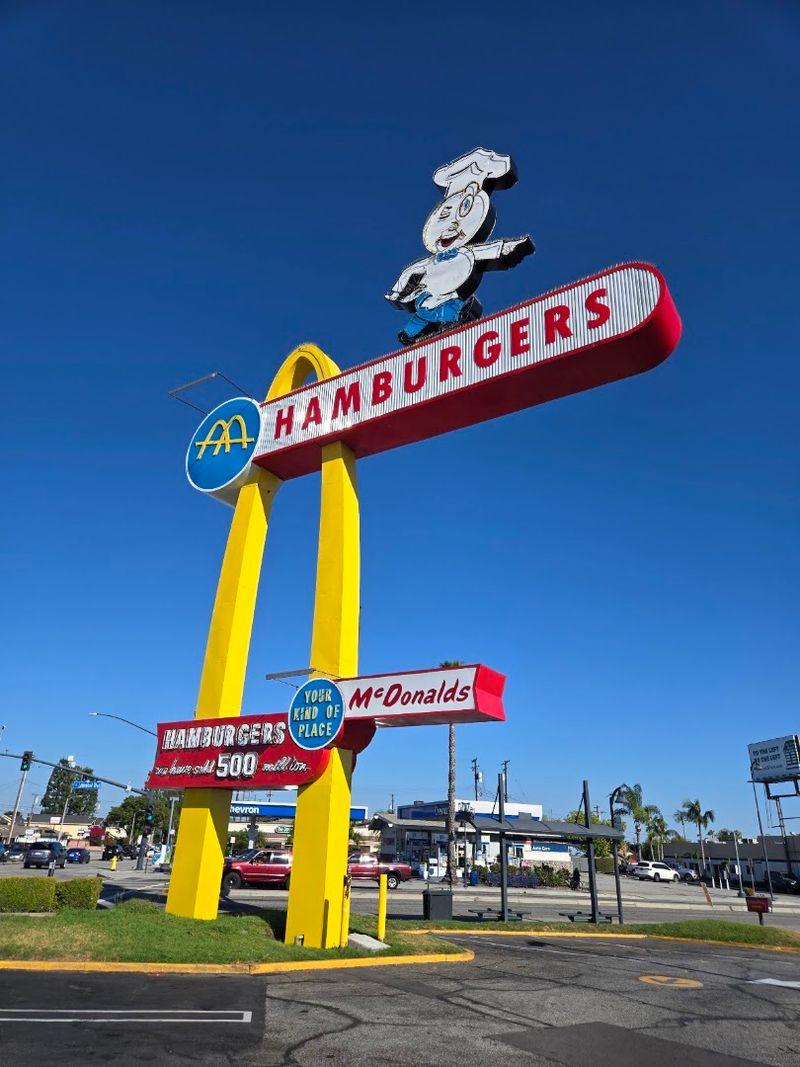
Long before Ronald McDonald became the face of the brand, a cheerful little character named Speedee was doing the job.
Perched atop the sign at the Downey location, Speedee is depicted as a chef with a hamburger for a head, winking and waving with the kind of cartoon confidence that defined mid-century American advertising.
The character was created to represent the McDonald brothers’ Speedee Service System, their revolutionary approach to fast and consistent food preparation.
Speedee was retired as the national mascot in the early 1960s when the brand pivoted toward a different identity, but this Downey location kept him visible.
His presence on the sign is one of the most photographed details at the site, a small but meaningful link to the brand’s original personality.
The sign itself has gone through some restoration work over the years, and recent visits have noted updates to its condition.
Spotting Speedee for the first time tends to prompt a double-take from visitors who only know the brand through its modern imagery.
The hamburger-headed chef communicates something playful and unpretentious about where fast food culture began.
Browse The Small On-Site Museum
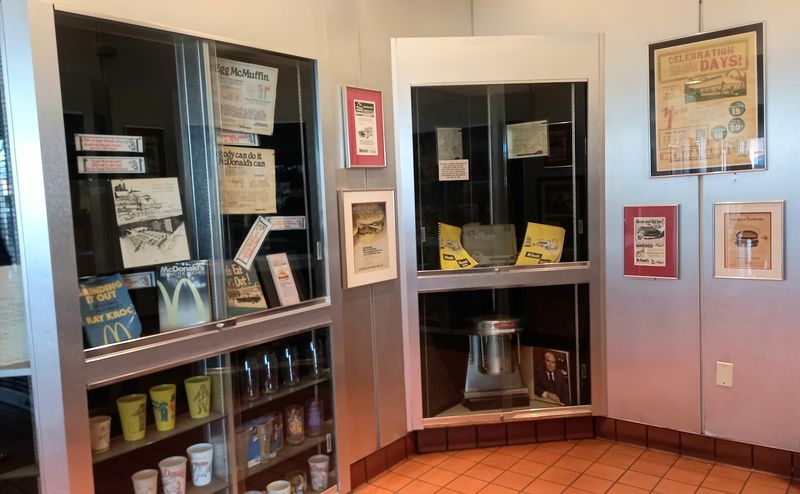
Right next to the operating restaurant, a compact museum offers a structured look at the origins of one of the world’s most recognizable food brands.
The museum is housed inside a replica of the very first McDonald’s location, which originally stood in San Bernardino, California.
That original building was demolished long ago, making this replica one of the only places where visitors can get a physical sense of what it looked like.
The space functions as both a gift shop and an exhibition area, with displays arranged to walk visitors through the brand’s early decades.
Restrooms are located inside the museum building, which makes it a practical stop during the visit as well as an interesting one.
The museum does not charge a separate admission fee, so stopping in requires nothing more than curiosity and a few extra minutes.
Opinions on the museum’s presentation vary, and it is worth approaching with realistic expectations rather than anticipating a polished, large-scale exhibition.
The collection is modest in size but meaningful in content, offering context that transforms the meal next door into something more layered.
Check Out Vintage Menus And Memorabilia
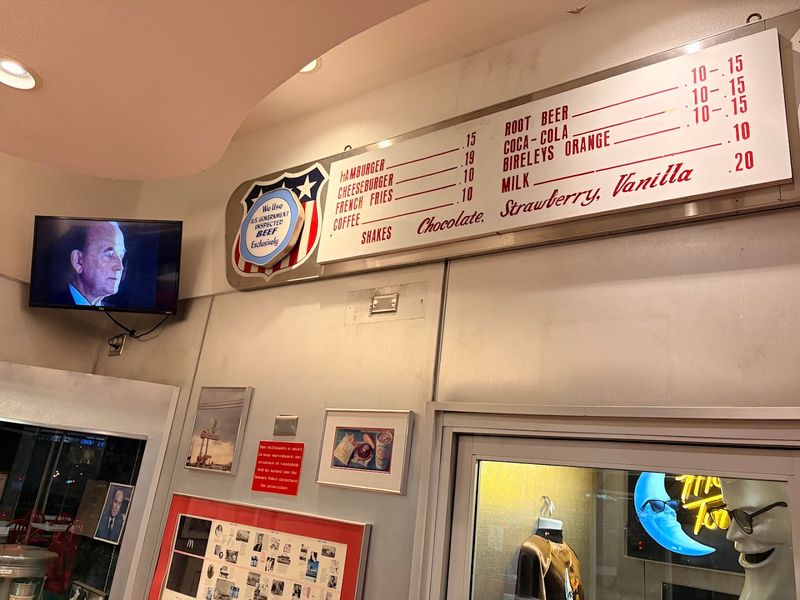
The memorabilia inside the Downey museum collection covers a surprisingly wide range of objects from the brand’s history.
Original uniforms worn by early crew members hang in displays alongside old cups, mugs, and packaging that reflect how dramatically the brand’s visual identity has shifted over the decades.
Seeing these items together creates a kind of informal timeline that is easy to follow even without reading every label.
Vintage kitchen equipment adds a more industrial dimension to the collection.
A multi-mixer of the type that originally caught Ray Kroc’s attention when he first visited the San Bernardino location is among the items on display, along with an Edison voice writer used in early operations.
These objects give a concrete sense of how the Speedee Service System actually functioned before automation and standardization changed everything.
Old menus are particularly striking for the prices they list, which serve as a quiet reminder of how much the economics of fast food have shifted.
Comparing those original price points to what gets charged at the window today is one of those small, unplanned moments that tends to stick with visitors long after they leave.
The memorabilia collection rewards slow looking and works best for those willing to spend a few unhurried minutes taking it all in rather than rushing through on the way to the counter.
Order Food From A Genuine Midcentury Landmark
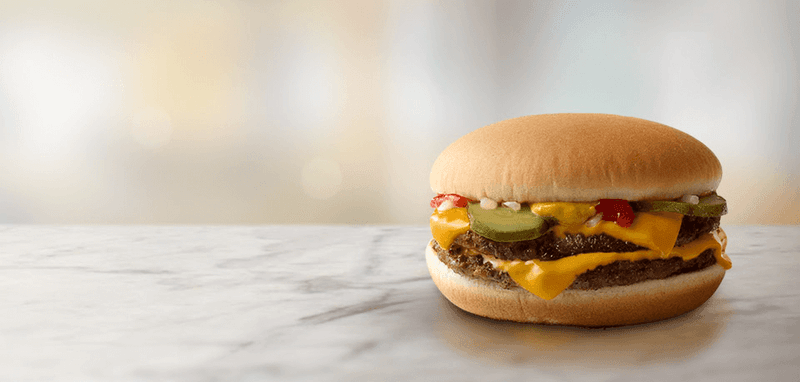
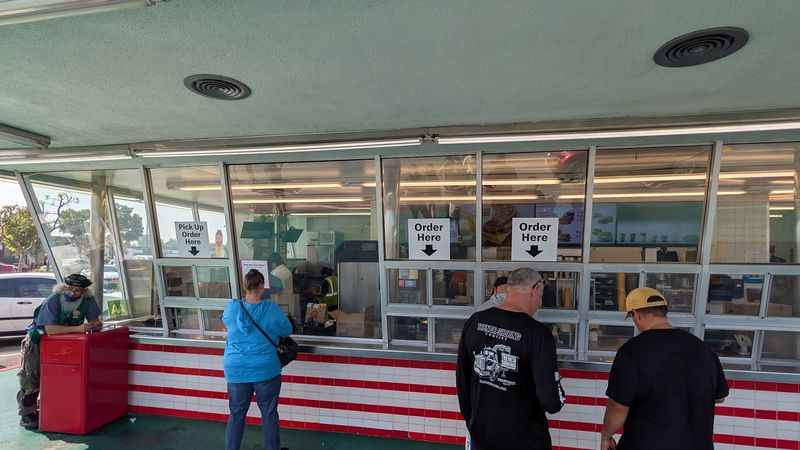
Ordering food here feels noticeably different from the touchscreen kiosks and mobile pickup shelves that define most modern McDonald’s experiences.
Customers walk up to a service window on the exterior of the building, place their order with a crew member face to face, and wait for their food in the open air.
The setup mirrors the original service model from the 1950s, when drive-ins and walk-up counters were the standard format for roadside dining.
A drive-thru was quietly added behind the building in 2016, offering a more conventional option for those who prefer it.
The addition was designed to avoid disrupting the historic facade at the front, so the retro visual experience remains intact from the street.
One menu item worth noting is the deep-fried apple pie, which was discontinued at other McDonald’s locations in 1992 when the chain switched to a baked version.
This location still serves the fried original, and it tends to be a highlight for visitors who remember it from childhood or have heard about it ahead of time.
Service pace at this location may be slower than at a typical McDonald’s, so arriving without a tight schedule tends to make the experience more enjoyable.
The food itself is standard McDonald’s fare, but the context surrounding the meal makes even a basic order feel a little more interesting than usual.
Notice The Glass-Wrapped Kitchen Design
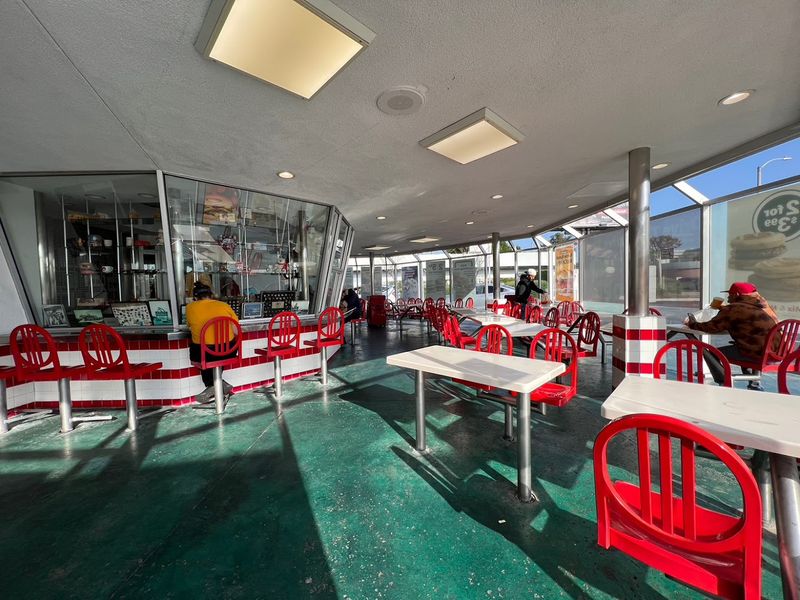
Transparency was a deliberate design choice when the original McDonald’s concept was being developed, and the Downey building reflects that philosophy in a very literal way.
Canted plate-glass windows wrap around the kitchen area, allowing anyone standing outside to look directly into the food preparation space.
The McDonald brothers believed that visible cleanliness would build customer trust, so they made the kitchen the centerpiece of the building rather than hiding it behind walls.
This open-kitchen concept was genuinely radical for its time. Most restaurants in the early 1950s kept their kitchens out of sight, treating food preparation as a private process.
Putting the cooking area on full display was a marketing decision as much as an architectural one, signaling to potential customers that there was nothing to hide about how the food was being made.
Standing outside and looking through those angled windows today still carries a certain novelty, even in an era when open kitchens have become common in upscale dining.
The difference here is that the glass is original, the angles are deliberately exaggerated for visual effect, and the whole setup dates back to a moment when fast food itself was a new idea.
The kitchen design is one of those details that rewards a slow walk around the building’s perimeter rather than a quick glance from the parking lot.
Learn How Locals Helped Save It From Demolition
The fact that this building still stands today is not an accident.
During the 1990s, the Downey McDonald’s faced a very real threat of demolition as the McDonald’s Corporation considered replacing it with a modern structure.
The prospect of losing the oldest operating location in the chain sparked significant pushback from community members, preservation advocates, and history enthusiasts who recognized what would be lost.
The National Trust for Historic Preservation responded by placing the restaurant on its list of America’s 11 Most Endangered Historic Places in 1994.
That designation brought national attention to the situation and added formal weight to the local campaign to save the building.
The Downey City Council also took action, blocking demolition efforts on the basis of the site’s historical significance to the city and to the broader story of American roadside culture.
McDonald’s Corporation ultimately agreed to restore the building rather than replace it, and the restored restaurant reopened in December 1996.
The restoration effort preserved the key architectural elements while making necessary updates to keep the building functional.
The story of how this location was saved is a reminder that preservation campaigns can work when enough people care enough to show up.