Exploring Nevada’s Unforgettable 120-Year-Old Desert Time Capsule
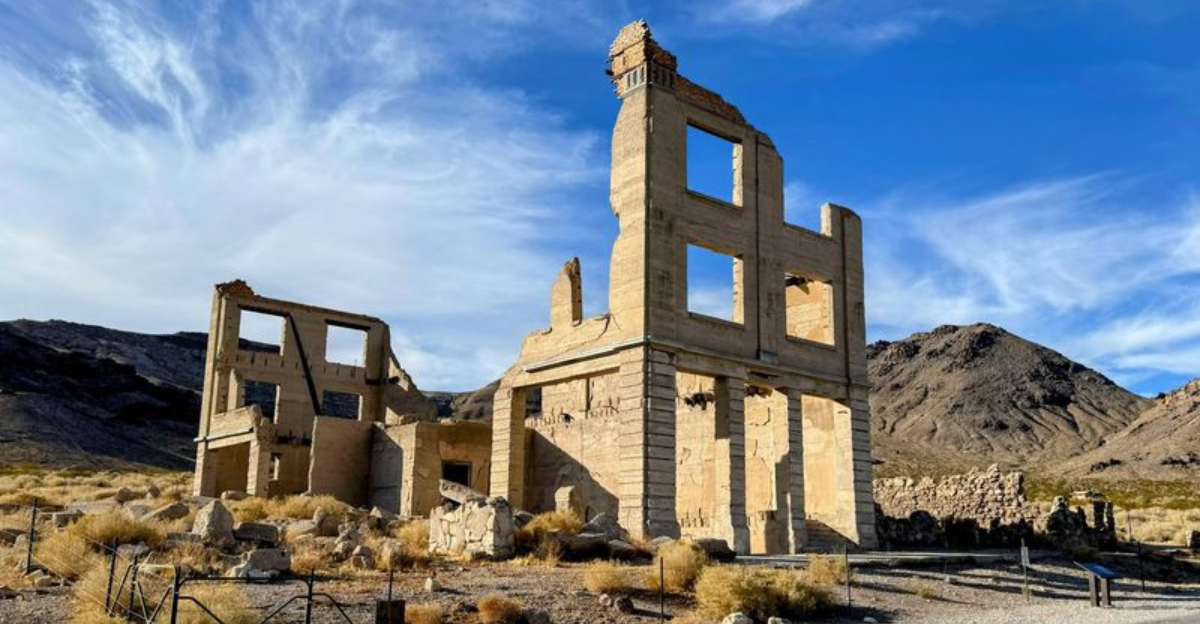
The scorched Nevada desert holds secrets in its shifting sands, with whispers carried on the dry wind.
A 120-year-old time capsule remains rooted in this quiet, empty land. Ruins stand along streets that once promised sudden wealth.
Each crumbling wall and scattered bottle hints at a boom that came and went. Afterward, the silence settled over the desert, thick and unbroken.
Have you ever felt the weight of history where the only resident is the wind? The silence speaks of dreams that were baked into the very soil.
These remains represent a world where time has no meaning at all. The golden dreams of pioneers still linger in the dust of the Mojave.
1. Gold In The Quartz
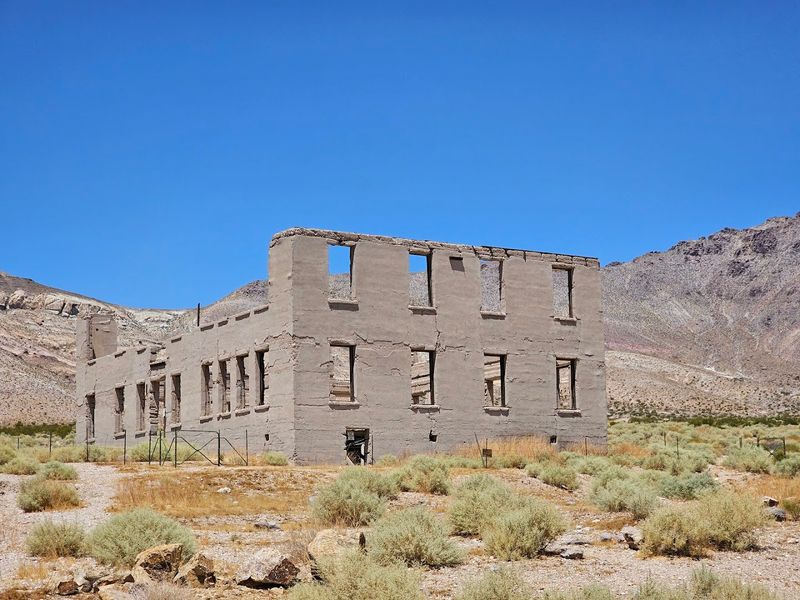
In August 1904, prospectors Frank ‘Shorty’ Harris and Ernest ‘Ed’ Cross spotted greenish, gold‑laced quartz in southern Nevada’s Bullfrog Hills. They named their find the Bullfrog Mine, a strike that launched a local gold boom.
This single discovery lit a fuse that nobody could stop.
Within weeks, hundreds of miners flooded the area. They pitched tents and staked claims across the barren landscape.
A new district was born almost overnight, and at its center, the town of Rhyolite began to take shape rapidly.
The settlement took its name from the volcanic rock found throughout the region. By 1905, the town was formally platted and lots sold quickly.
Saloons and boarding houses popped up along newly named streets. Have you ever wondered what it feels like to watch a city rise from nothing in weeks?
Investors from large coastal cities poured money into the area. They were convinced this was the next great American gold rush.
The desert was suddenly buzzing with ambition and noise. The clinking sound of picks against rock filled the air constantly.
The rush drew thousands of dreamers to the scorched earth.
2. Infrastructure In The Middle Of Nowhere
The site proved that a mining town in the Nevada desert did not have to be rough or primitive. At its peak in 1908, the town was home to 6,000 residents and featured impressive modern amenities.
Electric lights lit up the main streets at night. Piped water ran to homes and businesses across the district.
Telephone lines connected residents, and three competing newspapers kept everyone informed. There was a hospital, a school, and even a genuine opera house.
Performers entertained audiences who had traveled to this remote corner of the Mojave. Perhaps most astonishing was the complex railroad situation.
Three separate rail lines served the town at its height. These included lines coming from the north and others stretching toward the southern coast.
Each line competed for passengers and freight daily. Can you imagine the noise of three different trains steam-rolling through the sand?
Supplies and equipment arrived constantly to feed a community that seemed unstoppable. This unlikely metropolis was a hub of intense economic activity.
The evidence is written into the crumbling concrete walls that remain. It’s a sophisticated city built on a foundation of dust.
3. A Concrete Skeleton
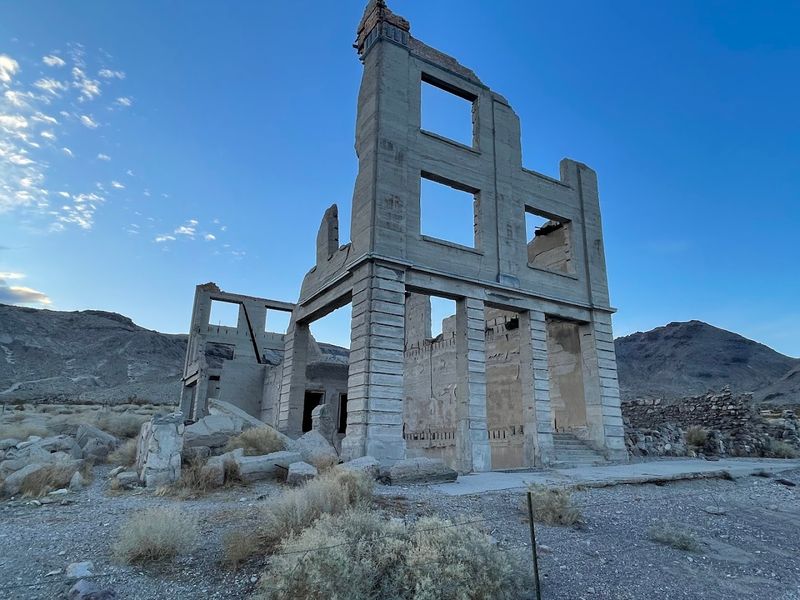
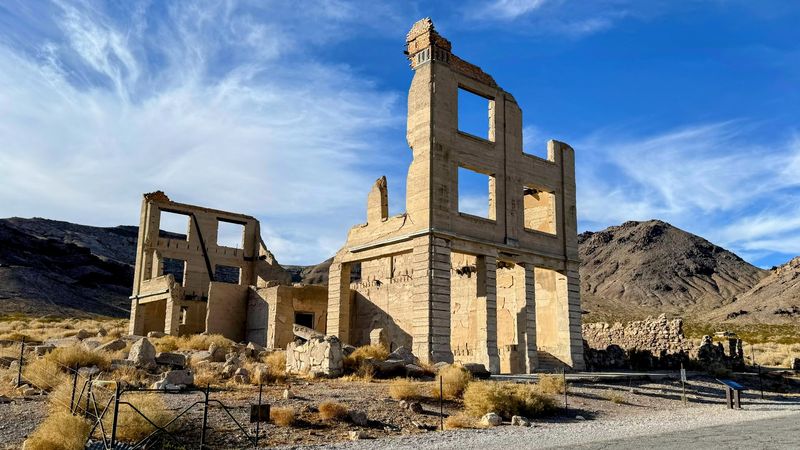
No single structure captures the rise and fall of this place like the hollow shell of the Rhyolite bank. Completed in 1908, this three-story building served as the crown jewel of the main street.
The construction used reinforced concrete for durability. This explains why its skeleton still stands while wooden buildings long ago vanished.
Step closer to see the ghost of its former elegance. Italian marble stairs once graced the interior alongside expensive mahogany woodwork.
Wealthy depositors conducted their business here during the town’s short life. The building also housed a telephone exchange and a brokerage office.
Today, the ruin is the most photographed structure in the entire area. Its tall window frames create perfect rectangles of blue sky.
Photographers travel hundreds of miles to capture this haunting image. Do these empty windows make you feel like the building is watching you?
Informational signs posted nearby explain the original layout and significance. They help visitors picture what the interior once looked like.
Few ruins in the American West carry this kind of power. It is a skeletal reminder of a financial empire.
4. The Bottle House
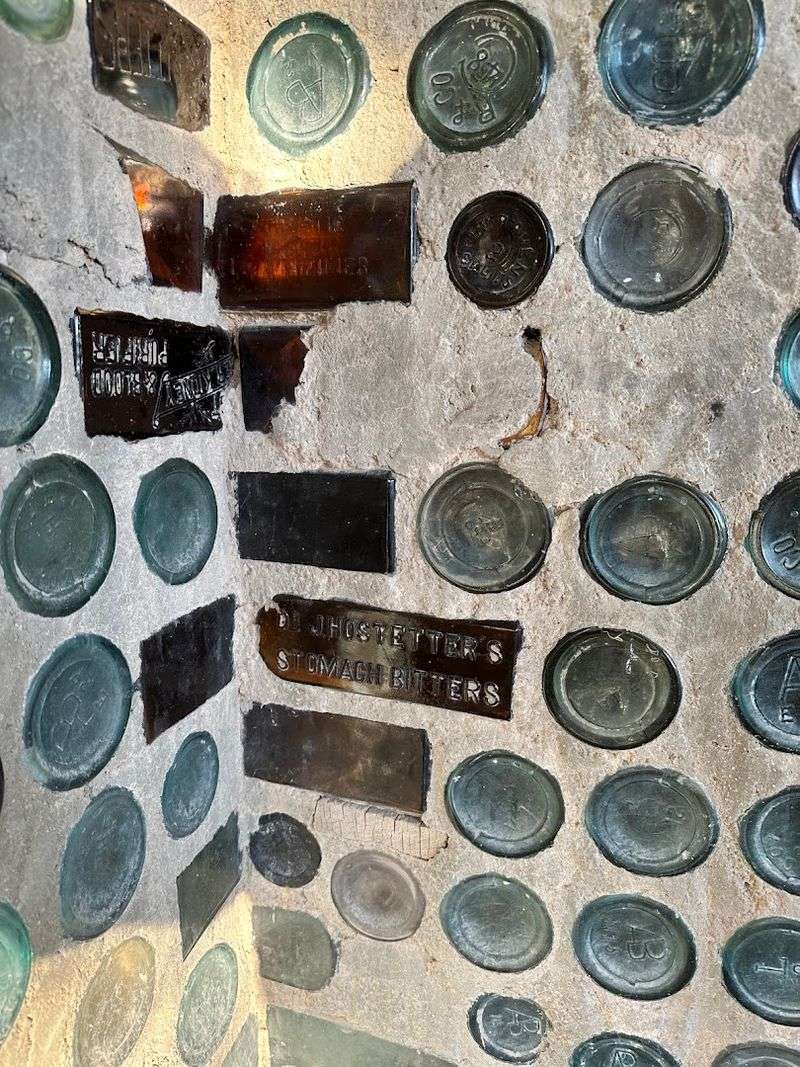
When timber was scarce, an elderly miner found a solution that nobody else would have considered. In 1906, he began building his house using empty glass bottles.
He used approximately 50,000 glass bottles for the walls. He set them in adobe mortar to create a sturdy structure.
The building process took several months to complete. Locals watched with a mix of amusement and admiration.
The bottles were set with their bases facing outward.
This created a textured exterior that glinted in the Nevada sun. Is it possible to find beauty in what others consider desert trash?
The house earned a second chapter of fame in 1925. A major film studio restored it for the filming of a silent movie.
That restoration helped preserve it through the many decades. Today it stands as one of the only fully intact structures.
Visitors consistently name it a highlight of their trip. There is simply nothing else quite like it in the Southwest.
The glass reflects the changing colors of the sky throughout the day.
5. A $130,000 Gateway
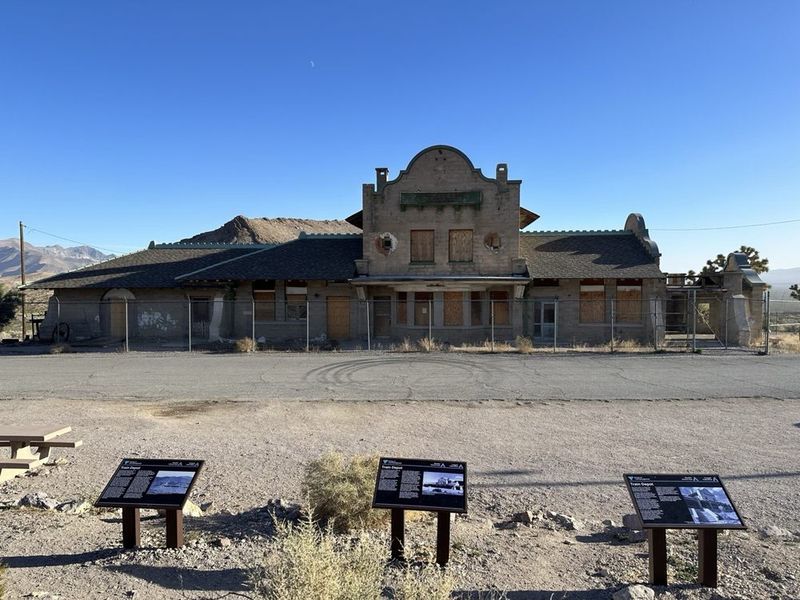
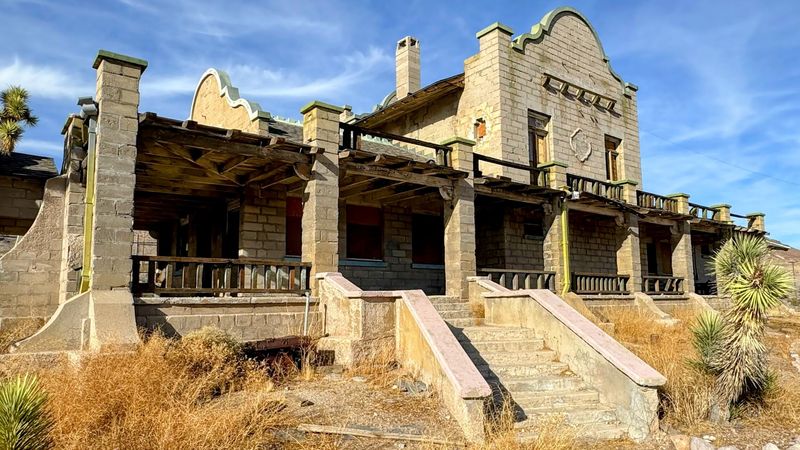
Arriving by train into this town must have been a grand experience. The regional railroad built its depot in a lavish Spanish style design.
The building featured arched windows and smooth stucco walls. Its construction cost a staggering $130,000 for a remote outpost.
The depot opened in 1908 just as economic cracks appeared.
Trains brought in passengers, heavy equipment, and plenty of optimism. For a brief window, the depot was the busiest spot.
Arrivals and departures happened daily during the mining boom. Would you wait at this station if the tracks led nowhere?
After the decline, the depot found a second life during the 1930s. It operated as a casino and bar for desert travelers.
That chapter ended, and now it is the best-preserved building. It is located within the historic town site.
A protective fence now surrounds it to discourage vandalism. Visitors can still admire the craftsmanship from a short distance.
That feeling of peace is entirely understandable in the desert.
6. The 1907 Panic
Booms do not last forever in the Nevada mining world. The first serious blow came in 1906 after a massive coastal earthquake.
Investment capital suddenly dried up as backers rebuilt their home cities. Then the national financial panic of 1907 hit the country hard.
Banks tightened credit and confidence in desert gold mines collapsed. The largest local mine in Rhyolite began winding down its operations.
Without that anchor, smaller operations followed and workers left. Does the silence of a dying town sound louder than the noise?
The population plummeted with shocking speed after the peak. By 1910, only a few hundred residents remained behind.
By 1920, that number had shrunk to just a handful of people. The town was essentially erased from active life very quickly.
Buildings were stripped for materials and equipment was hauled away. The desert slowly began reclaiming the dusty streets.
This story serves as a reminder of reversing fortunes.
Life in the desert is often dictated by outside forces.
7. Sculptures In The Sand
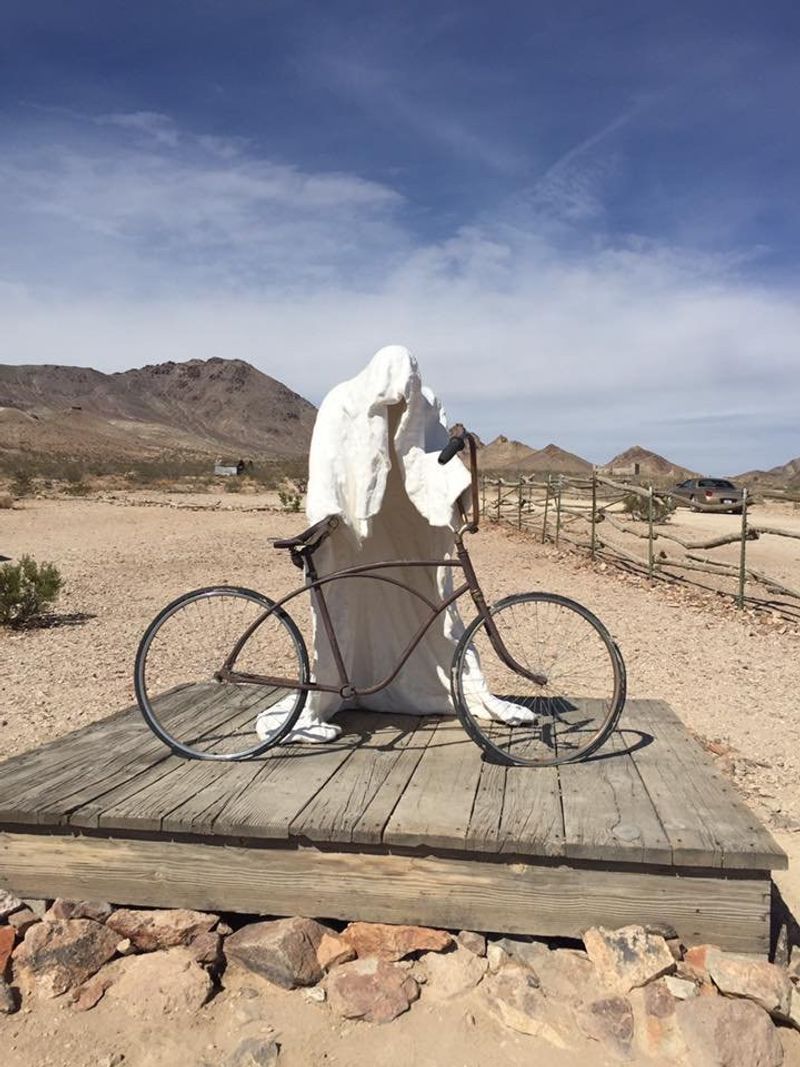
Something unexpected appears at the side of the road near the ruins. A group of large sculptures stands in the open desert.
They look like they arrived from a completely different dimension. This is an open air museum located right at the edge of the town.
It adds a surreal layer to an atmospheric destination. The centerpiece is a work depicting a famous biblical scene.
A European artist created it in 1984. He used ghostly, shrouded figures made from white plaster casts.
The figures glow against the brown desert floor at sunset. Do these white shapes look more like ghosts or desert statues?
Other works include a 24-foot steel miner watching the horizon. A striking figure made from cinder blocks also stands nearby.
The museum is free to visit and open year-round. Many different artists have contributed pieces here over the many decades.
They are drawn by the spirit of the place. For photographers, the desert light and shapes create unique images.
This art park keeps the area relevant for new generations. The statues watch the ruins in perpetual silence.
8. A Living Time Capsule
Planning a trip to these ruins is easy. The site is located just a few miles west of a small town in southern Nevada.
It sits off a state route for travelers to find. This is a natural stop for anyone driving through the region.
The area is managed by land officials and entry is free. The site is open daily for public exploration.
Visitors can walk or drive through the main ruins area. Informational signs explain what each structure used to be.
The large bank and the Rhyolite bottle house are the main highlights. Most people find that a visit takes two hours.
Comfortable shoes and a water bottle are absolutely essential.
The combination of ruins and art makes it rewarding. It is a top destination for those seeking solitude.
Historical ruins offer a glimpse into a forgotten world. You should leave before the sun sets over the hills.