This Family-Run Amish Restaurant In Indiana Is Worth Every Mile Of Country Road

Your GPS will sound less confident the closer you get. That is usually a good sign.
Indiana keeps some of its best food at the end of roads that do not bother with lane markings. The drive is part of it.
You will pass more farmland than gas stations. You will start wondering whether you missed a turn somewhere.
Then the parking lot appears, and it is fuller than the road suggested. This place cooks the way somebody’s grandmother cooks when she is showing off.
The noodles are made by hand and the pie crust is not from a box. Portions arrive with the assumption that you skipped breakfast.
Nobody here is chasing a trend or plating anything with tweezers. Service is warm and slightly nosy in the best possible way.
Come hungry, come early, and do not plan anything strenuous afterward. The details you need are waiting just below.
A Family Story That Started On April Fools’ Day

The real story here is better than the date suggests. Joe and Edna Schwartz were both raised on Amish farms.
They married in 1983 and went on to have twelve children.
For years they worked a hundred acre farm in Crawford County, and the plan was farming, full stop. Then the state ran a new highway straight through the middle of it.
The road sliced their best field into pieces and left them with land they could no longer work the way they always had. Plenty of families would have called that the end of something.
The Schwartzes looked at the traffic and saw people who would eventually get hungry. They opened the restaurant on April 1, 2009.
The date reads like a punchline, and the timing was anything but funny, but the gamble held.
Twelve children and twenty five grandchildren later, the place is still run by the same family. You will find it at 6738 West Governors Trace in Eckerty.
Longevity in rural dining is rare and it is never an accident. Seventeen years in, the parking lot still fills.
Berries, Corn, And Pumpkins Grown Down The Lane

Most restaurants source their produce from a truck. This one grows a portion of it on the family farm, and the family says so plainly on their own website.
That short trip from field to kitchen is the whole argument for eating out here rather than closer to home. Sweet corn in July tastes like a different vegetable than sweet corn in a can.
Anyone who has stood in an Indiana cornfield in August already knows this. The pumpkin patch sits across the way from the restaurant, which gives the fall visit a second reason to exist.
Kids wander out to it while the adults finish coffee. The seasonal rhythm matters more here than at a place with year round shipping.
Come in high summer and the vegetables will be at their best.
Come in late autumn and the pumpkins take over. Come in February and the kitchen leans on what it does with flour, butter, and time instead.
That is not a downgrade, just a different visit. The farm and the restaurant operate as one thing rather than two, which is increasingly hard to find anywhere.
Noodles, Pies, And Bread Made From Scratch

Homemade noodles are the honest test of a kitchen like this. Anyone can open a bag.
Rolling and cutting your own means somebody arrived early and meant it.
The Schwartz family lists what comes out of their kitchen rather than off a delivery pallet, and the list is long. Bread, cakes, and pies are baked on site.
The meatloaf is mixed there.
The fried chicken is breaded there. The barbecue and the casseroles are made there.
Even the peanut butter spread, which is the sweet Amish table staple people put on bread and then think about for weeks, is made in house.
That last detail tells you more than any of the others. Peanut butter spread is exactly the kind of thing a busy kitchen would happily buy in a tub, and they do not.
What you taste in a place like this is labor rather than technique. Nothing on the plate is complicated.
All of it takes hours somebody chose to spend.
The word scratch gets thrown around loosely on menus these days. Here it comes with a specific list attached, which is a fair way to judge it.
Cafeteria Style, With A Plot Twist

Grab a tray and start moving. The setup looks institutional and the food does not, which is the small joke of the place.
You have two ways to play it.
The single meal comes with your choice of meat and two sides, which suits anyone who wants lunch rather than an event. The all you care to eat option opens up the whole line, and that is what most people are here for.
Regular visitors offer one piece of tactical advice worth following. Choose your dessert on the way down the line rather than at the end, because the popular pies do not last the evening.
Portions run generous even on the smaller option, so nobody needs to upgrade out of fear. Hours matter here more than at a city restaurant.
The kitchen is closed Mondays.
Tuesday through Thursday it serves from eleven in the morning until eight at night. Friday and Saturday it runs until eight thirty.
Sunday is the short day, ten until two, and it is also the busiest, so arrive earlier than feels necessary. Driving an hour to find a locked door is a specific kind of disappointment.
The Fried Chicken And Meatloaf Faithful

Two dishes carry the reputation. The fried chicken and the meatloaf are what people name when they explain the drive to somebody who has not made it.
Both are made from scratch in the kitchen, and both are the sort of food that punishes shortcuts. Meatloaf especially.
It is a dish with nowhere to hide, since there is no sauce to fix it and no garnish to distract you.
Either the seasoning is right and the texture holds or it does not. That it keeps pulling repeat customers down these roads is the most useful review the place has.
Fried chicken tells you something different.
It tells you the kitchen commits to the timing, because good fried chicken cannot be held for long without going sad. Barbecue and casseroles round out the hot line, all made in house.
The casseroles are worth your attention even if casserole sounds like something you tolerate rather than order. In this tradition they are the backbone of the table rather than filler.
Come hungry enough to sample both mains, because choosing between them on a first visit is a decision you will second guess.
Save Room For Blackberry And Raisin Pie

Dessert is not the afterthought it is almost everywhere else. Pies and cakes are baked on site, with crusts made from scratch, and the all you care to eat option includes dessert along with the salad bar.
That combination is dangerous in the best way. You will build a plate with a plan and then abandon the plan when you see the pie case.
Raisin pie deserves a word of explanation for anyone who has never met one.
It is an old table dessert from this tradition, dense and sweet and spiced, and it has largely vanished from restaurant menus because nobody under fifty orders it on sight. Try it anyway.
Blackberry belongs to the summer end of the calendar and tastes like it. Buttered noodles and macaroni and cheese are the sides that make dessert a logistical challenge, since both are filling and both are hard to walk past.
This is where the earlier advice pays off. Pick your dessert on the way through rather than after you have already eaten.
Pace yourself on the main line. Nobody has ever regretted leaving room for pie.
A Gift Shop, A Gathering Room, And Peanut Butter To Go

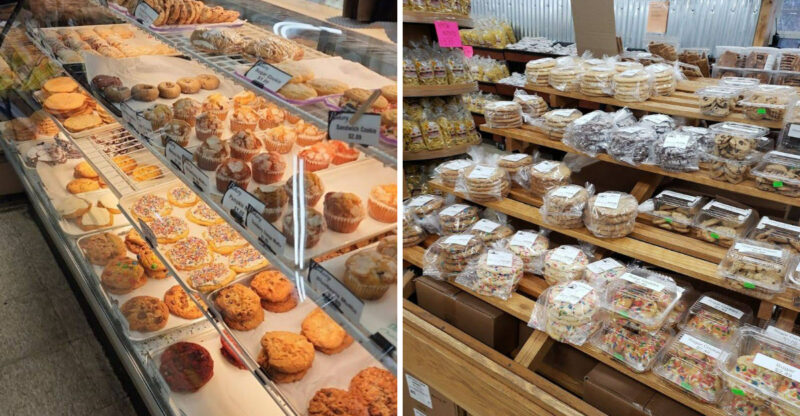
Leaving with nothing takes discipline most people do not have. The peanut butter spread is the souvenir that matters.
It is made in house, it travels well, and it turns an ordinary slice of bread at home into a small argument for going back. Visitors regularly buy more than one jar, which is the correct instinct.
Jellies and other pantry goods sit alongside it.
The gift shop area near the exit carries handmade crafts and local items, the kind of thing that looks better in a farmhouse setting than it will on your kitchen counter, and you will buy some anyway.
There is also a Gathering Room used for music and for groups, which fits the church social feeling that visitors keep reaching for when they describe this place. It is worth poking your head in before you head to the car.
The whole operation is built for lingering rather than turning tables. Nobody is hovering with a check.
Give yourself twenty extra minutes past the meal itself, because the shopping and the wandering are part of what you drove out here for.
Porch Swings, Giant Connect Four, And Hoosier National Forest

The setting does real work here. The restaurant sits in an unincorporated community surrounded by the Hoosier National Forest, which covers roughly 202,000 acres of southern Indiana.
Forested hills rise above the farmland on all sides. Patoka Lake is only a few miles off, which makes the obvious plan a morning on the water followed by a very large midday meal.
Hiking, boating, and fishing all sit within easy reach. Outside the restaurant there is a playground, and the pumpkin patch across the way gives kids a second destination in autumn
Families with restless children have somewhere to send them, which changes the arithmetic of a long lunch considerably.
Interstate 64 runs close by, so the country road portion of the trip is short enough to feel scenic rather than punishing. Parking is generous, including room for larger vehicles.
French Lick and Holiday World are both reachable for anyone building a longer day out of this. The drive through the forest is the part visitors mention as often as the food.
Treat it as half the reason you came rather than the price you pay to get there.