This North Carolina City Has The Fastest Internet In The State
A loading bar barely has time to become annoying here.
In Ookla’s first-half 2026 assessment of major U.S. cities, one North Carolina contender posted a median fixed broadband download speed of 380.47 Mbps, the fastest result in the entire group.
That is enough to make old-school buffering feel practically historical.
Speeds still vary by address and provider, of course, but the bigger story is competition. Several fiber companies offer multi-gigabit plans in parts of the area, which means residents can shop around instead of accepting whatever sluggish connection happens to show up first.
For remote workers, streamers, and anyone regularly downloading huge files, that kind of infrastructure can make everyday online life noticeably smoother.
Meetings behave better. Downloads finish before the snack break starts.
Even the spinning wheel of doom has fewer chances to make an appearance.
Some cities brag about nightlife.
This one quietly wins the Wi-Fi argument.
See The Number That Put This City At The Top

Durham’s headline number is 380.47 Mbps. Ookla’s Speedtest Intelligence data for the first half of 2026 gave the city that median fixed download speed among the most populous U.S. cities.
The result placed Durham first nationally in the group, which also made it the strongest North Carolina city in that particular ranking.
Median speed is useful because it describes the middle result across collected tests rather than highlighting the fastest premium plan available at one lucky address.
In other words, the number says more about typical measured performance than an advertised maximum ever could. Durham’s position also looks stronger when compared with the rest of the state.
Raleigh followed closely at 375.17 Mbps, and Winston-Salem reached 361.61 Mbps, enough for seventh place nationally in the same analysis. Those gaps are not enormous, but Durham still finished in front.
For residents, the ranking provides a broad snapshot rather than a promise, since actual speeds depend on provider, plan, equipment, network conditions, and the exact location of the home. Even so, the citywide result remains unusually strong by national standards in 2026.
Raleigh Keeps The Triangle Race Remarkably Close
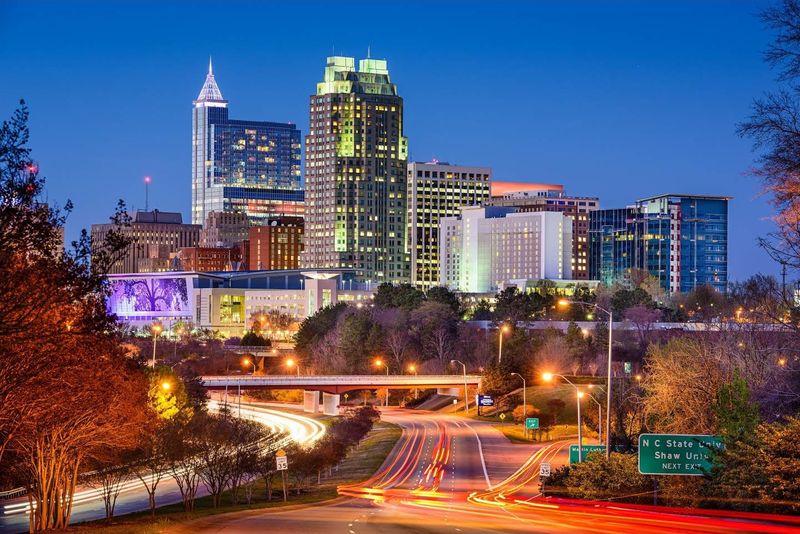
Only a short drive separates Durham from one of its closest broadband competitors. Raleigh recorded a 375.17 Mbps median fixed download speed in Ookla’s first-half 2026 data, placing third among the most populous U.S. cities and only a few megabits behind Durham.
Earlier Speedtest Intelligence figures from January showed the same tight race, with Raleigh at 400.49 Mbps and Durham a little higher at 406.41 Mbps.
The numbers make the Triangle unusually strong rather than turning the story into a runaway win for one city.
GFiber serves both markets and currently sells symmetrical 1 Gig, 3 Gig, and 8 Gig plans in the Raleigh-Durham area where service is available. AT&T Fiber also competes across parts of the region, while Spectrum remains a broad cable option.
That mix can change considerably from one neighborhood to another. Someone choosing between homes in Raleigh and Durham may see a bigger difference between two addresses than between the citywide medians.
The headline race is close, but local availability ultimately decides what a household can actually order and how fast it feels in daily use.
Different Rankings Tell A Different Broadband Story

Switch the dataset and North Carolina’s broadband leaderboard changes noticeably. BroadbandNow’s 2026 city study uses M-Lab performance data while also weighing access, affordability, fiber availability, and latency.
Under that system, Cary and Fayetteville placed well ahead of Durham overall. Fayetteville recorded a 601.9 Mbps median download speed, Cary reached 206.7 Mbps, and Durham came in at 211.5 Mbps.
Ookla’s first-half 2026 Speedtest Intelligence analysis drew from a different pool of tests and put Durham first among the most populous U.S. cities at 380.47 Mbps.
Testing periods, sample sizes, methodology, and cities included can all move the rankings around.
For someone comparing places to live, those differences make address-level service especially important. Providers do not cover every block, and the fastest plan advertised somewhere in Durham may not reach every apartment or house.
Citywide numbers still reveal how a market is performing, but they sit alongside another question that matters even more at home: which network reaches the property and what speed tier is available there right now.
That final check often matters more than the ranking for people choosing service.
Fiber Competition Gives Durham Plenty Of Headroom

Fiber has become one of the biggest reasons Durham can support such strong speeds. BroadbandNow’s 2026 city profile estimates fiber availability at 83.5 percent, while several major providers compete across different parts of the market.
GFiber currently offers service up to 8 Gbps in the Raleigh-Durham area, with matching upload and download speeds on its 1 Gig, 3 Gig, and 8 Gig tiers. AT&T Fiber advertises plans up to 5 Gbps in parts of Durham, and Frontier lists fiber service reaching as high as 7 Gbps where available.
Lumos has also been expanding its footprint in Durham and Orange counties after announcing a roughly $50 million project covering more than 600 miles of fiber.
By September 2025, the company said its Triangle build had brought fiber access to more than 34,000 homes, including thousands that had previously lacked service.
That competition matters because residents are not relying on a single network to drive upgrades. More providers building fiber means more chances for individual neighborhoods to gain faster options as construction continues across the Triangle and nearby communities over time, too.
Multi-Gig Plans Push Far Beyond Everyday Needs
Eight gigabits per second sounds almost absurd until you look at what modern households ask a connection to handle. GFiber’s current Raleigh-Durham lineup tops out at 8 Gbps, while AT&T Fiber offers up to 5 Gbps in parts of Durham and Frontier advertises as much as 7 Gbps in select areas.
Most homes do not need anything close to those maximum tiers for ordinary browsing or streaming, yet their presence shows how much capacity local fiber networks can deliver.
Multi-gig service becomes more useful when several people are moving very large files, backing up data, working with high-resolution video, or using bandwidth-heavy applications at the same time.
Equipment matters too. A laptop connected through an older Wi-Fi router will not suddenly receive 8 Gbps simply because the plan allows it.
Wired connections, compatible network hardware, and newer wireless standards are necessary to take fuller advantage of multi-gig speeds. For many households, a lower fiber tier may already feel extremely fast.
The remarkable part is having several levels above gigabit service available at all within one city market today in Durham.
Discover What Faster Service Means For Remote Work And Streaming
Uploads are where fiber can change the feel of a workday most dramatically. Download speed gets the headline number, but sending large video files, syncing cloud folders, backing up photographs, and joining high-quality video calls all depend heavily on upload capacity.
GFiber’s Triangle plans advertise matching upload and download speeds, and AT&T Fiber likewise offers symmetrical service on its fiber network.
Durham’s January 2026 Speedtest Intelligence profile measured a citywide median upload speed of about 131 Mbps, far above North Carolina’s statewide 2026 median of 22.8 Mbps in BroadbandNow’s M-Lab analysis.
That gap helps explain why the city can be attractive for work that regularly moves data in both directions. Low latency matters as well because it affects how quickly a connection responds during calls, gaming, and other real-time tasks.
Still, home equipment can become the weak link. Ethernet can provide a cleaner test of the connection reaching a house, while Wi-Fi performance varies with router placement, interference, building materials, and device capability.
Fast service works best when the network inside the home can keep up with the incoming line.
North Carolina’s Statewide Numbers Show A Wider Gap

Zoom out from Durham and North Carolina presents a more mixed broadband picture. BroadbandNow ranked the state 34th out of 51 jurisdictions in its 2026 broadband assessment, even as performance improved from the previous year.
Its analysis measured a statewide median download speed of 177.5 Mbps and a median upload speed of 22.8 Mbps.
Fiber availability reached 56.4 percent, up more than eight percentage points from 2025, while 92.1 percent of residents had access to the baseline wired or fixed-wireless service used in the study.
Durham sits well above those statewide speed figures in Ookla’s major-city data, but rural and less densely served areas continue to pull the broader numbers in another direction.
The contrast helps explain why a state can contain some of the country’s fastest urban broadband markets without ranking near the top overall.
Cary, Fayetteville, Durham, Raleigh, and Winston-Salem all show strengths under different 2026 measurements, yet coverage and performance remain uneven beyond those population centers.
North Carolina’s broadband story is improving quickly, but geography still matters from one county to another in everyday life and planning.
See How This City Ended Up Taking The National Number One Spot
For anyone actually moving to Durham, the most useful number is attached to a street address rather than the city name.
GFiber, AT&T Fiber, Frontier, Spectrum, Lumos, and other providers have different footprints, and even neighboring homes may qualify for different technologies or plan speeds.
GFiber’s own Triangle page asks customers to enter an address before showing availability, and AT&T gives the same advice for its Durham fiber service. That is the final step that broad rankings cannot replace.
A 380.47 Mbps city median tells you Durham performs exceptionally well as a market, but it cannot guarantee that one apartment has fiber or that another house can order the fastest tier.
Checking the providers available at the exact property also reveals whether the connection is fiber, cable, fixed wireless, or something else entirely.
Once that detail is known, Durham’s headline becomes much more practical.
The city has enough competition and infrastructure to rank among the country’s stronger major broadband markets in 2026. Even so, the best service is ultimately the one that delivers a reliable connection to your home every day.