This North Carolina Valley Is One Of The Best Places To Hear Wild Elk Bugling This Fall
Oh! Did you hear that?
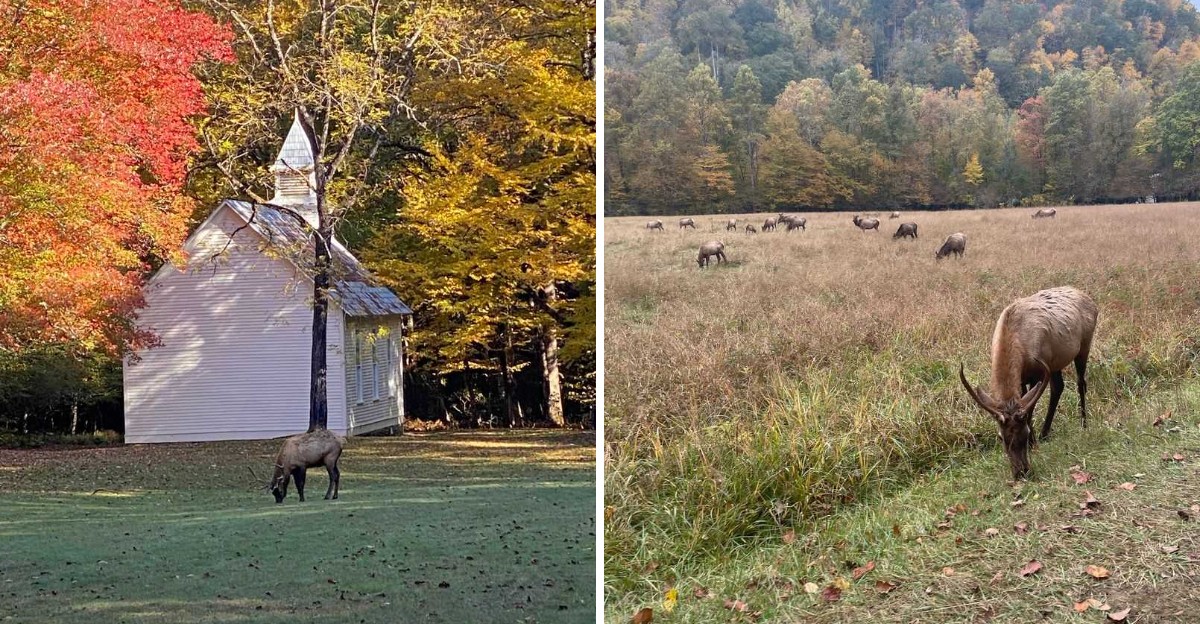
Somewhere across the North Carolina mountains, a wild elk is calling, and it sounds like the whole valley is listening. Autumn makes everything feel softer here.
The grass glows in the morning light, the air turns cool, and every little sound feels important. Then another bugle rolls across the fields, long and strange, and you almost forget to move.
It is the kind of moment that makes you want to whisper instead of talk. You wait quietly, hoping one of the elk will step into view nearby.
Maybe it does. Maybe you only hear the call.
Either way, the valley feels full of wonder, and for a little while, the woods seem alive with secrets.
Hear The Haunting Sound That Echoes Across The Valley Each Fall
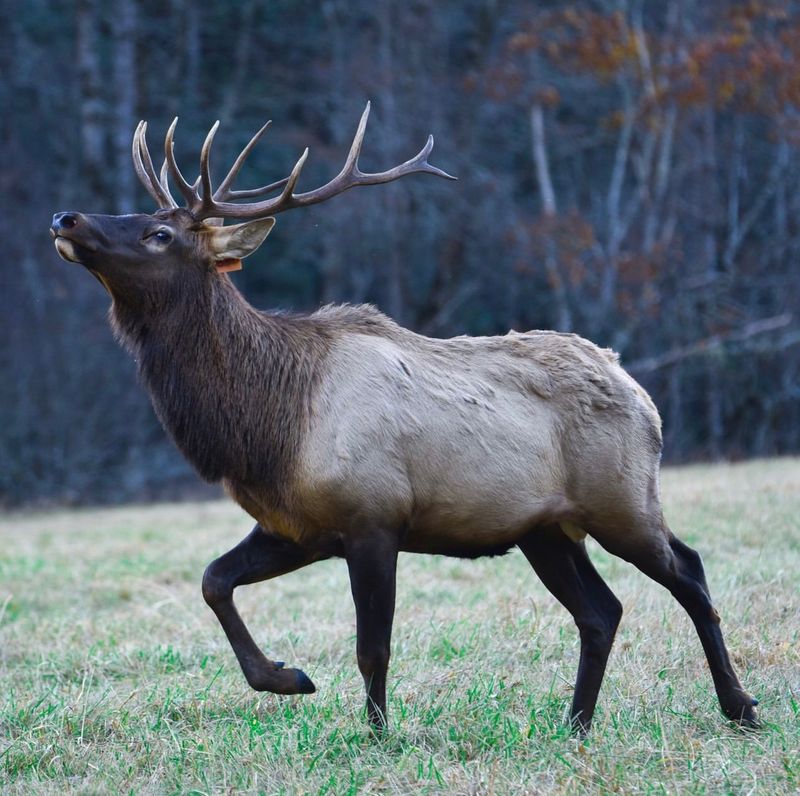
Few sounds in the southern mountains carry the way an elk bugle does. It starts low, climbs into a thin whistle, then breaks into grunts that roll across the grass and bounce off ridgelines.
Hearing it once tends to rearrange your idea of what a quiet autumn morning sounds like.
Bulls make that call during the rut, the breeding season that usually runs from mid-September through late October.
The open fields of Cataloochee Valley, inside Great Smoky Mountains National Park, work like a natural amphitheater, with peaks near 6,000 feet bouncing each call back across the meadow.
Set your directions for Cataloochee Creek Road, Waynesville, NC 28785.
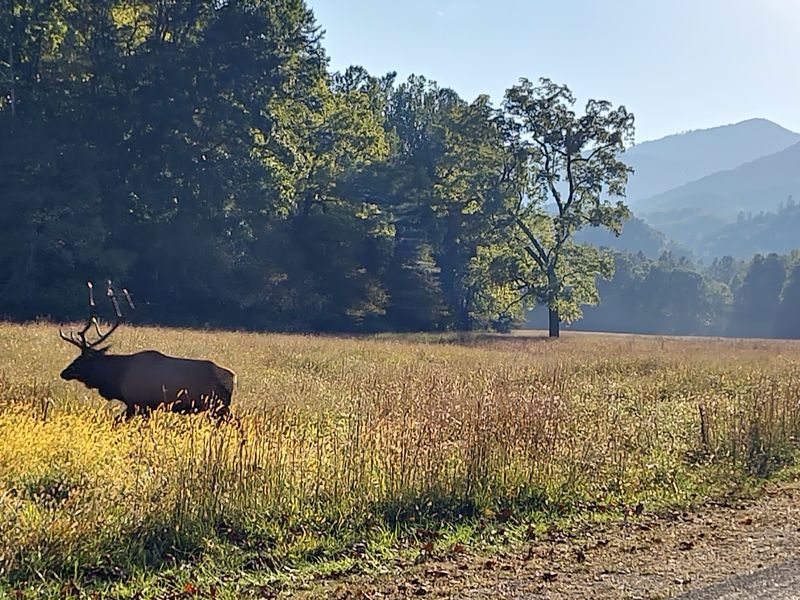
Morning is the sweet spot. Arrive around sunrise, when mist still hangs over the creek and frost crunches under your shoes, and the valley feels almost entirely yours.
The final hour of daylight offers a second chance, with golden light spilling across the grass.
Roll your window down, switch off the engine, and simply listen. Early morning is an excellent time to listen because elk are often most active around dawn.
Between bugles you may catch crows, the creek, and the soft tearing sound of elk pulling up mouthfuls of grass.
Discover Why Elk Gather In Cataloochee’s Open Meadows
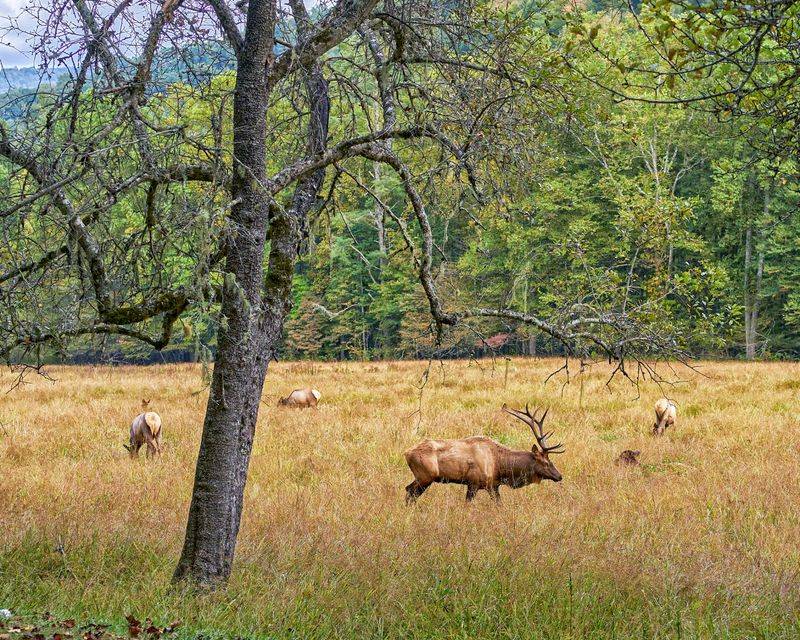
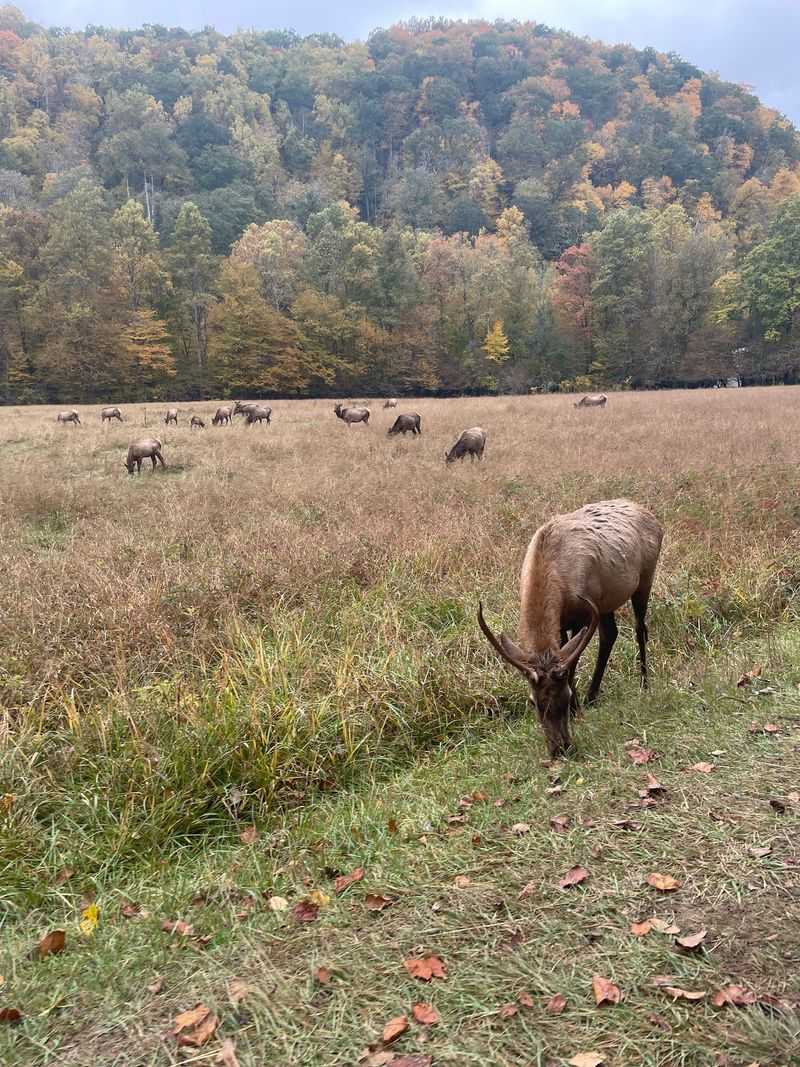
Grass is the whole reason. Cataloochee’s open fields provide elk with important grazing habitat alongside the surrounding forest.
Elk once ranged across the southern Appalachians, but overhunting and habitat loss eliminated them from North Carolina by the late 1700s and from the broader region by the mid-1800s.
In 2001 the park and its conservation partners released 25 animals here, followed by 27 more in 2002, brought in from Kentucky and Canada.
Those animals became the foundation of the herd you see grazing today.
Cool hours bring them out. Early morning and late afternoon temperatures suit them best, so that is when the meadows fill with dark-maned bulls and tawny cows moving slowly through the grass.
During the fall rut, bulls and cows frequently gather in Cataloochee’s open fields.
During the rut those same fields turn into open arenas. A dominant bull may gather and guard a harem of as many as 20 cows, circling constantly to keep them together.
Watching that patient herding, with the creek glinting behind and mountains stacked in blue layers, explains why the meadows matter so much.
Time Your Visit For The Best Chance Of Seeing The Herd
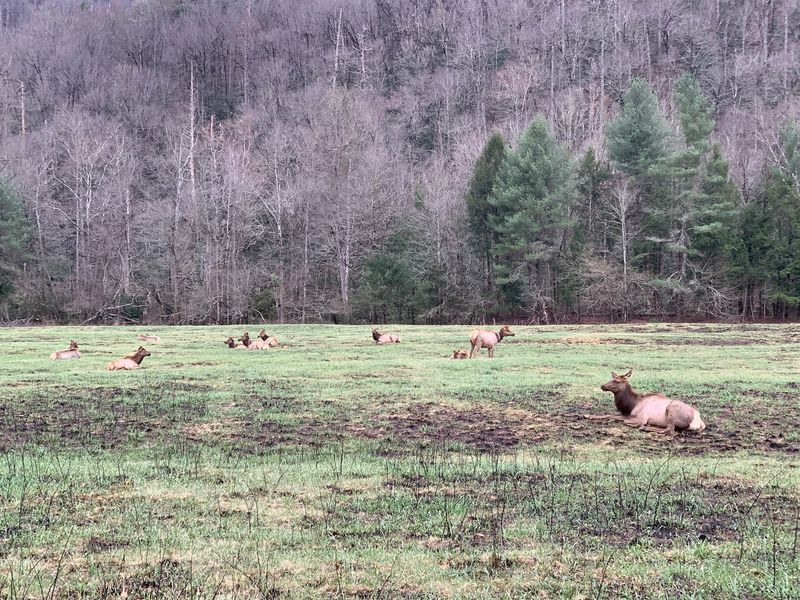
Plan around two clocks: the calendar and the sun. Mid-September through late October delivers the most action, when bugling, sparring, and herding happen almost daily.
The rut is the valley’s loudest, busiest season, and it lines up neatly with the first flushes of red and gold on the ridges.
Within any single day, the first and last light win. Many visitors set alarms for well before dawn so they can be parked at a pull-off as the sky turns gray, while others roll in about two hours before sunset and wait for the herd to drift out of the tree line.
Midday is the slow stretch. Elk sightings are generally more likely during the early morning and late evening than during the middle of the day.
Turkeys, groundhogs, and butterflies often fill the gap.
Weather can rewrite the schedule in your favor. Cloudy days can also bring elk into view outside the usual early-morning and late-evening periods.
Weekends in October fill the narrow roadside quickly, so an early start also buys you a better vantage point. Give yourself extra time, bring patience, and treat any sighting as a gift rather than a guarantee.
Watch Massive Bull Elk Compete During The Fall Rut
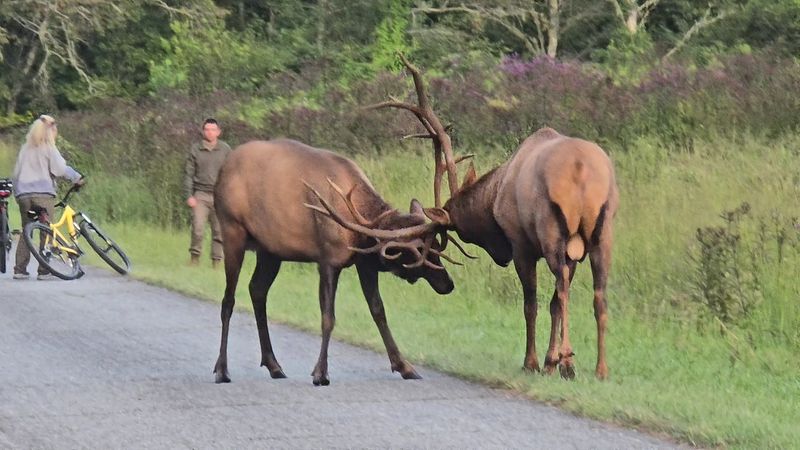
A mature bull can weigh in the neighborhood of 700 pounds and carry antlers that sweep back over his shoulders like bare tree branches. Seeing one step out of the mist at close range is the kind of moment people remember for years.
Competition drives nearly everything they do in autumn. Bugling comes first, a vocal announcement meant to warn rivals and impress cows without anyone getting hurt.
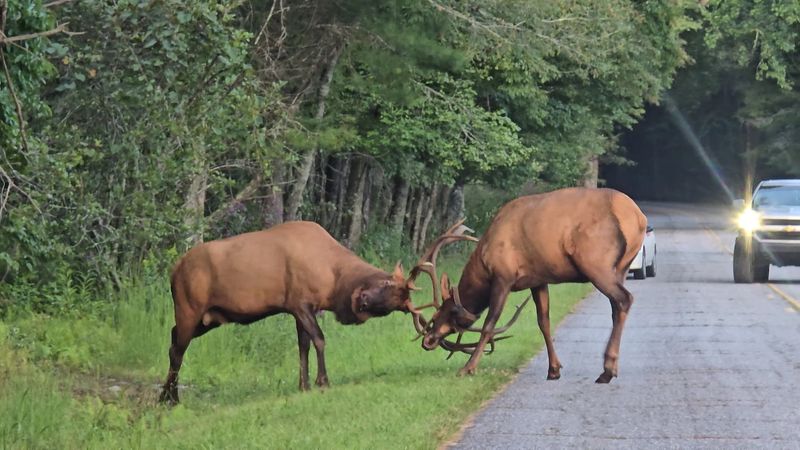
When calls alone do not settle matters, two bulls may lower their heads and lock antlers, pushing and twisting across the grass while their hooves tear up the turf. The clatter carries surprisingly far on a still morning.
Most of these contests end quickly, with the weaker animal backing off and trotting away. The display is largely ritual, a way of sorting rank without serious injury.
Park staff ask visitors to stay put during these standoffs, since startled animals can move unpredictably.
Meanwhile, the herd bull spends his days on patrol, trotting circles around his cows and keeping younger bulls away from the group.
Watch long enough and you start to notice personalities: the tireless one, the cautious one, and the hopeful youngster waiting at the edge of the field for his turn.
Find The Best Spots To Enjoy The Action From A Safe Distance
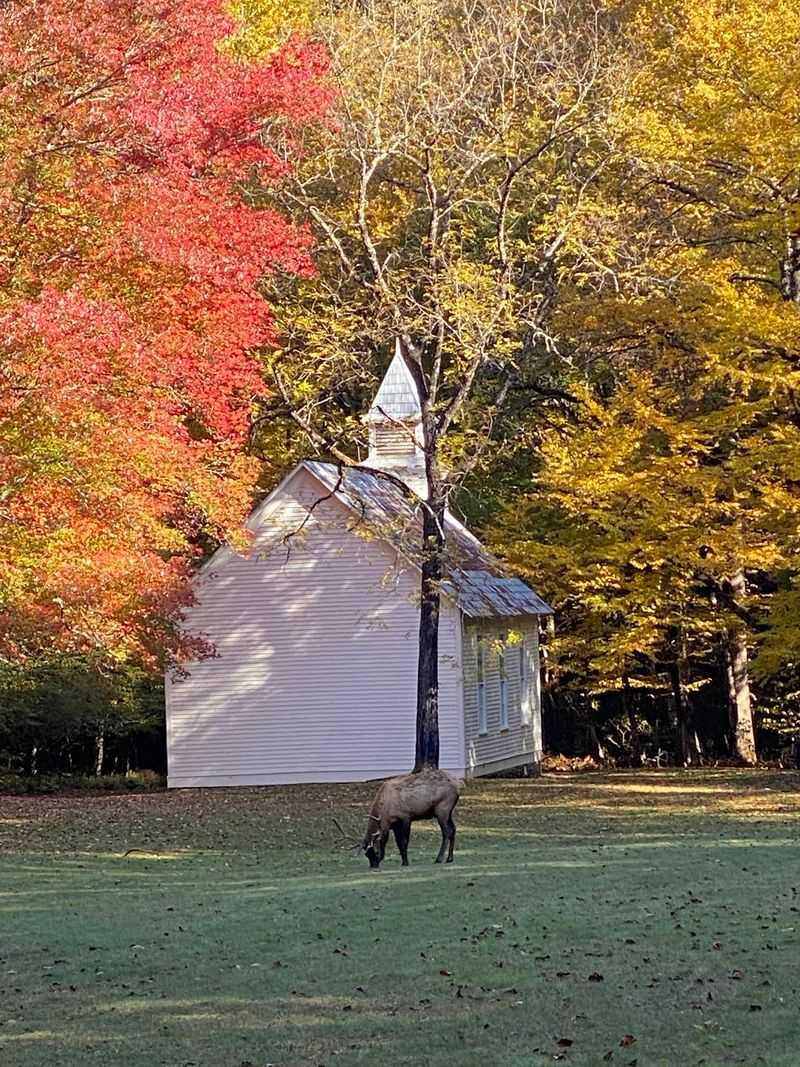
Roadside is the rule, not just a suggestion. Fields where elk graze are often closed to foot traffic during the rut, and staying on the road keeps both people and animals calm.
Crossing a fence line for a closer photo can flush an entire herd back into the trees.
Federal regulations require visitors to stay at least 50 yards away from elk, which works out to roughly 150 feet, about the length of a basketball court and a half. If an animal changes its behavior because of you, you are too close.
Your car doubles as an excellent viewing blind. Pull completely off the roadway at a designated pull-off, leave the travel lane clear, and watch through the window with the engine off.
Optics change everything. Binoculars, a spotting scope, or a camera with a long zoom let you study the wet shine on an antler tip or the steam rising from a bull’s breath without stepping an inch closer.
Use designated roadside pull-offs and remain completely off the travel lane while watching elk.
Few places in North Carolina let you observe wildlife this large in such a peaceful setting, so keep voices low and let the valley stay quiet.
Explore The Historic Buildings Scattered Around The Valley
Before the elk returned, this was farm country. Around 1,200 people lived here in 1910, raising apples, tending cattle, and gathering for Sunday singing in a white frame chapel.
Nine structures from the 1800s and early 1900s still stand, and five of them sit within easy reach of the main road.
Palmer Chapel, with its simple steeple and plank floors, anchors the group, while Beech Grove School preserves a two-room classroom where every grade shared a single stove.
Homes and barns fill out the picture. The Caldwell House shows off wood paneling and hand-built craftsmanship, and the Will Messer Barn and Caldwell Barn smell faintly of aged timber and hay dust.
Some historic structures are open to visitors, but fall field closures can restrict pedestrian access, so follow posted signs and park guidance.
Hikers can go deeper on the Little Cataloochee Trail, which climbs past old homesites to the Little Cataloochee Baptist Church, one of the most photographed buildings in this corner of North Carolina.
Pick up the self-guiding auto tour booklet near the valley entrance.
Each stop comes with a short history, and reading about the families who once farmed these fields makes the meadows feel layered with stories.
Prepare For The Winding Drive Into This Remote Corner Of The Smokies
Getting there takes effort, and that is part of why the valley stays peaceful. The most direct route from Interstate 40 uses Exit 20, followed by a short stretch of US 276 and then Cove Creek Road for about 11 miles into Cataloochee.
Pavement gives way to gravel partway up the mountain. Expect hairpin turns, blind curves, steep drop-offs, and long stretches without guardrails, all at a speed that rarely climbs above 15 miles per hour.
Budget between 45 minutes and an hour and a half from the interstate. Rushing simply is not an option, and the drive rewards anyone willing to slow down for the views opening between the trees.
Meeting oncoming traffic on the narrowest sections means someone has to yield, sometimes by backing up to a wider spot. Courtesy goes a long way here, especially when campers and horse trailers share the route.
Check conditions before you leave, since snow, ice, or storm damage can close the road with little warning.
Cell service disappears well before the entrance, and there are no fuel stops or stores along the final ten miles, so download directions ahead of time.
Know What To Bring Before Your Elk-Watching Adventure
Pack like the weather might change three times, because in the Smokies it often does. Layers, a warm hat, and rain gear handle frosty dawns and damp afternoons without fuss.
Optics top the list. Binoculars or a spotting scope bring distant animals into focus, and a zoom lens saves you from the temptation to creep closer.
Fill your tank before you turn off the interstate. Services vanish once the road narrows, so food, water, and a charged phone battery all belong in the car.
A paper map helps too, since navigation apps sometimes insist the entrance is closed.
A picnic turns a viewing trip into an afternoon. Spread a blanket in a grassy pull-off area, unpack sandwiches, apples from a roadside stand, and a thermos of hot apple cider, and let the mountains do the entertaining.
Parking tags are required for vehicles left longer than 15 minutes anywhere in Great Smoky Mountains National Park, and a solar-powered kiosk near the valley sells them.
Pack out every scrap of trash, keep pets leashed or inside your vehicle, and leave the meadows exactly as you found them.
Quiet visitors help keep this pocket of western North Carolina wild for the next family driving up the mountain.