This Remarkable Nebraska Fossil Park Lets You Watch 12-Million-Year-Old Rhinos Emerge From The Ash
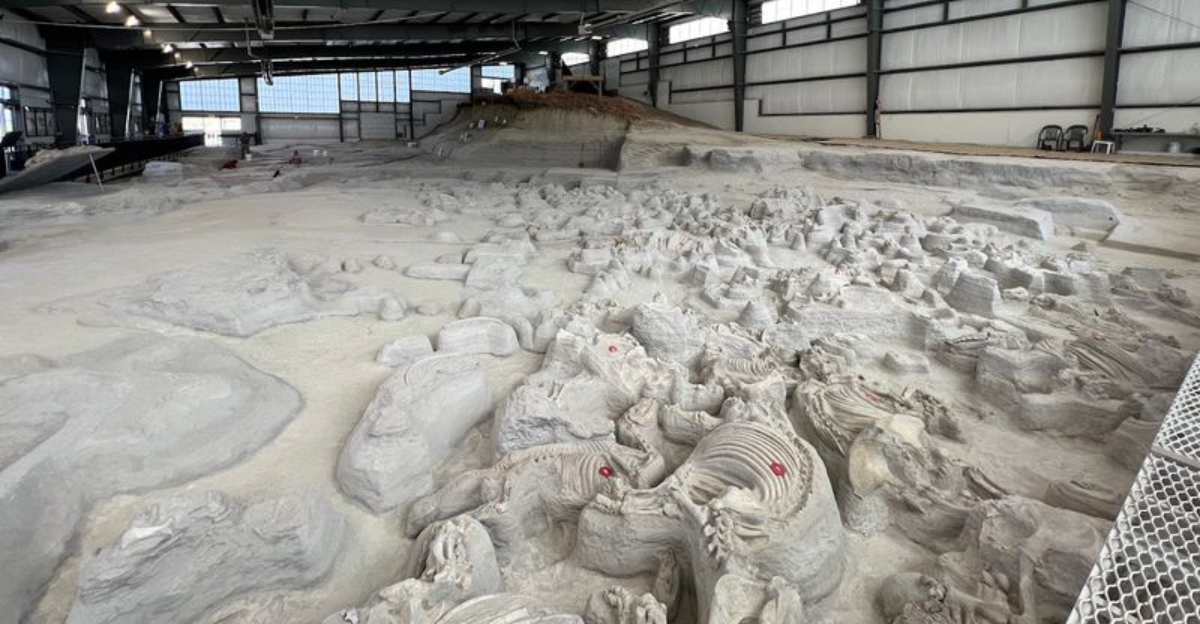
At first glance, the scene looks almost too strange to be real.
Shapes begin appearing beneath layers of ancient ash, slowly revealing animals that vanished millions of years ago.
The excitement comes from watching the past emerge in place, rather than seeing it arranged behind glass after the work is finished.
This corner of Nebraska holds one of the state’s most unusual encounters with deep time.
There is something especially gripping about standing near an active fossil bed and realizing the story is still being uncovered.
Every exposed bone adds another clue, while the surrounding landscape makes the discovery feel even more unexpected.
More Than 200 Skeletons Remain At The Site
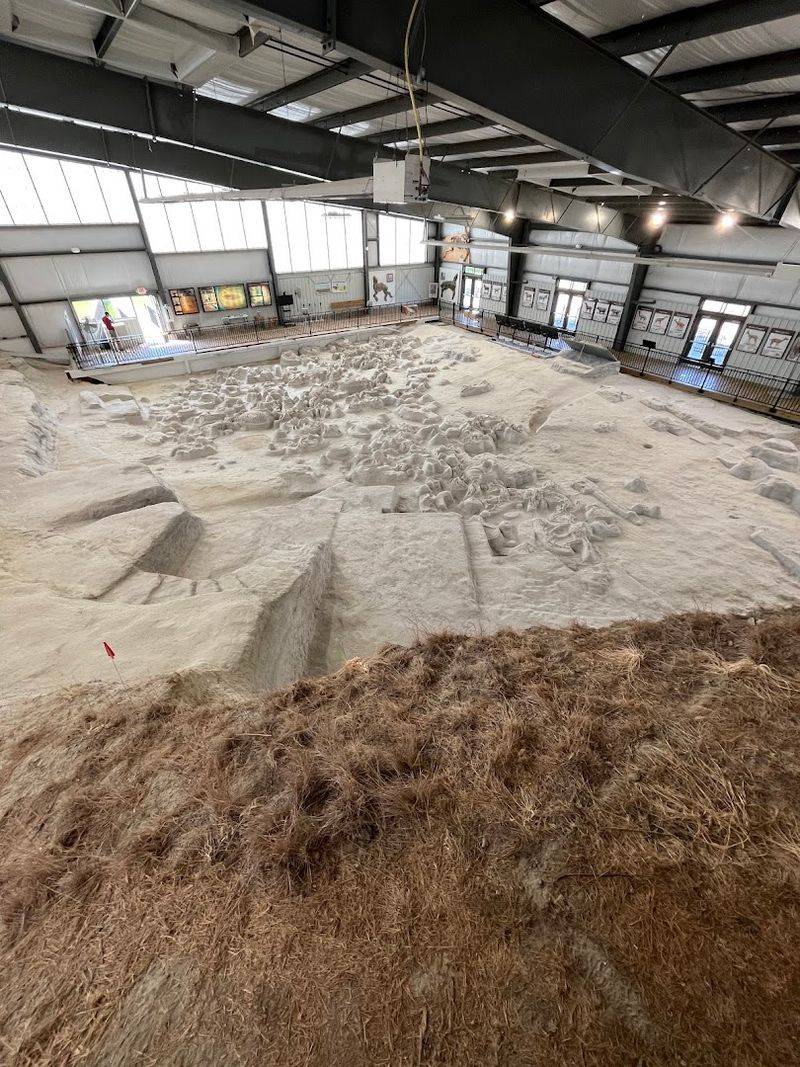
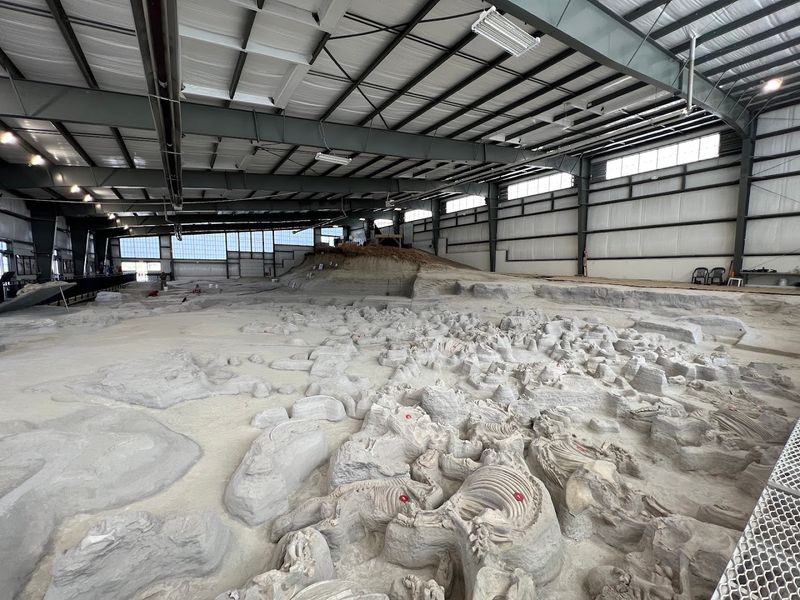
The sheer number of ancient skeletons spread across the floor below the walkway is genuinely staggering, and no photograph quite prepares a visitor for the scale of it.
More than 200 complete or nearly complete fossil skeletons have been documented within the ash beds, making this one of the densest concentrations of articulated vertebrate fossils anywhere in the world.
Many of these remains still rest precisely where researchers uncovered them, undisturbed and arranged as they were found.
That decision to leave so many specimens in place transforms the experience from a typical exhibit into something far more powerful.
Visitors are not looking at bones arranged in a display case but at an actual prehistoric scene, frozen in time beneath a layer of volcanic ash.
The abundance of articulated skeletons provides a detailed ecological snapshot of a vertebrate community from the late Miocene epoch.
That offers scientists and curious visitors alike an unmatched window into a world that vanished millions of years ago.
Entire Herds Of Rhinos Passed Here
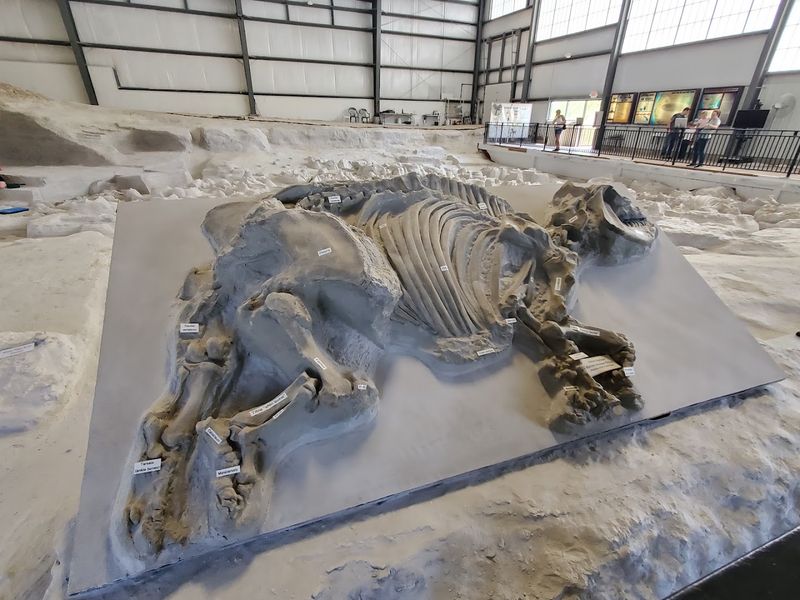
The barrel-chested rhinoceros species known as Teleoceras major is the undisputed centerpiece of Ashfall, and the numbers alone are astonishing.
Over one hundred individual rhino skeletons have been excavated here so far, making this one of the largest single-site collections of rhino fossils on the planet.
What makes the discovery even more remarkable is the variety of animals represented.
Adults, juveniles, and even unborn fetuses have been found together, suggesting that these animals gathered in large groups around the ancient watering hole much like modern hippos congregate near water sources today.
Some specimens even preserve the contents of their last meals.
The social behavior of Teleoceras major has been reconstructed largely from evidence found right here at Ashfall.
Researchers believe these animals likely lived in non-migratory herds and formed harems, a lifestyle quite different from the solitary tendencies of most modern rhinoceros species.
Seeing dozens of their skeletons clustered together on the bone bed floor makes that ancient social structure feel vivid and real in a way that textbook descriptions simply cannot replicate.
Visitors Can Watch An Active Excavation
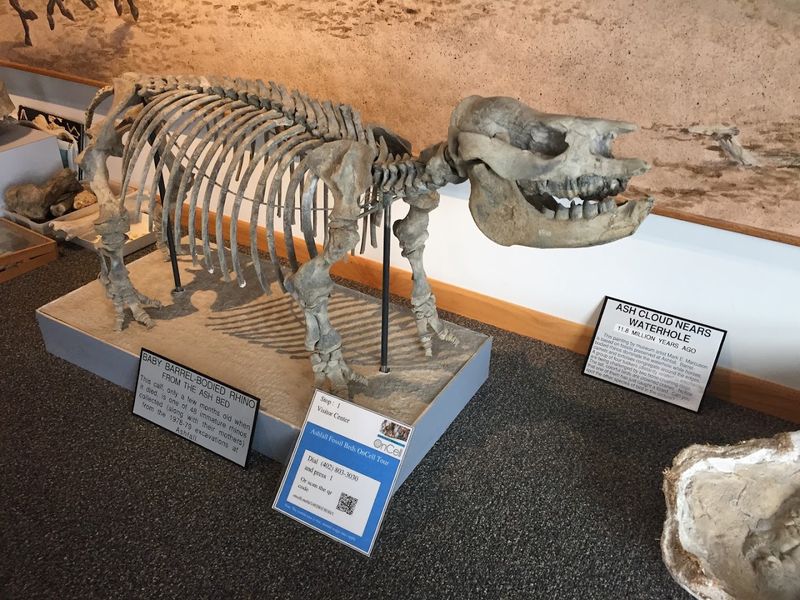
Most fossil museums show finished products: cleaned bones mounted on metal frames behind glass.
Ashfall operates on a completely different premise, and that difference is what makes a visit here feel genuinely alive.
Paleontologists and university interns continue carefully exposing bones at the original dig site while visitors observe from elevated walkways directly above.
The tools are small, the movements are deliberate, and the process is slow by design.
Watching someone gently brush ash away from a rib bone that has not been touched in 12 million years carries a quiet drama that is hard to describe but easy to feel.
Active excavation is most likely to be underway during the summer months when university students and researchers are on-site.
Staff members are generally available to answer questions and explain what is being uncovered in real time.
The site located at 86930 517th Ave, Royal, NE 68773, welcomes visitors Tuesday through Sunday from 9:30 AM with the visitor center serving as the starting point for understanding the dig before heading into the barn.
Each season has the potential to reveal something that changes the scientific record, which means no two visits to Ashfall are ever quite the same.
The Fossils Are Roughly 12 Million Years Old
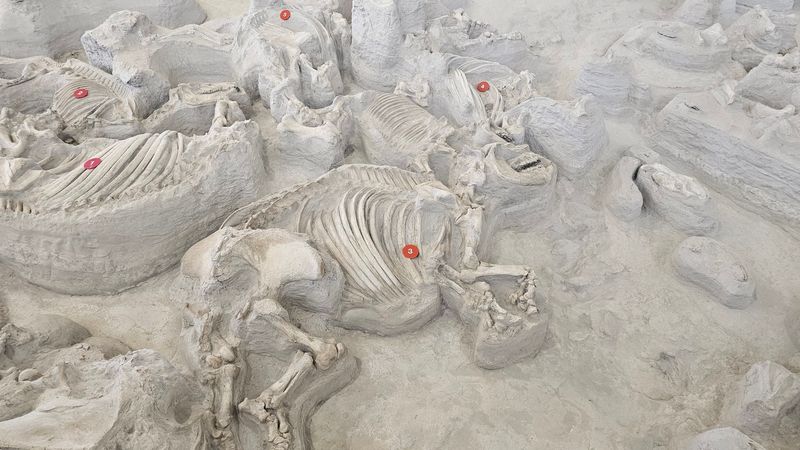
Twelve million years is a number that is genuinely difficult to wrap a human mind around, but standing above the bone bed at Ashfall makes it feel surprisingly tangible.
The animals preserved in the ash lived during the late Miocene epoch, a period long before modern bison, cattle, or any human being set foot on the Nebraska plains.
The geological context places the fossil beds within what scientists call the Ash Hollow Formation, a layer of sedimentary rock that records a dramatic chapter in the story of North America’s interior.
During the Miocene, the Great Plains supported a diverse and thriving community of large mammals, many of which look startlingly different from anything alive today.
Three-toed horses, long-necked camels, and barrel-chested rhinos roamed grasslands that covered much of what is now Nebraska.
The climate was somewhat warmer and wetter than it is today, and the landscape around the ancient watering hole would have felt lush by comparison to the dry prairie that surrounds the park now. Understanding that timeline helps place the fossils in a context that goes far beyond simply marveling at old bones.
These were real animals living real lives in a recognizable but profoundly different version of the same land.
A Distant Supervolcano Caused The Disaster
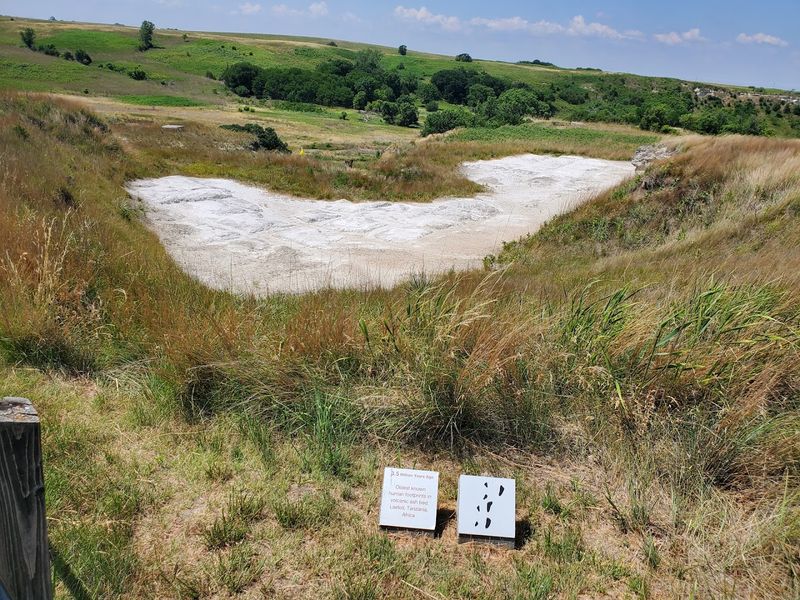
The story of how Ashfall came to exist begins nearly 900 to 1,000 miles west of Nebraska, in what is now southern Idaho.
A supervolcanic eruption from the Bruneau-Jarbidge caldera sent an enormous volume of fine volcanic ash billowing into the upper atmosphere, where wind currents carried it steadily eastward across the continent.
The scale of that eruption is almost impossible to visualize. Scientists estimate it was roughly 1,000 times more powerful than the 1980 eruption of Mount St. Helens, ejecting material across a vast swath of North America.
The ash that eventually settled over the Nebraska landscape accumulated to depths of 8 to 10 feet in low-lying areas like the watering hole where the Ashfall animals had gathered.
There was no warning, no visible fire, and no immediate explosion for the animals standing at the water’s edge.
The ash simply arrived, quietly at first, drifting down like a gray snowfall that never stopped.
Exhibits inside the visitor center walk through the eruption in detail, helping visitors understand how a geological event in Idaho could silently end the lives of hundreds of animals in Nebraska.
The connection between those two distant landscapes is one of the most striking scientific stories told anywhere in the country.
The Skeletons Were Preserved In Three Dimensions
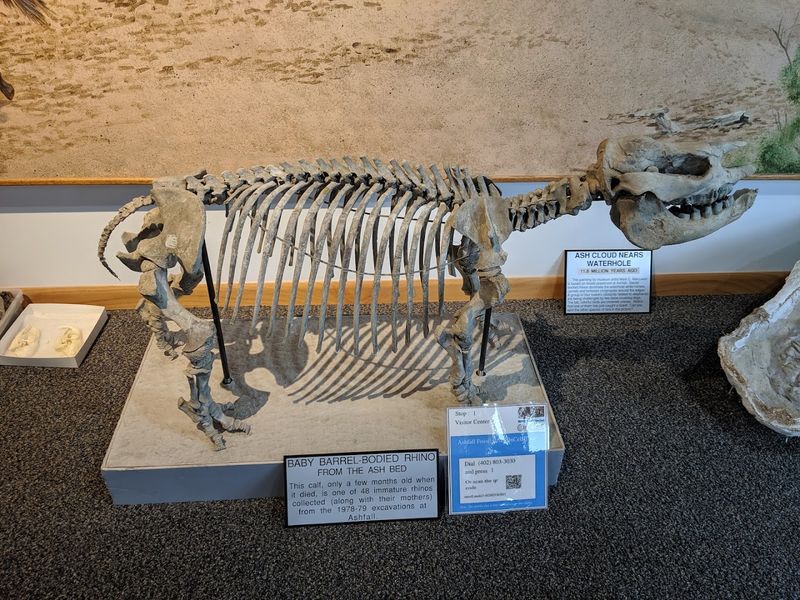
One of the qualities that sets Ashfall apart from almost every other fossil site on Earth is the three-dimensional nature of its preservation.
Most fossils found in sedimentary rock have been compressed over millions of years, leaving flattened outlines rather than full skeletal structures.
At Ashfall, the fine-grained volcanic ash acted differently. It settled gently around the bodies of the animals, filling in every cavity and contour without crushing the underlying structure.
Combined with the alkaline chemistry of groundwater moving through the deposit, this created conditions that fossilized the skeletons in extraordinary detail, preserving them in lifelike positions.
Rhinos can be seen lying on their sides with legs extended. Horses are found with necks arched and heads resting on the ground.
The three-dimensional quality of these remains gives paleontologists information that simply cannot be extracted from a flattened fossil, including posture, body proportions, and the spatial relationships between individuals.
For visitors, it means the bone bed looks less like a geological layer and more like a scene from a nature documentary, paused at a heartbreaking moment and held there for 12 million years.
Researchers Continue Making Discoveries
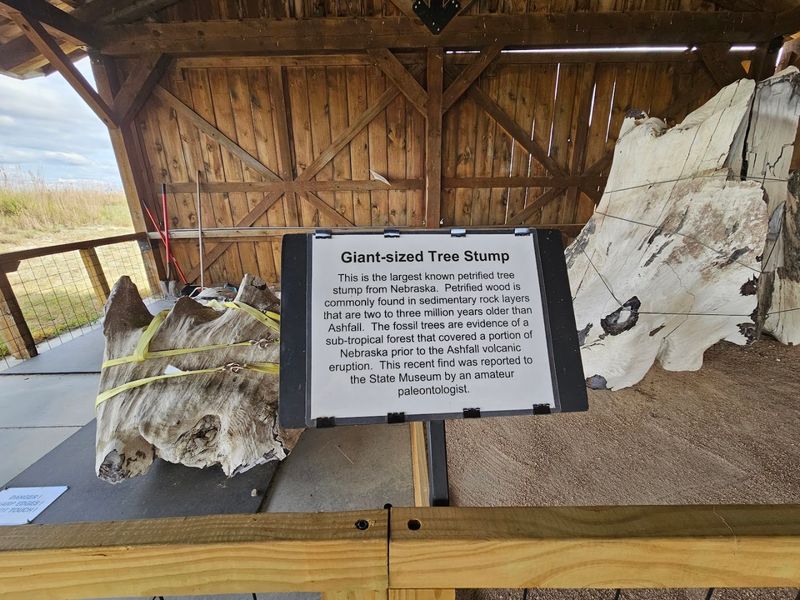
Completed excavations belong in textbooks. Ashfall belongs in the present tense.
The site remains scientifically active, with researchers from the University of Nebraska State Museum continuing to work the bone bed each season, and the full extent of the ancient watering hole has not yet been determined.
That ongoing uncertainty is genuinely exciting from a scientific standpoint.
New fossil species could still be waiting beneath the ash, and each excavation season has the potential to add information that reshapes the understanding of the late Miocene ecosystem.
The collaborative relationship between Nebraska Game and Parks and the University of Nebraska ensures that the research continues with proper resources and scientific rigor.
For repeat visitors, the active nature of the site means that what they see on a second or third trip may look meaningfully different from what they saw before.
Bones that were buried on a previous visit may now be exposed and identifiable. A section of the bone bed that appeared unremarkable may have yielded something unexpected over the winter.
That quality of ongoing discovery gives Ashfall a vitality that static exhibits simply cannot match. The site is not a finished story waiting to be read; it is a story still being written, one careful brushstroke at a time.
It Is A National Natural Landmark
Not every remarkable place receives formal recognition, but Ashfall has earned one of the most meaningful designations available to a natural site in the United States.
On May 9, 2006, the U.S. Department of the Interior officially designated Ashfall Fossil Beds as a National Natural Landmark.
That designation places the site among a select group of locations recognized for their exceptional scientific importance to the natural heritage of the country.
Ashfall is one of only 59 National Natural Landmarks in the United States designated primarily for paleontological resources, a category that reflects just how rare and significant a site must be to qualify.
The recognition acknowledges the exceptional concentration and three-dimensional preservation of complete prehistoric mammals found here, qualities that set the site apart from other fossil localities around the world.
National Natural Landmark status does not change the visitor experience directly, but it signals something important about how the scientific community and federal government view the site’s global significance.
Ashfall is not simply an interesting regional attraction; it is a world-class paleontological resource that happens to be located in rural Nebraska.
The designation ensures that its importance is formally documented and that its protection carries the weight of national recognition alongside state management.
The Park Operates Seasonally
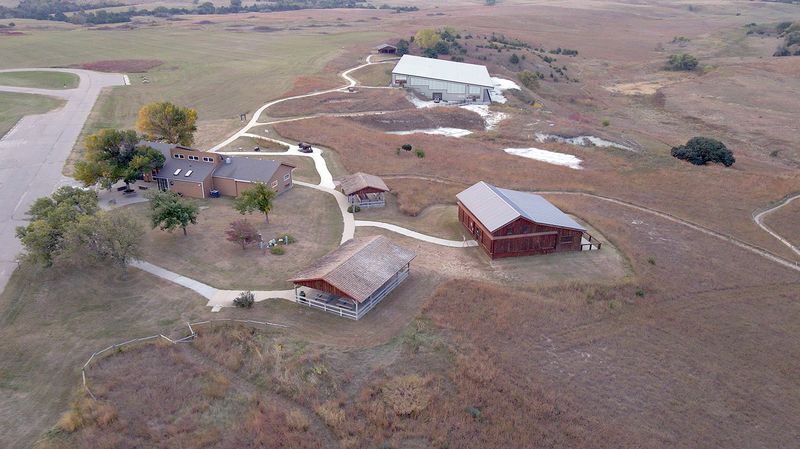
Planning a trip to Ashfall requires a bit more advance attention than visiting a year-round attraction, because the park operates on a seasonal schedule that generally runs from early May through early October.
Outside those months, the site is closed to the public.
Operating hours during the open season are Tuesday through Saturday from 9:30 AM to 4:30 PM and Sunday from 12:30 PM to 4:30 PM, with Mondays closed.
Those hours can shift throughout the season, and checking the current schedule at ashfall.unl.edu before making the drive is strongly advisable, particularly for visitors traveling a significant distance.
Summer months tend to offer the richest experience because university students and researchers are most likely to be actively working the bone bed during July and August.
Visiting on a weekday during those months increases the chances of watching excavation in progress and having extended conversations with the people doing the work.
Cooler morning hours are generally more comfortable for exploring both the indoor barn and the outdoor trails, particularly during Nebraska’s warmer summer weeks.
Admission is paid at the gift shop inside the visitor center, and a Nebraska state park entry permit may also be required, so confirming current admission requirements before arrival helps avoid any surprises at the gate.