You Can Walk Under A Coral Cathedral One Man Carved Alone In Homestead, Florida
I pulled off a busy highway in South Florida expecting a roadside curiosity and a stretch of my legs. What I found instead was a walled compound of stone slabs so heavy that trucks would struggle with them, all cut and set in place by one small man working by himself.
He stood barely over five feet tall and weighed around a hundred pounds, yet he shifted blocks weighing tons. Nobody ever figured out exactly how he did it, and that unanswered question is the whole reason the place sticks with you.
A Stone Compound on South Dixie Highway
Drive south out of Miami far enough and the strip malls thin out into nurseries, fruit stands, and farm fields. Somewhere in that stretch, an eight-foot wall of pitted gray stone appears on the side of the road, looking less like a museum and more like the ruins of something nobody bothered to explain.
The place is Coral Castle, a privately owned museum and sculpture garden at 28655 S Dixie Hwy in Homestead. Google Maps files it simply as a museum, which undersells the strangeness considerably.
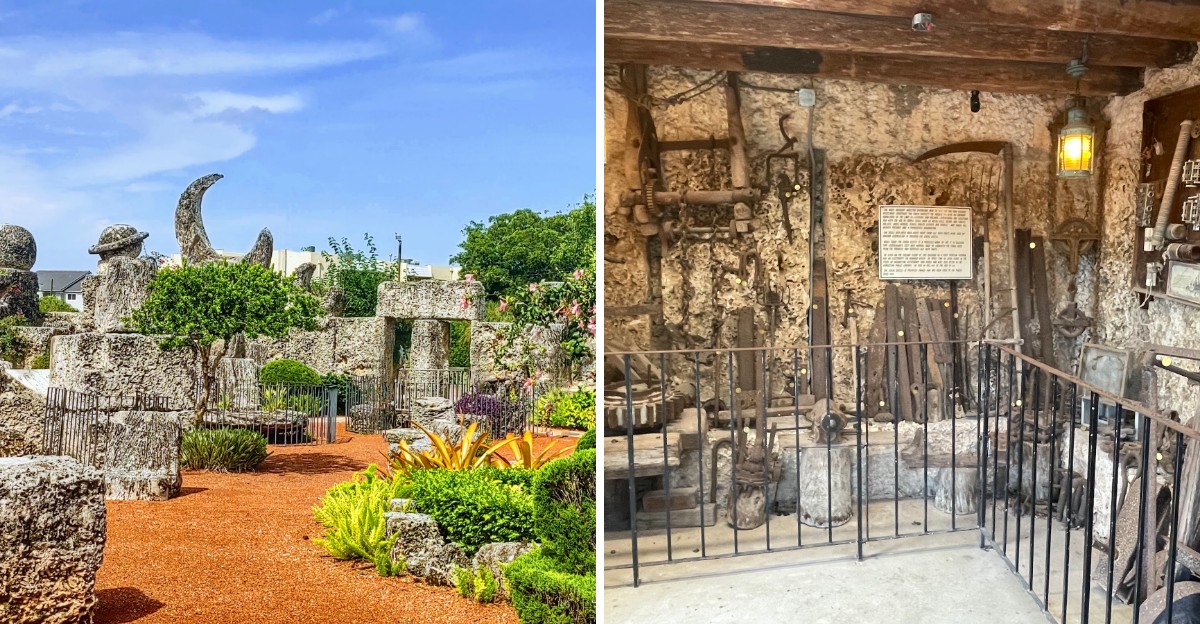
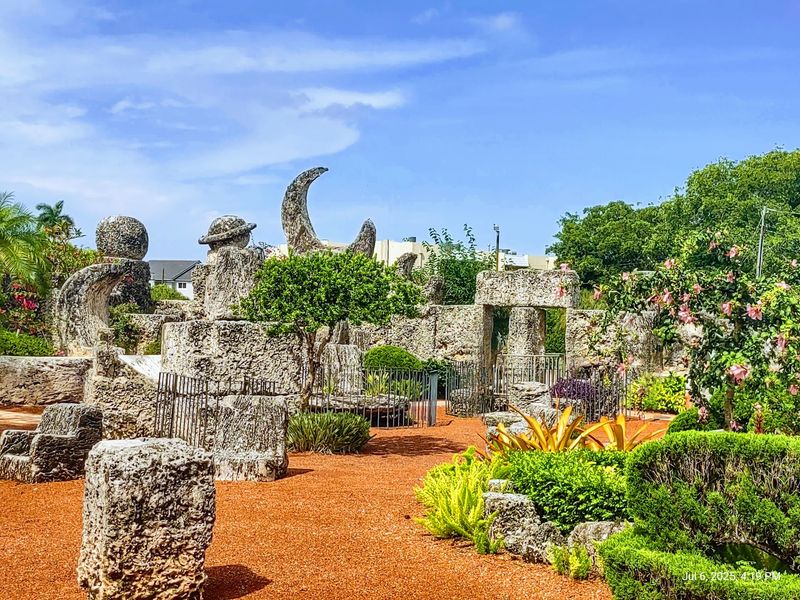
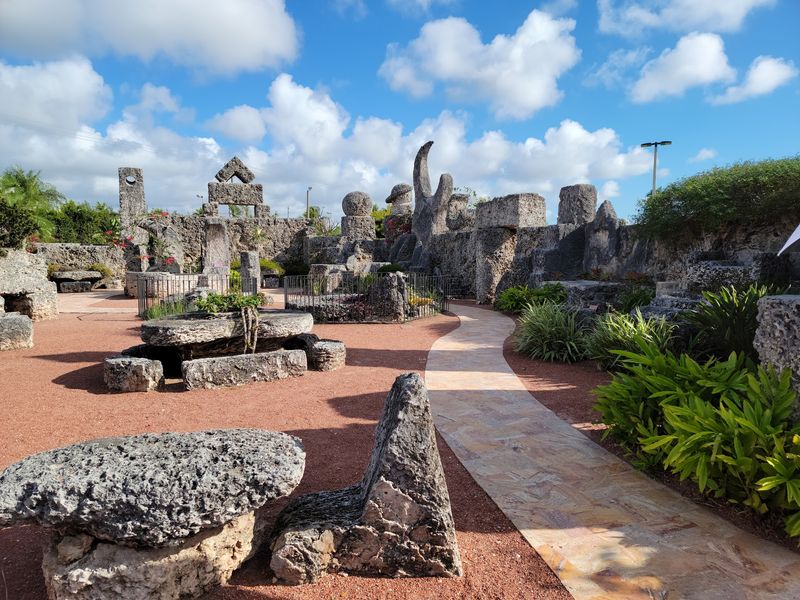
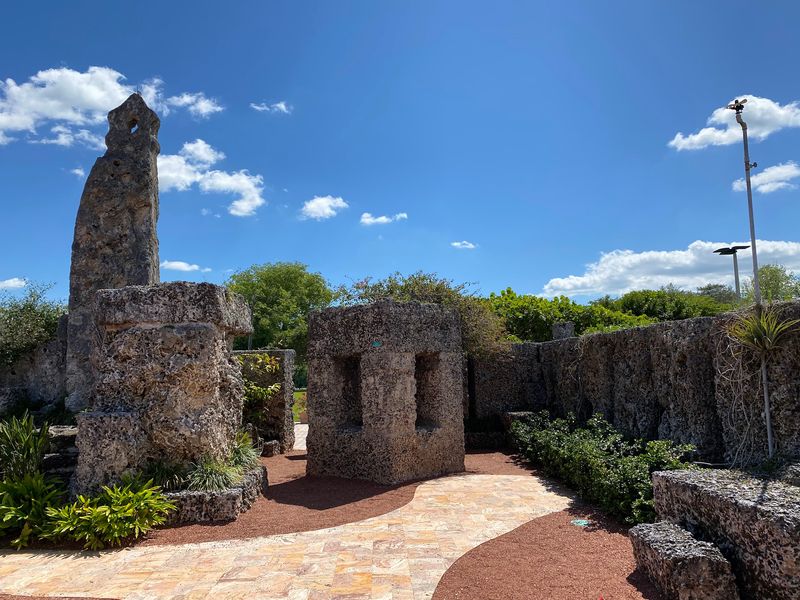
Behind that wall sit carved tables, chairs, a crescent moon, a two-story tower, a working sundial, and a telescope aimed at Polaris. All of it was quarried and set by Edward Leedskalnin, a Latvian immigrant who worked from 1923 to 1951 without a crew, without a crane, and mostly without witnesses.
Roughly 1,100 tons of oolitic limestone went into the project. Locals call it coral rock, which is where the name comes from.
Parking is free, the lot is easy to spot, and the whole thing hides in plain sight beside one of Florida’s oldest highways.
Edward Leedskalnin and the Love That Started It
Every odd monument has an origin story, and this one begins with a canceled engagement in Latvia. Edward Leedskalnin was set to marry a younger woman named Agnes Skuvst, and the wedding never happened.
He left Europe, eventually landed in South Florida, and began carving.
He called her his Sweet Sixteen for the rest of his life, and he built the entire compound as a monument to her. She never came to see it.
Consider the physical math for a moment. A man just over five feet tall, about a hundred pounds, quarrying limestone by hand and setting slabs that weigh as much as a pickup truck loaded with more pickup trucks.
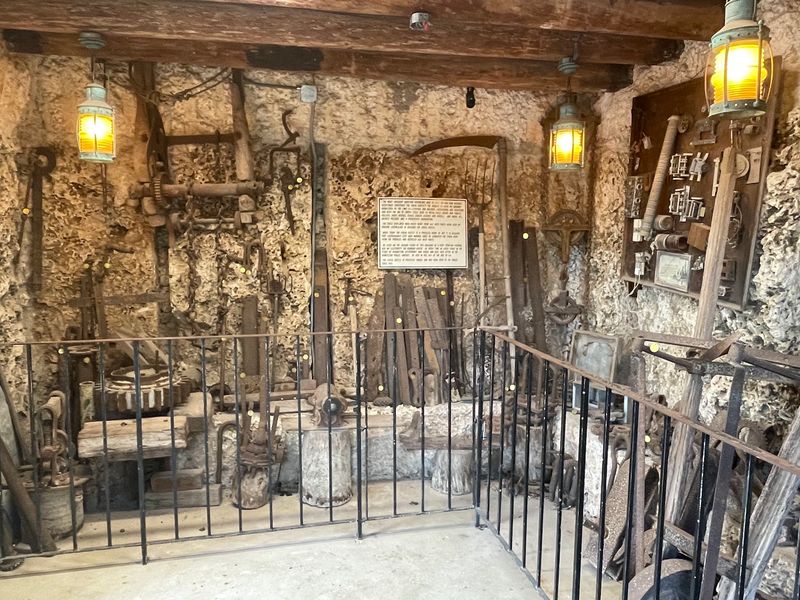
He built his own tools from junked car parts, rigged tripods, levers, and pulleys, and worked largely after dark.
That nighttime habit fuels the speculation to this day. Leedskalnin dropped hints that he had worked out the methods ancient builders used on the pyramids, then declined to elaborate.
The romance is what gives the stone its weight. Without Agnes, the site is masonry.
With her, it’s a letter nobody answered.
The Nine-Ton Gate That Moved With One Finger
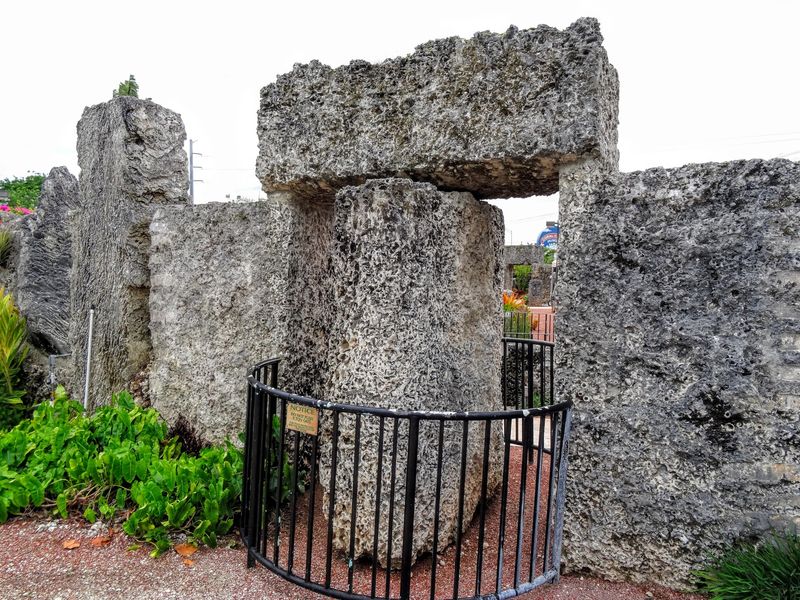
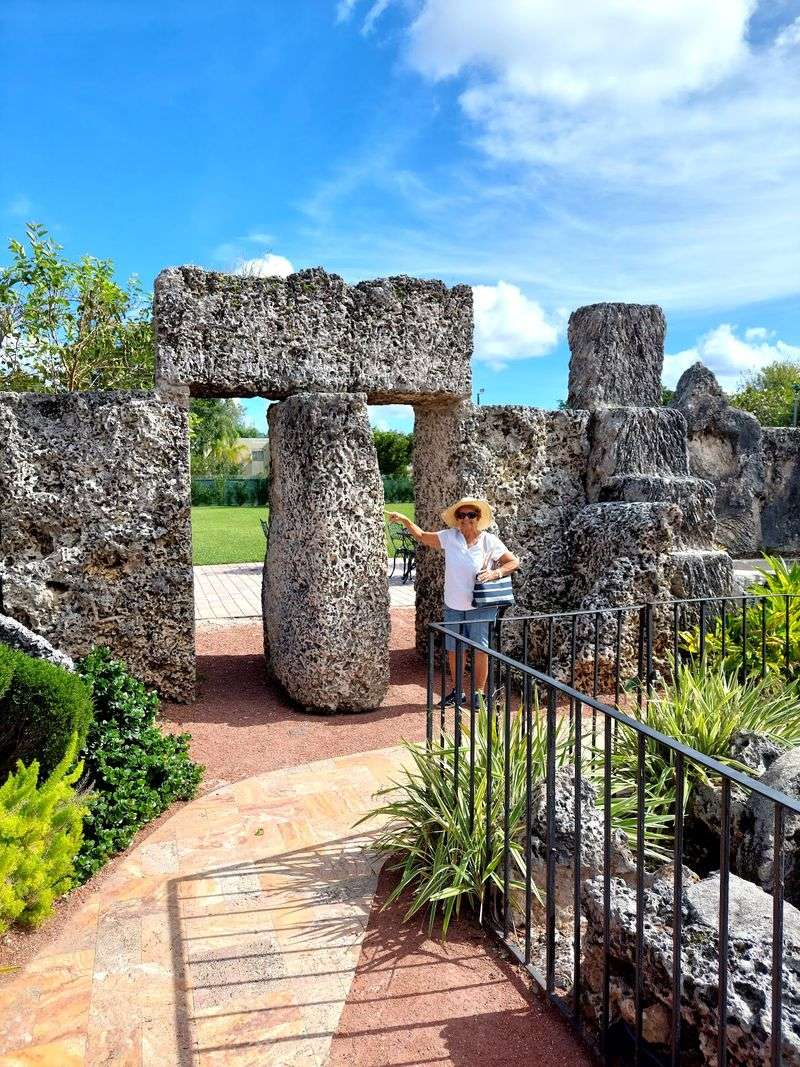
Of everything inside the walls, the gate is the piece engineers keep coming back to. It weighs about nine tons and once swung open at the push of a finger, balanced so precisely on its pivot that a child could work it.
The fit is what unsettles people. The stone sits in its opening with a gap so even and tight that it reads as machined rather than chipped out by hand in a Florida field.
When the gate eventually stopped turning, a crew with heavy equipment removed it to find the problem. They discovered a shaft drilled dead center through the block, resting on a truck bearing.
Reinstalling it took a crane, several people, and a good deal of time. It has never worked quite as smoothly since.
Let that sink in. A team with modern machinery could not restore what one man achieved alone with scrap metal and patience.
You cannot touch the gate, and that restriction disappoints some people. Standing next to it while a guide explains the bearing is enough to make the point.
Furniture Carved for Giants
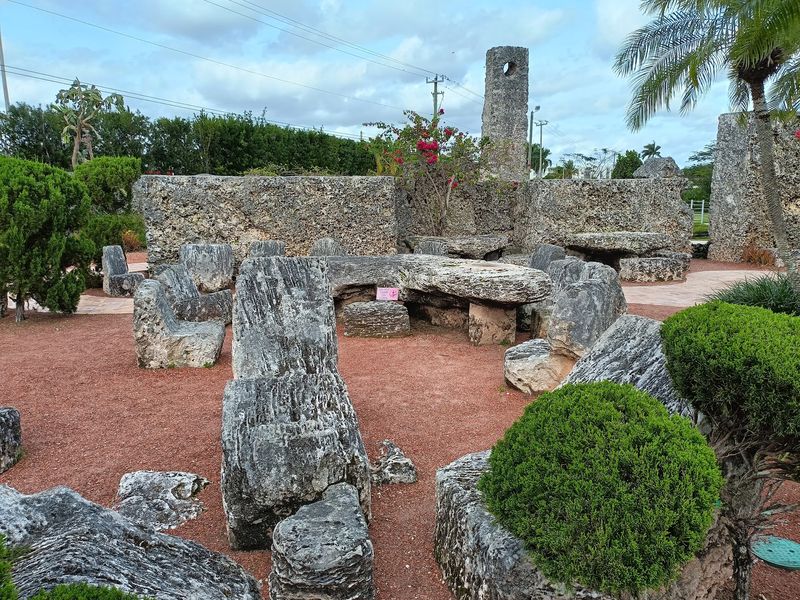
Picture a dining set nobody could ever steal. Leedskalnin carved tables, chairs, benches, beds, and a rocking chair that tips the scale around five tons, all from the same porous limestone as the walls.
One table is cut in the shape of Florida, complete with a depression standing in for Lake Okeechobee. He used it as a birdbath, which may be the most quietly charming detail on the property.
There’s a throne room with chairs sized for a family. There’s a bathtub.
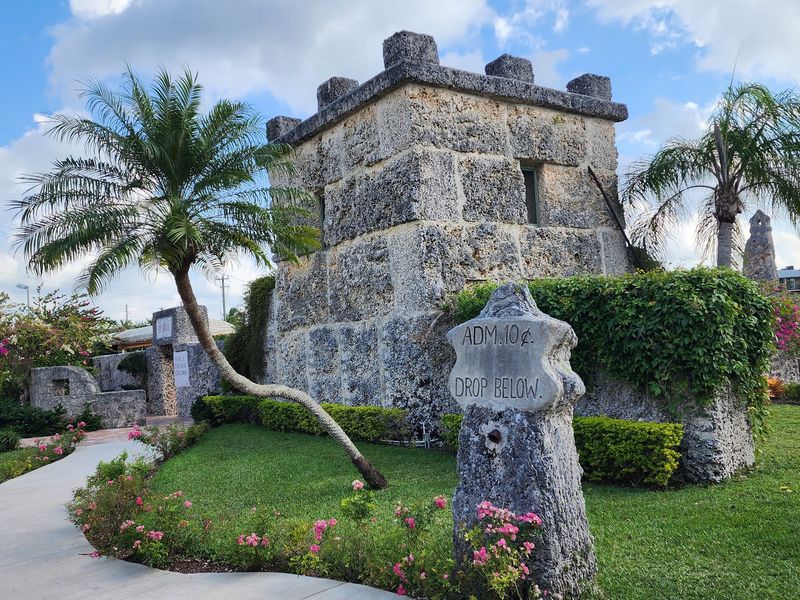
There’s a barbecue pit and a well. The two-story tower he lived in held his sleeping quarters upstairs and his workshop below, with rope-and-pulley rigging still visible.
The scale plays tricks on you. Photographs flatten these pieces into ordinary garden furniture, and only in person does the sheer mass register, especially once a guide mentions the tonnage of the block you happen to be standing beside.
He also carved astronomical instruments, a sundial that keeps decent time, and a stone clock and calendar that reportedly took him three years to finish. The man had no shortage of ambition.
The Sundial, the Telescope, and a Sky Full of Math
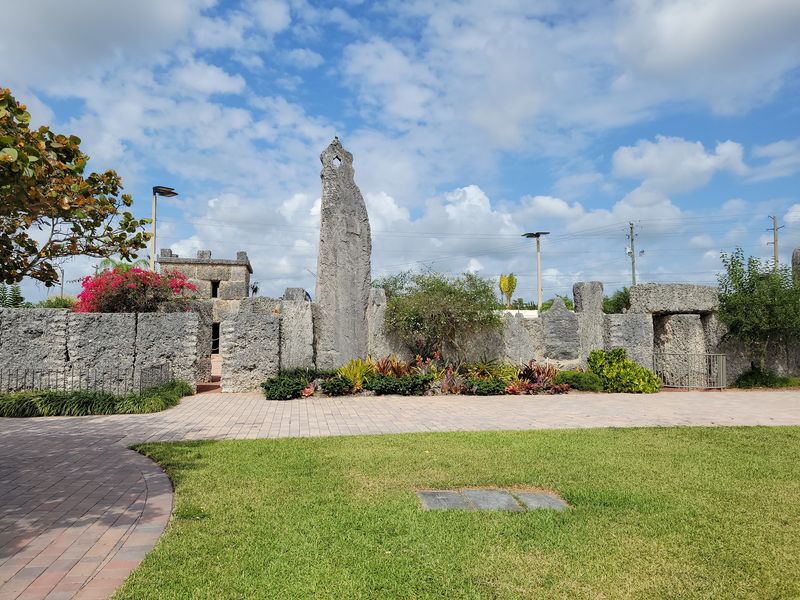
Astronomy turns out to be the thread running through the whole compound. A carved sundial tracks the hours, and a stone telescope stands aimed at the North Star, cut and aligned with nothing more sophisticated than measurement and stubbornness.
The sundial reads the time of day and marks the seasons. The Polaris telescope, a tall slab with a crosshair, still lines up with the star it was built to frame.
Nearby sit a crescent moon, a carved Saturn, and a Mars figure, arranged like a lesson plan in rock. Leedskalnin had roughly a fourth-grade education and taught himself the rest from books and observation.
Standing under those pieces on a bright Florida afternoon, the achievement stops being about muscle and becomes about arithmetic. Getting nine tons of limestone to point accurately at a fixed star requires calculation long before it requires lifting.
Guides usually pause here, and the pause is earned. Kids who lose interest in the love story tend to perk back up when someone explains that the stone in front of them functions as a clock.
The Three-Year Move From Florida City
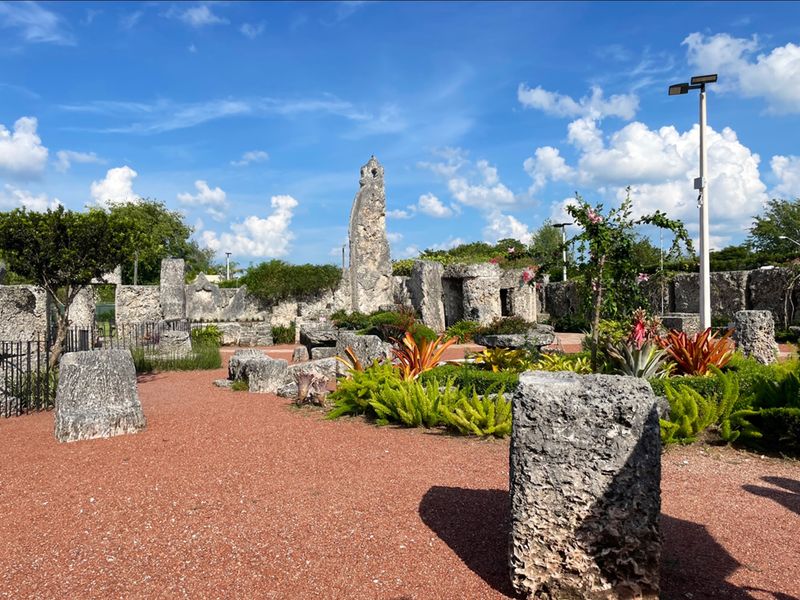
Here’s the part of the story that most people miss until a guide brings it up. Leedskalnin built the original version of his compound in Florida City, then decided in 1936 to move the entire thing ten miles north to Homestead.
He did not abandon it and start over. He took it with him, block by block, and the relocation consumed three years.
A borrowed truck and driver handled the hauling, but Leedskalnin loaded and unloaded everything himself, always arranging for the driver to be elsewhere when the heavy work happened. Nobody watched him do it.
The reason for leaving is often given as a wish for more privacy and a better spot along the highway, where paying visitors might wander in. He called the new site Rock Gate Park and charged a small admission, occasionally leaving a note on the gate when he stepped out.
Consider the willpower involved. Most of us hesitate to move a sofa across a room, and this man disassembled a stone compound, drove it up the road, and put it back together better than before.
Guided Tours, Audio Headsets, and a Short Film
Admission starts indoors with a short documentary that lays out Leedskalnin’s life, the construction, and the theories. Watching it first makes everything outside land harder, so don’t skip ahead to the courtyard.
From there you can join a live guided tour or use an audio tour on your own schedule. Tours run through the day, and the guides carry the experience.
Mentions of the tour guides dominate the feedback about this place, and the commentary tends to blend hard facts with the gossip and folklore that have collected around the site over the decades.
Access to the grounds is tied to having a guide present, which shapes how you plan your hour. You can photograph freely and step off the walkway in places, but touching the stone is off-limits, including the famous gate.
Tours start on the hour, so arriving mid-hour means catching the tail end of one group and the beginning of the next. Doing the loop twice is allowed and helps, because a second pass catches what the first one glosses over.
Expect roughly 60 to 90 minutes total.
Ancient Aliens, Magnetism, and Other Theories
Ask ten people how the blocks were moved and you’ll get ten answers, several of them involving beings from elsewhere. The History Channel has covered the site, the ancient aliens angle comes up constantly in conversation about it, and the guides lean into the speculation with obvious enjoyment.
Leedskalnin fed the fire himself. He wrote pamphlets on magnetic current, claimed he understood the principles behind the pyramids, and refused to demonstrate his method.
Engineers offer a more grounded explanation: tripods, block and tackle, iron tools shaped from old car parts, and a deep understanding of leverage. Limestone here is relatively soft and workable when freshly quarried, which helps.
The night work may simply have been a way to avoid the heat and keep onlookers away.
Neither camp can close the case, and that’s precisely why the place endures. A monument with a tidy explanation would just be a garden with big rocks in it.
The conspiracy talk gets folded into the tour rather than pushed as truth, which keeps things fun without tipping into nonsense. You leave with your own theory, which is the point.
Gardens, Shade, and a Gift Shop Anyone Can Enter
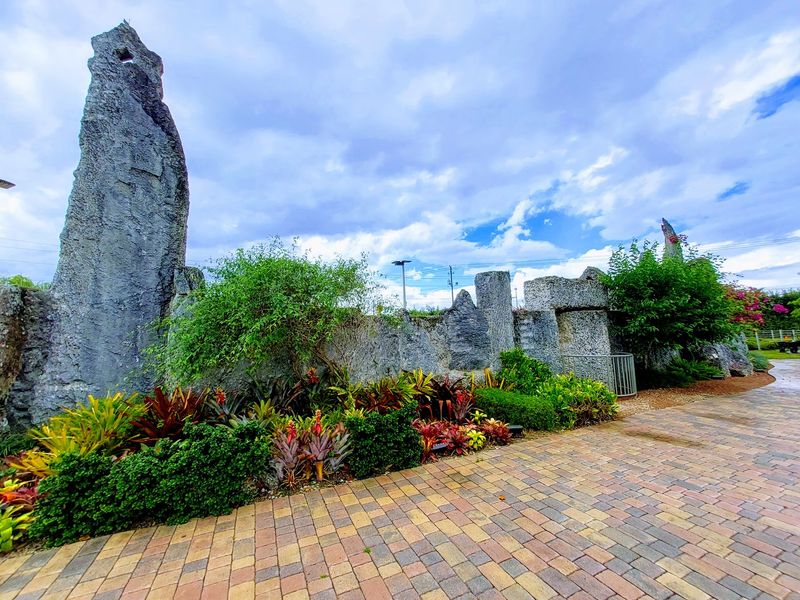
Bright bougainvillea, tropical plantings, and busy wildlife soften what would otherwise be a lot of gray stone under a hard sun. The landscaping came later than the original construction, and the grounds are kept in good shape.
South Florida heat is the real variable. Staff hand out umbrellas for shade, which sounds like a small courtesy until you’re standing in an open courtyard at midday and grateful for it.
The gift shop sits near the exit and stocks books, pamphlets, and souvenirs tied to Leedskalnin’s writings and the theories around him. You do not need a ticket to browse it, which is a nice quirk of the layout.
Pets are allowed on the grounds, so the dog does not have to sit in the car. The property is compact, more courtyard than campus, and the walking is easy.
The compound was added to the National Register of Historic Places in 1984, and it shows in the upkeep. Restrooms, shade, and cold air at the shop make it a manageable stop even in the sticky months, which in this part of Florida means most of them.
Who Gets the Most Out of It
A mystery lover gets the best value here. So does anyone who likes engineering puzzles, folk art, or stories about people who refused to be talked out of an impossible idea.
Kids do surprisingly well, especially once a guide starts comparing stone weights to cars. The tour is conversational and question-friendly, so curious children tend to stay engaged rather than drift.
Anyone expecting a sprawling attraction with rides and interactive exhibits should recalibrate. The site is small, the stones photograph smaller than they feel, and you cannot climb or touch anything.
Reading a little history before arriving raises the payoff sharply, and the introductory film helps if you skip the homework.
Romantics have their own reason to come. The whole compound is an unanswered love letter carved in rock, and that framing hits differently once you’re standing inside the walls.
Photographers should plan around the light, since midday sun flattens the stone and bleaches the sky. Morning shots are kinder.
It pairs well with a longer South Florida day rather than standing alone as a destination, which is exactly how most people treat it.
Getting There, Hours, and Parking Notes
Homestead sits about an hour and a half south of central Miami depending on traffic, and the drive down South Dixie Highway is straightforward. The address is 28655 S Dixie Hwy, and the entrance is visible from the road.
Doors open at 9 AM every day of the week, and the museum stays open into the evening. Arriving right at opening usually means no line and a smaller tour group.
Parking is free and easy. The lot handles cars comfortably; a 30-foot RV can squeeze in on a quiet day, but anything larger or towing will not fit.
Admission covers the film, the tour, and the grounds, and ticket prices run higher than a typical roadside stop, so check current rates before you commit a whole family to it. Buying in for a ten-minute lap will feel thin, while staying the full hour and a half and repeating the loop stretches the value considerably.
Nearby, the Redland farm stands, tropical fruit groves, and the road toward the Everglades and the Keys make it simple to build a full day around a stop here.
The Verdict on Florida’s Strangest Monument
Some places impress by size, some by beauty, and a few by the sheer improbability of their existence. The last category is where this one lands.
Nothing here sparkles. The stone is rough, pocked, and the color of old concrete, and photographs never quite convey how heavy it all is.
What carries the visit is the arithmetic you keep running in your head: one man, hand tools made from scrap, three decades, 1,100 tons, no help, no explanation.
Go in with the right expectations and it delivers something few attractions manage, which is a puzzle you cannot solve on the drive home. Go in expecting spectacle and the compact grounds may feel slim against the ticket price.
The audio tour, the film, and a talkative guide are what turn a courtyard of rocks into a story about obsession and heartbreak and physics.
Leedskalnin never explained his method, never got his bride, and never stopped carving. Whatever else you make of the place, you leave thinking about what a determined person can pull off with almost nothing, which is a decent souvenir from any road trip.