These 8 North Carolina Tunnels Look Unsettling Even In Daylight
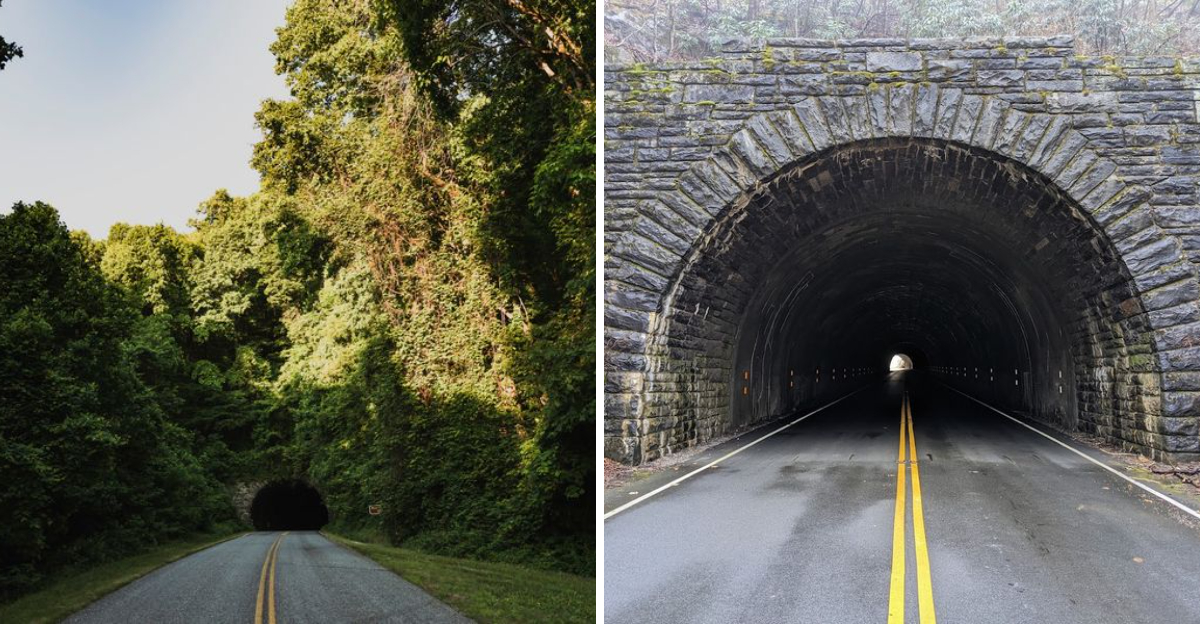
A dark opening in the side of a mountain can make even the bravest traveler slow down.
Across North Carolina, these shadowy passages appear along scenic roads, old rail routes, and rugged mountain landscapes. Some were carefully carved through solid rock.
Others remain tied to plans that never fully came together.
Each one carries a different mood. Daylight fades quickly inside, sounds bounce off the walls, and the exit can look much farther away than it really is.
That strange feeling is part of the appeal.
History follows many of these routes, but nature has added its own touch. Mist gathers near the entrances, vines creep across stone, and cool air drifts out even on warm afternoons.
A few feel peaceful. Others may have you walking faster without admitting why.
These eight passages prove that an ordinary drive or hike can become much more interesting with one dark opening ahead. Just try not to be the person who immediately asks what might be living inside.
1. Road To Nowhere Tunnel
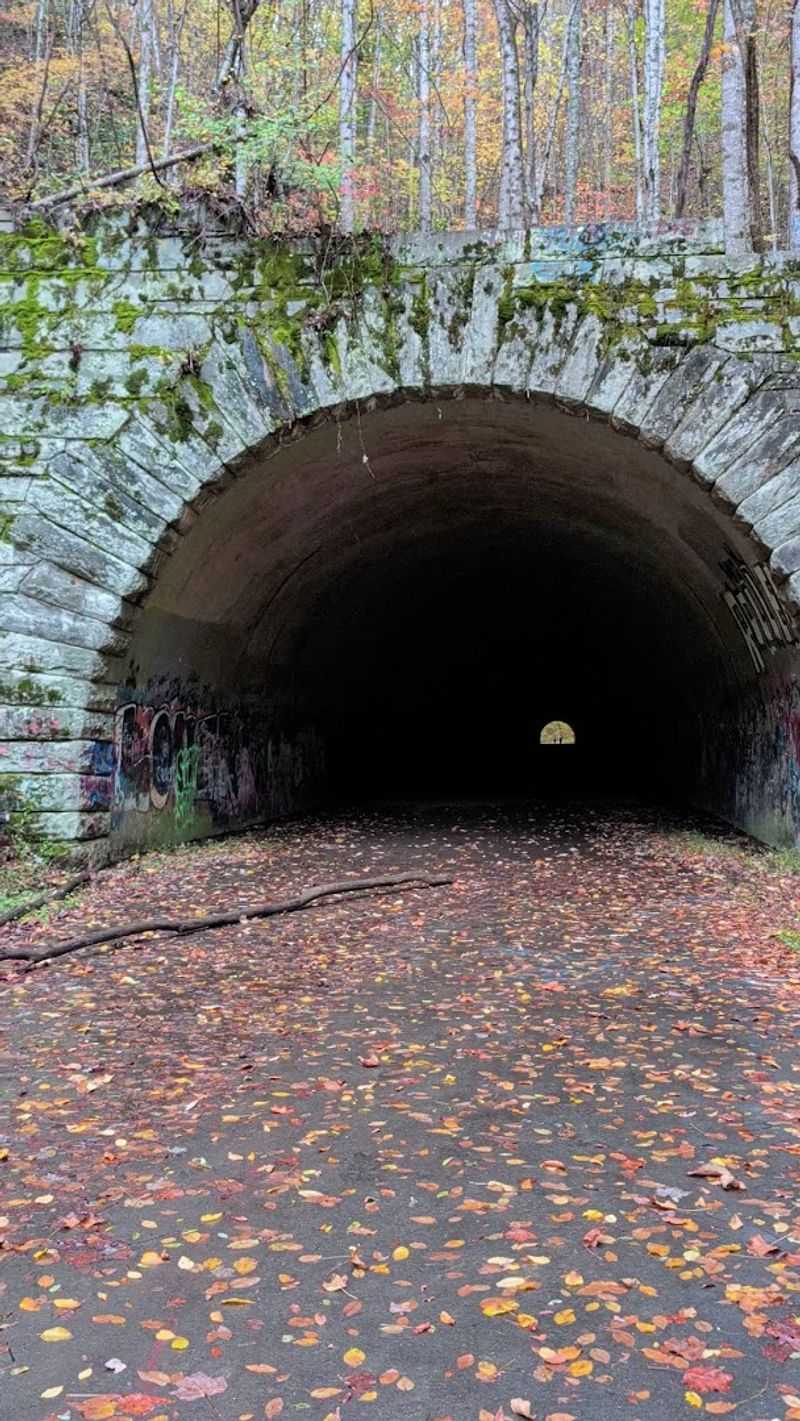
Following Lakeview Drive west from Bryson City brings you to a mountain passage that no longer carries cars. The paved route ends at the 1,200-foot Lakeview Drive Tunnel inside Great Smoky Mountains National Park, where a small parking area allows visitors to continue on foot.
Daylight weakens quickly inside the unlit bore, and a flashlight makes the walk easier once the entrance recedes behind you.
Hiking connections wait beyond the opposite portal, including Lakeshore Trail, Goldmine Loop Trail, and Noland Creek Trail.
A bypass path also climbs around the tunnel. History gives the stop more weight than its nickname suggests.
Fontana Lake covered older roads and separated former residents from community sites and family cemeteries. A 1943 agreement called for a new route along the lake’s north shore, and construction began during the 1960s.
Slope instability, high costs, and environmental challenges ended the project in 1972. Visitors now encounter a finished tunnel attached to a road that never reached its planned destination.
Motorized traffic is permanently prohibited inside, so park at the designated end of Lakeview Drive rather than trying to continue. A Great Smoky Mountains parking tag is required when a vehicle remains parked longer than 15 minutes.
2. Beaucatcher Tunnel
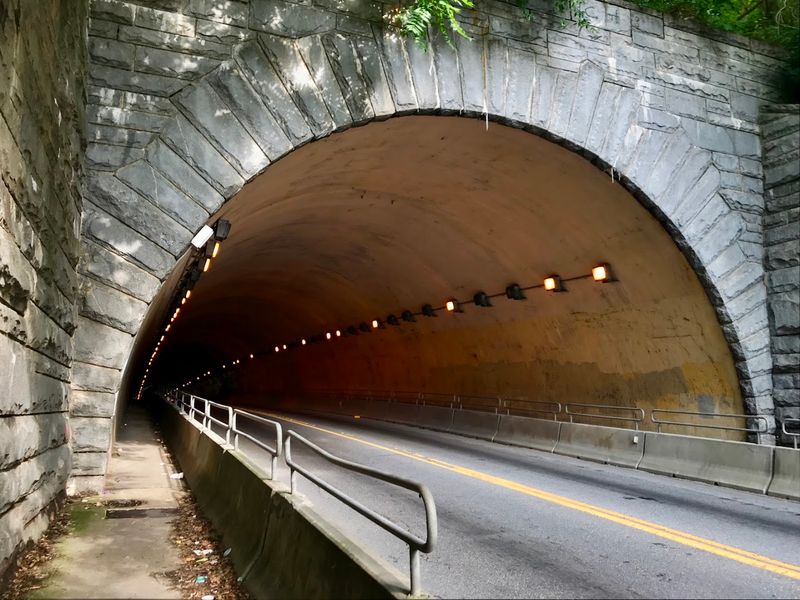
Daily traffic makes this Asheville passage easy to treat as an ordinary shortcut, but its stone-framed entrance still creates a striking transition beneath Beaucatcher Mountain. The tunnel carries U.S. 70 and U.S. 74A between downtown Asheville and the city’s eastern side.
Work began in 1927, when critics questioned the cost of boring through a ridge toward an area that had not yet seen extensive development. Construction delays and design changes added to those doubts.
Cars began using the tunnel in 1929, and the connection became increasingly important as neighborhoods and businesses expanded eastward. Modern drivers experience the practical result in less than a minute.
Open streets narrow into an enclosed corridor, daylight drops, and the sound of nearby vehicles becomes more concentrated. This remains a busy transportation route rather than a sightseeing stop, so slowing suddenly for photographs can create problems for everyone behind you.
Renovation work completed decades later added rock faces at both entrances, addressed water leaks, and improved the sidewalks and protective barriers. What feels routine to Asheville residents once represented a costly and controversial decision.
Nearly a century later, the tunnel still shows how one piece of infrastructure can alter travel patterns and encourage a city to grow beyond a natural barrier.
3. Cowee Tunnel
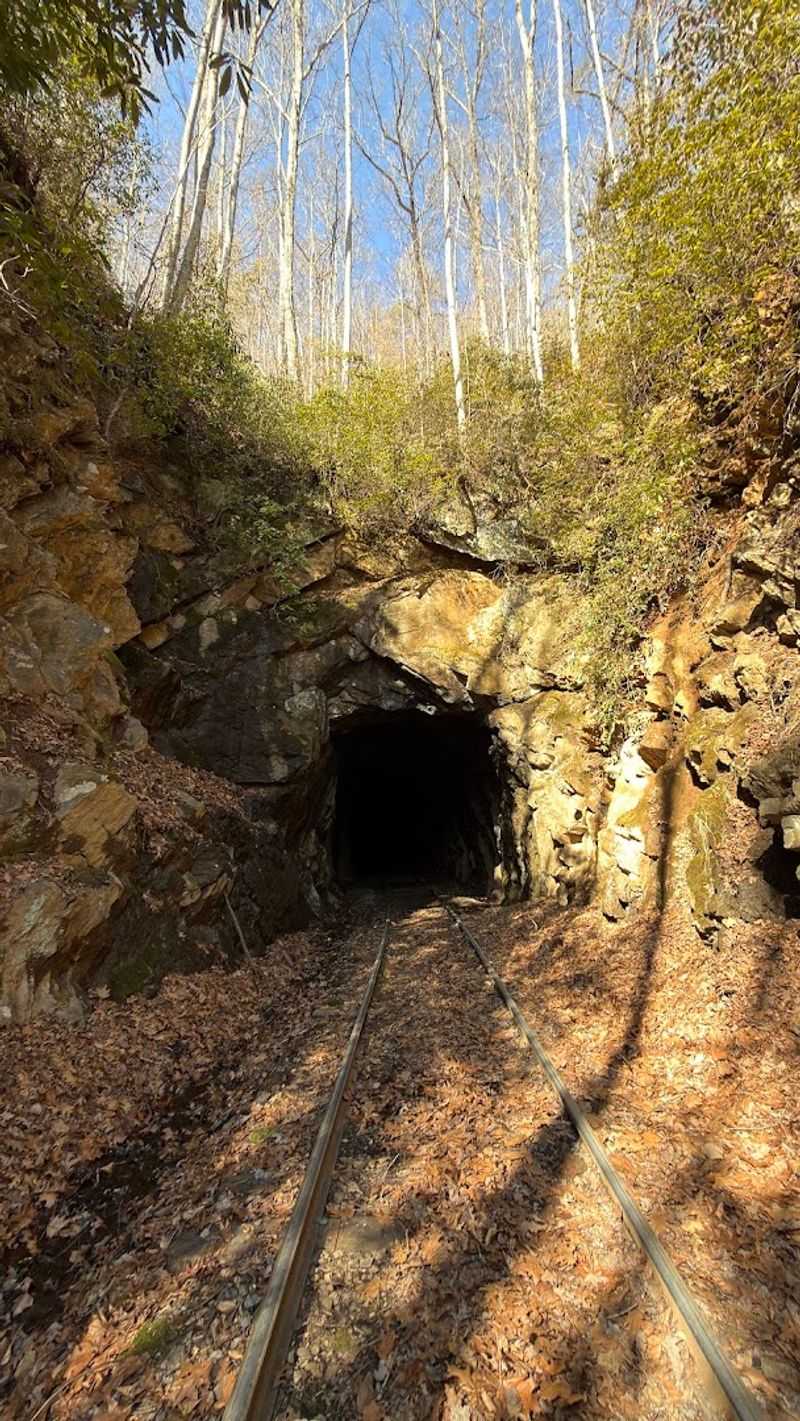
Passengers experience Cowee Tunnel aboard the Great Smoky Mountains Railroad rather than by walking into it independently. The active rail passage stands west of Dillsboro on the Tuckasegee River Excursion, which currently travels between Bryson City and Dillsboro.
Its interior extends for more than 800 feet, briefly replacing river scenery with darkness and amplified train noise. Documented history makes this tunnel far more serious than the supernatural stories sometimes attached to it.
North Carolina used incarcerated laborers during construction of the Western North Carolina Railroad, placing men in tightly controlled and dangerous working conditions. On December 30, 1882, a boat carrying workers across the Tuckasegee River overturned near the tunnel.
Nineteen Black prisoners drowned. Their deaths are now recognized through historical interpretation and a marker near the river, but the story should not be reduced to a frightening legend.
Any uneasiness comes from understanding the human cost behind the route. Current excursion passengers still travel through the tunnel, yet the tracks remain part of an operating railroad and are not a public walking path.
Viewing the passage from a scheduled train is the appropriate way to experience it. As the windows darken, the moment offers space to consider the people whose labor pushed the rail line through difficult mountain terrain.
4. Little Switzerland Tunnel
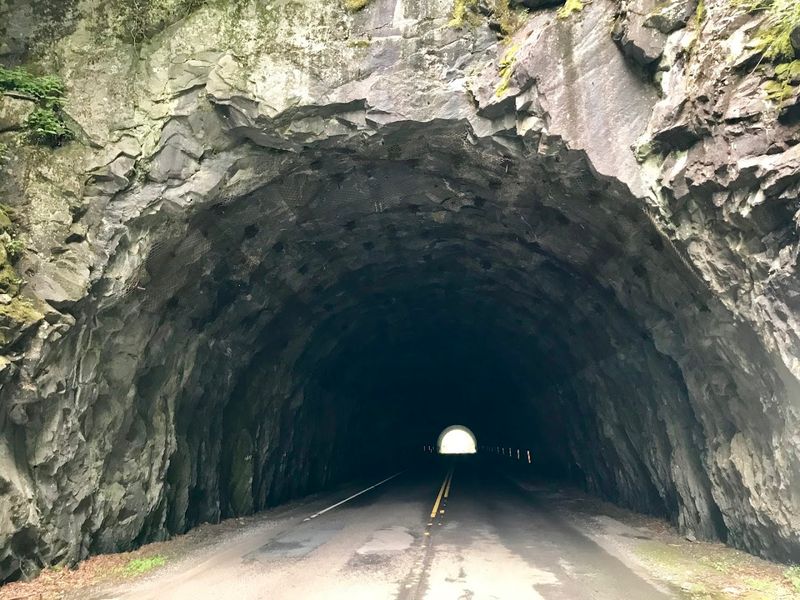
Approaching milepost 333.1 brings a sudden break in the open mountain scenery. Little Switzerland Tunnel carries the Blue Ridge Parkway for 575 feet beneath the ridge, and no permanent lighting brightens its interior.
Curves and strong daylight outside can make the entrance appear darker than expected, so low-beam headlights should already be on before you reach the portal.
Stonework around both openings follows the Parkway’s broader design language, allowing the roadway to pass beneath the slope without replacing the ridge with a broad cut.
Drivers of taller vehicles should note the official clearance measurements: 14 feet 3 inches at the edge line and 19 feet 2 inches at the center. Crossing the center line to gain height is illegal and unsafe.
Current access requires extra attention. The National Park Service road report dated July 28, 2026, lists the section between NC Highway 226 and Little Switzerland as open, which includes the tunnel.
The Parkway closes immediately south of Little Switzerland at milepost 333.9 because of continuing Hurricane Helene recovery work. Visitors can reach the tunnel from the open northern approach but cannot continue through the next closed section.
Check the official status again before traveling, since construction schedules and emergency conditions may change after the latest update.
5. Twin Tunnel North
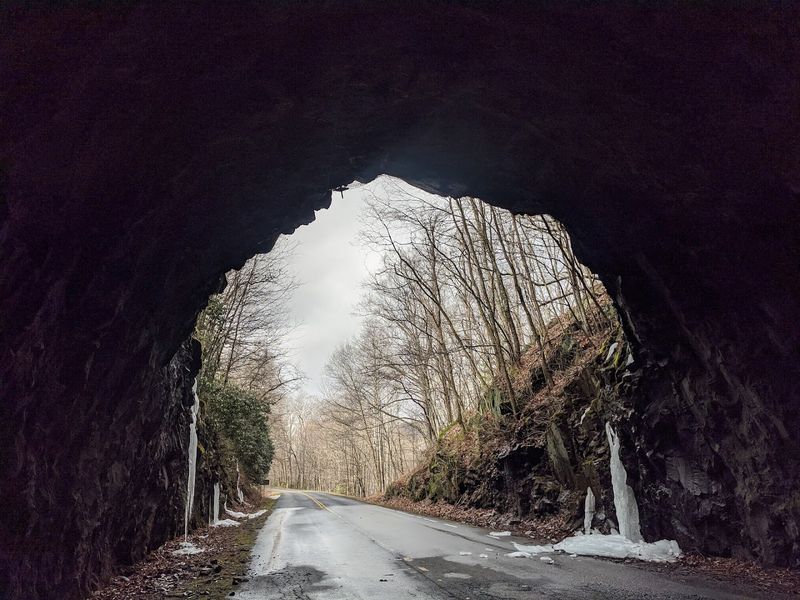
Two closely spaced passages normally create one of the Parkway’s quickest shifts between darkness and daylight near mileposts 344.5 and 344.7. Twin Tunnel North begins the pair with a 350-foot crossing beneath the ridge.
Its companion, Twin Tunnel South, follows after a short open stretch and runs for 407 feet. No interior lighting assists drivers in either passage, making headlights and careful speed especially important whenever the route is available.
Cyclists also use the Parkway, and the National Park Service warns motorists not to pass them inside tunnels. Current conditions change how this entry should be approached.
As of July 28, 2026, the section from NC Highway 80 to Mount Mitchell State Park remains closed because of Hurricane Helene damage. Twin Tunnel North falls within that closure, and the Park Service states that recreation of any kind is prohibited there.
Visitors should not walk around gates, cycle into the closed area, or try to reach the portal for photographs. The tunnel remains an important part of the Parkway’s mountain engineering, but it is not currently an accessible roadside attraction.
Once officials reopen the section, the closely timed pair will again create its familiar sequence of shadow, brief forest, and another dark entrance. Until then, respecting the closure protects visitors and ongoing recovery work.
6. Tanbark Ridge Tunnel
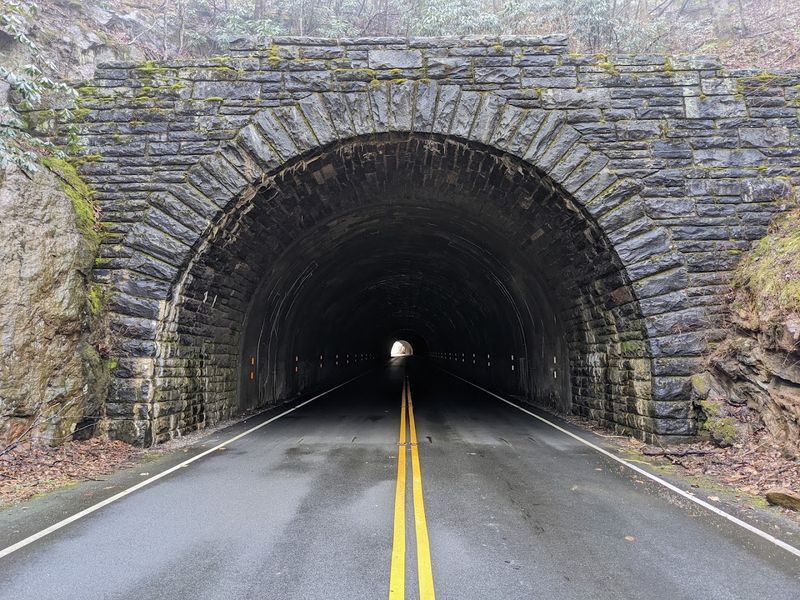
Moisture often gives this unlit passage a darker appearance than the surrounding weather would suggest. Tanbark Ridge Tunnel runs for 843 feet near Blue Ridge Parkway milepost 374.4, placing it among the longer tunnels on the North Carolina portion of the route.
Official measurements give it 14 feet 3 inches of clearance at the edge line and 19 feet 1 inch at the center. Taller vehicles must remain within their lane and fit beneath the lower edge clearance rather than drifting across the center line.
As of July 28, 2026, the Parkway section containing Tanbark Ridge Tunnel is open, although road conditions can change with maintenance, weather, and emergency work.
Low-beam headlights are necessary before entering because the interior has no fixed lights and natural light may not reveal cyclists or obstacles soon enough.
Water seepage can leave the walls and pavement looking damp even during pleasant weather. Drivers should keep moving at a controlled speed instead of stopping inside or near the entrance for photographs.
Thick woodland and stone portal work help the structure settle into the ridge, giving the approach much of its visual impact. Nothing needs to be exaggerated here.
The long dark opening, cool interior, and muted echo already make the crossing feel noticeably different from the forested road on either side.
7. Pine Mountain Tunnel
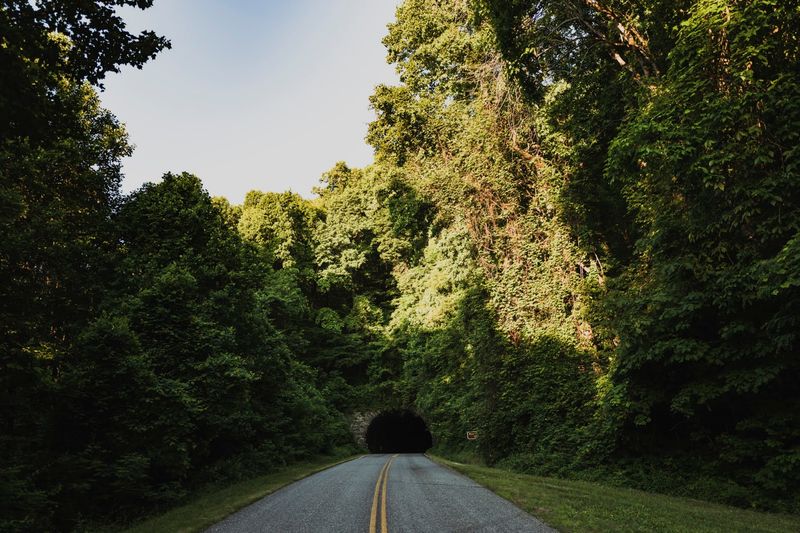
Nearly a quarter mile of enclosed roadway makes this passage feel longer than the brief tunnels encountered elsewhere on the Parkway. Pine Mountain Tunnel reaches 1,462 feet at milepost 399.1, making it the longest tunnel on the Blue Ridge Parkway.
Official clearance measures 14 feet 3 inches at the edge line and 18 feet 8 inches at the center. No permanent lights illuminate the bore, so daylight may fall away well before the opposite portal appears close.
Engine and tire sounds reflect from the interior surfaces, giving even moderate traffic a heavier presence. Drivers should keep low beams on, hold their lane, and remain prepared to encounter cyclists.
Stopping for a photograph or attempting to pass inside would create an avoidable danger. The National Park Service listed the surrounding section as open on July 28, 2026, though later weather or maintenance can alter access without much warning.
Building the Parkway through this terrain required engineers to choose between broad mountainside cuts and passages through ridges. Pine Mountain shows the tunnel approach at its largest scale on the route.
Forest and sky return sharply at the exit, making the transition into open scenery feel immediate. Its effect comes from measurable features rather than folklore: considerable length, an unlit interior, cooler air, and the changing acoustics of a road carried deep beneath the mountain.
8. Big Witch Tunnel
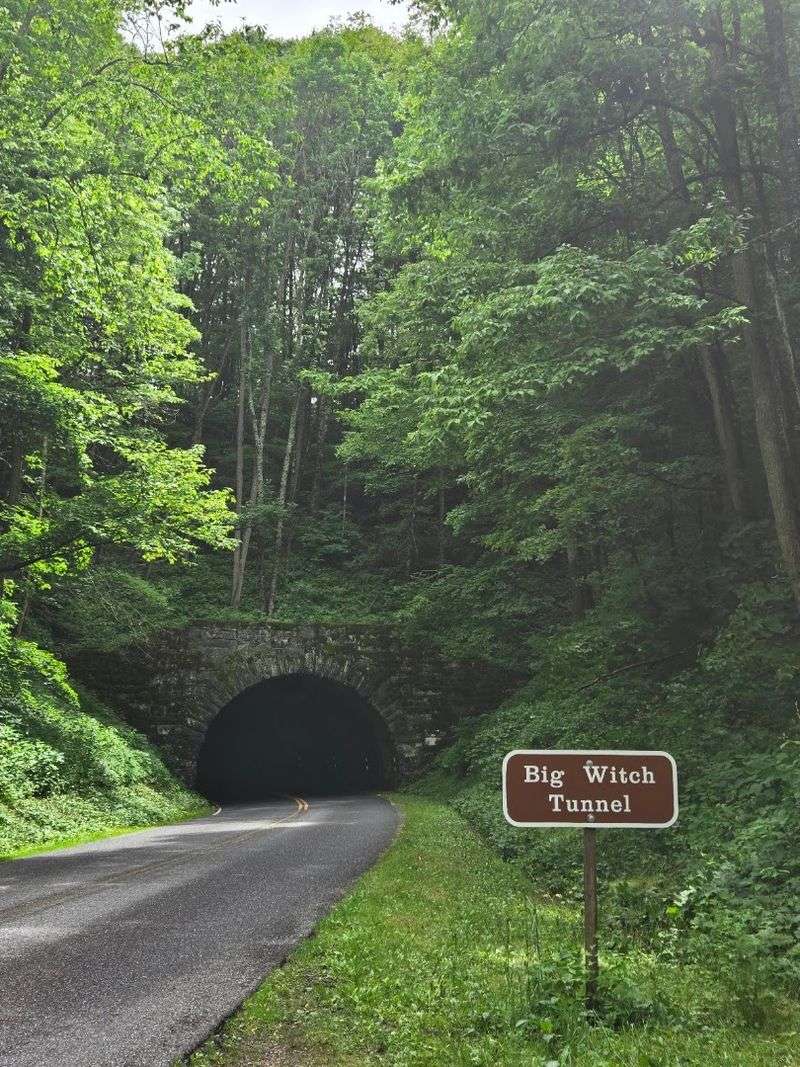
Its name can suggest the wrong story before you know the cultural background. Big Witch Tunnel stands near Blue Ridge Parkway milepost 461.2 and runs for 353 feet beneath a ridge close to Cherokee.
The name honors Big Witch, a respected Cherokee medicine man whose responsibilities included obtaining eagle feathers used in ceremonies.
Treating the name as a supernatural reference overlooks that history and the surrounding landscape’s continuing connection to the Eastern Band of Cherokee Indians.
Big Witch Overlook appears nearby at milepost 461.9 and offers a safer place to pause than the tunnel approach. Inside the passage, the official edge-line clearance drops to 11 feet 7 inches, one of the lower measurements on the Parkway, while the center reaches 18 feet.
Drivers of tall vehicles must review those numbers before traveling and should never cross the center line to seek extra height. Low-beam headlights remain necessary because the tunnel has no interior lighting.
As of July 28, 2026, the Parkway between Soco Gap and U.S. 441, including Big Witch Tunnel, is open. Current status should still be checked before departure.
Darkness lasts only a short time inside, but the shaded approach and stone portal create a strong contrast with the mountain views outside. Cultural context gives the crossing more meaning than an invented ghost story ever could.