Connecticut Is Home To One Of The Most Striking Gothic Cathedrals In New England
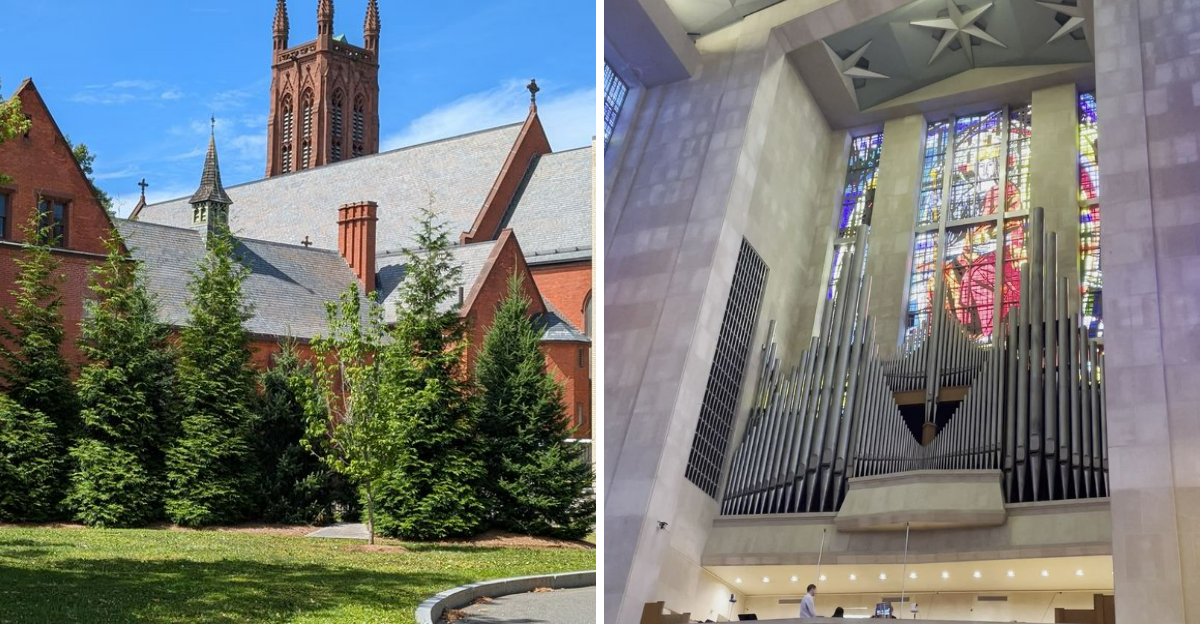
I only stopped because it started raining and I needed somewhere dry for five minutes. That plan fell apart the moment I opened the door.
Cold gray light turned into color, pouring down from windows taller than any I had seen in Connecticut. I stood frozen near the entrance, neck craned back, completely forgetting about the rain outside.
An organ was playing somewhere above me, low and slow, filling every corner of the stone walls. A stranger next to me whispered that she comes here just to sit, no service, no reason, only quiet.
I understood immediately. Twenty minutes passed before I remembered I had somewhere else to be.
I have visited plenty of old buildings across Connecticut, but none stopped me in my tracks like this one did that afternoon.
A Tower That Rises Nearly 300 Feet Above The Street
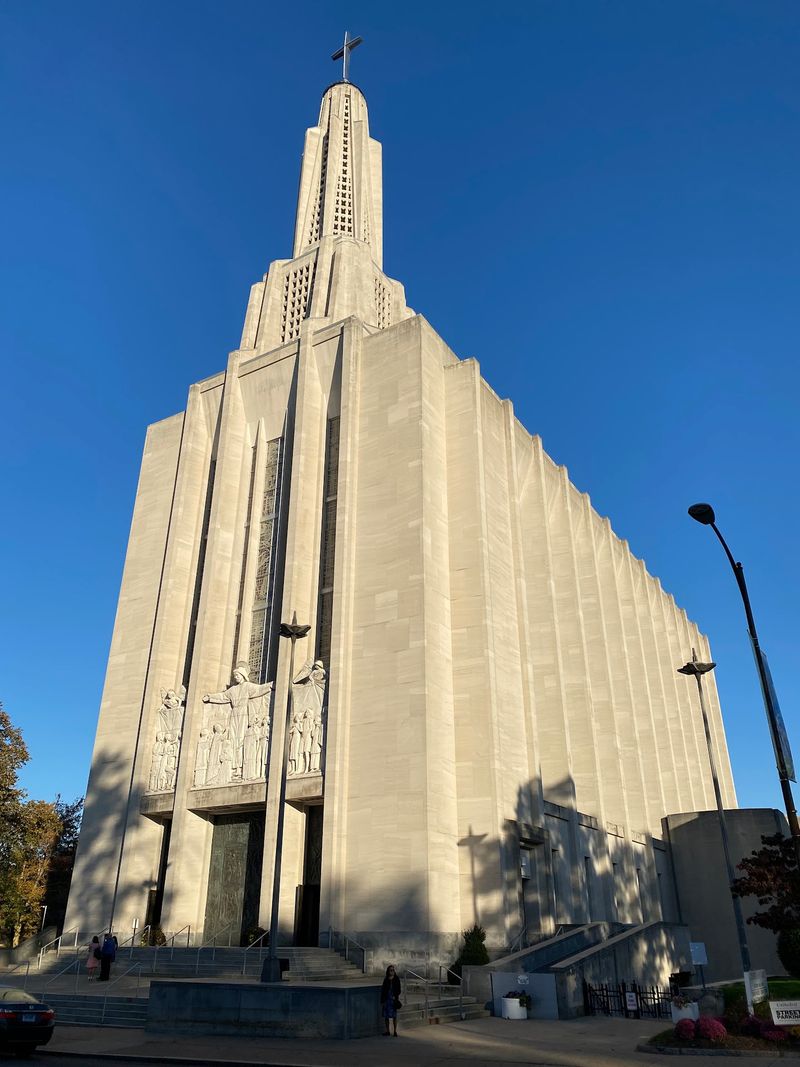
The first thing that grabbed me was the height. The cathedral rises 281 feet from the sidewalk, with its stainless-steel cross extending even higher.
Light gray Alabama limestone covers the reinforced concrete frame. The smooth, coursed stone gives the whole thing a clean, almost sculpted look.
Here is the clever part. The stone blocks near the top are cut with open voids, like a giant piece of lace.
Sunlight moves through those openings all day long. The shadows shift, so the tower never looks quite the same twice.
Architects often call the style a modern take on Gothic, with strong vertical lines. It rises rather than sprawls, which is exactly what old cathedrals did with pointed arches.
A newer computer-controlled lighting system now glows from inside the tower. After dark, the structure reads like a beacon across the surrounding neighborhoods.
Crews also repaired the steeple and facade in recent years. Roughly 150 stone units were replaced and joints were repointed with care.
Bring a camera and stand across the street for the best angle. That is the view I keep coming back to at the Cathedral of Saint Joseph.
You will find it at 140 Farmington Avenue in the state capital
Bronze Doors That Weigh Five And A Half Tons
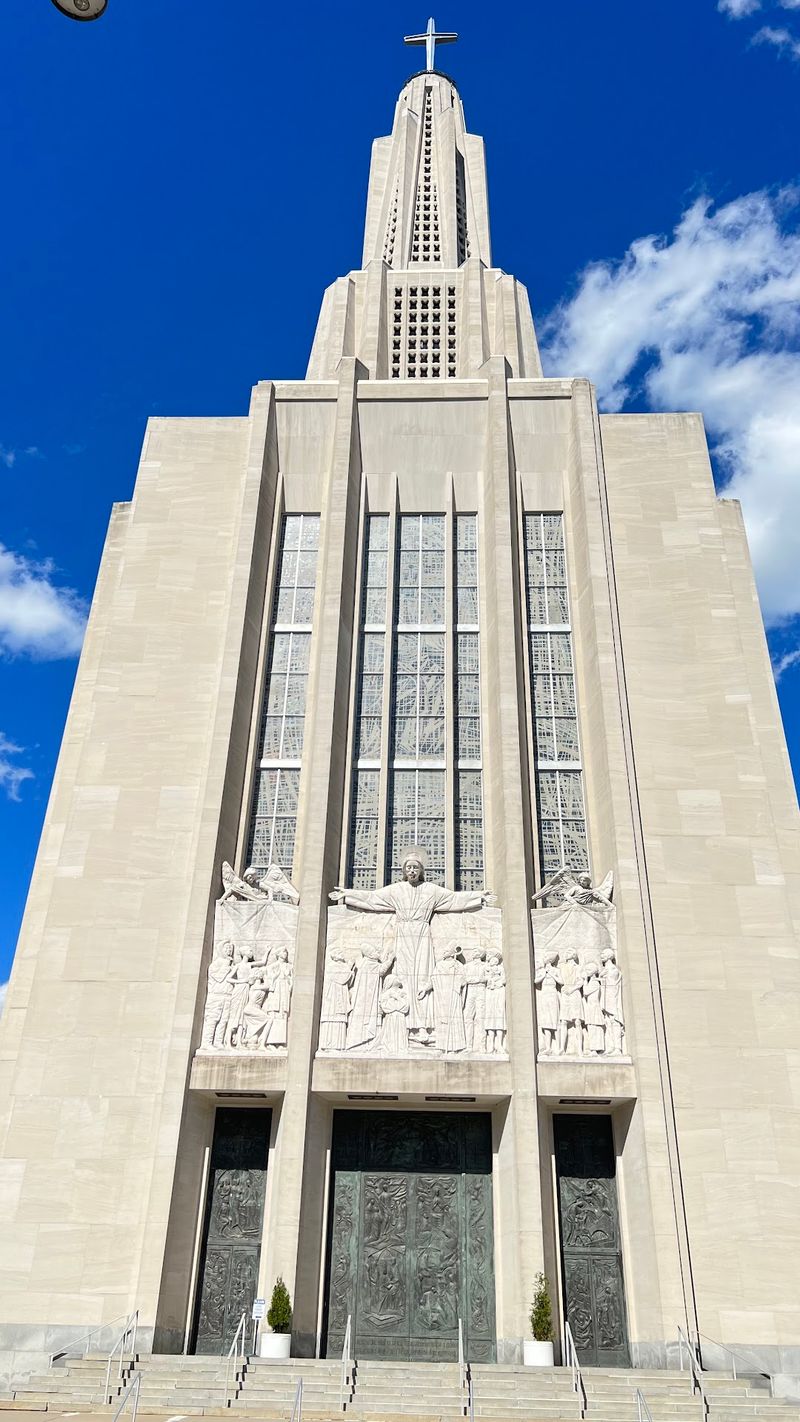
Most entrances are forgettable. These doors are not.
The tall bronze doors weigh five and a half tons together. That is heavier than a full-size pickup truck, standing upright in front of you.
Detailed panels cover the metal surface. Each one shows a biblical scene, cast in relief so the figures catch the light.
I spent longer outside than I expected, just tracing the panels with my eyes. Kids seem to love this part too, since the images tell stories without words.
Look up before you go through. A large frieze above the entrance shows Saint Joseph, the patron of the archdiocese.
The carving sits flat against the stone, which keeps the front wall calm and clean. Nothing fights for attention, and that restraint makes the doors feel even bigger.
Doors like these were meant to slow visitors down. You cannot rush past five and a half tons of art.
Practical tip from experience: pause here for a photo before you enter. Once you get inside, the light takes over and you will forget everything behind you.
Stained Glass Panels Nearly 70 Feet Tall
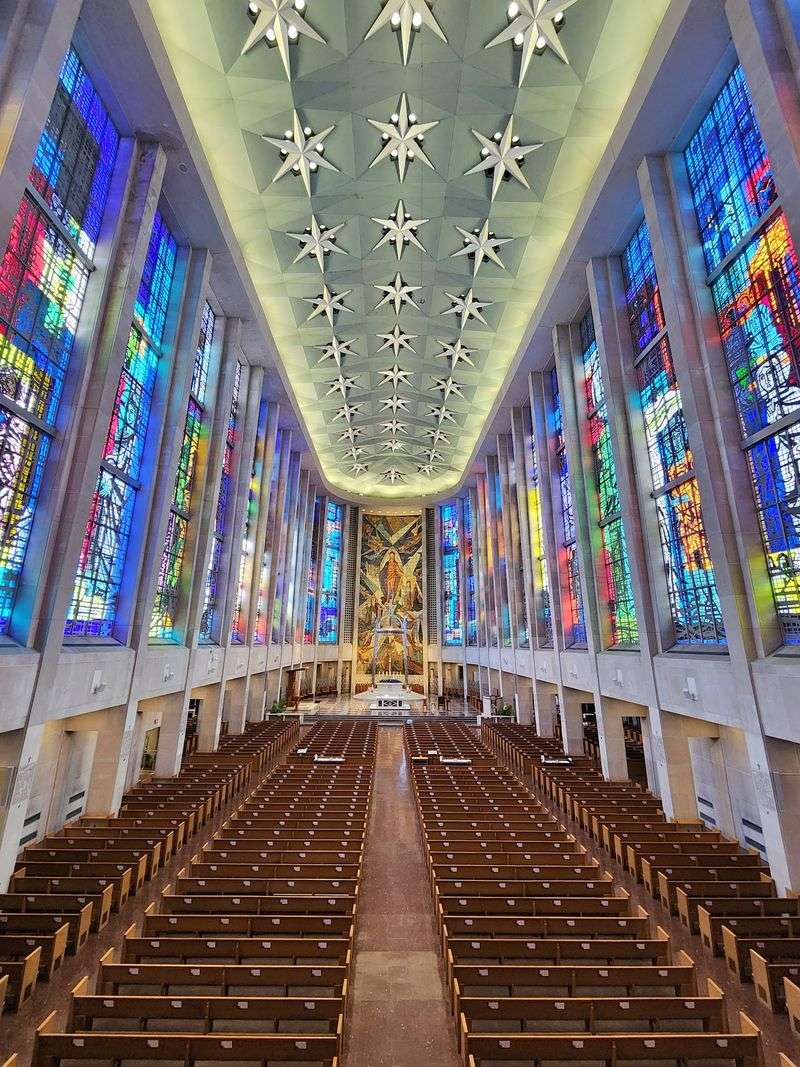
Nothing prepared me for the windows. They stretch roughly 70 feet high and about 14 feet wide.
French artisans crafted the glass. Many visitors compare the effect to Sainte-Chapelle in Paris, where color seems to replace the walls entirely.
There are twenty-four of these giant windows. Together they illustrate Gospel themes, including the coming of the Savior and the institution of the Holy Eucharist.
The method behind them is unusual. Instead of traditional lead cames, the glass is set directly into concrete.
That approach makes the colored chunks read like jewels in a stone frame. Up close you can see thickness in the glass that regular windows never have.
Timing matters more than you think. Late morning and mid afternoon send different colors sliding across the floor and pews.
On a sunny day the whole nave turns blue, then gold, then red. On a cloudy day the tones soften and the space feels quieter.
Sit in the middle of the nave for the widest view. Side seats can put a pillar between you and all that light.
The Largest Ceramic Tile Mural On Earth
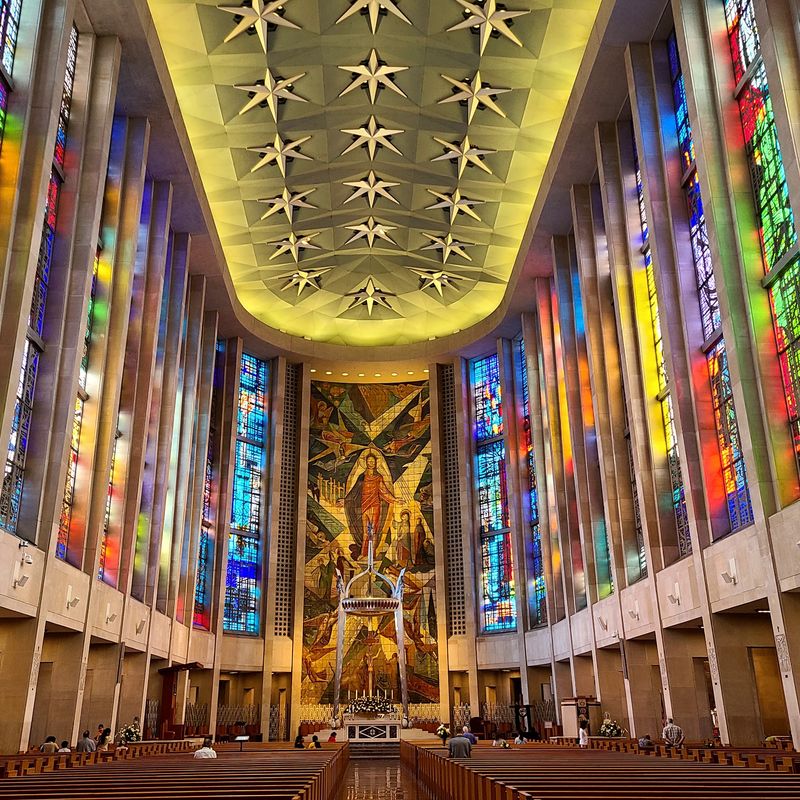
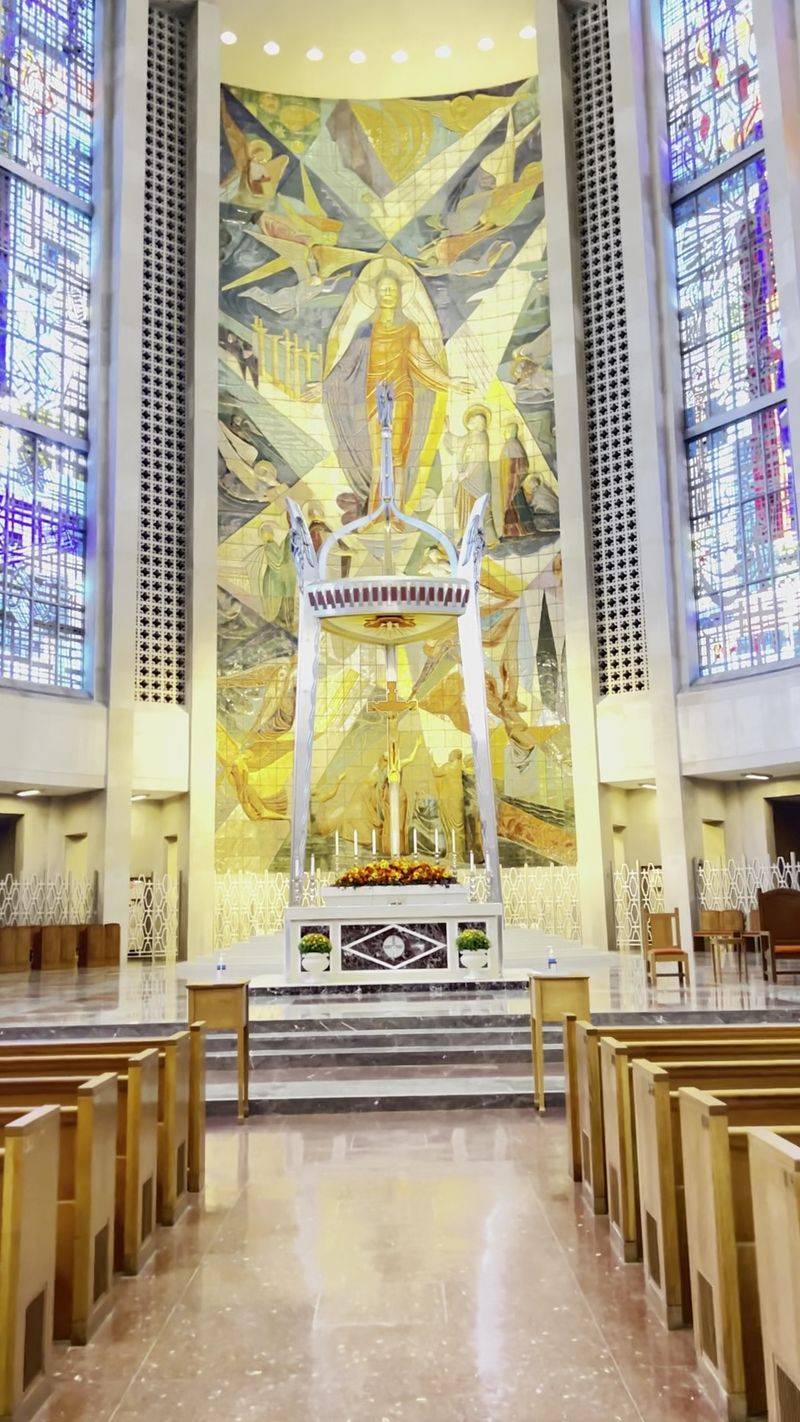
Behind the altar sits a record holder. The ceramic tile mural known as Christ in Glory is recognized as the largest of its kind in the world.
Photos flatten it. In person, the scale is hard to process because the piece climbs the entire back wall.
Thousands of small tiles build the image. Step closer and the picture breaks into squares of color, then reassembles when you back up.
That trick alone is worth the trip. I watched a family walk forward and backward twice, just testing the effect.
The mural gives the sanctuary a clear focal point. Your eyes land there naturally, no matter where you sit.
Color choices keep it from feeling cold. Warm tones balance the blue flood coming from the tall windows on either side.
Try visiting when the room is quiet. Morning hours usually offer calm and fewer distractions.
If you only remember one detail from your visit, it will probably be this wall. It turns a big modern room into something genuinely awe-inspiring.
An Etched Glass Wall By Janos Hajnal
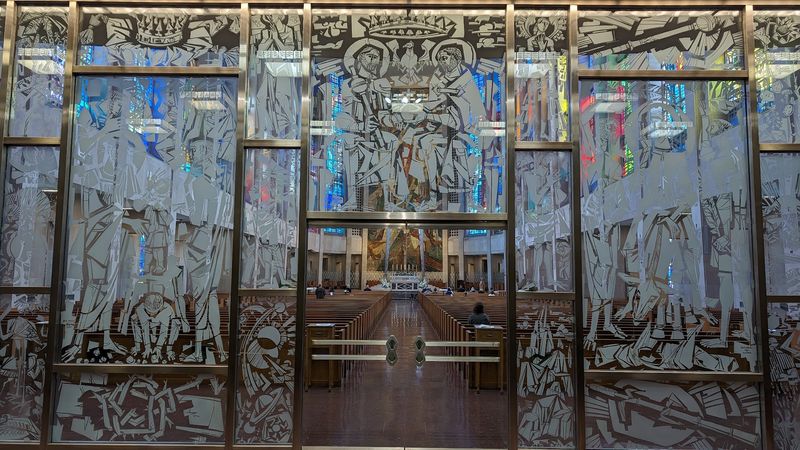
Between the entry area and the main worship space stands a wall of etched glass. It separates the narthex from the nave without blocking your view.
Hungarian artist Janos Hajnal designed it. The engraved images depict the Kingdom of Christ on Earth and in Heaven.
What I like is how it works both ways. From the lobby you get a preview of the nave, softened by frosted lines.
From inside, the same wall glows faintly with borrowed light. Glass replaces the heavy doors many churches use, so the space feels open.
Etching is painstaking work. Every figure and line had to be cut into the surface rather than painted on.
Stand a few steps back to see the full composition. Get close and you can follow individual strokes across the panels.
Small details like this often get skipped by visitors rushing toward the altar. Slow down for two minutes here and you will notice far more.
It is also a good spot to gather a group before heading in. Quiet, bright, and easy to find.
A Tripod Baldachin And A Ceiling Full Of Stars
Look up over the altar and you will find a baldachin, a canopy that marks the most important spot in the room. Ordinary version?
Not here.
Cast and sheet aluminum form the structure. Its tripod shape stands for the Holy Trinity, three parts working as one.
Metal instead of carved wood was a bold choice for the 1960s. The result feels light rather than heavy, and it never crowds the mural behind it.
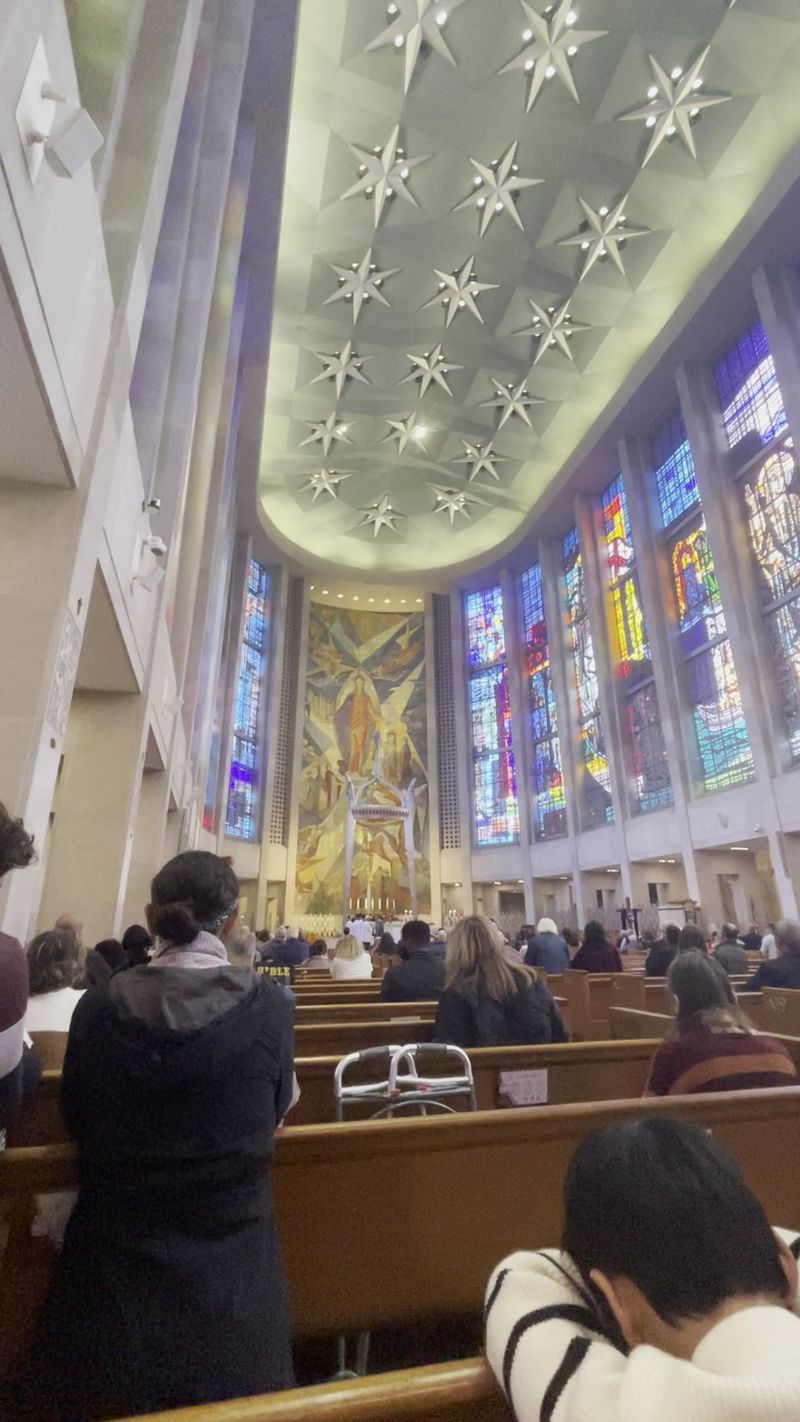
Then there is the ceiling. Lights across it are shaped like stars.
The effect is subtle during bright hours. In dimmer light they seem to float, almost three-dimensional above your head.
I noticed people leaning back in the pews just to study them. It is a rare church detail that makes visitors grin.
Together, the canopy and the star lights turn the ceiling into part of the artwork. Nothing up there is filler.
Bring a friend who likes design. They will spend the whole visit pointing at things you might otherwise walk right past.
Connecticut’s Largest Pipe Organ Lives Upstairs
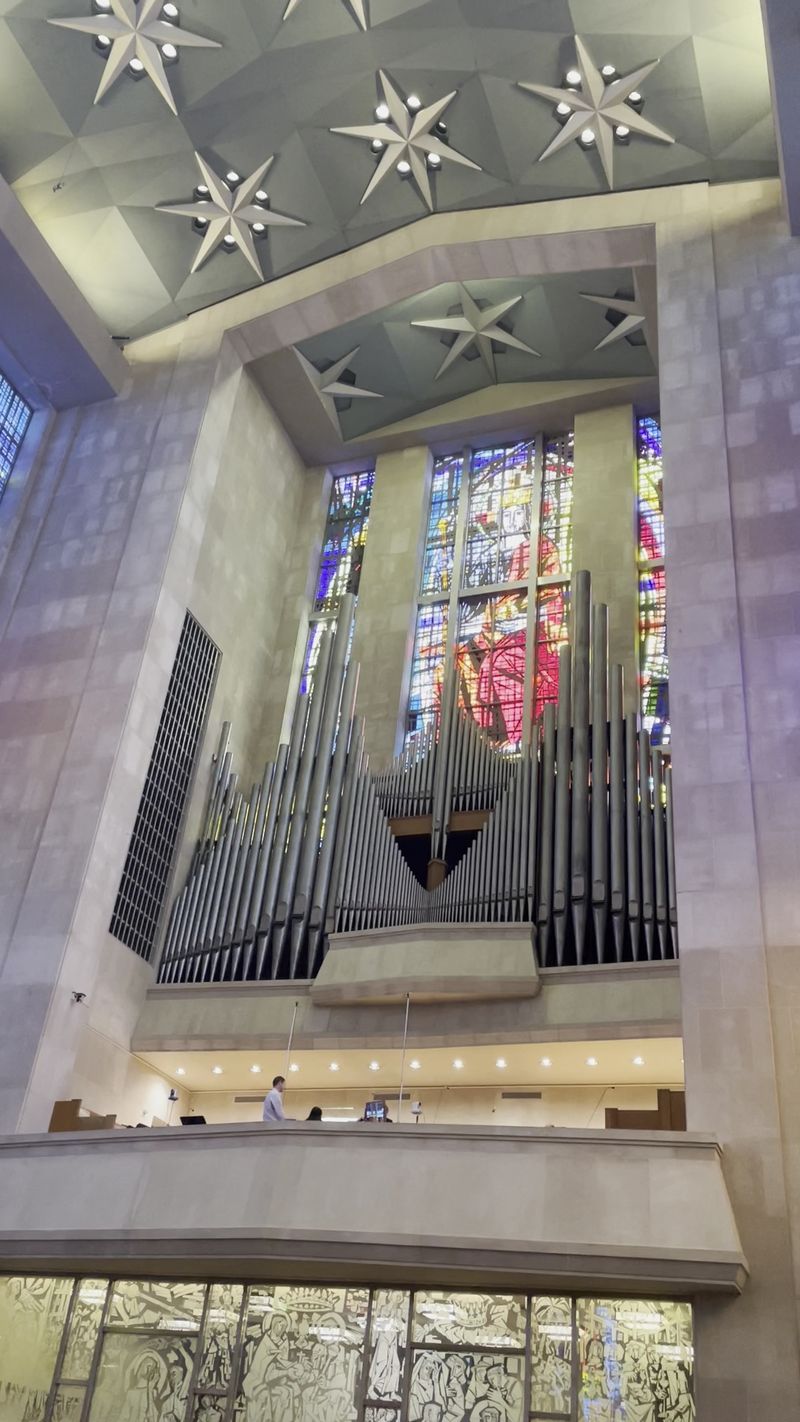
Sound is the feature nobody photographs. The rear gallery organ is the largest pipe organ in Connecticut.
The numbers are wild. It has four manuals, six divisions, 81 stops, 95 registers, 114 ranks, and 6,878 pipes.
The Austin Organ Company of Hartford built it, along with a second instrument in the Blessed Sacrament Chapel. That smaller organ has three manuals and 1,195 pipes.
Hearing it is a full-body experience. Low notes travel through the floor and the pews before they reach your ears.
The room helps. All that stone and glass gives the sound a long, generous ring.
Concerts happen here, including seasonal programs during the holidays. Those fill up, so arriving early is smart.
Even without a scheduled performance, practice sessions sometimes drift through the building. Getting a few minutes of that by accident is a small gift.
If music is your thing, check the schedule before you drive over. A quiet visit is lovely, but a visit with the organ playing is unforgettable.
Chapels And Mosaics Fill A Grand Interior
Big rooms can feel impersonal. That is where the chapels come in.
Two main chapels sit off the nave. One holds a tabernacle and altar with a mural of Jesus and his disciples.
The second features a mural of the Holy Family and contains the baptismal font. Both offer a smaller, calmer scale than the main space.
Smaller chapels line the sides as well. Mosaic decoration covers them, and kneelers are set out for individual prayer.
Life-size mosaic figures give each one its own identity. The tiny tiles catch light in a way paint simply cannot.
Meanwhile, the main sanctuary seats about 1,750 people. Side chapels are not even counted in that number.
Choose your seat with care during big services. The pillar-free nave offers clear views of the sanctuary from the pews.
For a quiet stop, the side chapels win every time. They are the part of the building where the noise of the street truly disappears.
Planning Your Visit On Farmington Avenue
A little planning makes this trip smooth. Hours can vary around Masses and special events, so check the cathedral’s current schedule before visiting.
During confirmations and other large events, nearby lots sometimes help with overflow. Arriving early is still the safest plan.
Accessibility has improved a lot. Newer entrances, an elevator, and updated facilities were added in recent renovations.
The history here is worth knowing before you walk in. The first cathedral, designed by Patrick Keely, was consecrated in 1892 and lost to fire on December 31, 1956.
Eggers and Higgins of New York designed the replacement, which was consecrated on May 15, 1962. The property contributes to the Asylum Avenue District, listed on the National Register of Historic Places since 1979.
Big moments still happen inside. The 2020 beatification Mass for Father Michael J.
McGivney, founder of the Knights of Columbus, took place here.
Give yourself an hour. You will want it.