7 Connecticut Churches That Become Surprisingly Mysterious After Sunset
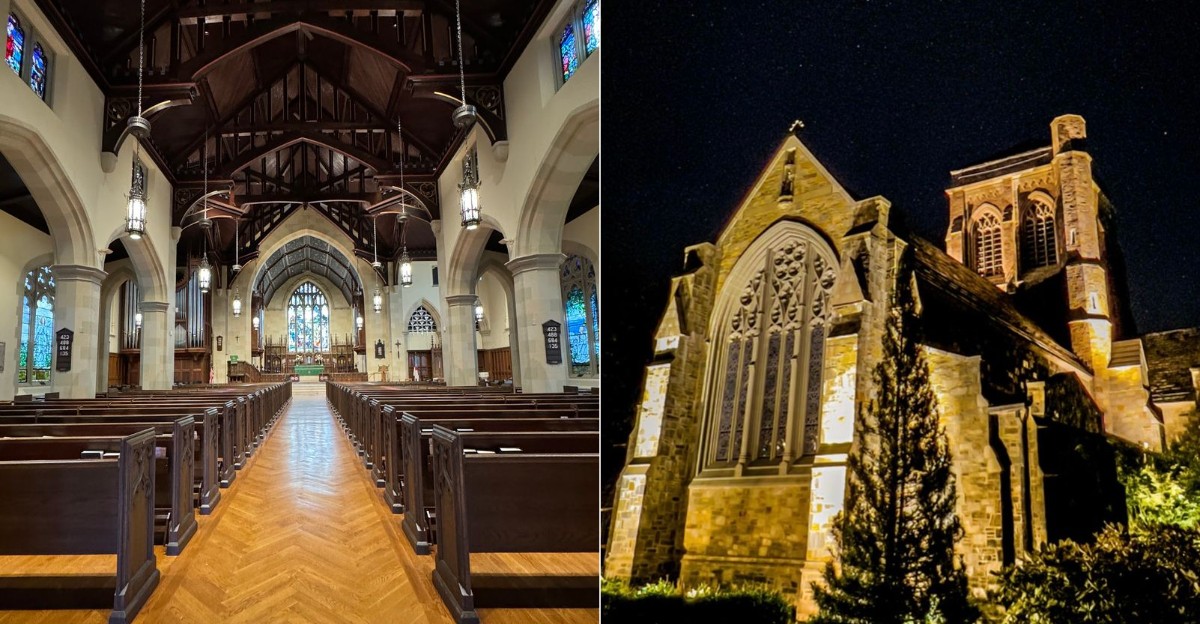
Churches can feel completely different once daylight fades and the familiar details start slipping into shadow.
Stone walls look heavier, old windows catch the last bit of light, and quiet grounds suddenly feel much more atmospheric than they did an hour earlier.
That shift gives certain Connecticut churches an unexpectedly mysterious side after sunset. Nothing has to happen for the mood to change.
The architecture does most of the work.
Tall towers and darkened doorways can make even a peaceful building feel like it belongs in an old story, especially when the streets around it start getting quieter.
You may have passed the same place dozens of times during the day without thinking twice.
At night, it can feel almost unfamiliar. That is what makes these churches so intriguing after dark.
The history is still there, but the shadows make you notice it in a completely different way.
1. Center Church On The Green, New Haven
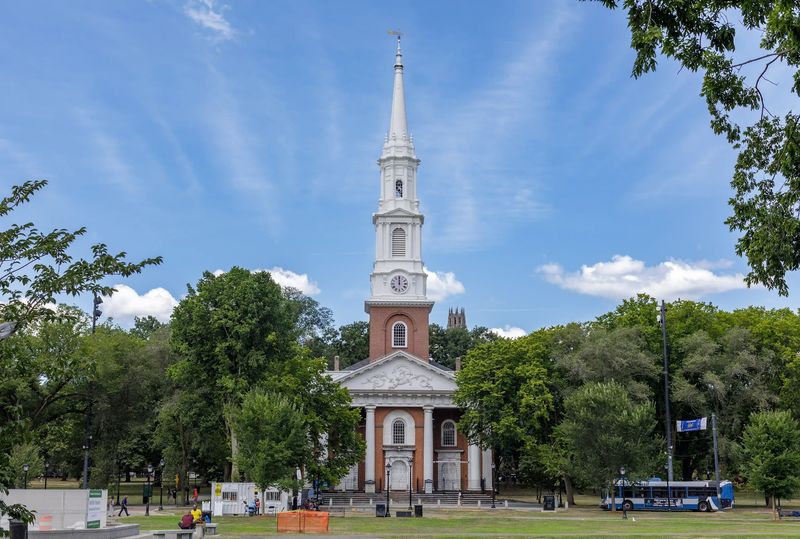
The floor hides a remarkable piece of New Haven history. The gravestones were never relocated.
They remain beneath the church where the burial ground originally stood.
Center Church on the Green was built over part of that early cemetery between 1812 and 1814, creating a protected crypt around the stones. About 137 marked graves survive there, with dates beginning in 1687.
Reverend James Pierpont, one of Yale College’s founders, is among the people identified. Margaret Arnold, the first wife of Benedict Arnold, is also represented, while Sarah Rutherford Trowbridge has the crypt’s oldest dated stone.
Church records note that more than 1,000 unidentified burials may lie within the crypt area.
The congregation dates to 1639, after Puritan settlers arrived the previous year. Its present meeting house is the congregation’s fourth.
Architect Ithiel Town modeled the Federal-style building after St. Martin-in-the-Fields in London.
The meeting house stands at 250 Temple Street, New Haven, CT 06511, on the New Haven Green. Its raised main floor hints at the historic space below.
Inside, a Tiffany Studios window designed by Joseph Lauber depicts Reverend John Davenport preaching beneath an oak tree in 1638. A Waterford crystal and pewter chandelier adds another detail.
A Fisk pipe organ remains part of weekly worship.
Preservation work in 1990 replaced the crypt’s concrete floor with uncemented brick to improve moisture movement. The church remains an active congregation.
Public crypt tours are currently offered on the second Sunday of each month at 10 a.m., with space limited to 30 visitors on a first-come basis.
2. Church Of The Good Shepherd, Hartford
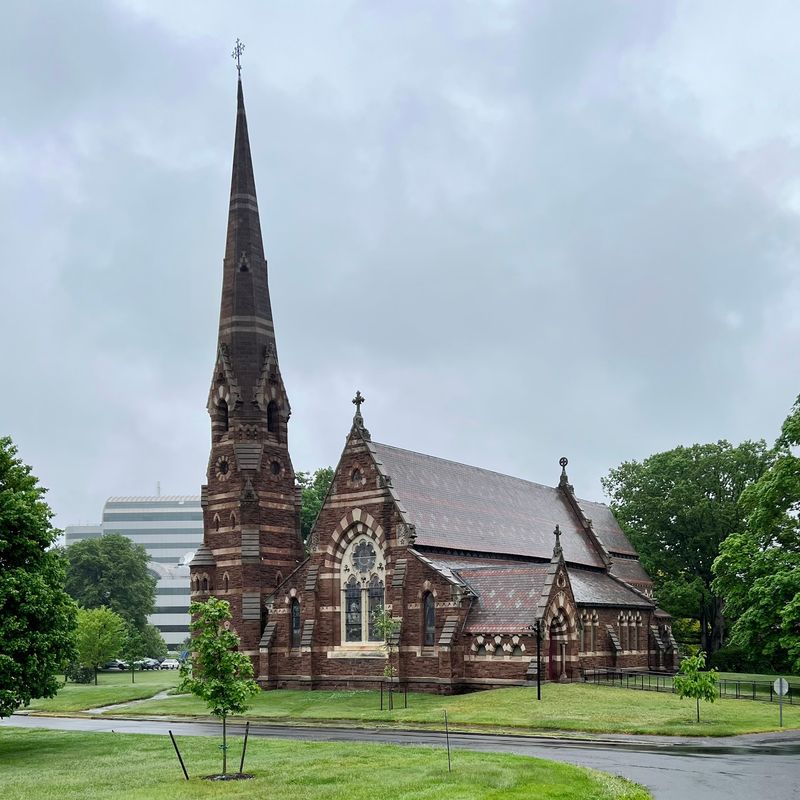
Look closely at the southwest entrance arch and you will spot revolver cylinders, triggers, hammers, and pistol handles carved into the stone. Known as the Armorers’ Porch, it is one of the strangest and most personal details on any state church.
Factory workers of the era would have recognized every shape.
Elizabeth Jarvis Colt commissioned the church as a memorial to her husband, Samuel Colt, and three of their children who passed away in infancy; Edward Tuckerman Potter designed the Gothic Revival building, whose cornerstone was laid in 1867 before its consecration in 1869.
The parish itself was founded in 1868, with Elizabeth Colt envisioning a church where Colt Armory owners, managers, and workers could worship together, a purpose the congregation still honors today.
Portland brownstone and Ohio sandstone make up the exterior, topped by a steeply pitched polychrome slate roof, stone crosses on the gable ends, and a square buttressed tower with a spired belfry. Shadows across all that texture do something dramatic at twilight.
Inside, heavy chestnut timbers frame the roof and the ceiling is painted blue with gold stars, mirroring the blue dome of the nearby East Armory.
A baptismal font commissioned by Elizabeth’s sister shows cherub-like children holding a large shell basin, dedicated to the three Colt children who passed away in infancy.
Upstairs in the parish house, a memorial alcove for Caldwell holds two brass cannons, a ship’s bell, and a painting of him aboard his yacht, the Dauntless.
Find it at 155 Wyllys St, Hartford, CT 06106, a contributing property in the Coltsville Historic District. Services are offered in English and Spanish, and interior tours can be requested.
3. Church Of The Holy Trinity, Middletown
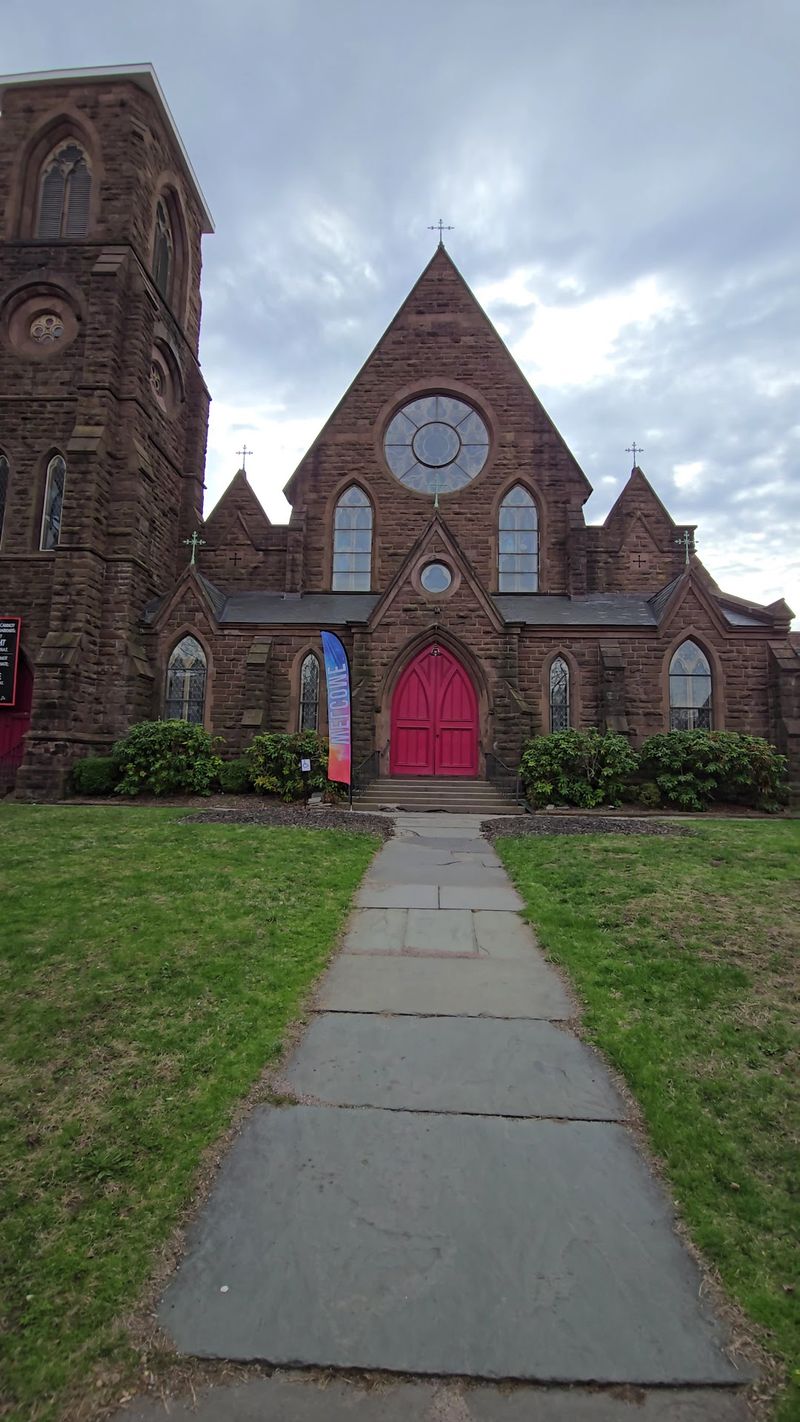
Dark brownstone gives this church an unmistakable presence. The details become more impressive up close.
Gothic Revival architecture shapes nearly every part of the building, from its pointed windows to the prominent tower.
The parish’s story reaches back much further than the current structure. It was formally organized as Christ Church in 1750, following Anglican services held in Middletown earlier in the century.
Martha Mortimer Starr later left land on Main Street to the congregation with one condition: the parish had to adopt the name Church of the Holy Trinity.
Construction of the present church began in 1870, and the building was completed in 1874. Architect Henry Dudley designed it in the Gothic Revival style using local brownstone.
A large rose tracery window dominates the symmetrical facade, while narrow arched openings emphasize the height of the buttressed bell tower.
The building is the parish’s third church, replacing the Broad Street structure that later became Russell Library. It also served as the cathedral of the Episcopal Diocese of Connecticut during Bishop John Williams’s tenure, remaining the diocesan cathedral until 1899.
Inside, elaborate tracery trusses rise from cast-iron supports. The altar and reredos were added around 1892 from designs by New York architect Charles Haight.
Most of the church’s stained glass underwent restoration completed in 2011.
The church stands at 381 Main Street, Middletown, CT 06457. Its position along the city’s historic Main Street makes the dark stone exterior especially easy to notice among neighboring buildings.
The property was added to the National Register of Historic Places in 1979. Today, the congregation remains active, with regular Sunday worship continuing inside the landmark building.
4. St. James Episcopal Church, New London
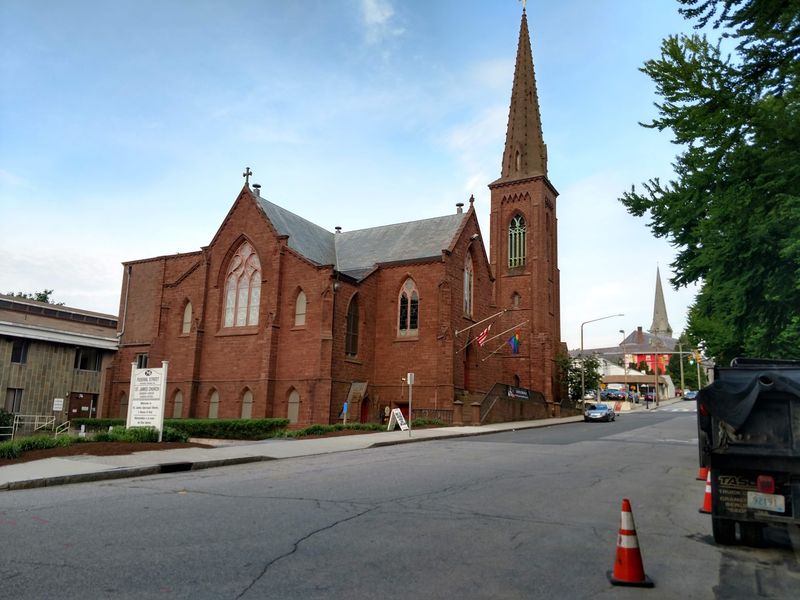
One of New England’s largest collections of Tiffany glass in a single building can be seen right here in New London. Six Louis Comfort Tiffany windows fill this church, installed beginning in 1910, replacing some of the original 1850 glass believed to have come from the Henry E. Sharp Studio.
The two transept windows are the standouts. On the south side, three saints appear: Sebastian, Joseph holding the infant Jesus, and Francis, commemorating members of the Lawrence family.
The north transept shows the Holy Family, given in memory of Lyman Allyn. Lit from inside after dark, both turn the sanctuary into shifting fields of color.
Richard Upjohn, the English-born architect behind Trinity Church in Manhattan, designed this one just a year after finishing that project.
Built between 1847 and 1850 from red New Jersey freestone, it was consecrated on June 11, 1850, and its cruciform plan includes north and south transepts plus a bell tower at the northwest corner.
History runs deeper still. Samuel Seabury, the first Bishop of the Episcopal Church in the United States, served as rector here from 1785 until 1796.
He rests in Hallam Chapel in the undercroft, with an Upjohn-designed cenotaph on the north side of the sanctuary and his original grave slab still outdoors, now protected by a duplicate.
The congregation dates to 1725, and this is its third home, at 76 Federal St, New London, CT 06320. A Memorial Garden occupies the courtyard, and the church houses a 4-manual Skinner pipe organ.
5. Christ Church Greenwich, Greenwich
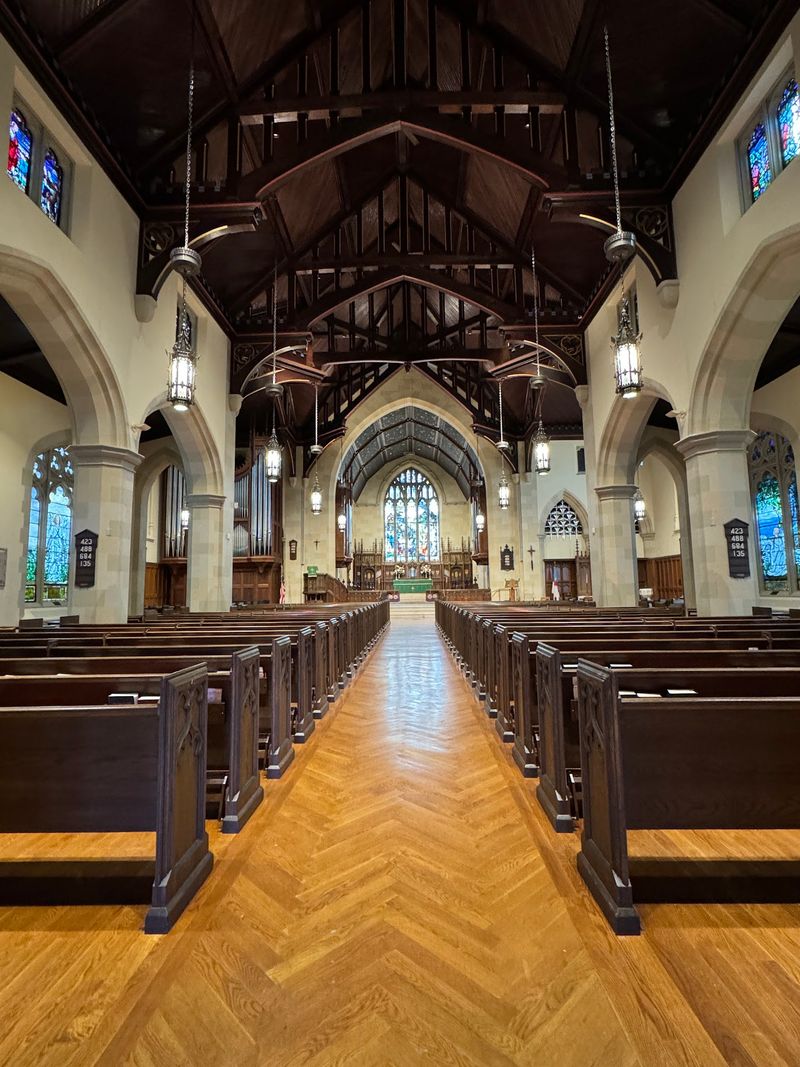
The tree is impossible to ignore. Its trunk twists with age.
An English yew has been growing here since around 1800. Its unusual shape has made it one of the most distinctive features on the grounds.
The yew received Connecticut Notable Tree recognition and was chosen as a Greenwich Tree Conservancy Treasured Tree in 2024. It rises behind Christ Church Greenwich in a cemetery whose history stretches back to the 19th century.
The parish itself was established in 1749, while the current stone church opened in 1910. Battlements and pinnacles give its square tower a castle-like profile.
Inside, stained glass gives the sanctuary much of its character. Two windows were produced by Tiffany Studios, including the Resurrection Angel Window, which likely dates to the late 1800s and was moved into the present building in 1910.
Another major window, made in London by Heaton, Butler and Bayne, was created for the new sanctuary and depicts the Resurrection.
The church stands at 254 East Putnam Avenue, Greenwich, CT 06830, within the historic ten-acre campus. Its 5,000-square-foot sanctuary seats more than 600 people, making it the largest worship space in Greenwich.
The central church buildings were extensively renovated in 2015.
Behind the church, the cemetery occupies about three acres and was acquired in 1839. A 15-foot stone Celtic cross west of the sanctuary was installed in 1924.
It commemorates 152 parish members who served during World War I, adding another layer to the long history preserved across the property.
6. Old Trinity Church & Cemetery, Brooklyn
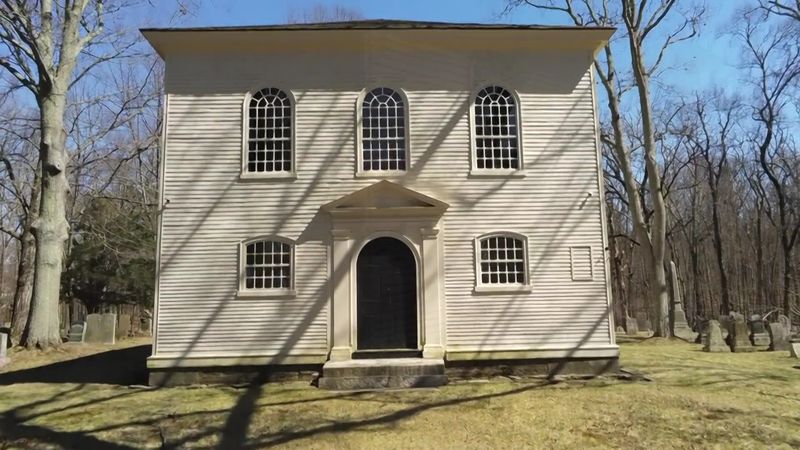
Local tradition warns that anyone who jumps the churchyard wall here brings a curse on themselves. Stories of that sort cling to this quiet corner of Brooklyn, and they are only part of what makes the place linger in your memory.
Completed in 1771, the plain wood-frame building is the oldest surviving Anglican meeting house in Connecticut and appears on the National Register of Historic Places.
Its rigid, boxy form follows other New England examples of the period, and the siding, fastened with hand-cut nails, is largely original.
Inside, colonial worship is preserved almost intact. Original box pews with doors on wrought iron hinges fill the floor, and the pulpit and reading desk are the ones parishioners used more than 250 years ago.
The building exists because of royalist Godfrey Malbone, who funded it and used labor from enslaved individuals for its construction. His goal was to finish an Anglican meetinghouse before a planned Congregational church could be completed, sparing him taxes toward that project.
The surrounding cemetery dates to 1772 and holds monuments to many prominent area families. Fading light across the leaning stones is what earns this site its reputation among people who chase atmosphere.
The property sits at 60 Church St, Brooklyn, CT 06234, with grounds generally open to visitors during daylight hours.
The church closed during the Revolutionary War when its first priest would not omit prayers for the Royal Family. Today the congregation worships nearby, using the old building for special events and occasional services.
7. St. Michael’s Parish, Litchfield
One peppercorn a year. That was the rent an English settler named John Davies agreed to in 1747 when he leased land for the first church on a 999-year term, payable each year on the Feast of St. Michael the Archangel. The name stuck.
The congregation traces back to 1745, and the building standing today, consecrated on July 13, 1921, is its fourth.
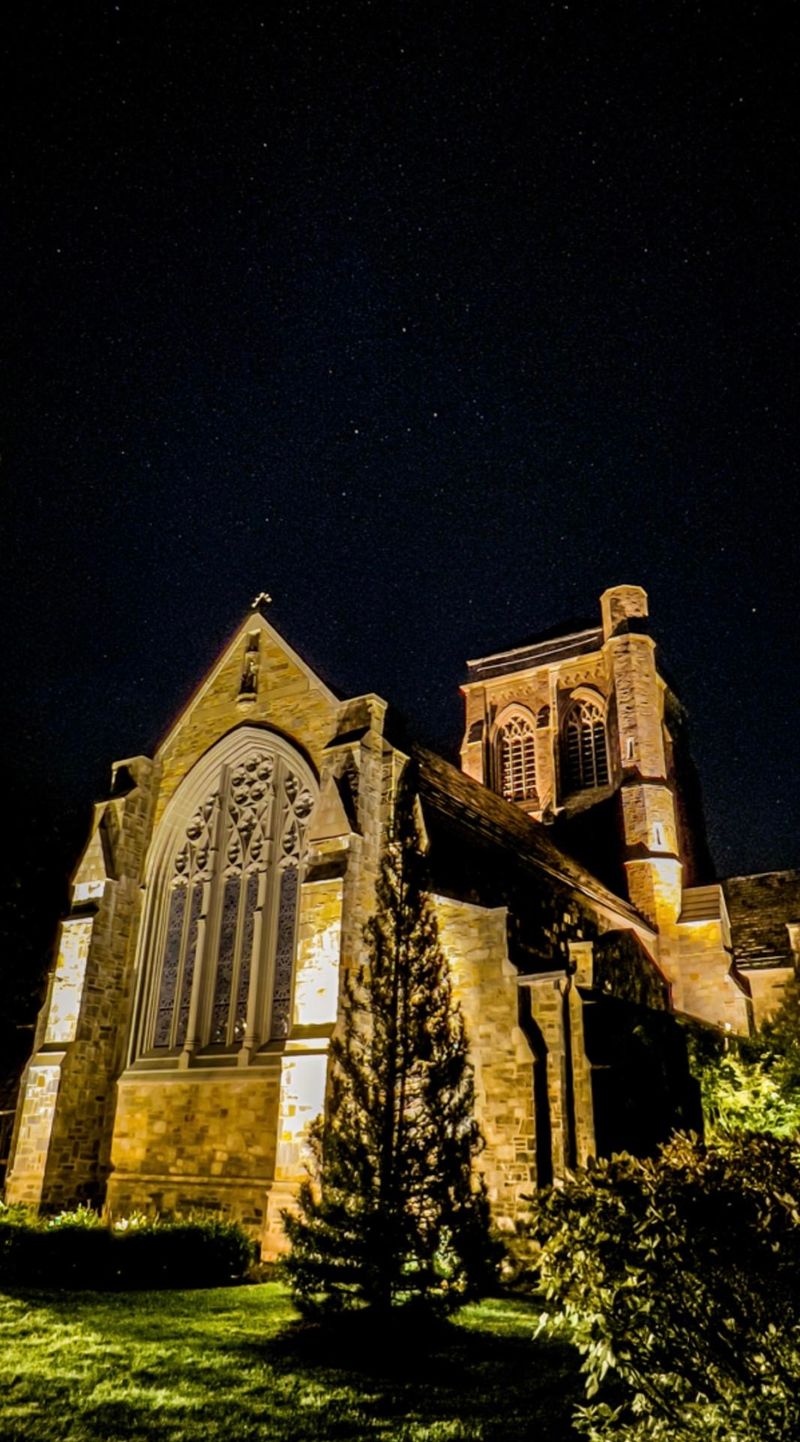
Architects Rossiter and Mueller of New Haven designed a cruciform Neo-Gothic structure in the English Decorated style, faced with Roxbury granite and cast stone, built without a steel superstructure.
The church was a gift from Henry R. Towne in memory of his wife, Cora White Towne. Its cornerstone was laid on June 6, 1920, before consecration the following year.
Wander over to 25 South St, Litchfield, CT 06759 as the light fades and the granite deepens into gray-brown tones that daytime photos never capture.
The interior rewards a slow look. English oak carved by the Irving and Casson Company shapes the reredos, choir stalls, pulpit, and organ case.
The altar is Sienna marble from Italy, altar paintings came from the muralist H. Siddons Mowbray, and the nave floor uses custom terra cotta tiles by Moravian Pottery and Tile Works copying designs from a fifteenth-century English priory.
Glass is where things get remarkable. The altar window of St. Michael and the Ascension Lilies window are attributed to Louis Comfort Tiffany Studio, originally made between 1895 and 1899 for the previous building.
A medallion window by Reynolds, Francis and Rohnstock echoes the cobalt glass of Chartres Cathedral, and a 1968 double lancet by Gabriel Loire of Chartres shows the Eye of God.