Concrete Dinosaurs Are Hiding Among The Ruins Of This Historic Florida Sugar Mill
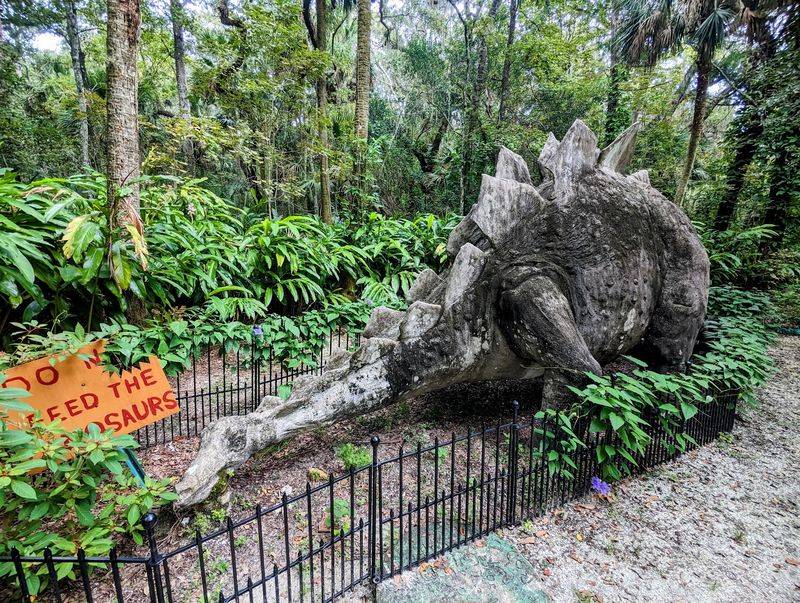
Somewhere in Florida, behind a quiet stretch of suburban streets, there is a shady garden where nineteenth-century mill ruins share the shade with weathered concrete dinosaurs. It sounds like two separate attractions that got shuffled together by accident, and in a way, that is exactly what happened.
The walk takes about an hour, costs nothing, and ends up sticking in your memory far longer than a place this small has any right to. Bring a camera and a little curiosity, because the story behind those dinosaurs is stranger than the statues themselves.
Where the Dinosaurs and the Ruins Share a Yard
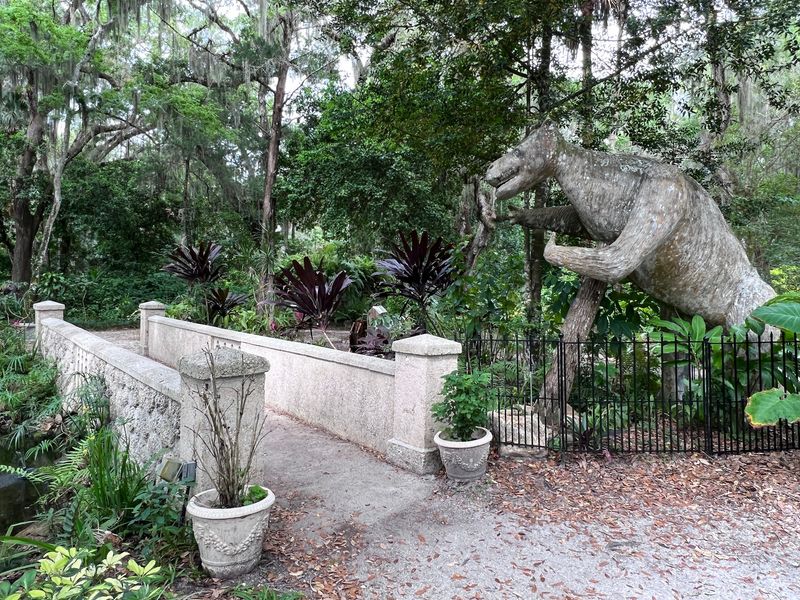
Ten acres of oak shade, crushed-shell paths, and coquina stone walls make up Dunlawton Sugar Mill Gardens, a botanical garden in Port Orange that doubles as one of Florida’s oddest historic sites. The address is 950 Old Sugar Mill Road, and the drive in takes you through ordinary residential blocks before the trees close overhead.
What sets the property apart is the collision of eras. Ruins of a nineteenth-century sugar operation sit within easy walking distance of concrete dinosaurs built in the mid-1900s, and both are surrounded by labeled garden beds full of native and tropical plants.
The county owns the land, and the Botanical Gardens of Volusia, Inc. has leased and tended it since 1985. Admission is free, with a donation box near the entrance for anyone who wants to help.
Maps live in a mailbox at the entrance, and the idea is to take one, use it, and put it back before you leave. The site earned a spot on the National Register of Historic Places in 1973, which explains the interpretive signage scattered along the trails.
From Land Grant to Sugarcane Fields
Back in 1804, the property began its recorded life as a sizable land grant, long before anyone thought of planting gardens here. By 1832 it had become the Dunlawton Plantation, dedicated to growing sugarcane and turning it into molasses.
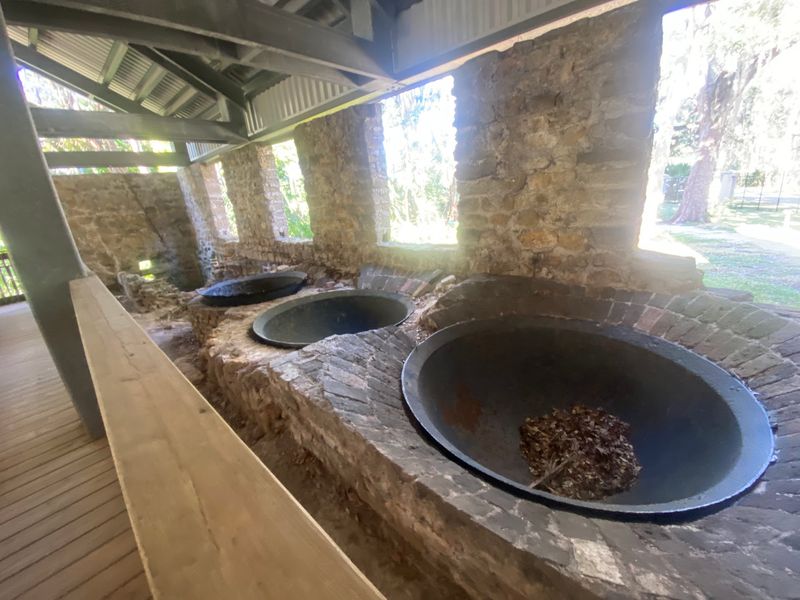
Sugar was demanding work, and the machinery reflected that. A rolling cane press crushed the stalks, a steam furnace supplied the heat, and enormous iron kettles boiled the juice down into syrup.
Those pieces are still on site, laid out roughly as they once stood.
The operation was short-lived. The plantation was destroyed in 1835 during the Second Seminole War, rebuilt afterward, then destroyed a second time in 1856 during the Third Seminole Indian War.
Sugar production never started again.
The kettles found one more job during the Civil War, when they were pressed into service for salt-making, a reminder that heavy iron rarely goes to waste.
Today the ruins are sheltered under an enclosure that keeps the weather off the stonework, and the preservation work is careful enough that the layout reads clearly even to a first-time visitor.
Bongoland, the Florida Roadside Park Named for a Baboon
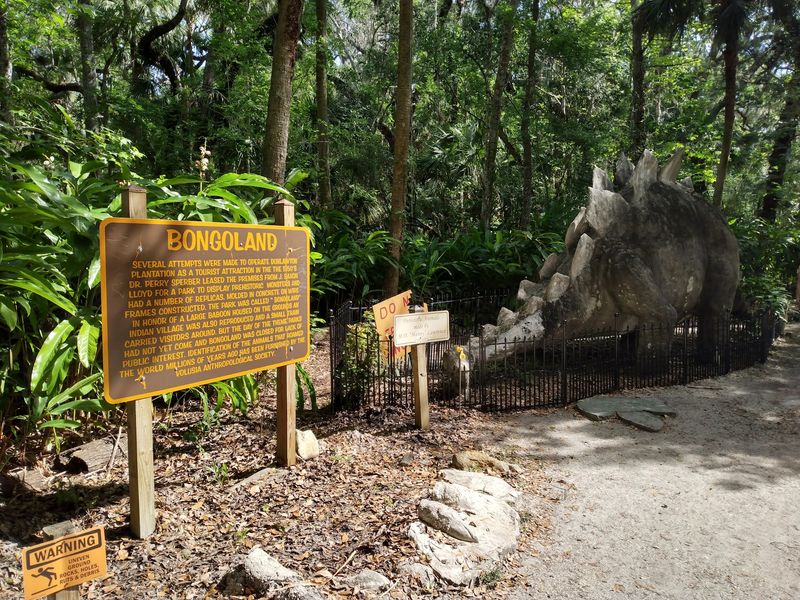
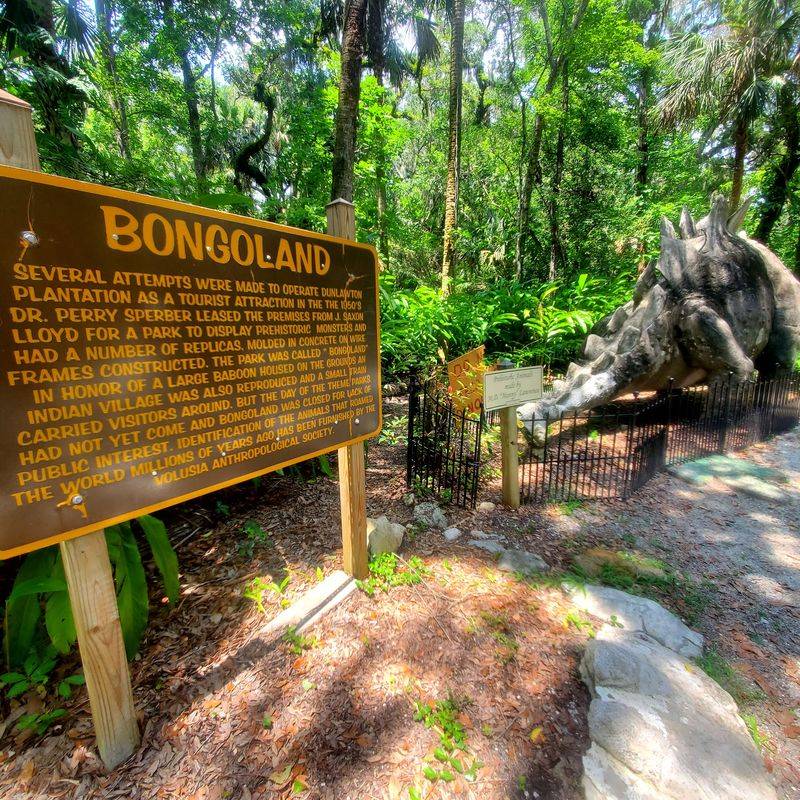
A baboon named Bongo gave this place its strangest chapter. Between 1948 and 1952, Dr. Perry Sperber leased the old mill property and turned it into an amusement park called Bongoland, named after the resident primate who lived on the grounds.
Roadside attractions in mid-century Florida had to work hard for attention, and Bongoland threw everything it had at the problem. There was a replica Native American village, an assortment of animals, and a miniature train that looped through the property carrying passengers past the ruins.
The headliners, though, were the dinosaurs. Sculptor M.D. “Manny” Lawrence shaped them out of chicken wire and cement, working at a scale that seems almost reckless now.
His roster included a 42-foot Tyrannosaurus Rex, a 30-foot Stegosaurus, a 25-foot Triceratops, and an 8-foot Dimetrodon.
None of it lasted. The park closed around 1952, the train stopped running, and the animals moved on.
What stayed behind was the concrete, quietly settling into the Florida soil while the jungle grew back around it.
Concrete Giants Still Holding Their Ground
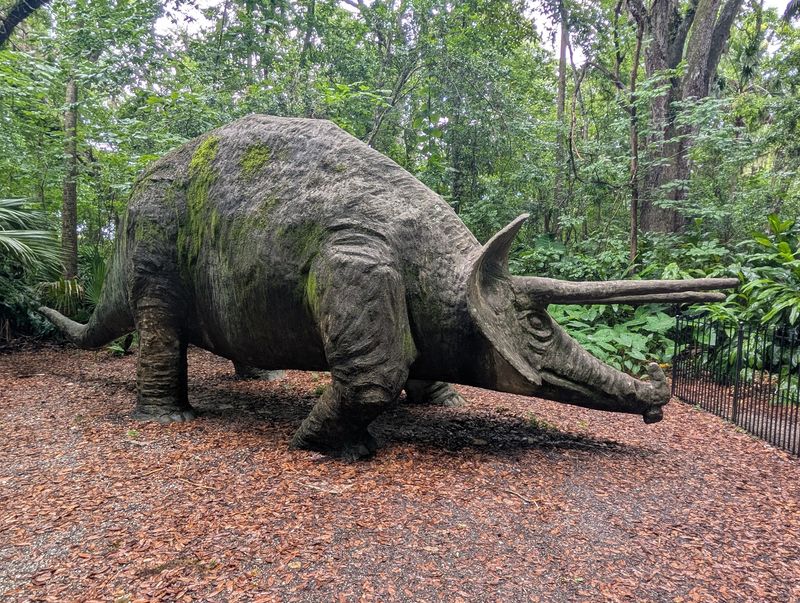
Round a bend on one of the shell paths and there it is: a grey concrete flank about the size of a delivery van, half-swallowed by ferns. About five of Manny Lawrence’s original dinosaurs still stand in the gardens, and coming across them on foot is the whole charm of the thing.
Seven decades of Florida humidity, sun, and rain have left their signature. Surfaces are faded and mottled, edges have softened, and some of the sculptures wear a patina of lichen that almost passes for camouflage.
The big Tyrannosaurus did not make it. The statue collapsed in July 2019 after heavy rain, which is a plain reminder of how fragile chicken wire and cement become over time.
Because of that fragility, climbing on the remaining sculptures is discouraged. Look, photograph, walk around them, and leave the concrete alone.
Photographers do well here in the late afternoon, when light filters sideways through the oaks and the dinosaurs throw long, unlikely shadows across the mulch. Children tend to spot them before adults do.
Themed Beds and a Native Plant Education
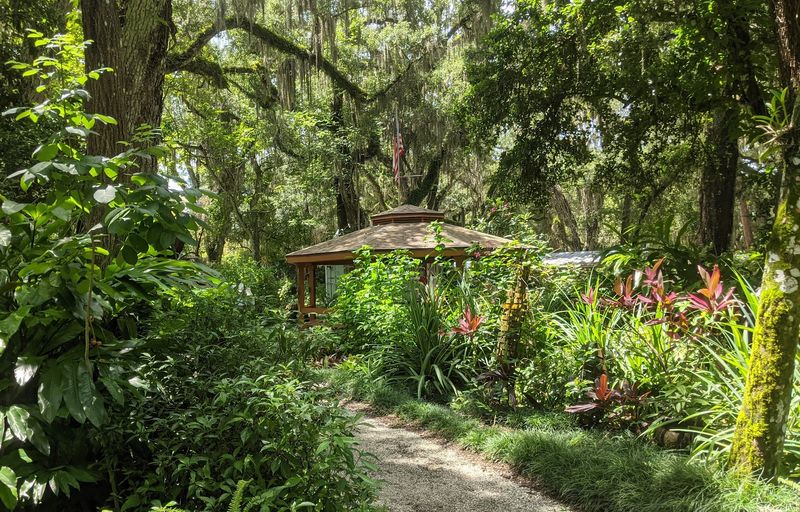
Plant people leave here with a longer wish list than they arrived with. The beds are organized by theme, so you move from Florida natives to a flowering garden to an herb section to a Florida hammock without ever feeling like you are wandering aimlessly.
Labeling is meticulous. Almost everything carries a marker, which turns a casual stroll into a low-effort crash course in what actually thrives in this climate.
Azaleas, palms, bromeliads, and liriope all make appearances.
There is no greenhouse, and the site does not suffer for it. In this part of the state, plenty of what northern gardens coddle indoors simply grows outside.
Wilder sections are left to do their own thing, with swooping naturalistic growth threading between the cultivated beds. The contrast between curated planting and old Florida scrub is part of what makes the layout interesting rather than merely pretty.
An Asian garden, a handful of small enclosed garden spaces, and water features break up the route. Rain just before a visit does nice things here, leaving wet leaves that catch the afternoon light.
Gnome Villages, Painted Rocks, and Other Small Surprises
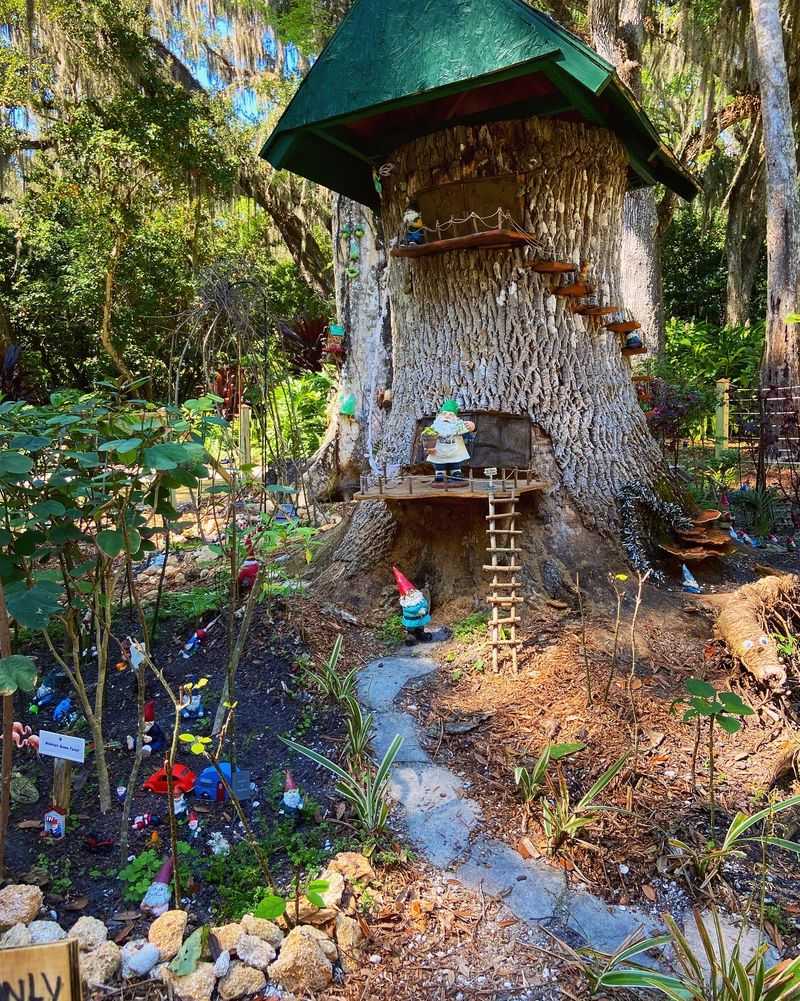
Keep your eyes on the ground and the tree roots. A gnome village sits somewhere along the paths, a miniature arrangement of tiny houses and figures that gets rearranged and added to over time, and finding it feels like being let in on a joke.
Painted rocks are the other scavenger hunt. People leave decorated stones and occasionally shells around the grounds, and hunting for them keeps kids moving forward on a walk they might otherwise lose interest in halfway through.
Whimsical art placements turn up in unexpected corners too, mixed among the sculptures and plantings without any obvious plan. The effect is closer to a well-loved neighborhood project than a curated museum installation.
Small free libraries are part of the setup as well, with books for children and adults that can be taken home or swapped for one of your own.
Two cats have been spotted making themselves comfortable around the mill area, which feels appropriate for a property that has already housed a baboon. None of these details are advertised, and stumbling on them is the point.
Volunteers Keep the Whole Thing Running
Nobody would guess the budget from looking at the beds. The gardens run on volunteer labor and donations, yet the grounds hold up against botanical gardens with grants, endowments, and full-time horticultural staff.
Staffing swings with the seasons. Winter brings the volunteer roster up to around twenty people; summer heat can shrink it to as few as five, which makes the year-round condition of the place more impressive rather than less.
A small plant sale area sits near the paths, stocked with extra bromeliads, liriope, and whatever else has been divided or propagated recently. Saturdays are the main sale day, with a cash box beside the table, and leftovers sometimes linger into Sunday.
Local honey shows up for sale too, alongside the plants.
Interpretive signage, marked trails, trimmed beds, and clean restrooms all come out of the same volunteer effort. The donation box near the entrance is red and hard to miss, and dropping something in it is the simplest way to say thanks for a garden that charges nothing at the gate.
The Chapel, the Oaks, and a Quiet Kind of Atmosphere
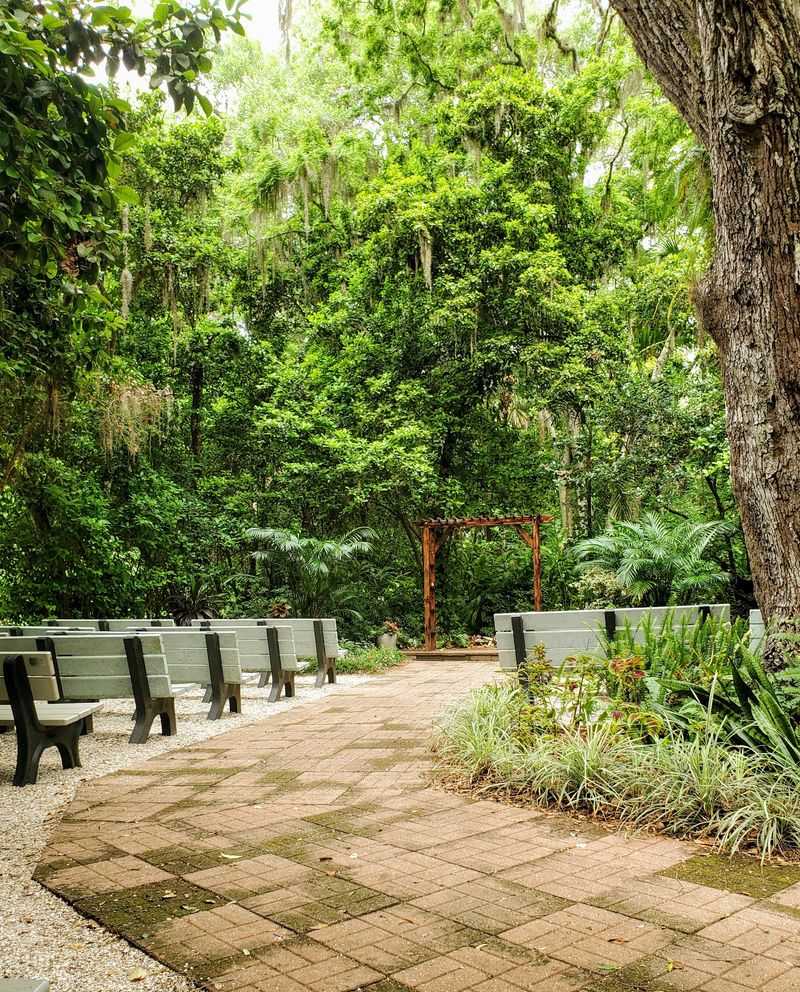
Live oaks do most of the heavy lifting on atmosphere. Their canopy covers a good share of the property, which means shade even in serious heat and a soft, filtered light that makes the whole garden feel cooler than the parking lot suggested.
A small chapel stands among the plantings and hosts weddings, so live music drifting through the trees on a Saturday afternoon is a real possibility. Benches are placed throughout the grounds for anyone who wants to sit and listen instead of keeping moving.
Crowds are rarely an issue. Even on pleasant weekends the paths stay comfortably open, and the residential setting keeps traffic noise almost entirely out of earshot.
Spider webs strung between branches, flowers at various stages of bloom, and the odd caterpillar migration give the place a different character depending on the month you show up. Regulars notice that no two visits look quite the same.
Bug spray is a reasonable thing to carry. Shade and moisture that make the garden pleasant also make it hospitable to insects.
Repeat walks reward you, since seasonal change is dramatic here.
Who Gets the Most out of a Visit
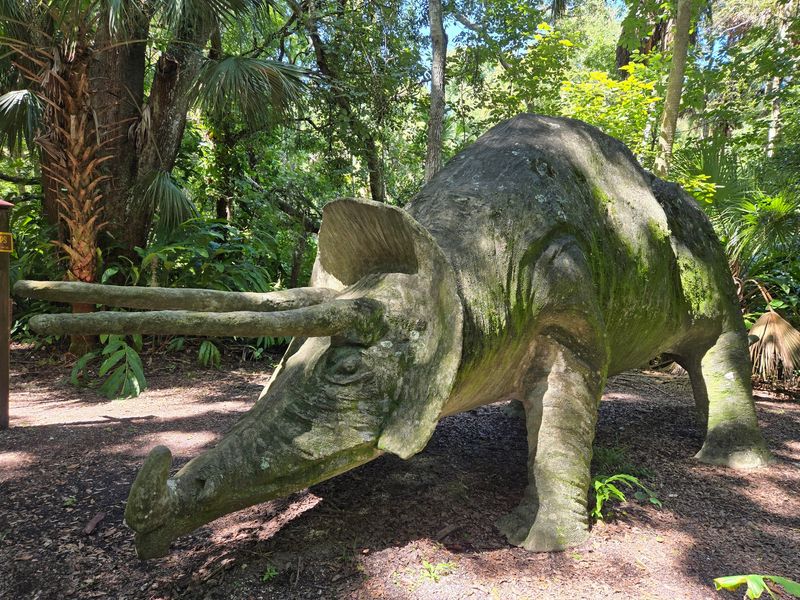
Dinosaurs plus a scavenger hunt for painted rocks is a strong combination for anyone visiting with children between roughly four and ten. The loop is short enough to finish before energy runs out, and there is something new around most corners.
Gardeners and plant collectors get a different payoff. Labeled native beds, a plant sale table, and honey for sale make this an easy stop for anyone who thinks of a garden as a reference library.
History readers will find the interpretive trail through the mill satisfying without being overwhelming. Signage is placed so it informs the walk instead of interrupting the scenery.
Mobility varies across the property. Some paths are flat and easy, others cross uneven terrain, and those stretches are clearly marked, so groups with mixed walking ability can split routes and still meet up.
Photographers, picnickers, and people who just need a calm hour outdoors all fit here comfortably. Augmented reality game players will find several points of interest clustered on the grounds.
An hour covers everything at a relaxed pace, though lingering is easy.
Hours, Parking, and Getting There
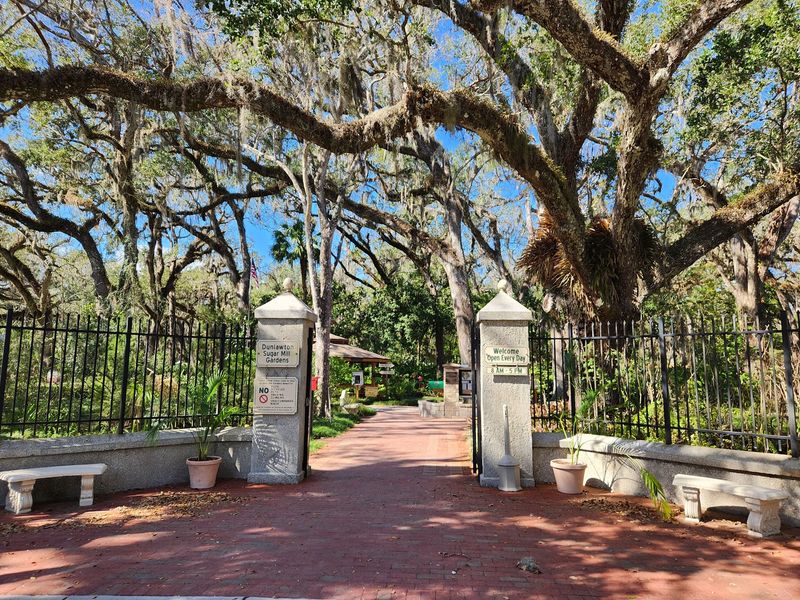
Planning is simple because the schedule barely changes. Gates are open from 8 AM to 7 PM every day of the week, including Monday, and admission is free for everyone.
Find the entrance at 950 Old Sugar Mill Road in Port Orange. Navigation apps handle the route well, and the last few turns wind through a cluster of suburban neighborhoods where kids play near the street, so ease off the accelerator on the way in.
On-site parking is plentiful most of the time. Weddings at the chapel can fill the lot, and there is additional parking across the street plus nearby alternatives if needed.
Restrooms sit close to the entrance and are kept clean, and there is a water fountain on the grounds.
Grab a map from the mailbox at the entrance and return it on your way out. Picnic lunches work well here, and the shaded benches make good spots to stop.
Daytona Beach is a short drive away, which makes the gardens a natural pairing with a morning at the shore.
Why the Odd Mix Works So Well
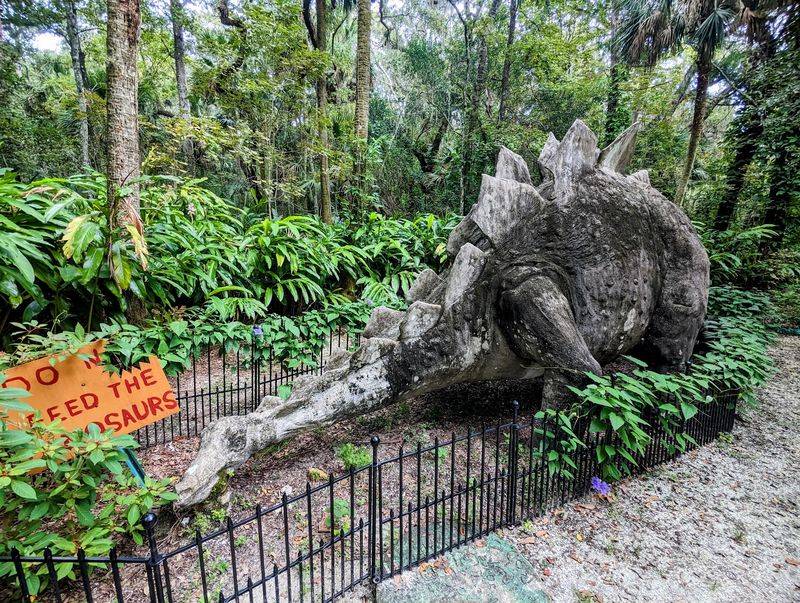
On paper, none of this should hang together. A failed sugar operation, an amusement park named after a baboon, chicken-wire dinosaurs, and a carefully labeled collection of native plants have no business occupying the same ten acres.
Somehow the combination lands. Each layer was left in place rather than cleared away for the next one, and walking the loop means moving through 1832, 1950, and the present without ever leaving the shade.
Expectations are usually too low on arrival. The residential approach and the modest entrance suggest a neighborhood pocket park, and the extent of the paths comes as a surprise once you are inside.
Set aside an hour, more if you read the signage or go looking for the gnome village. Morning visits are cooler, late afternoon is better for photographs, and the season you pick will change what is blooming.
Bring a few dollars for the donation box and cash if you want plants or honey. For a free stop in Volusia County, the ratio of strangeness to effort here is hard to beat, and the concrete dinosaurs alone justify the detour.