This Under-The-Radar New York Museum Is Packed With Motorcycles Worth Seeing
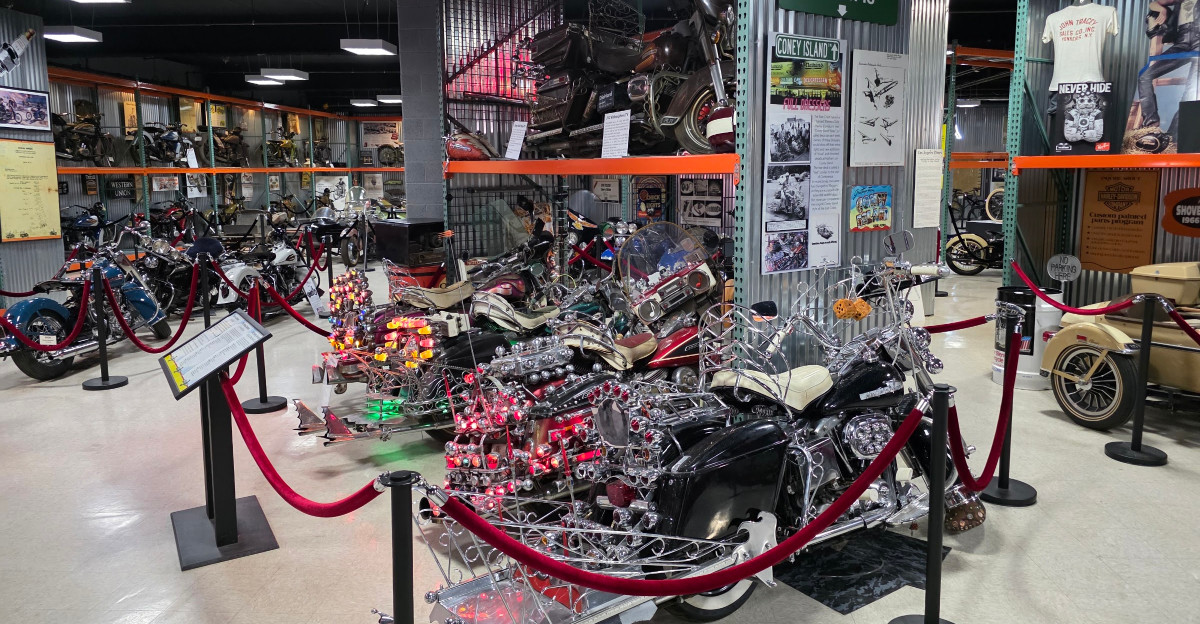
Chrome everywhere. Bikes everywhere. And just when you think you have seen the wildest one, another machine rolls into view looking even stranger.
One New York museum packs thousands of square feet with motorcycles ranging from elegant classics to military bikes, custom builds, and movie machines.
You do not need to know a thing about engines to have fun here. The designs do the work.
One bike looks gorgeous. Another looks slightly unhinged. Then you spot one cut in half and suddenly everyone is staring at the mechanics inside.
This is the kind of museum where “one more room” becomes the entire afternoon.
A Family Passion Turned Museum
Every great collection starts with a single spark. For this one, the spark was a 1929 Indian Scout bought back in 1947.
That first bike started a hobby that grew for decades. The love for motorcycles passed from father to son, and the son learned to build custom choppers. Together, the family kept adding bike after bike to their growing collection.
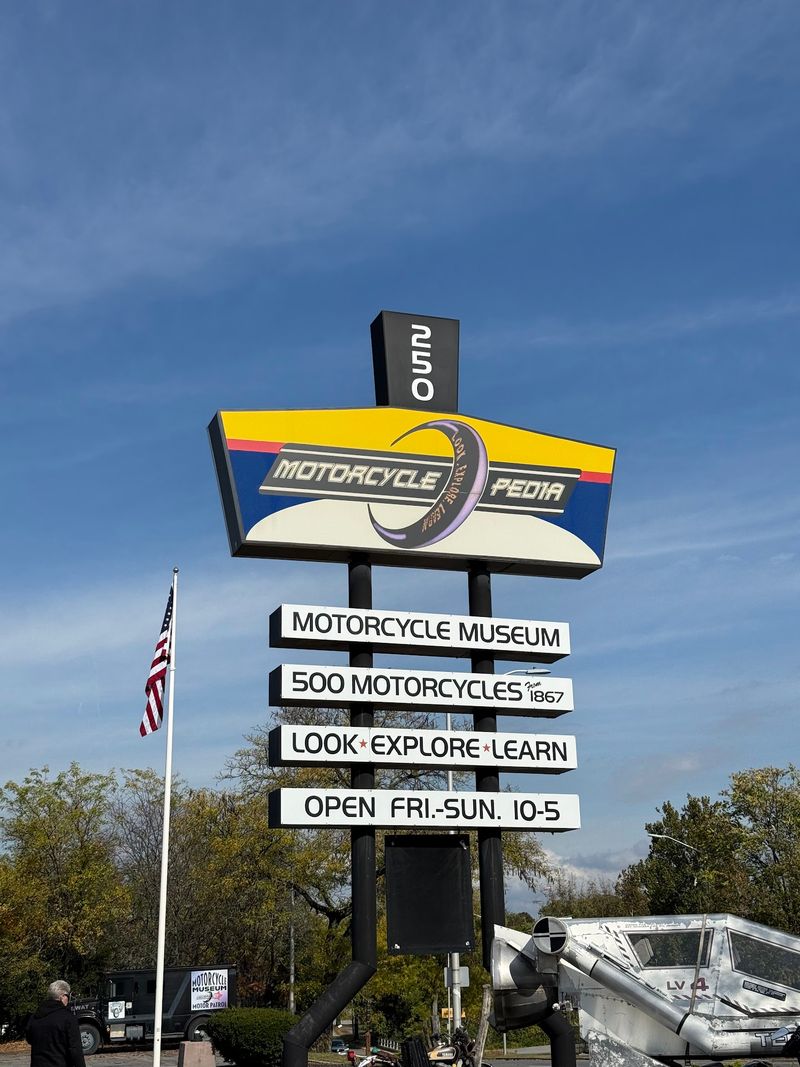
In 2011, they created a foundation and opened the doors of Motorcyclepedia Museum. The collection now fills an 85,000-square-foot, two-story building and includes more than 650 motorcycles.
The main focus here is early American motorcycles. Many early machines still show their bicycle roots, with narrow frames, thin tires, small engines, and exposed mechanical parts.
Those early inventors were tinkerers with big dreams. Their experiments helped push motorcycles from motorized bicycle-like machines toward increasingly specialized designs.
Comparing early examples with later bikes makes those changes easy to see.
Plan to arrive with plenty of time, because the building is huge. Your adventure in New York motorcycle history starts at 250 Lake St in Newburgh.
The Incredible Indian Timeline
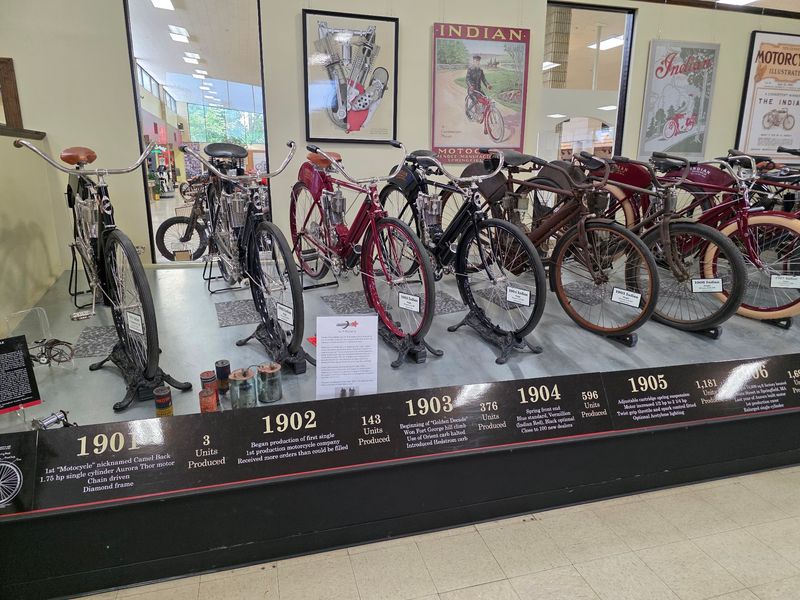
Picture a parade of bright red bikes that never moves an inch. That is the Indian Timeline, one of the museum’s signature displays.
The gallery shows an Indian motorcycle from every production year. It starts in 1901, when the company began, and runs all the way to 1953. The timeline is only one part of the museum’s broader Indian collection.
Some of the very earliest years are careful replicas. Later years show bikes that have been beautifully restored. A few are original and unrestored, with worn paint that shows their age proudly.
Walking slowly is the best approach here. Changes in frames, engines, tanks, controls, fenders, and proportions become clearer when the motorcycles are viewed in chronological order.
The arrangement works almost like a three-dimensional timeline of American motorcycle design.
The display follows the rise and eventual end of the original Springfield, Massachusetts company. More than half a century of engineering and styling changes sits in one continuous sequence.
The mix of replicas, restorations, and unrestored originals keeps the timeline from feeling uniform. Each motorcycle shows a slightly different stage in the company’s history.
Wild Rides In Chopper City
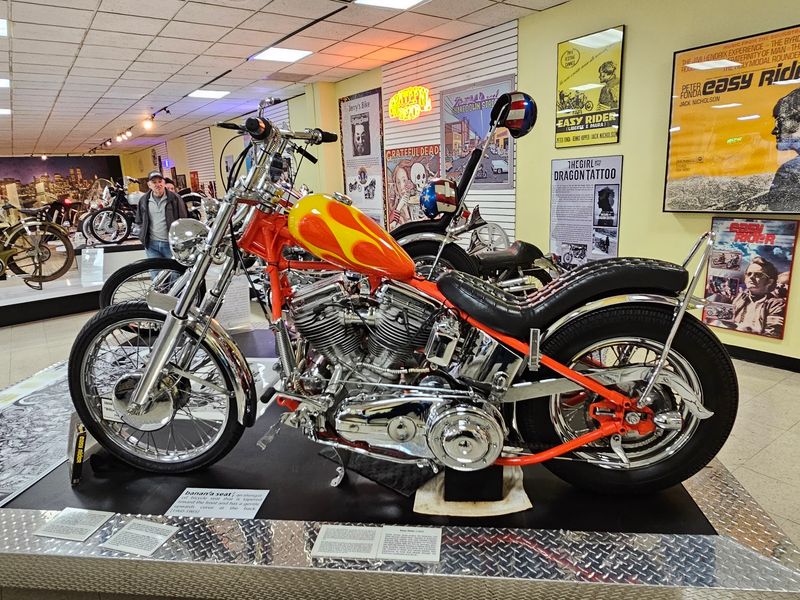
Long forks, tall handlebars, and paint jobs that pop. Chopper City is where the museum lets its hair down.
The gallery focuses on custom choppers, including work connected to major figures in American custom-motorcycle culture.
It also ties back to the family story, since custom bike building became an important part of the collection’s development.
Some machines stretch familiar motorcycle proportions almost beyond recognition. Extended forks, unusual bodywork, sculptural frames, and elaborate finishes make the engineering as noticeable as the decoration.
Replicas of the famous choppers from the film Easy Rider sit in this section too. These bikes connect the gallery to the custom-motorcycle culture of the 1960s and 1970s.
This room shows that motorcycles can be more than transportation. They can also be a way to express a particular design style. Extended forks, molded bodywork, unusual frames, and elaborate paint make the differences easy to spot.
Look closely at the paint details and odd shapes. Some of the most interesting fabrication is easier to appreciate from a few feet away than from across the gallery.
Bikes On Patrol And Duty
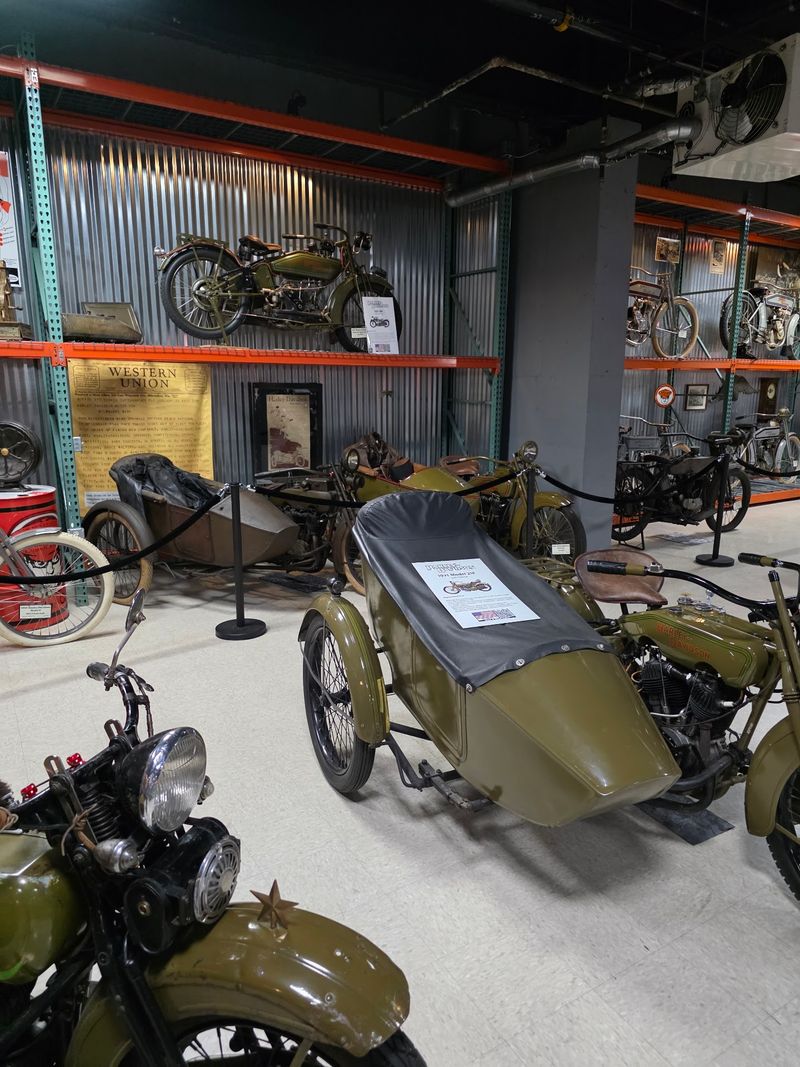
Not every motorcycle was built just for weekend fun. Some had serious jobs to do, and this part of the museum focuses on them.
The police and military galleries trace how motorcycles helped officers and soldiers.
Bikes were fast, quick to turn, and able to squeeze through tight spaces. Those qualities made them useful for patrol, transportation, communications, and other official work.
Police bikes from the City of Newburgh and the Town of New Windsor are on display. The local machines connect the broader motorcycle story directly to the Hudson Valley.
One historically significant piece is a Dallas Police Harley-Davidson. It rode in the motorcade of President John F. Kennedy on November 22, 1963, and was later used in the film JFK.
Its history gives the display a much heavier context than most of the machines around it.
The military collection includes Army motorcycles and a World War II-era Kettenkrad. Practical equipment and military hardware show how motorcycles and related machines were adapted for very different conditions.
Take a moment to read the signs here, since the stories add real depth. Much of the importance comes from where these machines served, not simply how they look.
Hollywood Bikes Up Close
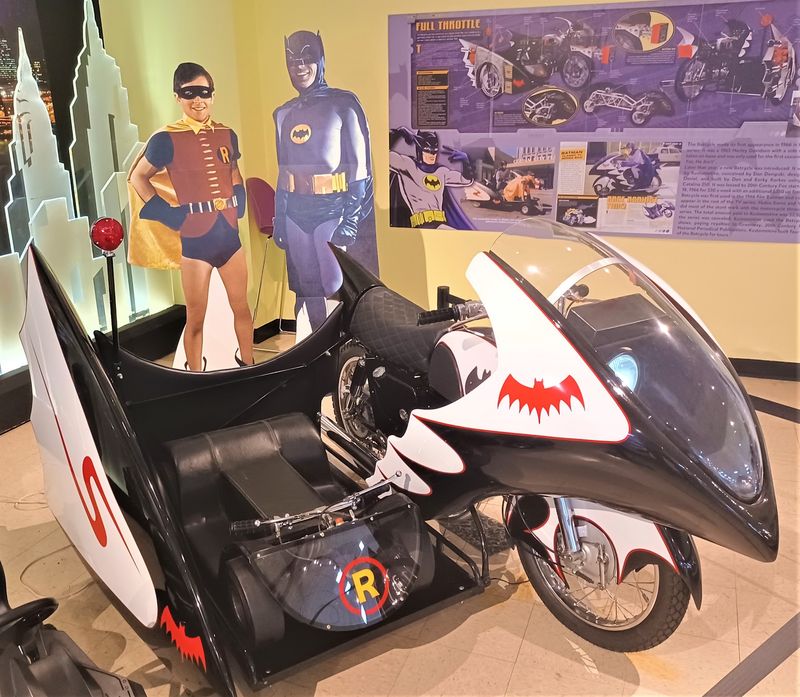
Lights, camera, throttle. The Movie Gallery brings motorcycles from film and television into the museum.
The Batcycle from the 1960s Batman television era is one of the recognizable highlights. A motorcycle associated with Ghost Rider adds another dramatic screen connection.
The entertainment collection reaches beyond those two machines.
A futuristic Lightcycle associated with Tron: Legacy adds a completely different design, while other motorcycles connect to films, television, and popular culture across several decades.
Replicas of the famous Easy Rider choppers appear elsewhere in the museum. Together with the screen-used and screen-connected machines, they show how motorcycles became visual symbols of speed, independence, and rebellion.
Old movie posters hang throughout the museum too. They help show how motorcycles shaped popular culture over many decades. Albums, comics, and other memorabilia extend that story beyond the bikes themselves.
This gallery also gives non-riders an easy way into the collection. Recognizable screen designs put the motorcycles into a familiar cultural context without requiring any knowledge of engines.
A Spin Around The World
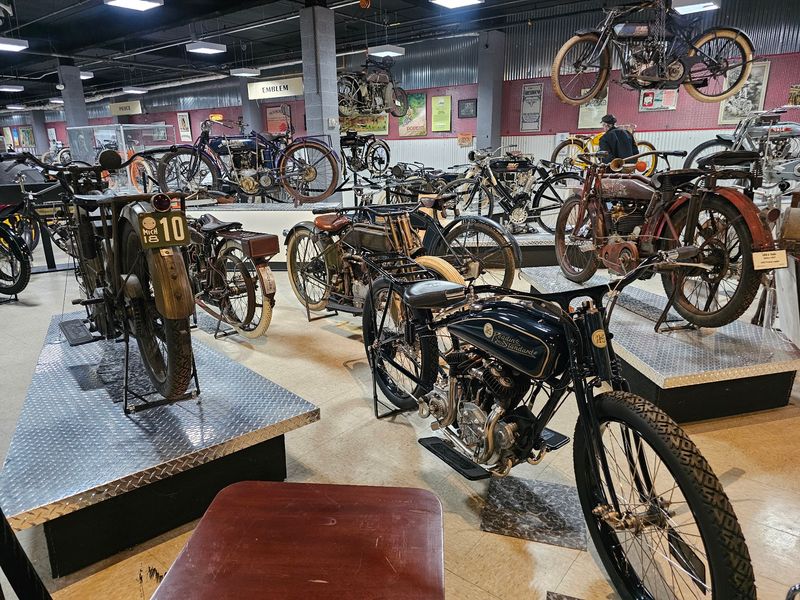
Grab your passport, or at least pretend to. The international collection broadens the museum far beyond American motorcycle history.
On the lower level, the Circa Gallery shows early machines from around the globe.
Names like Thor, Reading-Standard, Yale, Pope, and De Dion-Bouton fill the room. Early Harley-Davidson models also make an appearance.
Elsewhere downstairs, imported vehicles add another layer of variety. One of the strangest is a three-wheeled Velorex from Czechoslovakia with a fabric body stretched over its frame.
Classic Vespa scooters bring a cheerful Italian style. Husqvarna and Opel motorcycles add even more variety.
British and Japanese machines show how manufacturers in different countries approached the same basic idea in very different ways.
A particularly revealing engineering display is a 2004 Ducati 999S sliced right down the middle.
You can see the engine, gears, suspension, and hidden parts inside. The cutaway turns a complete motorcycle into a full-size mechanical diagram.
The lower level rewards extra time after the headline displays upstairs. Older machines, imports, scooters, and engineering oddities give the museum much of its range.
Posters, Albums, And Local Legends
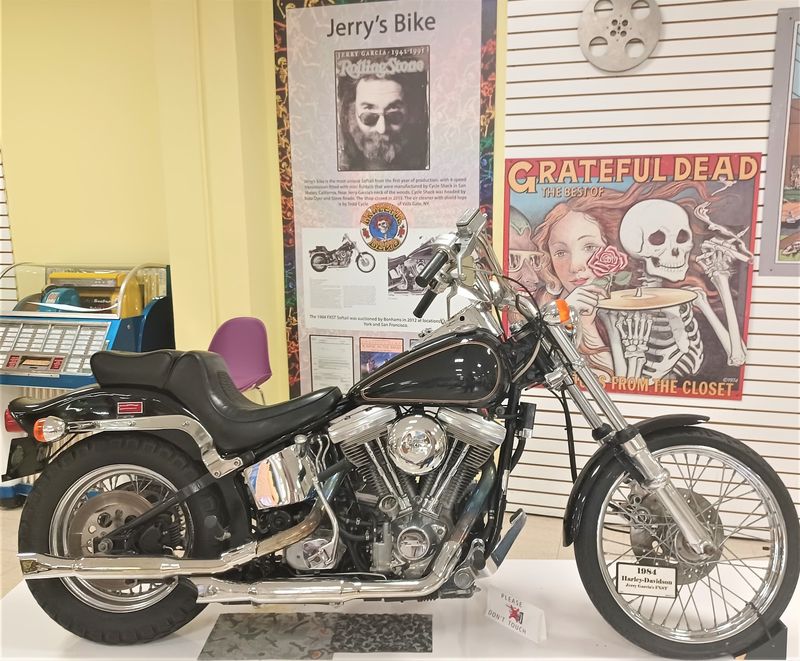
Some of the most interesting finds are not bikes at all. The walls and cases are packed with motorcycle memories from many eras.
Vintage posters show how companies once sold motorcycles to the public.
Old vinyl albums with bikes on their covers add a musical twist. Together with comics and movie material, they show how motorcycles became part of popular culture.
The museum also reflects the Mid-Hudson region of New York. This area has a long motorcycle culture with deep local roots. A dedicated display honors a nationally known custom builder who grew up around Newburgh.
That local connection adds another layer to the collection. Some of the motorcycle story on display developed within the same Hudson Valley communities that surround the museum today.
Exhibits also change and rotate over time. Returning visitors may find different motorcycles or memorabilia incorporated into the galleries.
With more than 650 motorcycles under one roof, a first visit can easily become an exercise in spotting details that were missed a few minutes earlier.
Smart Tips Before You Ride
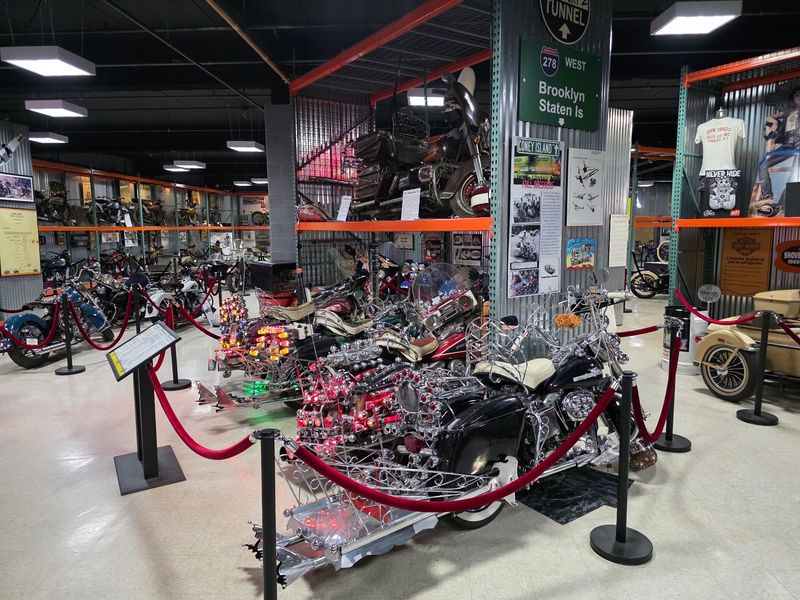
A little planning goes a long way here. The museum is much bigger than it looks from the street.
The museum opens Thursday evenings from 4 to 8 PM. On Friday, Saturday, and Sunday, hours run from 10 AM to 4 PM. It is closed Monday through Wednesday, so plan your trip carefully.
Give yourself at least two hours to explore both floors. The 85,000-square-foot building can easily fill several hours for visitors who stop to read the displays and compare individual motorcycles.
The two-floor layout is easier to manage when visitors start with the galleries that interest them most, then leave time for the lower level.
This New York museum has also been associated with large wooden Wall of Death motordromes used for stunt-riding demonstrations at special events.
Those demonstrations are not part of a standard museum visit, so any current performance should be confirmed through the event calendar.
Newburgh sits in the Hudson Valley, making it easy to pair the museum with a longer regional drive. The collection is substantial enough to be the main destination rather than simply a quick roadside stop.
Motorcyclepedia Museum remains active in 2026 with more than 650 motorcycles and extensive memorabilia.