Nebraska Is Home To A Carhenge Built From 39 Vintage Cars Painted Gray
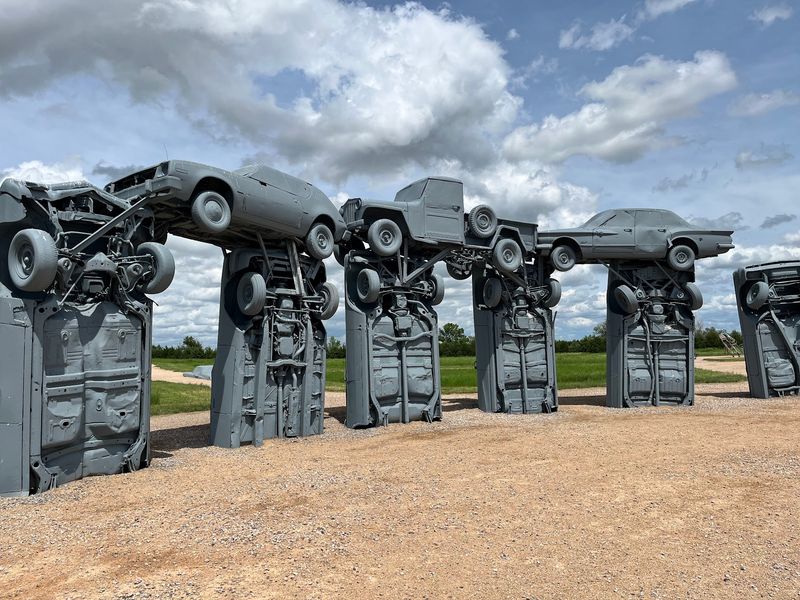
A 1962 Cadillac stands in for the heel stone. The rest of the circle is built from classic American cars, planted trunk-down in the dirt and painted gray like ancient rock.
Someone looked at England’s most famous stone ring and thought, why not use Detroit steel instead? I love that kind of thinking.
The proportions match the original, and the whole thing stretches roughly 96 feet across.
It sits out on the High Plains of western Nebraska, where the sky is huge and the horizon goes on forever. You can wander right up to the cars, read the placards, and even pick up a souvenir sticker.
I can’t imagine anyone driving past this without a double take. So how did a family reunion turn into one of the strangest monuments in America?
A Stone Circle Made Of Steel Waits On The High Plains
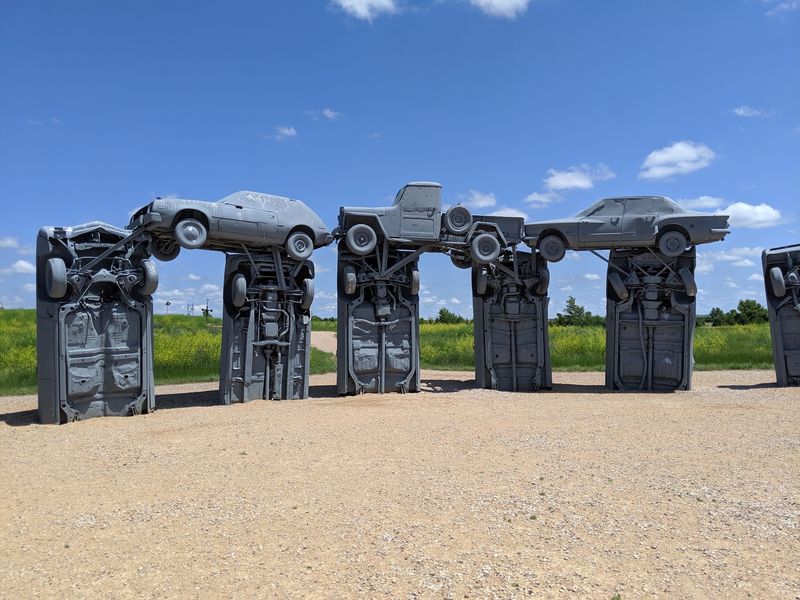
Carhenge is a full-scale replica of England’s Stonehenge, built from vintage American automobiles instead of giant stones. It sits just north of Alliance, Nebraska, a couple of miles outside town.
The circle measures about 96 feet in diameter. That matches the size and proportions of its ancient inspiration, which is no small feat with cars.
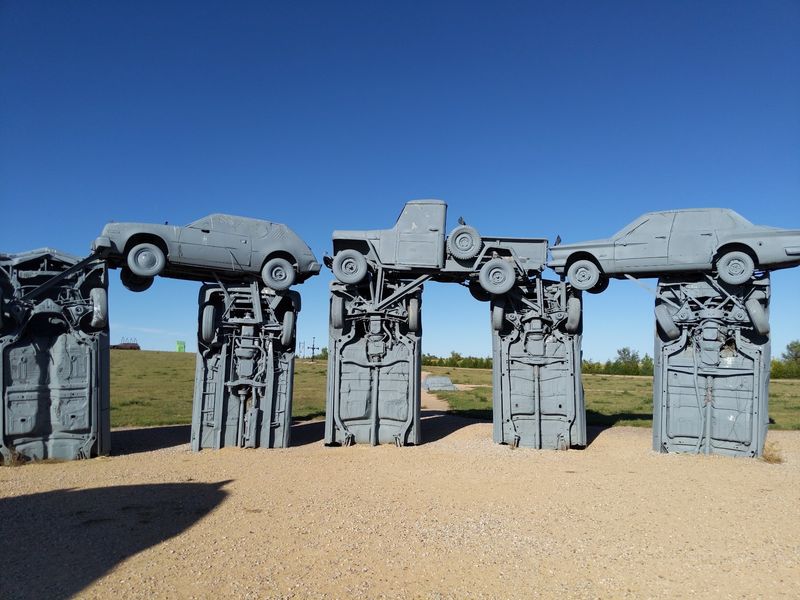
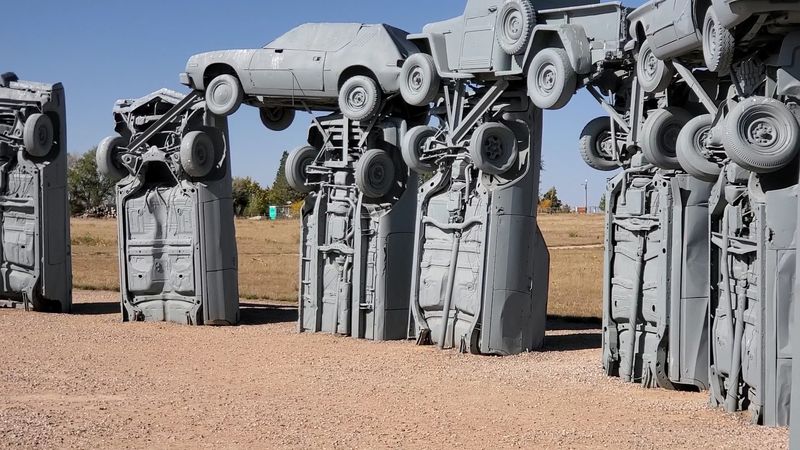
Some vehicles stand upright, buried five feet deep with their trunks pointing down. Others are welded across the tops like the stone lintels at the original monument.
The result looks oddly convincing from a distance. Travelers driving the back roads have stopped simply because they spotted a familiar shape on the horizon.
Up close, of course, you start noticing tail fins and bumpers. That’s when the giggles usually kick in, and the camera comes out.
The gray paint is the clever part. It makes the cars read as stone, so the illusion holds until you’re nearly standing beside them.
Nothing about this place should work, yet it absolutely does. It’s part sculpture, part joke, and part tribute, all planted firmly in Nebraska soil.
A Son’s Tribute That Started As A Family Reunion
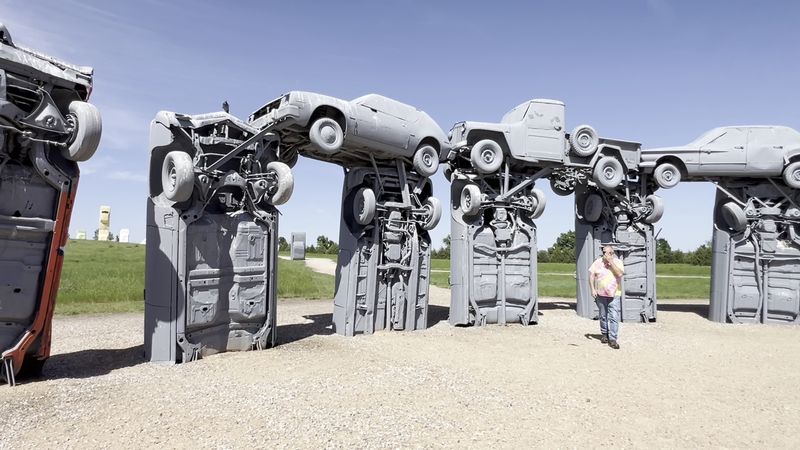
Artist Jim Reinders came up with the idea in 1982. He wanted a memorial to his father, and he had a very specific model in mind.
Reinders had lived and studied in England. While there, he observed Stonehenge closely and learned its design, which became his blueprint.
In June 1987, he gathered about 35 family members near Alliance. Instead of potato salad and lawn games, the reunion became a construction project.
Picture the group texts for that one, if they’d existed back then. Bring sunscreen, and maybe a welding torch.
The family raised the cars together and finished the job that same month. Carhenge was dedicated on the summer solstice of 1987, a fitting date for a henge.
One placard on site sums up the spirit nicely. Your first question might be why, but Reinders would simply have answered, why not?
I like that the whole thing grew out of love and stubborn creativity. Reinders passed in October 2021, but he lived to see his idea become internationally known.
That Gray Paint Is Doing Some Heavy Lifting
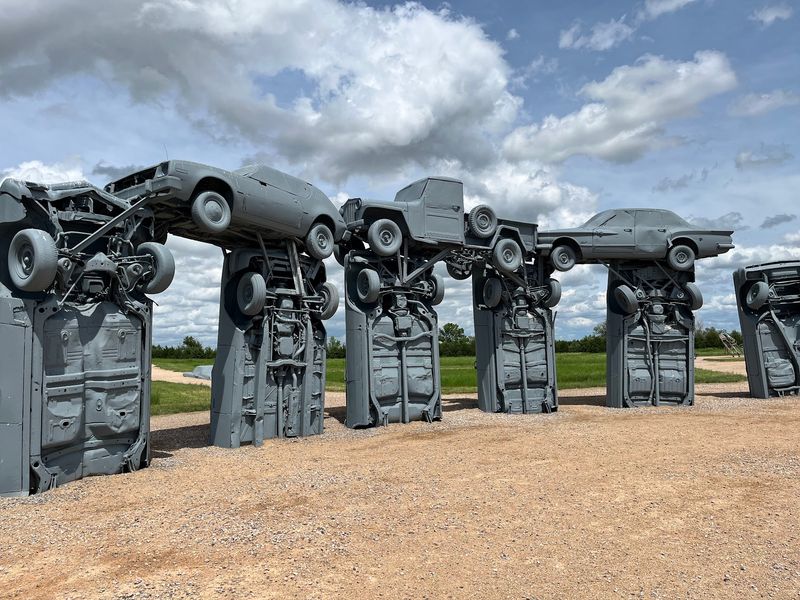
Thirty-nine cars, one color. The uniform gray turns chrome-era Americana into something that looks surprisingly like weathered rock.
The vehicles mostly come from the 1950s and 1960s. That’s the golden age of American automaking, full of big bodies and dramatic lines.
Without the paint, the site might look like a colorful pile of old rides. With it, the shapes blend into one solid monument against the prairie.
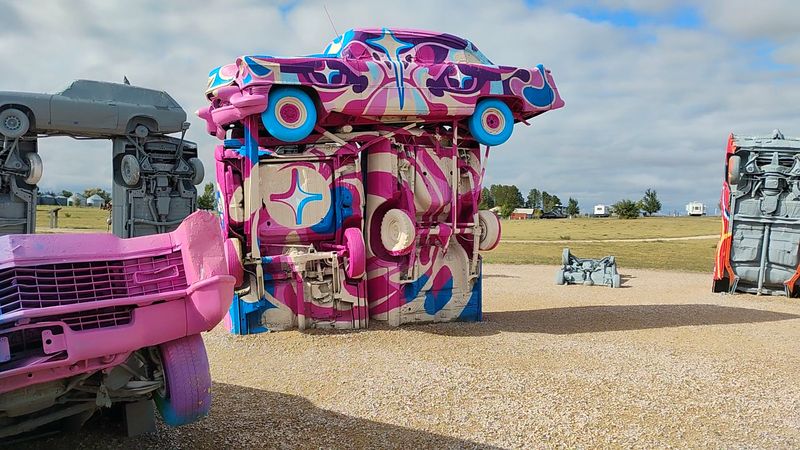
Folks who visited years ago sometimes remember the cars looking different. Over time, some vehicles have carried painted artwork alongside the gray.
That shifting look keeps return trips interesting. You might spot a detail that wasn’t there on your last swing through western Nebraska.
Still, gray remains the signature. It’s what gives the circle its stone-like silhouette, especially when the light starts dropping.
Sunset makes those painted surfaces glow softly. Families stopping in the evening have gotten some lovely photos as the sky changes behind the cars.
It’s a simple choice with a big payoff. A coat of paint basically turned Detroit into Salisbury Plain.
Meet The Cadillac Playing The Heel Stone
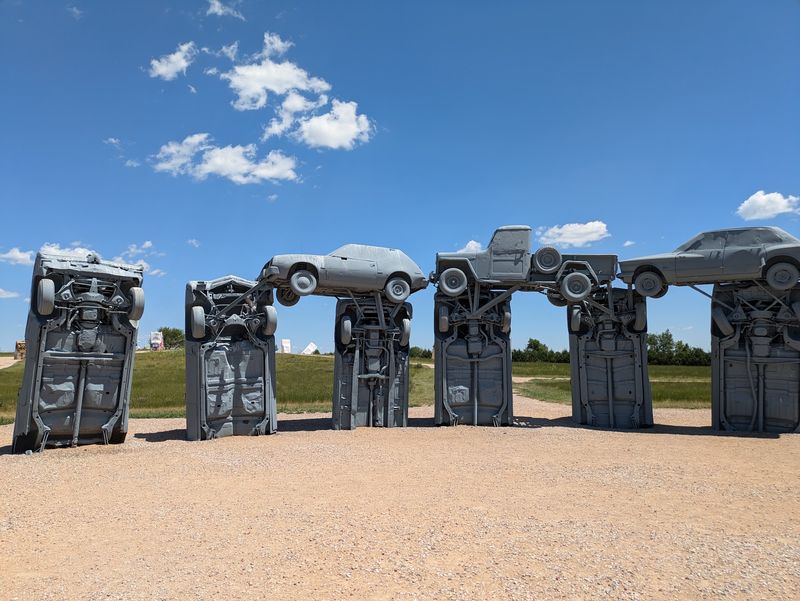
Every henge needs its heel stone. At Carhenge, that honor goes to a stately 1962 Cadillac.
At the real Stonehenge, the heel stone sits apart from the main circle. Reinders kept that detail, which shows how carefully he studied the original layout.
Choosing a Cadillac feels perfect, honestly. If you’re going to cast a car as the most famous stone in the arrangement, pick one with some swagger.
The rest of the cars form uprights and arches around it. Welded pieces span the tops, recreating the trilithons that make Stonehenge so recognizable.
Walking among them, you start appreciating the engineering. These are heavy vehicles balanced and secured to stand up to plains wind.
And that wind can be fierce out here. Cold, dusty mornings happen, so a jacket in the car is a smart move outside summer.
Car buffs will enjoy spotting body styles and trying to guess models. Everyone else can just enjoy the absurdity of a Cadillac guarding an ancient design.
It’s a reverent nod to the past. It also happens to be very, very funny.
Salmon, Wagons, And A Giant Wind Chime Fill The Car Art Reserve
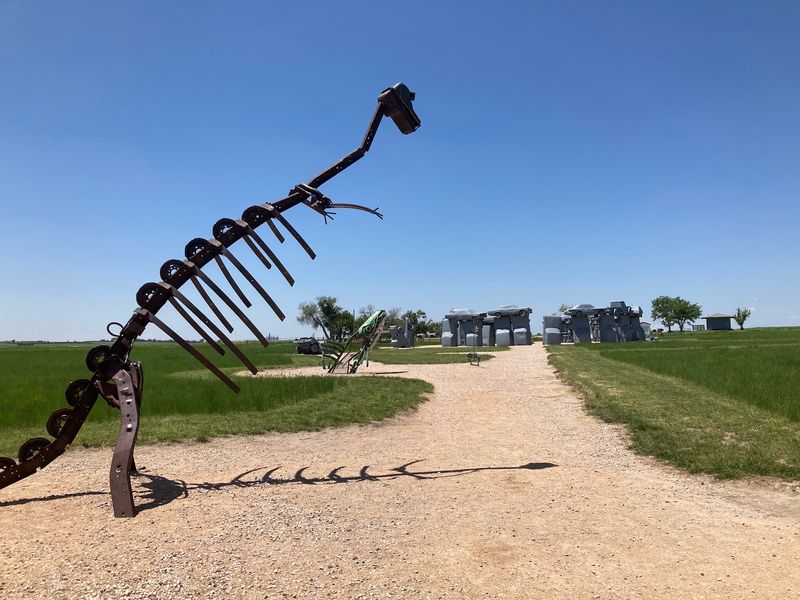
Here’s a bonus most first-timers don’t expect. Beyond the main circle sits the Car Art Reserve, packed with more sculptures made from cars and car parts.
One standout is Spawning Salmon, a piece that won a sculpture contest. Cars leaping upstream is not a sentence you read every day.
Then there’s The Car-nestoga Wagon. It’s a station wagon cleverly shaped to look like a Conestoga wagon, a pioneer nod with a modern twist.
A massive wind chime built from vehicle frames also stands on the grounds. It’s an unexpected surprise for anyone who thought the circle was the whole show.
Three foreign cars are intentionally buried at the site, too. A sign marks the spot with a playful statement about American industry.
The reserve shows how different artists handle the same unusual material. Some pieces are clever, some are silly, and a few are surprisingly graceful.
Give yourself time to wander the full grounds. Wide gravel paths make it easy to loop around and catch every piece.
Once Called An Eyesore, Now A Point Of Pride
Not everyone cheered in 1987. Plenty of local residents first saw Carhenge as an eyesore or a vertical junkyard.
That reaction makes sense if you think about it. A ring of buried cars appearing outside town would raise a few eyebrows anywhere.
Over the years, though, opinions shifted. People began appreciating the artistic value and the visitors it drew to Alliance.
In 2013, the Friends of Carhenge donated the site to the citizens of Alliance. It officially became a public park, owned by the community it once puzzled.
The Friends of Carhenge still support the landmark through fundraising. That ongoing care helps keep the grounds tidy and the sculptures standing tall.
I find this part of the story genuinely heartwarming. A town went from scratching its head to claiming the oddball as its own.
If you grew up around the Panhandle, you probably have opinions. Maybe you remember the early grumbling, or maybe you’ve only known it as a beloved landmark.
Either way, Carhenge stuck around. Stubborn art has a funny way of winning people over.
Hollywood, Pixar, And An Eclipse Came Calling
Fame found this field in western Nebraska. Carhenge has shown up in books, television programs, and commercials over the years.
It even appeared in a webseries spinoff from Pixar’s Cars franchise. Honestly, where else would animated cars go to feel spiritual?
In August 2017, the site became a popular viewing spot for the total solar eclipse. A Stonehenge replica under a darkened sky is about as on-theme as it gets.
The ancient original has long been linked with the sun and seasons. Watching an eclipse from its automotive cousin made that connection feel delightfully literal.
All that attention helped turn Carhenge into a bucket-list stop. People chasing all 50 states sometimes swing through just to check Nebraska off.
Fellow henge fans also make the rounds. Some travelers pair it with other quirky replicas, comparing notes on each creative spin.
Still, the fame hasn’t made it fussy. It’s the same open field, the same gray cars, and the same sense of humor.
That mix of celebrity and simplicity is part of the charm. Big reputation, small-town ease.
Grab A Marker And Leave Your Name Behind
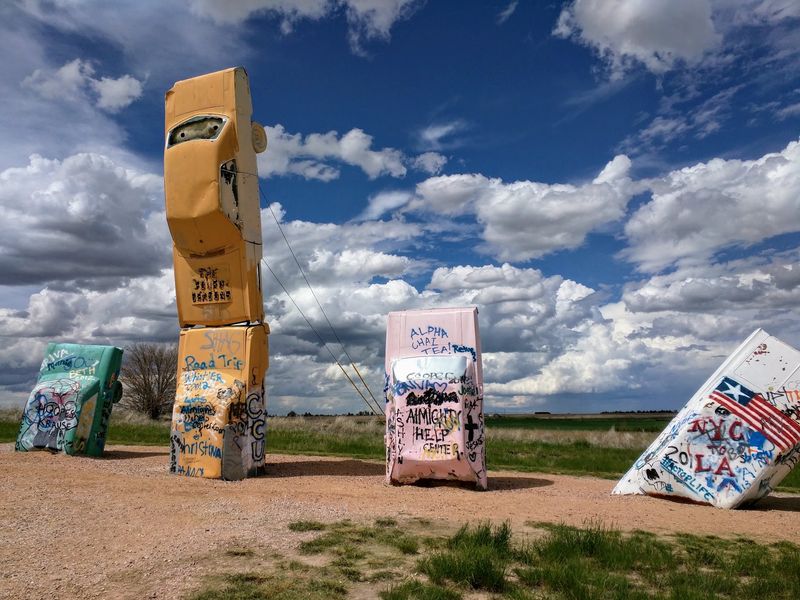
Most monuments ask you not to touch. Carhenge hands you permission to write on one.
A designated car on site welcomes signatures in permanent marker. You get to add your name to the long list of people who made the trip.
Kids especially love this part. It turns a quick look into something personal they can point to in photos later.
The site also mentions a time capsule. It’s another nod to how this place keeps collecting stories from the folks who pass through.
Families stopping on long drives have found it becomes a trip highlight. Even little ones can run the gravel paths and gawk at cars standing on end.
Leashed dogs are welcome, too. Your four-legged copilot deserves a stretch break as much as anyone.
Do keep an eye on the ground, though. Snakes have been spotted on the grounds from time to time, which is normal for open prairie.
Bring your own marker if you want a favorite color. Then add your mark and become a tiny piece of the monument’s ongoing tale.
The Gift Shop Is Worth A Few Minutes Of Your Stop
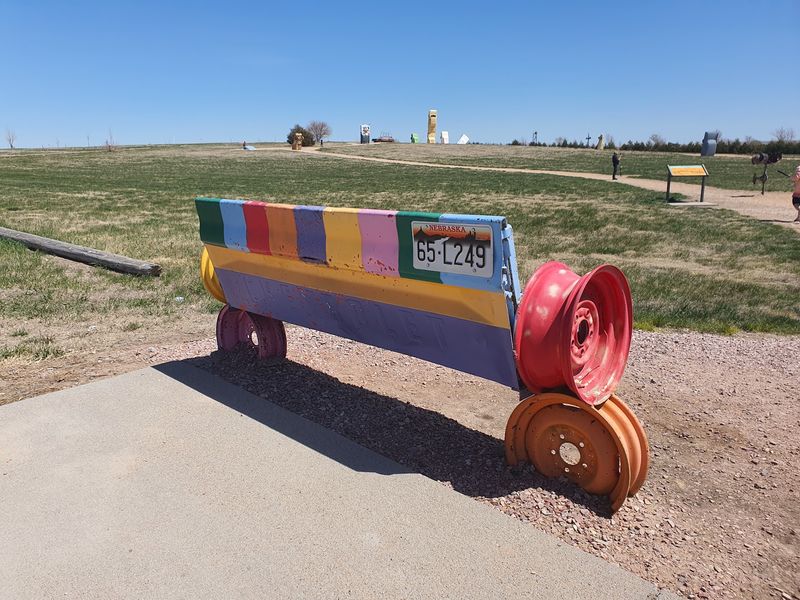
Stickers, postcards, and t-shirts are the usual haul. The Pit Stop Gift Shop gives you something to take home besides photos.
A visitor center was built on site in 2006. It offers helpful background on how Carhenge came together and why it matters.
The shop operates seasonally, with summer being the main stretch. Outside those months, you may find it closed, though merchandise is also sold online.
Refreshments and snacks are available when it’s open. That’s handy when the nearest big-city convenience store is a long way off.
Staff at the register have a friendly reputation. A little small-town hospitality goes a long way after hours on the highway.
Picnic tables also sit on the grounds, including a covered one. Packing a lunch makes the stop feel like a proper break.
Plan accordingly if you arrive early or late. The monument itself is always there, but shop hours follow the season.
Either way, buying a souvenir helps support the site. Considering admission costs nothing, it’s a nice way to say thanks.
Free Admission And Round-The-Clock Access Make This Easy
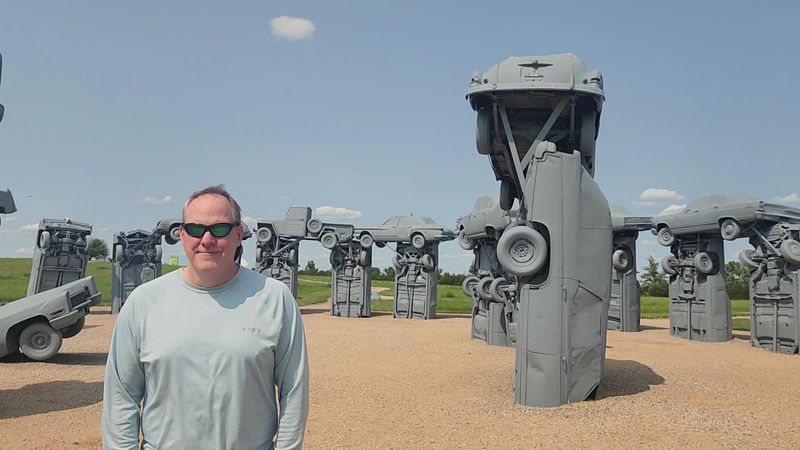
Good news for budget travelers: there’s no admission charge. Donations are welcome, but nobody’s guarding a ticket booth.
You’ll find Carhenge at 2151 County Road 59 in Alliance, Nebraska. It sits a short drive north of the city center.
The grounds are open all day, every day. Sunrise stops and golden-hour visits are both on the table, depending on your route.
Parking is plentiful, which helps during busy road trip season. The walkways are wide gravel paths, easy to follow around every sculpture.
Most people spend somewhere around 20 to 30 minutes. Car lovers and photographers can easily stretch that longer.
Weather is the real wild card here. High Plains wind can whip dust around, so sunglasses and a light layer are smart picks.
Shoes with decent grip help on gravel too. Flip-flops will work, but sneakers make wandering the reserve more comfortable.
A full afternoon of quirky fun without spending a dime? That’s tough to beat anywhere in the state.
A Scenic Detour Beats Another Stretch Of Interstate
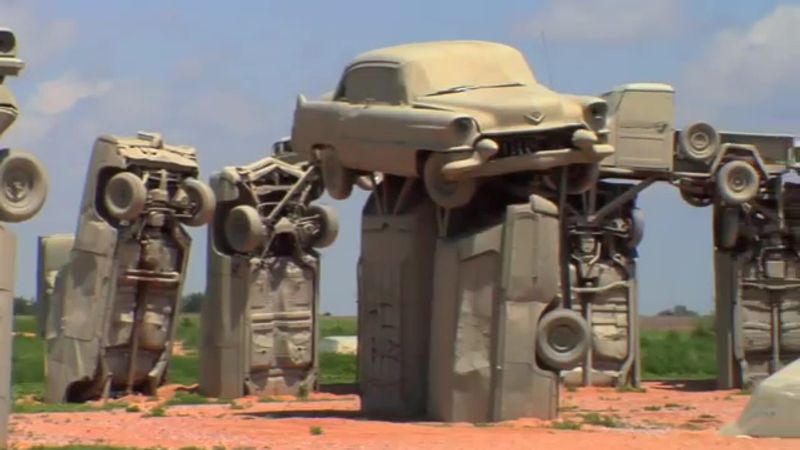
Interstate 80 gets you across Nebraska fast. It doesn’t get you to a ring of buried Cadillacs.
Many travelers build Carhenge into a northern route instead. Scotts Bluff National Monument makes a natural pairing, with its sweeping views and trail history.
From there, Alliance is a reasonable jaunt north. A stop at Carhenge breaks up the drive with something wonderfully weird.
Afterward, Highway 20 rolls east across the Sandhills. That quieter stretch shows off a calmer, prettier side of the state.
Heading toward the Black Hills? Mount Rushmore is roughly a two-hour drive from Carhenge, making it an easy add for South Dakota trips.
Day-trippers from around the Panhandle can make a simple loop of it, too. Scottsbluff folks have driven out of their way just for this stop.
The roads themselves become part of the adventure. Big skies, open grassland, and very little traffic set a relaxed pace.
Ask yourself which you’d remember more years later. Another truck stop, or a Stonehenge made of Detroit’s finest?
Alliance Has A Sunken Garden Worth A Detour
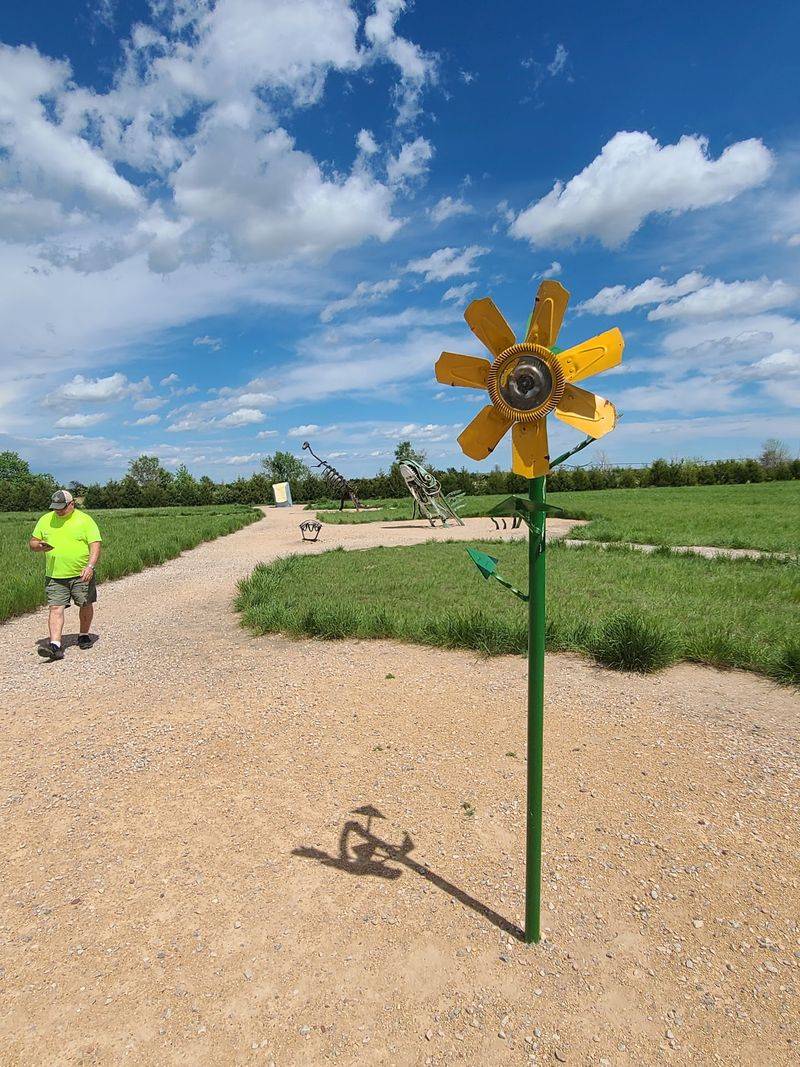
Carhenge may be the headliner, but Alliance has more to see. The town makes a pleasant spot to refuel and stretch.
Central Park dates to the 1930s as a Works Progress Administration project. It features a sunken garden and a fountain built in 1935.
That kind of Depression-era craftsmanship is always fun to spot. It adds a gentle, historic contrast to the wild car sculpture up the road.
Alliance also offers dining and local shopping. Grabbing a meal in town turns a quick photo stop into a real outing.
Museums in the area round out the options for history fans. Families can easily fill a relaxed afternoon between the park and the monument.
Travelers who need a quick connection will find a rest area a few miles from Carhenge. It offers free Wi-Fi, handy for checking the next leg.
Small towns like this reward a little curiosity. Slowing down often turns up the best parts of a Nebraska road trip.
So don’t just snap and go. Give Alliance a little love while you’re there.
Why Not Is Still The Best Reason To Go
Some landmarks impress through sheer size. Carhenge impresses because somebody had the nerve to build it at all.
A son honored his father with a family project nobody else would dream up. Decades later, people from around the world still pull off the road to see it.
It’s free, open around the clock, and easy to reach from the Panhandle. Kids can run, dogs can sniff, and grown-ups can giggle at a Cadillac posing as a rock.
The Car Art Reserve adds surprises around every turn. The gift shop sends you home with proof, in case friends don’t believe you.
Is it a long day’s drive for everyone? Sure, but the payoff fits neatly into a weekend loop through western Nebraska.
Pair it with Scotts Bluff or the Sandhills, and you’ve got a trip worth planning. Add sunset at the circle, and the photos practically take themselves.
I believe every state needs a landmark this gloriously odd. Nebraska just happens to have one built from 39 gray cars.
Go see it for yourself. Why not, right?