10 New York Basilicas, Cathedrals, And Shrines Worth A Special Road Trip In 2026
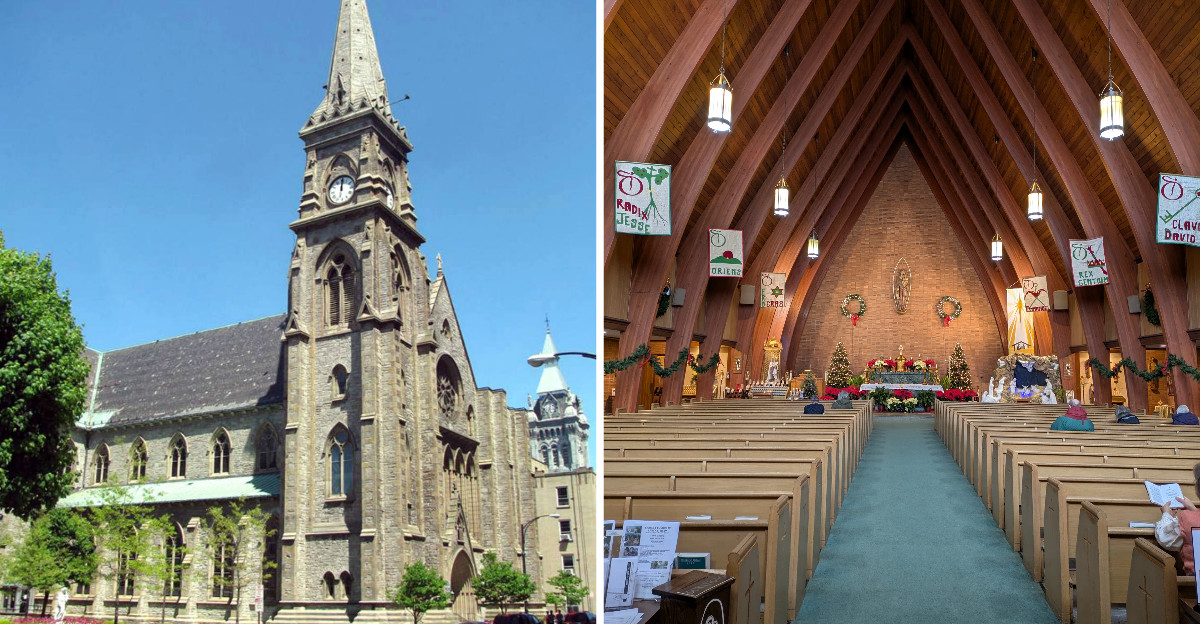
What makes a church worth hours behind the wheel?
Try this: one basilica near Buffalo holds roughly 2,000 to 2,500 carved and painted angels, placed so one appears in nearly every sight line.
That’s a fair answer, but it gets better.
When that copper dome was finished in the 1920s, it ranked second in size only to the U.S. Capitol. A small-town priest dreamed it up, and you can still find his tomb inside.
New York hides stories like that in places you’d never expect. Peacocks stroll one cathedral’s grounds in Manhattan.
A quiet Mohawk Valley hillside connects to the first Native North American saint.
Turns out the best road trips don’t always end at a beach.
1. Our Lady Of Victory National Shrine & Basilica
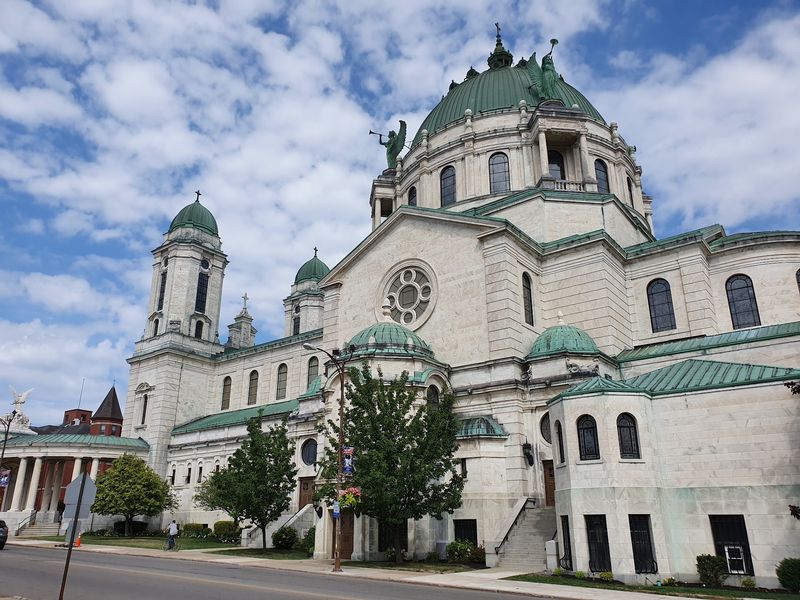
Counting angels here could fill your whole afternoon. The basilica holds an estimated 2,000 to 2,500 of them in sculpture and art.
Father Nelson Baker wanted an angel visible from virtually every direction, and the decoration certainly keeps your eyes moving.
The building at 767 Ridge Road in Lackawanna, came from that priest’s ambitious plans.
Construction began in 1921, finished in 1925, and culminated in a consecration on May 25, 1926. Pope Pius XI designated it a minor basilica shortly afterward, only the second in the United States.
Outside, sweeping marble colonnades frame the entrance. Above them rises an 80-foot-wide copper dome, crowned by four trumpet-bearing angels standing 18 feet tall.
The dome was second in size only to the U.S. Capitol’s when it was completed. Its copper covering is undergoing a multiyear restoration.
Inside, the painted Assumption and Coronation fill the dome. Fourteen marble Stations of the Cross line the nave, while a nine-foot statue of Mary anchors the main altar.
Even the original mahogany pews received careful restoration. Ceiling murals portray Mary under different titles, while stained glass tells stories from both Testaments.
The Grotto Shrine, fashioned from volcanic rock, contains Father Baker’s tomb. A museum downstairs traces his charitable work.
With its hundredth anniversary marked in 2026, this extraordinary Lackawanna landmark has an especially meaningful reason to celebrate.
2. Cathedral Of St. John The Divine
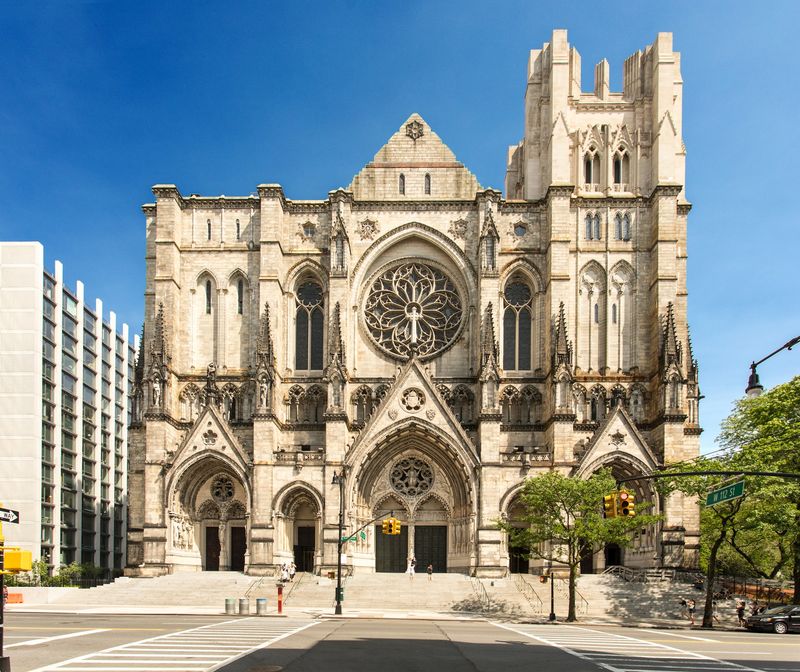
Construction began in 1892, and the building still isn’t finished.
Yet its enormous Gothic interior already stretches 601 feet, making the Cathedral of St. John the Divine one of Manhattan’s most astonishing architectural projects.
The cathedral is the seat of its Episcopal diocese. Its history is still being written.
Its full length was consecrated in 1941, and the building and surrounding Close received city landmark status in 2017. Completion remains an open-ended project, which is an unusual story for a cathedral this grand.
Begin at 1047 Amsterdam Avenue, New York. Massive stonework surrounds the western doors, but the real surprise waits inside: a rose window roughly 40 feet across, assembled from more than 10,000 pieces of glass.
Artwork includes a piece by Keith Haring, seventeenth-century tapestries, and a September 11 memorial sculpture. Concerts, choral services, and changing cultural programs make the calendar as interesting as the architecture.
And yes, the peacocks are real. They wander the landscaped Cathedral Close, although the grounds are generally closed to sightseeing visitors on weekdays while school programs are in session.
Sightseeing hours are normally 9:30 a.m. to 5 p.m. Monday through Saturday and noon to 5 p.m. Sunday.
Timed admission is encouraged for sightseeing, while prayer and meditation remain welcome without a sightseeing ticket.
3. Our Lady Of Fatima Shrine
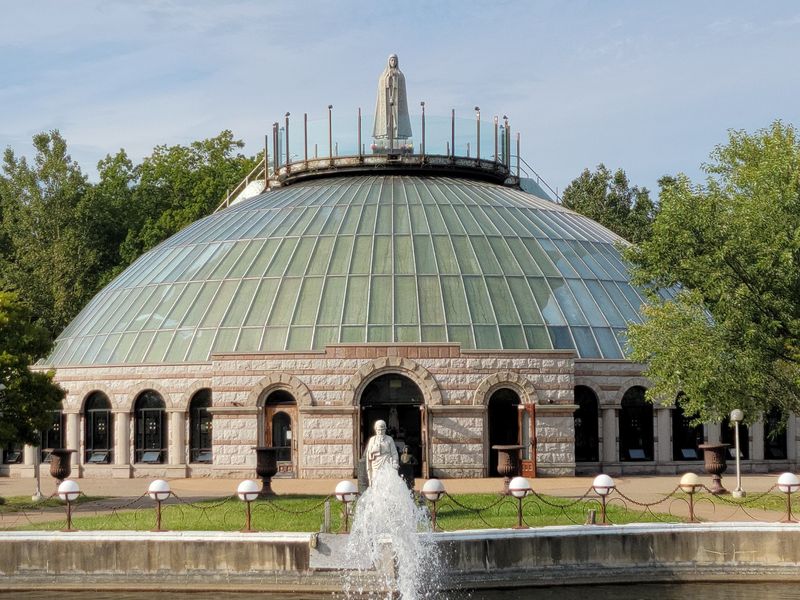
A ten-ton statue standing on top of a glass dome is quite the welcome sign.
The 13-foot figure of Our Lady of Fatima was carved from Vermont granite, and stairs lead up to a remarkable view of the surrounding countryside.
This is the Basilica of the National Shrine of Our Lady of Fatima, directed by the Barnabite Fathers.
The sanctuary’s circular design looks wonderfully different from the pointed arches at many older churches. Its glass-and-plexiglass dome represents the Northern Hemisphere, an architectural detail worth noticing from below.
The property at 1023 Swann Road in Youngstown, has plenty to explore beyond the rotunda. More than 130 life-size statues appear along the Avenue and Aisle of Saints.
A large outdoor rosary circles a heart-shaped reflecting pool, while smaller chapels and garden shrines give the grounds a contemplative rhythm.
Inside the basilica, a Carrara marble altar anchors the worship space. Copper relief panels depict the mysteries of the rosary, and bronze Stations of the Cross continue the artistic theme.
The seasonal finale is particularly colorful. The 2026 Festival of Lights begins November 21 and continues through January 3, 2027.
Outside that celebration, Masses and prayer services follow a regular schedule, with a gift shop and limited cafeteria service on the property. Niagara Falls is nearby, making this an easy addition to a longer day.
4. National Shrine Of Our Lady Of Martyrs
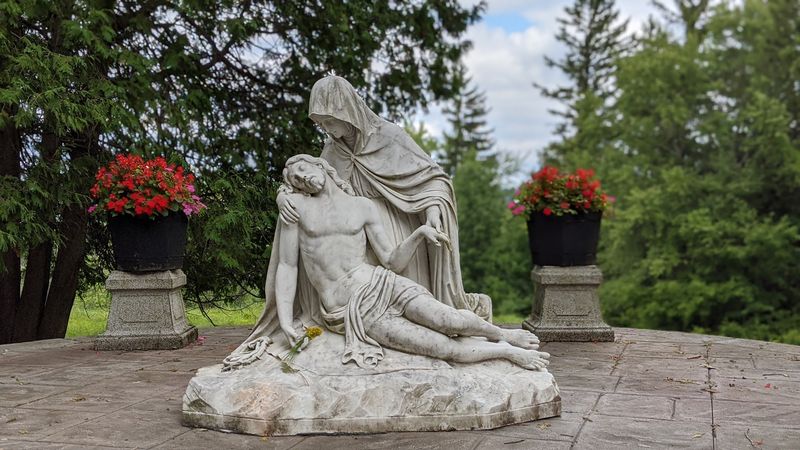
History runs deep on this Mohawk Valley hillside.
Near Auriesville, the National Shrine of Our Lady of Martyrs recalls three seventeenth-century Jesuit missionaries, Saints Isaac Jogues, René Goupil, and John Lalande, whose stories are closely connected with the region.
The grounds are also traditionally associated with Ossernenon, the Mohawk village connected to Saint Kateri Tekakwitha’s birthplace.
Farther along the valley, her later life and baptism are commemorated at the separate shrine in Fonda. Together, these places trace distinct chapters of early Catholic history in the Mohawk Valley.
Spread across the hillside at 136 Shrine Road in Fultonville, the complex offers far more than a single chapel. The enormous outdoor Coliseum hosts major services, while the Martyrs Chapel provides a smaller gathering space.
The Coliseum stands out even before you enter its remarkable interior. Paths lead toward the ravine, and a museum explores the site’s historical connections.
The setting changes the pace of a road trip. Instead of racing between exhibits, you can spend time outdoors, looking across open ground toward the Mohawk Valley. Comfortable walking shoes are a sensible choice for the pathways.
Seasonal planning matters. The shrine’s 2026 public visiting season concluded October 20, with reopening scheduled for May 1, 2027.
Make this a spring or summer itinerary stop rather than assuming year-round access. Pairing it with Fonda makes the regional story especially rewarding.
5. St. Patrick’s Cathedral
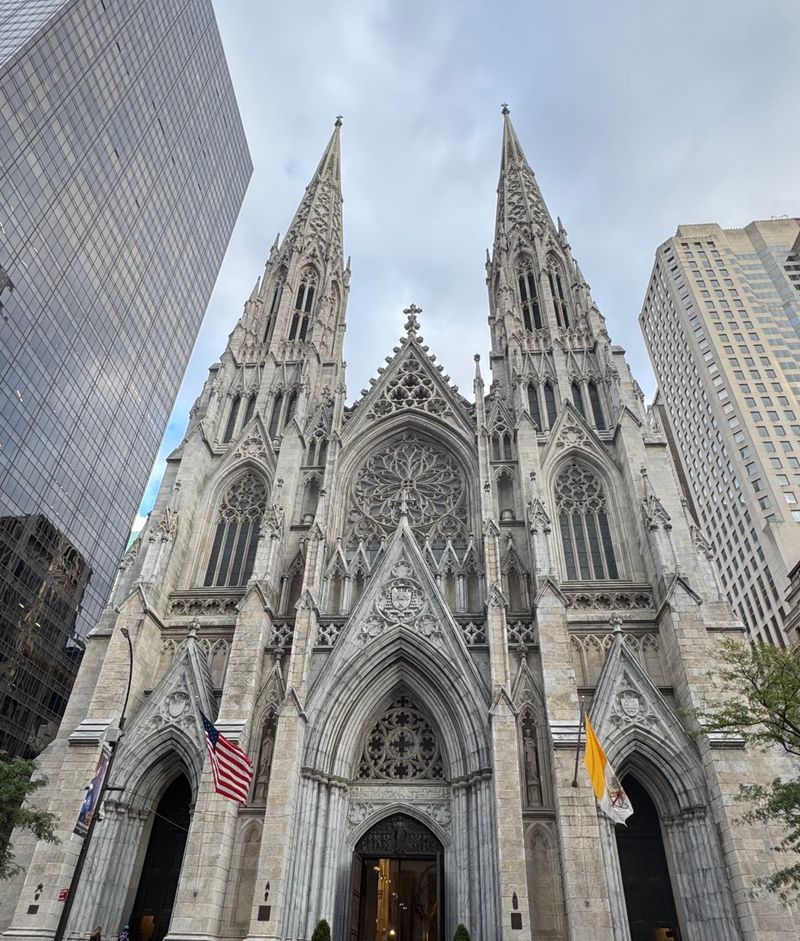
Across the street from Rockefeller Center, twin 330-foot spires win the attention contest. That’s no small feat in Midtown Manhattan, where grand buildings tend to compete for every glance.
St. Patrick’s Cathedral is the seat of the Archbishop of New York and a celebrated example of Gothic Revival architecture.
James Renwick Jr. designed the church, which opened in 1879 after years of construction. Its pale stone exterior occupies the block between Fifth and Madison avenues, from 50th to 51st streets.
The entrance faces Fifth Avenue, and the address is simply 5th Avenue, New York. The facade’s carved details are easy to overlook from a passing taxi.
Once inside, the city bustle gives way to a soaring nave, elegant columns, side altars, and stained-glass windows. The cathedral can seat about 2,400 worshippers, yet individual chapels still provide intimate spaces for reflection.
Look for the richly carved altar details and the great rose window above the entrance.
Organ music is another part of the cathedral’s heritage: its historic instruments contain thousands of pipes and are undergoing a major renovation scheduled to continue into 2027.
The doors usually open daily from 6:45 a.m. until 8:45 p.m., with Masses throughout the week.
Combining this stop with the original St. Patrick’s Cathedral on Mulberry Street gives a fascinating glimpse at how the city’s Catholic community grew.
6. Cathedral Of The Immaculate Conception
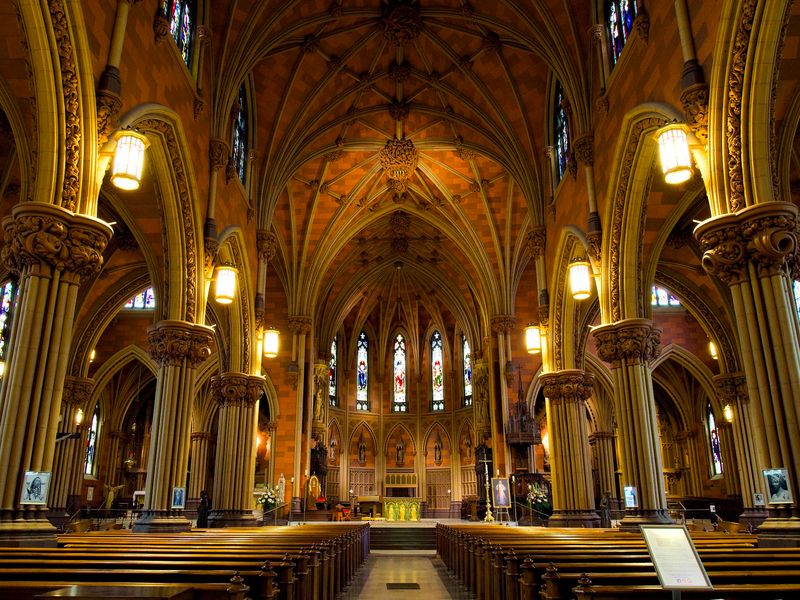
In the 1960s, this cathedral nearly lost its spot to Empire State Plaza. Instead, it survived, and Albany is better for it.
The contrast between its Gothic towers and the modern government complex tells that story before you even step inside.
Construction began in 1848, and the cathedral was dedicated in 1852.
Architect Patrick Charles Keely designed the impressive sandstone church for Albany’s growing Catholic community. Its north spire rose in 1862; the south followed in 1888, giving the skyline the pair seen today.
The building stands at 125 Eagle Street, Albany, beside Madison Avenue.
Its nineteenth-century stained glass came from England, while carved woodwork, elaborate plaster vaults, and carefully shaped stone details reflect craftsmanship from several European traditions.
One remarkable feature has its own international pedigree. The Stations of the Cross earned first prize at the 1889 Paris Exposition before being presented to the cathedral in 1898.
That’s an unexpected connection between a quiet religious interior and a famous world’s fair.
Restoration work in the 2000s renewed its exterior and returned rich colors to the interior by 2010. The cathedral remains the principal church of the Diocese of Albany and hosts important diocesan celebrations.
For a visit in 2026, scheduled worship and periods of Eucharistic adoration provide opportunities to see the interior. Tours can also be arranged in advance, making this a rewarding Capital Region stop.
7. Basilica Of St. Mary Of The Angels
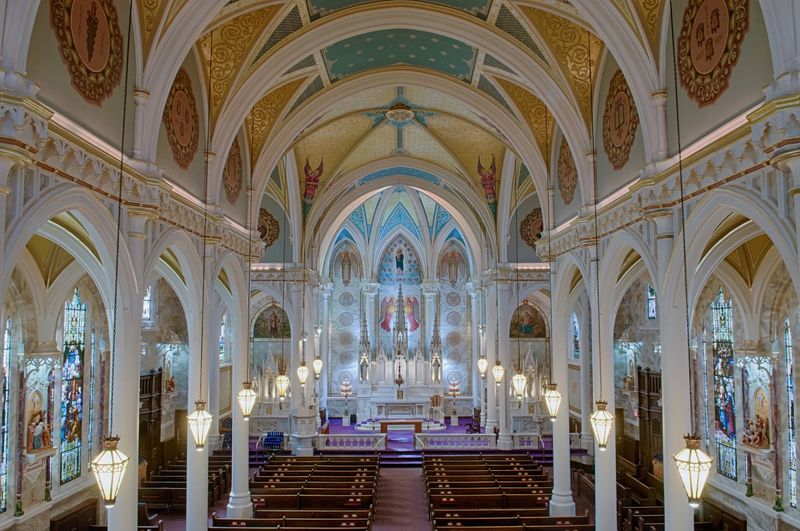
Olean might not top many travel lists, but this basilica makes a strong case for it.
Ornate decorations and stained-glass windows turn an otherwise ordinary street corner into something worth slowing down for.
The current Gothic Revival church was built in 1915 and consecrated in 1919.
Its most distinctive windows use the Munich style, yet they were made in the United States by craftspeople drawing on European traditions. Rich figures and carefully layered colors give the glass a storytelling quality.
There is another surprise overhead. During the building’s centennial restoration, the ceilings gained blue and gold decoration inspired by older designs discovered within the church.
Looking up reveals painted patterns that pull the nave together without overwhelming the original architecture.
The basilica stands at 202 South Union Street in Olean, a practical stop for a Southern Tier drive. Inside, original oak doors, detailed altars, and a long history of parish worship make the building feel lived in rather than frozen in time.
Free guided tours usually take place on three Fridays each month, excluding the first Friday. They last roughly 45 minutes to an hour, and private arrangements are possible with advance notice. Self-guided materials are another option.
Regular visiting hours are 6:30 a.m. to 6 p.m. on weekdays and until 3 p.m. on weekends, subject to services and special events.
8. Saint Kateri National Shrine And Historic Site
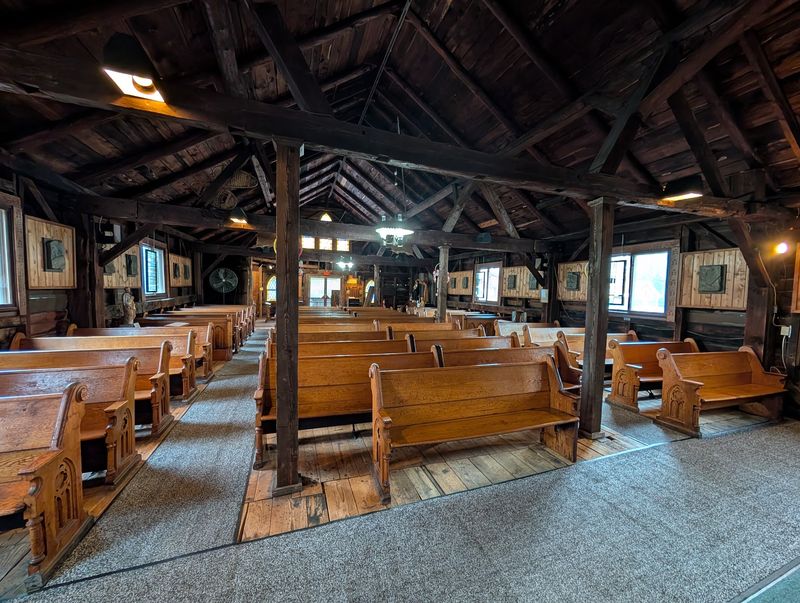
A 1782 barn now holds a chapel and a museum. That’s quite a career change for a farm building, and only the beginning of what makes this Fonda property unusual.
The shrine honors Saint Kateri Tekakwitha, the first Native North American saint canonized by the Catholic Church in 2012.
She lived in the nearby Mohawk village of Caughnawaga and was baptized there in 1676. Her birthplace is associated with Ossernenon near Auriesville, so the two shrines commemorate different parts of her life.
Inside the converted barn, Saint Peter’s Chapel occupies the upper floor, while the museum displays Native American art and artifacts from local archaeological work.
A short hike leads to the Caughnawaga village site, preserved as an important archaeological landscape.
The grounds around 3636 NY-5, Fonda, cover approximately 130 acres. Trails wind through woods and meadows toward Kateri Spring, associated with the water used for her baptism.
An outdoor sanctuary and Candle Chapel offer additional places to pause.
The visiting schedule changes significantly with the seasons. From May through October, the chapel and museum are open daily, and weekend Masses are offered.
From November through April, those buildings are closed, but outdoor areas and trails remain accessible from dawn to dusk when weather permits.
That makes autumn and early spring visits especially suited to walking the grounds, with the historic indoor exhibits saved for warmer months.
9. National Shrine Of Our Lady Of Mount Carmel
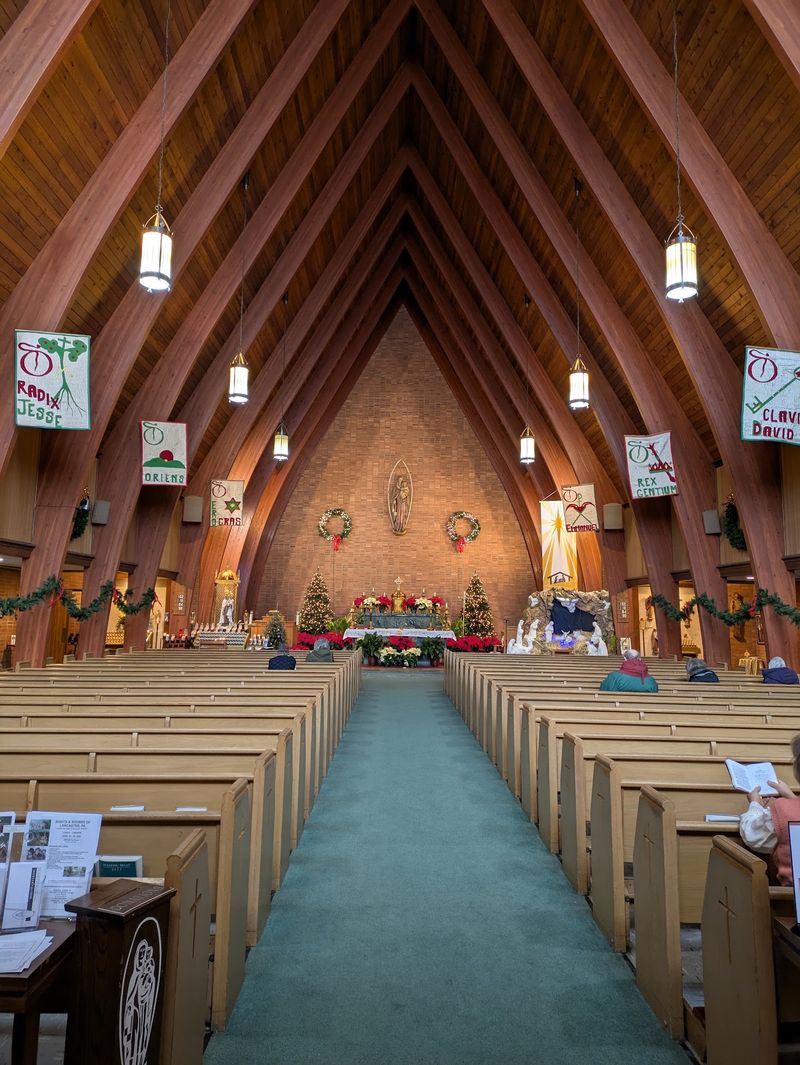
How many ways can one peaceful property invite you to slow down? Middletown’s answer includes a cloister walk, garden shrines, and woodland paths that make a short stop feel pleasantly unhurried.
The National Shrine of Our Lady of Mount Carmel is cared for by Carmelite friars and centers on devotion to Mary.
Its grounds extend across roughly sixty acres, giving the site a country-retreat atmosphere despite its accessible Hudson Valley setting.
The main chapel at 70 Carmelite Drive, Middletown, makes a natural starting point.
Indoor shrines honor several saints, including Saint Thérèse, while outdoor features include a meditation garden, the Our Lady of Knock Shrine, and a quiet picnic grove.
The Cloister Walk deserves extra time. Its Carmelite Stations of the Cross bring a distinctive devotional theme to the pathways, complemented by statues, planted spaces, and areas for reflection.
The landscape encourages a measured pace rather than a checklist of quick stops.
Daily Mass and regular prayer services remain central to the shrine’s activities. A gift store carries religious items and reading material, although its hours differ from those of the chapel and grounds.
Plan Monday visits carefully because access becomes limited after the morning Mass. Tuesday through Friday generally offers longer visiting hours, while weekends follow shorter schedules.
10. Saint Joseph Cathedral
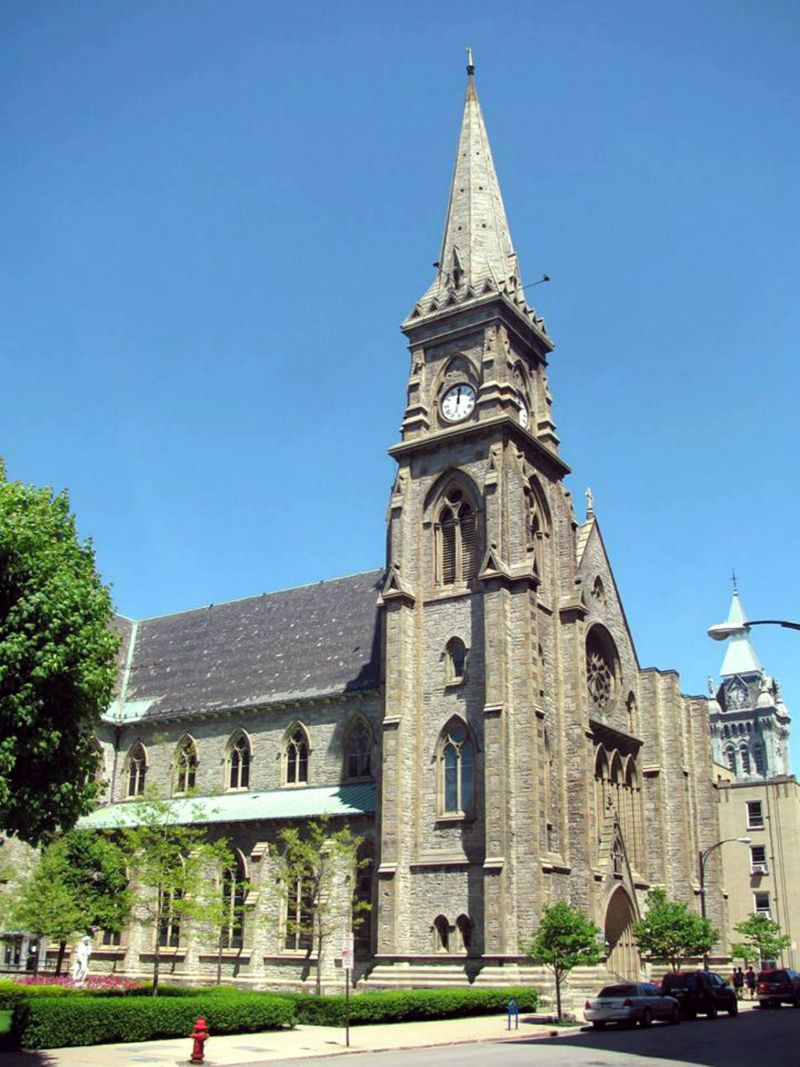
Western New York already gave you angels and a granite giant. Downtown Buffalo adds the mother church of its Catholic diocese.
St. Joseph Cathedral was established under Buffalo’s first bishop, John Timon, in 1847.
Construction followed in the early 1850s, and the building was dedicated in 1855. A newer cathedral later took over its role, but the original church once again became the diocesan seat in the 1970s.
That history gives the Gothic Revival structure on Franklin Street an unusual distinction. It is not simply an old church still standing; it is a landmark that resumed the very responsibility it was built to fulfill.
Inside, one feature deserves special attention: the Hook and Hastings pipe organ installed in 1877.
The instrument is a remarkable surviving example of nineteenth-century American organ building, with a musical legacy spanning generations of cathedral services.
Find the cathedral at 50 Franklin Street, Buffalo, within easy reach of other architectural landmarks. St. Joseph remains a working cathedral, hosting regular Masses, diocesan ceremonies, and concerts.
Visitor access follows worship rather than the office schedule. The church opens around services for prayer, and guided tours can be arranged in advance.
The office generally operates Monday through Thursday, but those hours should not be mistaken for sightseeing hours. For a Buffalo-area road trip, it makes a fitting final chapter after Lackawanna and Youngstown.