One Connecticut Lighthouse Has A Ghost Story Sailors Still Whisper About
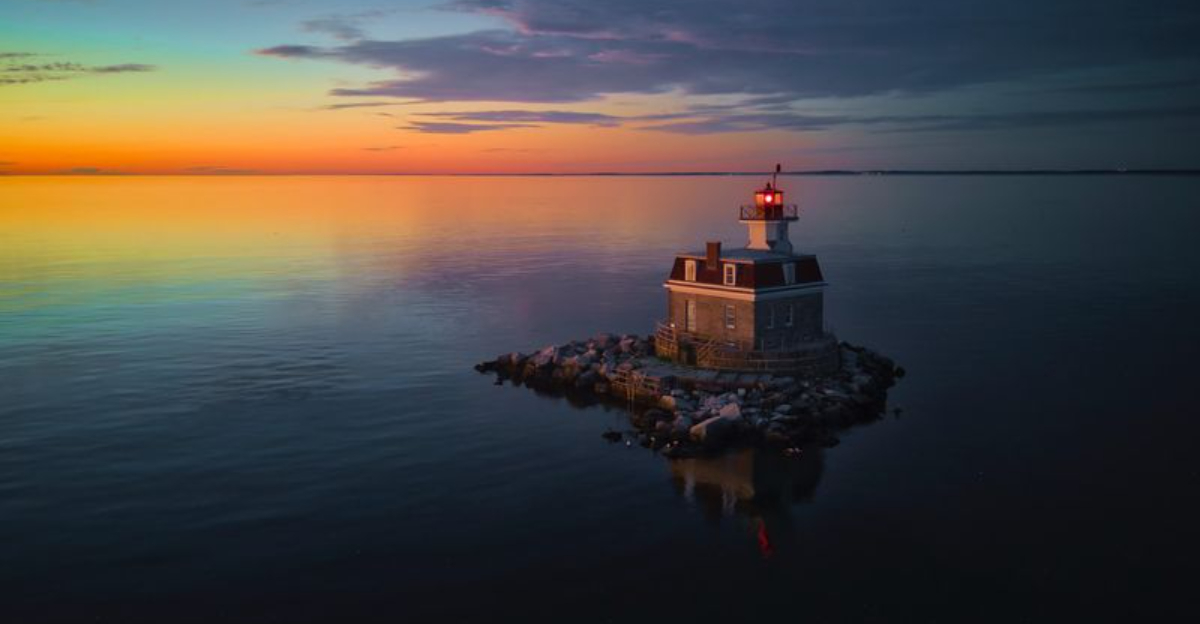
Far from shore, a solitary lighthouse has spent generations watching over dangerous water. Its setting already feels dramatic, especially when fog settles in and the waves begin to rise.
Then you hear the stories connected to it, and suddenly the view takes on a completely different mood.
This lighthouse in Connecticut carries a ghost story that still follows it across the water after more than a century.
The details have been passed down through sailors, keepers, and curious locals who never quite agreed on what really happened. Some accounts sound eerie.
Others feel almost too specific to ignore. That uncertainty is exactly what keeps the legend alive.
The tower itself remains just distant enough to feel mysterious, standing where the shoreline gives way to open water. Even in daylight, it has a lonely presence that makes the old stories easy to imagine.
Once night falls, the mystery feels much harder to dismiss.
1. Standing Guard Above The Reef Since 1874
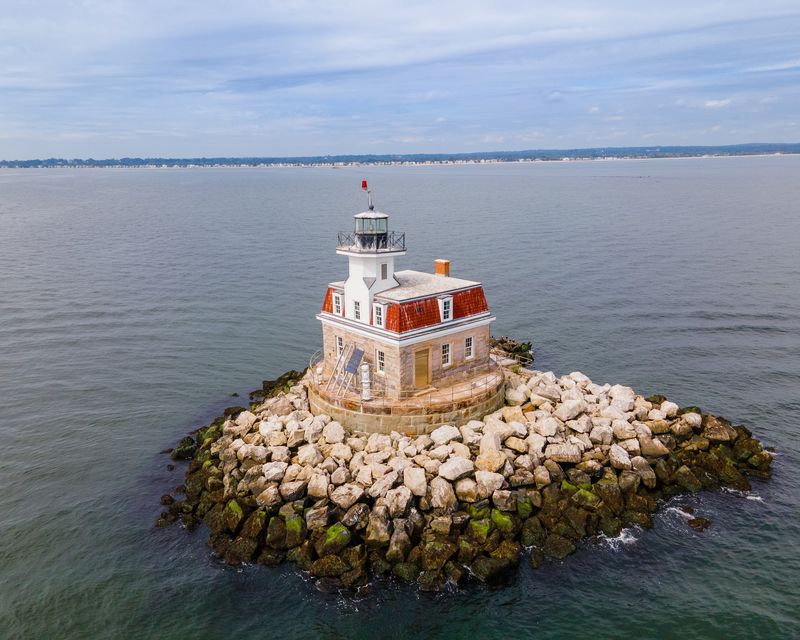
Built in 1874, Penfield Reef Lighthouse holds a remarkable distinction as one of the last offshore masonry lights constructed in the United States.
Resting on a cylindrical granite caisson filled with a concrete core, the structure was engineered to endure the relentless punishment of Long Island Sound’s open waters.
The craftsmanship behind its foundation reflects the serious engineering ambitions of the era.
The lighthouse features a two-story keeper’s quarters topped with a distinctive mansard roof, a hallmark of the Second Empire architectural style that was fashionable during the 1870s.
A wood-frame tower rises seamlessly from the roof framing, blending function and form in a way that feels both practical and visually striking.
Positioned to mark the south side of the Black Rock Harbor entrance off Fairfield, it has guided vessels safely through treacherous waters for 150 years.
The light was automated in 1971, ending 97 years of continuous manned service. Despite no longer needing a keeper to operate it, the beacon still functions as an active aid to navigation today.
The lighthouse was added to the National Register of Historic Places in 1990, securing its legacy as a significant piece of American maritime history worth preserving for future generations.
2. Why This Dangerous Coast Needed A Lighthouse

Long before the lighthouse existed, the waters around Penfield Reef had already earned a grim reputation among sailors. Hidden underwater ledges lurked just below the surface, invisible to approaching vessels until it was far too late to change course.
The reef did not announce itself with dramatic cliffs or visible rocks, which made it all the more dangerous.
Shipwrecks were not rare occurrences here. During the winter of 1866 to 1867 alone, four separate vessels ran aground on the shoal.
In 1864, the steamer Rip Van Winkle narrowly avoided a catastrophic disaster in these same waters, an incident that sent shockwaves through the local maritime community.
Local merchants and mariners grew increasingly vocal about the need for a permanent solution. The economic and human toll of repeated groundings was undeniable, and pressure mounted on lawmakers to act.
Congress responded by allocating construction funds in 1870 and 1871, setting the project in motion.
The resulting lighthouse became a critical piece of safety infrastructure for vessels traveling through one of the busiest and most hazardous stretches of the Long Island Sound corridor, where tides, currents, and submerged geology created a uniquely unforgiving environment for maritime navigation.
3. The Keeper Behind The Famous Legend
Not many lighthouse stories carry the weight of what happened to Keeper Frederick A. Jordan.
On December 22, 1916, he climbed into a small dory and started rowing toward the mainland, handmade Christmas gifts stowed aboard, hoping to make it home to his family for the holiday. The Sound had other ideas.
Strong winds whipped the water into something no small boat could handle, and about 150 yards northwest of the lighthouse, Jordan’s dory flipped over.
Assistant Keeper Rudolph Iten watched the whole thing unfold from the lighthouse, powerless to launch a rescue boat since the conditions made it impossible to do so safely.
Jordan struggled against the freezing water before finally going under. It wasn’t until the following March that he was found along Long Island’s shore.
Coming just days before Christmas, the loss hit even harder given the timing. Iten was cleared of any wrongdoing and went on to be promoted to head keeper, taking over the very rooms Jordan once called his own.
That single detail would end up shaping everything that came next.
4. How The Ghost Story Endured
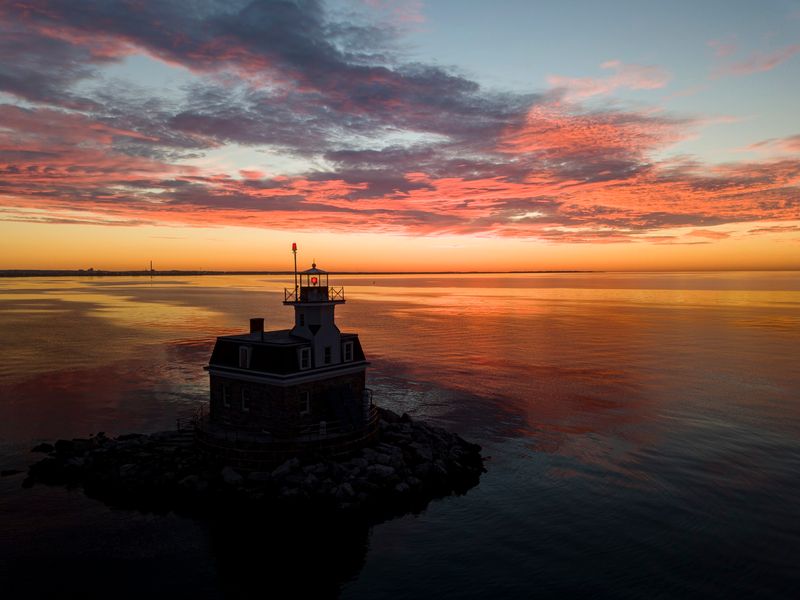
The ghost story did not take long to take root after Keeper Jordan’s passing. Rudolph Iten, the man who had watched Jordan drown and then stepped into his role, began reporting deeply unsettling experiences inside the lighthouse.
He described feeling an unearthly chill and claimed to have seen a gray, phosphorescent figure emerging from Jordan’s former room on more than one occasion.
Perhaps the most chilling detail Iten shared was discovering the keeper’s logbook lying open to the exact page recording Jordan’s drowning, despite no one having touched it. Iten and other assistant keepers reportedly prepared to sign affidavits confirming their encounters with the apparition.
Later keepers noted that the light itself sometimes behaved strangely, particularly in the hours before a storm rolled in.
A story from 1942 added another chapter to the legend. Two boys whose boat capsized near the lighthouse were reportedly guided to shore by an elderly man who then vanished without a trace.
When shown a photograph, the boys allegedly identified the man as Jordan. Mariners navigating the Connecticut coast have continued to report sightings of a lone figure in the lantern room or hovering above the reef during stormy weather, keeping the legend very much alive.
5. Fierce Storms That Tested The Tower
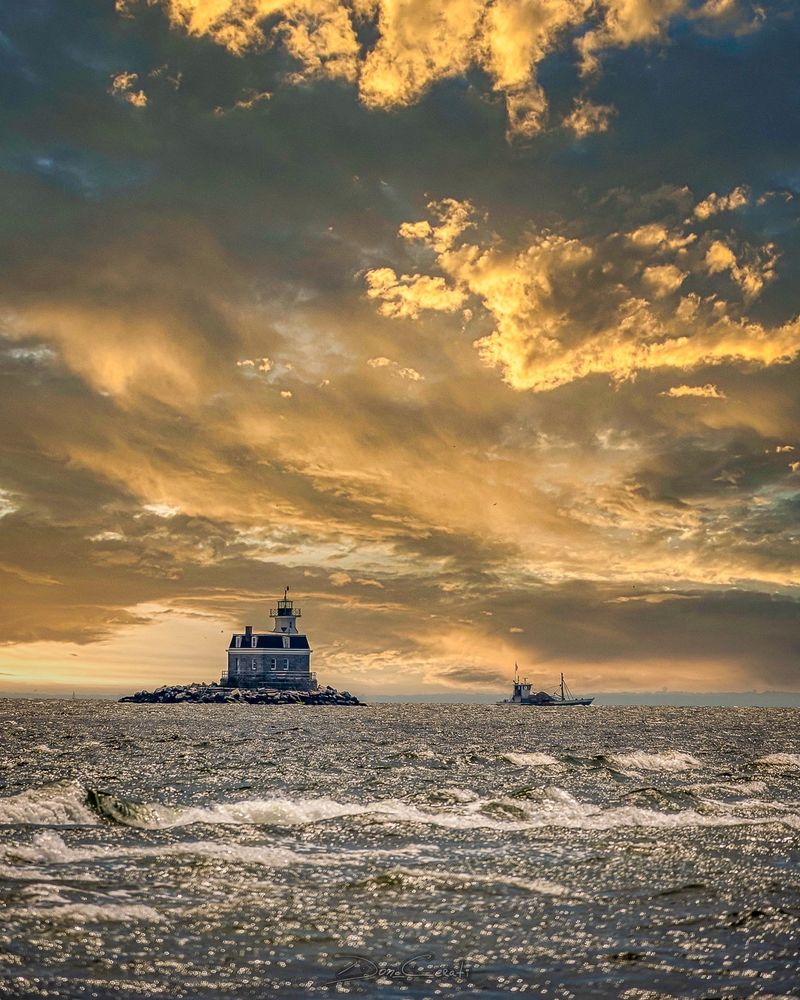
Standing alone in open water, Penfield Reef Lighthouse has had no shelter from the storms that roll through Long Island Sound. Its exposed position means that every major weather event hits the structure directly, with waves sometimes crashing over the lantern room itself.
The tower’s survival across 150 years is a testament to the quality of its original construction.
Hurricane Sandy struck in 2012 with particular ferocity, sending waves of at least 12 feet crashing into the lighthouse. Windows, doors, siding, and roofing were all displaced by the force of the storm, leaving the structure in urgent need of repair.
Emergency restoration work followed in 2015 to address the damage and stabilize the building.
Earlier challenges also tested the lighthouse’s resilience. An inspection in 2000 revealed a rotted main support beam that had caused the lantern to visibly tilt.
Between 2001 and 2003, crews repaired leaks in the lantern, repointed mortar joints, and installed a new stainless-steel roof on the lantern room.
The hurricane of September 1938, described as the worst in Long Island Sound’s recorded history, was another defining moment, with an assistant keeper weathering that terrifying storm alone inside the lighthouse while waves hammered the granite walls relentlessly from every direction.
6. Hidden Features Few People Notice
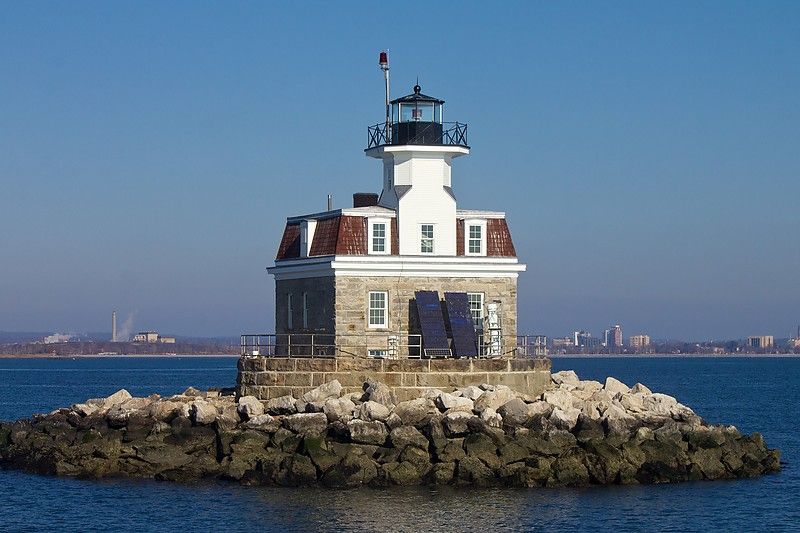
Most people who spot Penfield Reef Lighthouse from the shore see a compact, sturdy structure rising from the water. Getting a closer look by boat reveals architectural details that are easy to overlook from a distance.
The exterior is built from granite ashlar with brick backup, reinforced by heavy timber framing and iron flat plates anchored into the granite at spaced intervals for extra wall strength.
The foundation system beneath the water is equally impressive. A cylindrical granite block caisson measuring 108 feet in diameter is filled with riprap and concrete, and it houses two cisterns within its structure.
This kind of engineering was considered cutting-edge for offshore construction in the 1870s and remains a point of interest for those who study lighthouse history.
Inside, the keeper’s dwelling originally contained a kitchen, a sitting room, an oil room, and four bedrooms on the second floor. The light used a fourth-order Fresnel lens that revolved using a clockwork mechanism requiring manual winding by the keepers.
The beam was positioned 51 feet above mean high water and emitted a flashing red light. A fog bell was part of the original equipment, later replaced by a fog horn capable of projecting sound signals for one nautical mile across the open water.
7. The Isolated Life Of Lighthouse Keepers
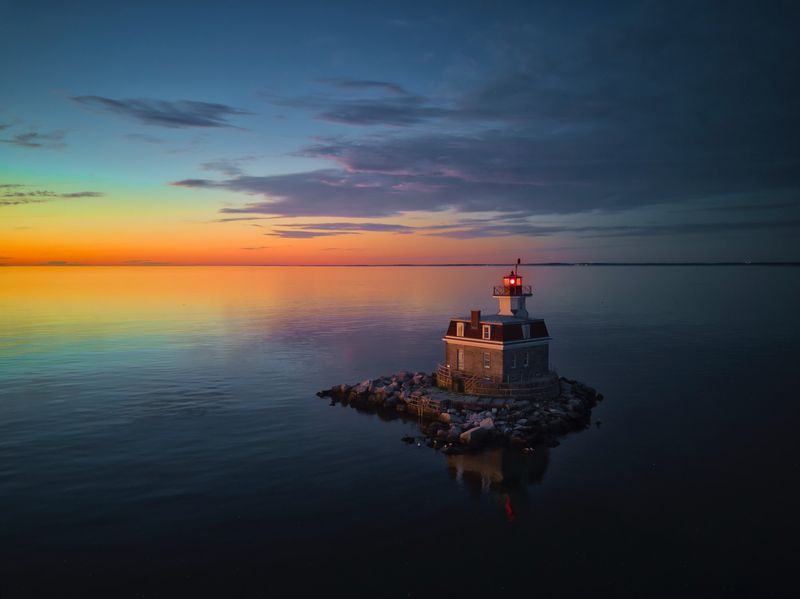
Life at Penfield Reef Lighthouse was shaped almost entirely by isolation and routine. Keepers and their assistants lived in the attached dwelling with few comforts and very little connection to the world onshore.
Supplies arrived by boat on an irregular schedule, and rough weather could strand the keepers at the lighthouse for weeks without relief or resupply.
Daily duties were demanding and non-negotiable. Maintaining the beacon, cleaning the lenses, recording weather conditions, and keeping the structure in good repair occupied most of each day.
During the Coast Guard era, three men were typically assigned to the station, with two on duty at any given time, following a rotation of two weeks on and one week off.
Turnover among staff was high, with many keepers staying for only a year or two before requesting a transfer. Loneliness was a persistent challenge that the logbooks and historical accounts make clear.
Keepers reportedly placed signs in windows requesting newspapers, describing them as worth their weight in gold. Occasional visitors who stopped by by boat sometimes brought food or news from the mainland, which was received with enormous gratitude.
Beyond their primary duties, keepers also performed rescues, helping distressed canoeists, swimmers, and even repairing a motorboat that had foundered directly on the reef.
8. Coastal Views That Never Get Old
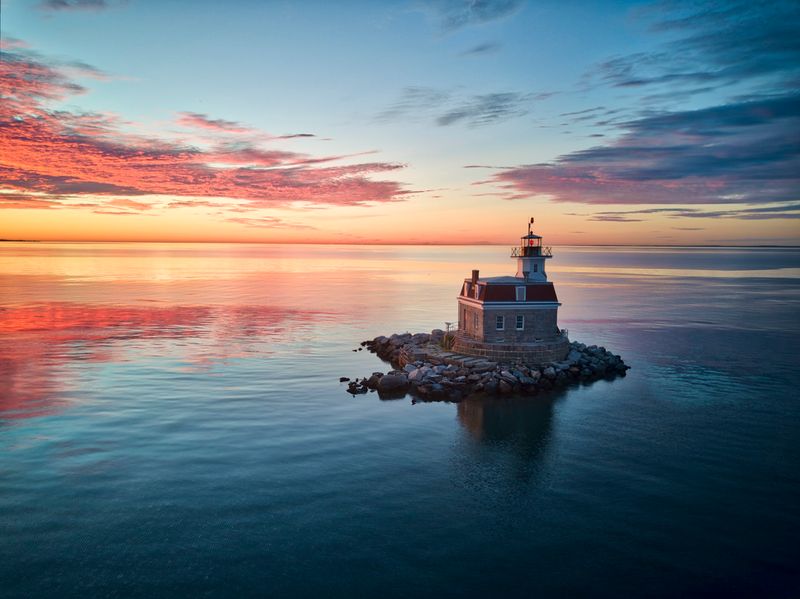
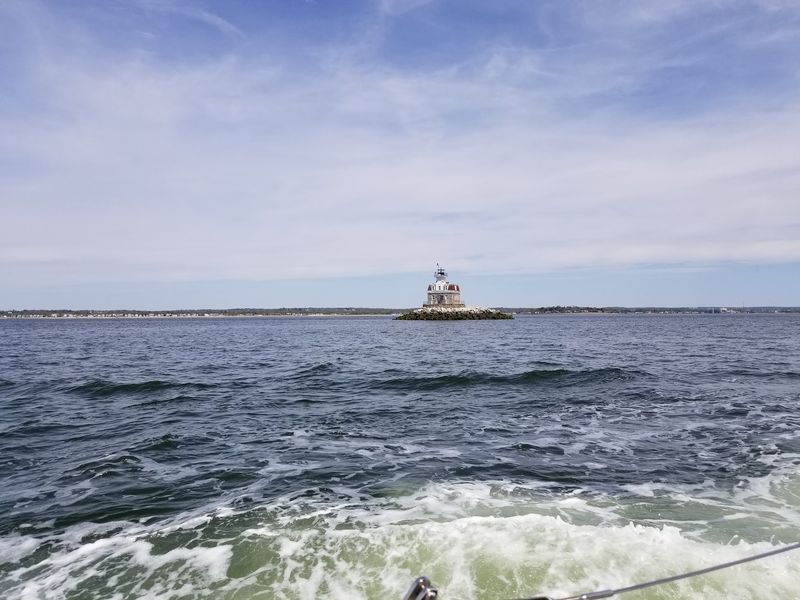
Fairfield Beach sits about 1.1 to 1.4 miles from Penfield Reef Lighthouse, close enough that you can spot it on a clear day, though it looks tiny from that far out.
Getting out on the water is really the only way to appreciate its actual scale and setting, and some intermediate paddlers even make the trip out by kayak, though the tidal currents mean timing has to be planned carefully.
Once you’re out there, the view opens into a sweeping stretch of Long Island Sound in every direction. Local anglers know the reef well as a reliable fishing spot, since the tidal patterns pull in a good variety of fish.
Ospreys have also been spotted nesting at the lighthouse during the summer, giving the whole scene an extra bit of wildlife charm.
The coastline near Fairfield Beach makes for a solid launch point for a day on the water, with plenty to do right along the shore. Worth knowing before you go: the lighthouse is privately owned, so there’s no public access or tours.
You can approach it by boat, but locals warn not to underestimate the tidal race around the reef, since it can shift fast and catch unprepared visitors off guard.
9. A Legend That Still Fascinates Visitors
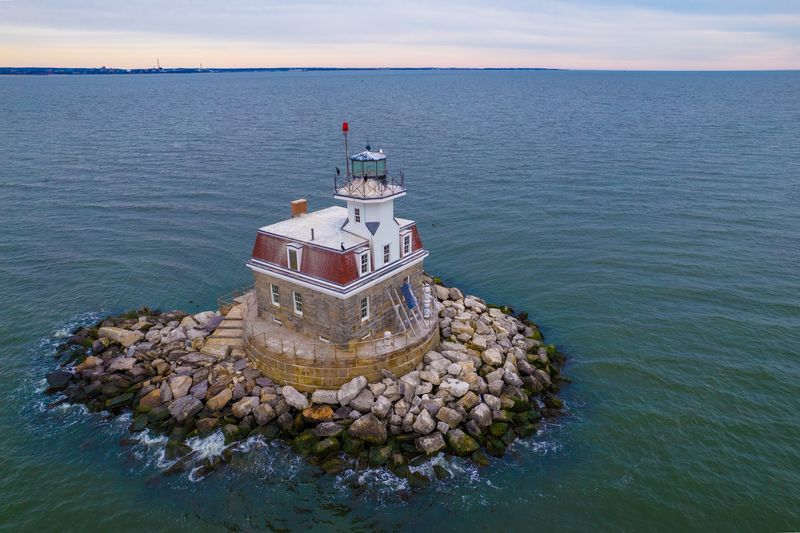
The ghost of Keeper Jordan has become one of the most recognized pieces of maritime folklore along the state coast.
Stories of his apparition reportedly aiding sailors caught in dangerous conditions have circulated for decades, giving the legend a protective quality that makes it feel different from typical ghost stories.
The idea that a keeper who lost his life trying to reach his family now watches over others in peril carries a kind of quiet emotional weight.
Penfield Reef Lighthouse has earned a reputation as a paranormal hotspot among those who follow such things.
Environmental psychologists have noted that older, isolated structures like this one tend to be more readily perceived as haunted, which adds an interesting layer of perspective to the ongoing fascination.
The lighthouse is often compared to New London Ledge Light, another Connecticut Sound landmark with its own famous ghost story.
Beyond the supernatural angle, the lighthouse holds a firm place in state’s maritime history as a functioning navigational aid and a striking piece of 19th-century engineering.
The story of Frederick Jordan and the lighthouse he once tended continues to draw curious visitors to the Fairfield shoreline, where on a foggy evening the lantern still blinks steadily across the dark water, just as it has for 150 years.