This California Desert Stop Feels Ancient, Surreal, And Completely Unplanned
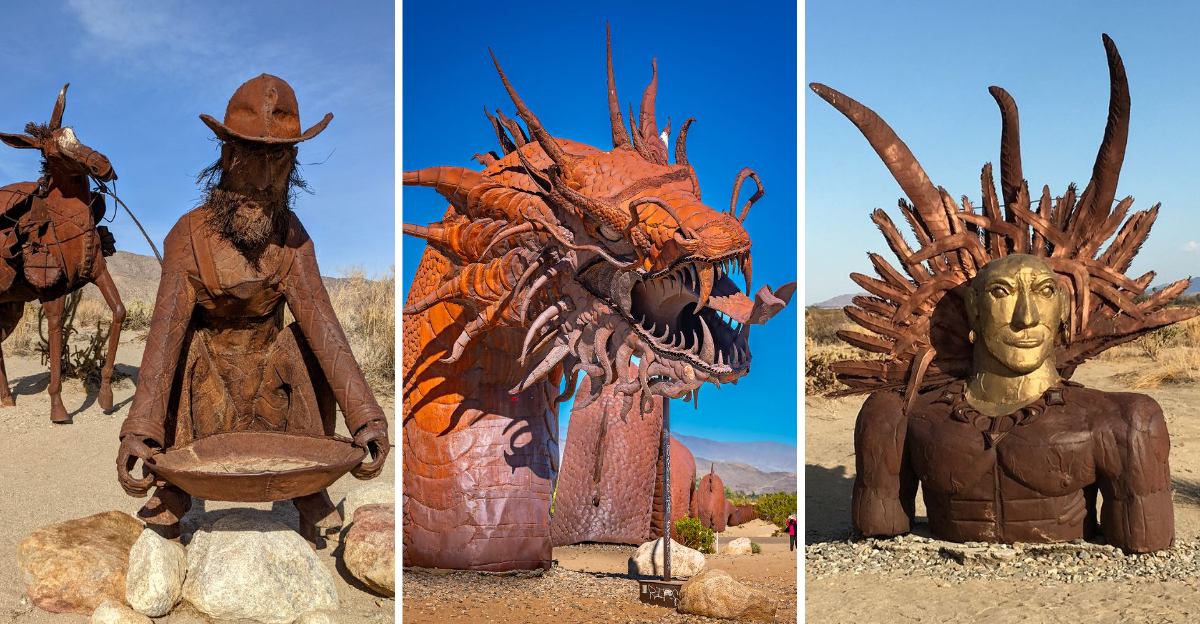
Not a theme park. Not a museum. Not even a fenced attraction. Just towering metal creatures standing exactly where the desert allows them.
Dinosaurs pause mid-stride, mammoths loom against open sky, and mythical figures appear without explanation or instruction. California desert art breaks every expectation here.
Spread across open land near Borrego Springs, more than 130 massive sculptures turn emptiness into spectacle.
There are no tickets to scan and no paths to follow. Visitors drive, stop, wander, and discover at their own pace.
The experience feels accidental in the best way, as if the artwork arrived before anyone decided where it belonged.
Created by Ricardo Breceda, the figures draw power from their setting rather than competing with it.
Inside Anza-Borrego Desert State Park, steel and sand share the same silence. The result feels ancient and surreal at once, and once seen, impossible to forget.
1. A Self-Taught Sculptor’s Unexpected Journey
Ricardo Breceda never planned to become an artist whose work would define a desert landscape.
Originally from Durango, Mexico, he worked in landscaping and construction before his daughter’s simple Christmas wish changed everything.
After watching Jurassic Park III, she asked for a dinosaur, and Breceda decided to build one himself.
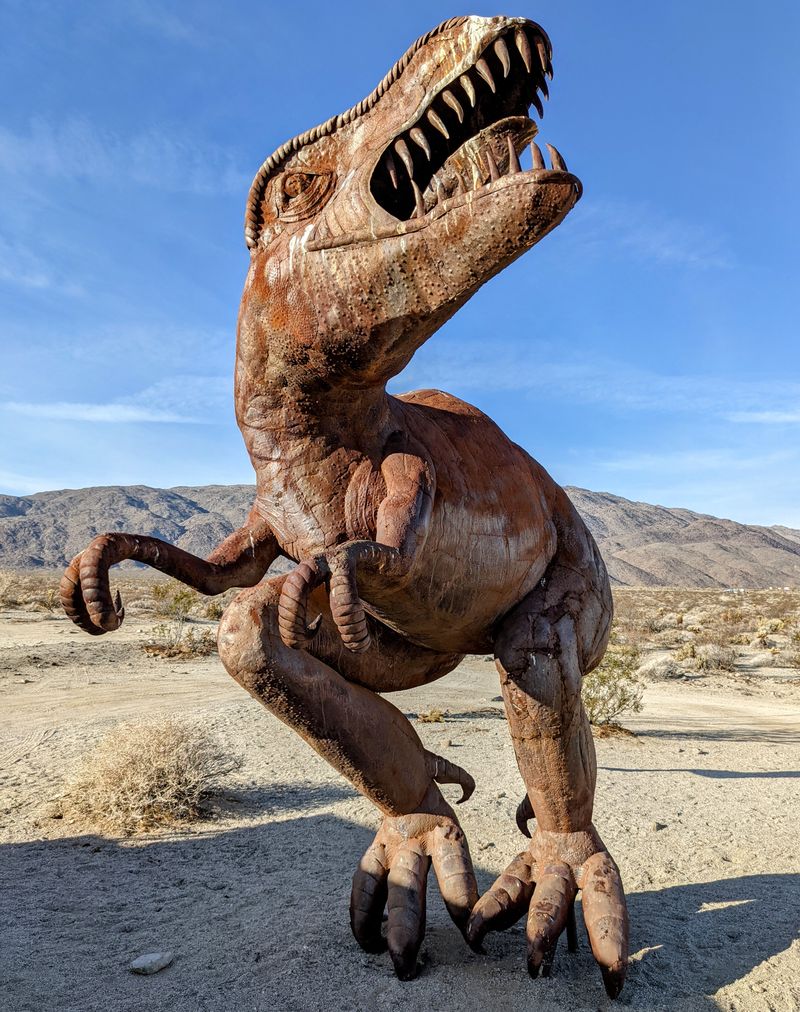
That first creation measured 20 feet tall and 45 feet long, a Tyrannosaurus rex that marked the beginning of an extraordinary artistic career.
Breceda taught himself metalworking techniques through trial and experimentation, developing skills that would eventually bring over 130 sculptures to life.
His approach combines engineering precision with artistic vision, allowing him to create creatures that appear both scientifically accurate and fantastically imaginative.
Dennis Avery noticed Breceda’s work and saw potential for something remarkable.
The heir to the Avery Label fortune commissioned the sculptor to populate his desert property with metal creatures that would capture the imagination of anyone passing through.
Breceda’s background in construction proved valuable, as his sculptures needed to withstand intense desert heat, occasional windstorms, and the relentless sun that beats down on the Anza-Borrego region throughout much of the year.
2. Dennis Avery’s Vision For The Desert
Dennis Avery inherited wealth from his family’s label-making business, but his legacy in Borrego Springs extends far beyond financial success.
He purchased Galleta Meadows Estate with a vision that seemed unusual to many locals at first.
Rather than developing the land for profit or keeping it as private property, Avery wanted to create something the entire community could enjoy without barriers or admission fees.
His decision to commission life-sized prehistoric creatures reflected both personal interest and community spirit.
Avery understood that Borrego Springs, a small desert town, could benefit from an attraction that would draw visitors while remaining accessible to everyone.
The sculptures would serve as both art installation and educational experience, bringing ancient history to life in a place where fossils and geological formations already told stories of Earth’s distant past.
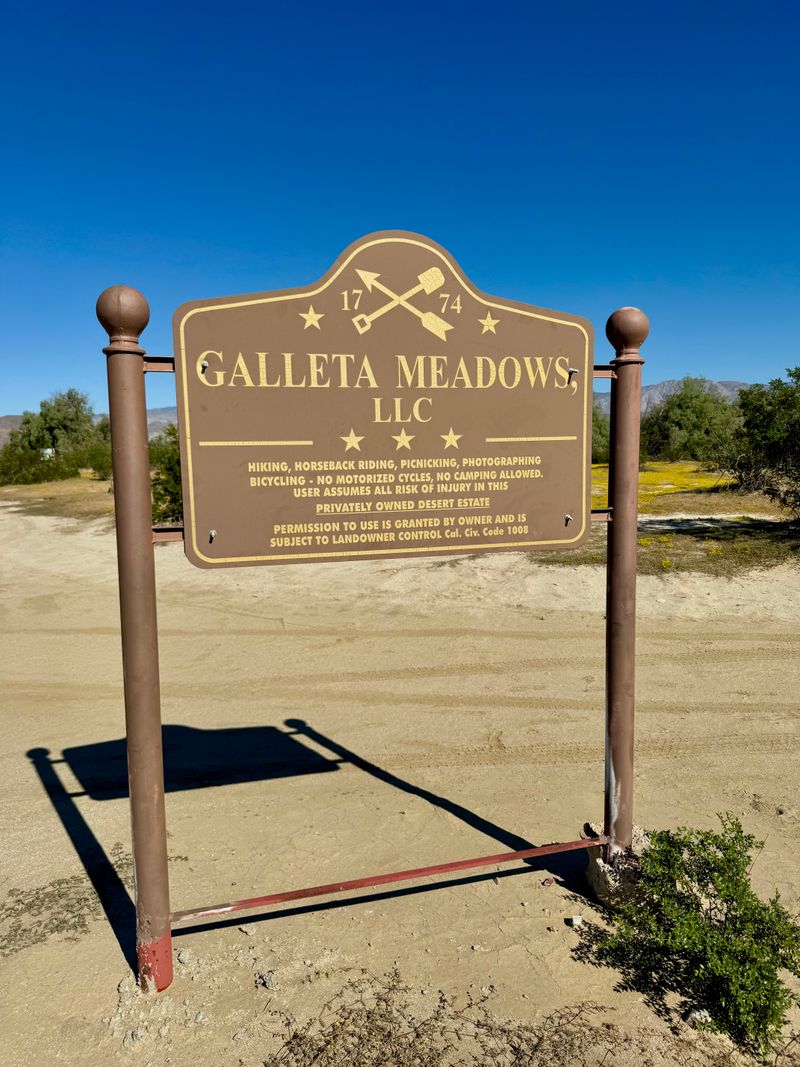
Avery kept the property unfenced and open year-round, a choice that distinguishes Galleta Meadows from most art collections. Visitors need not make reservations or pay entrance fees.
The estate operates on trust, with Avery’s vision continuing even after his passing, maintained by those who share his belief that art belongs in open spaces where anyone can encounter it unexpectedly.
3. More Than Dinosaurs Populate This Desert
While dinosaurs capture immediate attention, the sculpture collection spans multiple themes and time periods.
Breceda created representations of Ice Age mammals, including woolly mammoths and saber-toothed cats that once roamed Southern California.
These creatures remind visitors that the desert has witnessed countless transformations, hosting vastly different ecosystems throughout geological time.
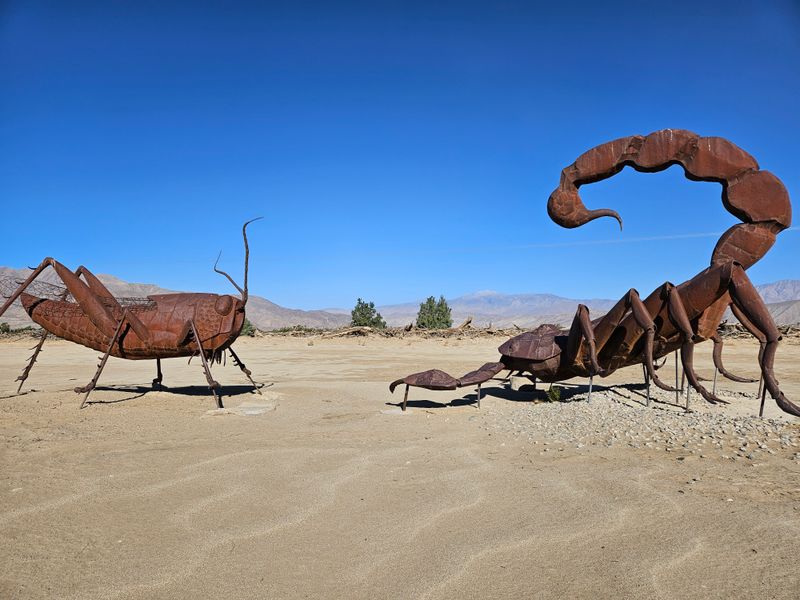
Desert wildlife also features prominently among the installations. Metal scorpions, some measuring several feet in length, crouch near the roadside.
Bighorn sheep, the official state mammal of California’s desert regions, stand alert on fabricated rocky outcrops.
These contemporary desert inhabitants share space with their prehistoric counterparts, creating visual conversations across millions of years. Mythical and fantastical creatures add another dimension to the collection.
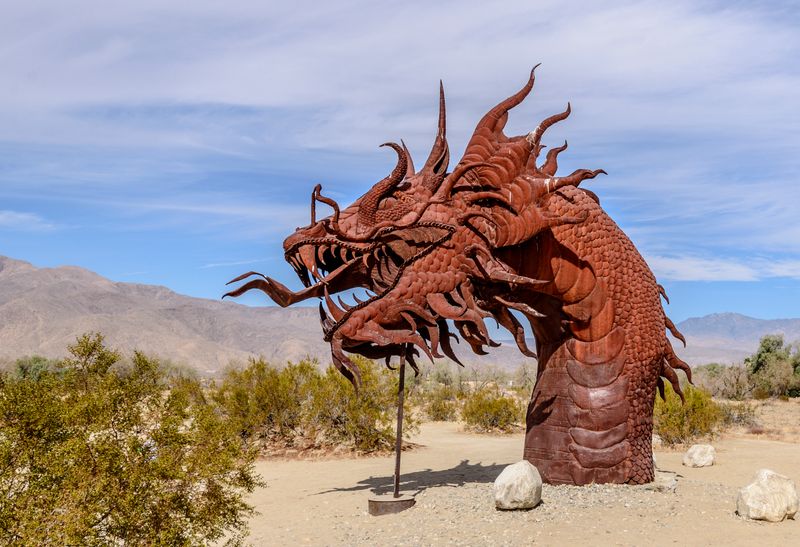
A 350-foot serpent appears to slither through the sand, its segmented body rising and falling across the landscape. Grasshoppers the size of horses perch near the road.
These imaginative pieces transform the desert into a place where reality and fantasy merge, where visitors might encounter anything around the next bend in the road.
4. Accessing The Sculptures By Car
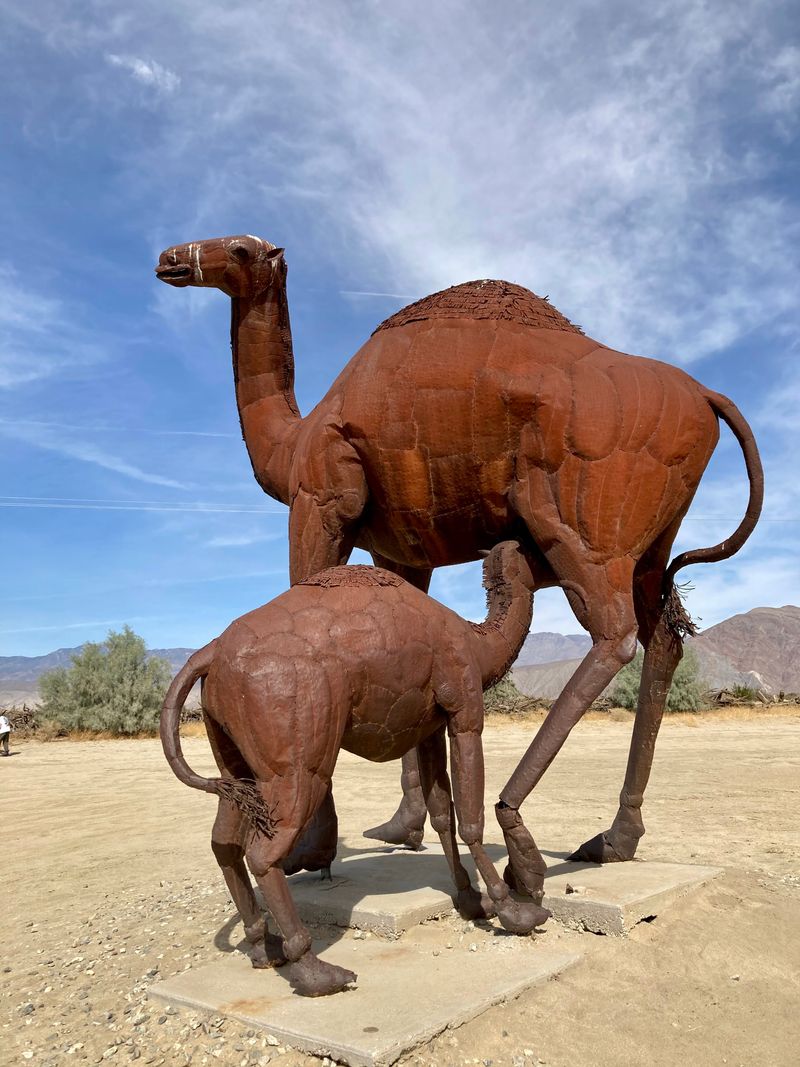
Galleta Meadows Estate extends along Borrego Springs Road and surrounding areas, allowing visitors to view most sculptures without leaving their vehicles.
This accessibility makes the experience suitable for people with varying mobility levels and for families traveling with young children.
Some sculptures stand directly beside paved roads, while others require short drives on maintained dirt tracks that most vehicles can navigate safely during dry conditions.
The sculptures are spread across several miles, so a complete tour typically takes one to two hours depending on how long visitors spend at each installation.
Many people drive the route multiple times, discovering new details or catching different lighting conditions that transform how the metal surfaces appear.
Early morning and late afternoon offer particularly striking views as shadows lengthen and the metal takes on warm tones from the sun.
Parking near individual sculptures happens informally along road shoulders where space permits. Visitors should watch for other cars and avoid blocking access for local residents or emergency vehicles.
The unfenced nature of the property means sculptures appear suddenly, making slow, attentive driving important for both safety and full appreciation of the artwork.
5. Obtaining Maps For Complete Exploration
The Anza-Borrego Desert Natural History Association maintains detailed maps showing sculpture locations throughout the area.
Their bookstore in Borrego Springs provides printed versions, and digital maps can be accessed online before or during visits.
These guides prove valuable because sculptures occupy both obvious roadside positions and less visible locations that casual drivers might miss.
Maps typically indicate which sculptures appear north versus south of downtown Borrego Springs, helping visitors plan efficient routes based on available time and interests.
Some installations cluster together, while others stand in relative isolation, creating different experiences.
The maps also note which sculptures require dirt road access, allowing visitors to decide whether their vehicles can safely reach those locations.
Local businesses and visitor centers sometimes offer their own guides with additional information about the artist, the property’s history, and suggestions for photography spots.
These supplementary materials enhance understanding of the project’s scope and significance.
Having a map also helps visitors identify specific sculptures by name, as the collection includes dozens of pieces that might otherwise blur together in memory after viewing so many impressive installations in a single visit.
6. Timing Visits For Comfortable Temperatures
Summer temperatures in Borrego Springs regularly exceed 100 degrees Fahrenheit, with readings sometimes climbing above 115 degrees during July and August.
These conditions make outdoor exploration genuinely dangerous for extended periods, as the metal sculptures absorb heat and the desert offers minimal shade.
Heat exhaustion and dehydration pose real risks during summer months, even for visitors who remain mostly in air-conditioned vehicles.
Spring and fall provide more moderate temperatures, typically ranging from the 70s to 90s depending on the specific month.
March through May offers the additional benefit of potential wildflower blooms, when winter rains have been sufficient.
Desert vegetation adds color to the landscape during these months, creating more photogenic backdrops for the sculptures.
October through November brings similarly pleasant conditions as temperatures gradually cool from summer extremes.
Winter months from December through February see cooler temperatures, occasionally dipping into the 40s at night and reaching comfortable 60s and 70s during the day.
These months attract the most visitors to Borrego Springs, meaning more traffic near popular sculptures.
Early morning visits during any season offer advantages, including softer light for photography and smaller crowds at the most photographed installations.
7. The Serpent That Stretches Across The Sand
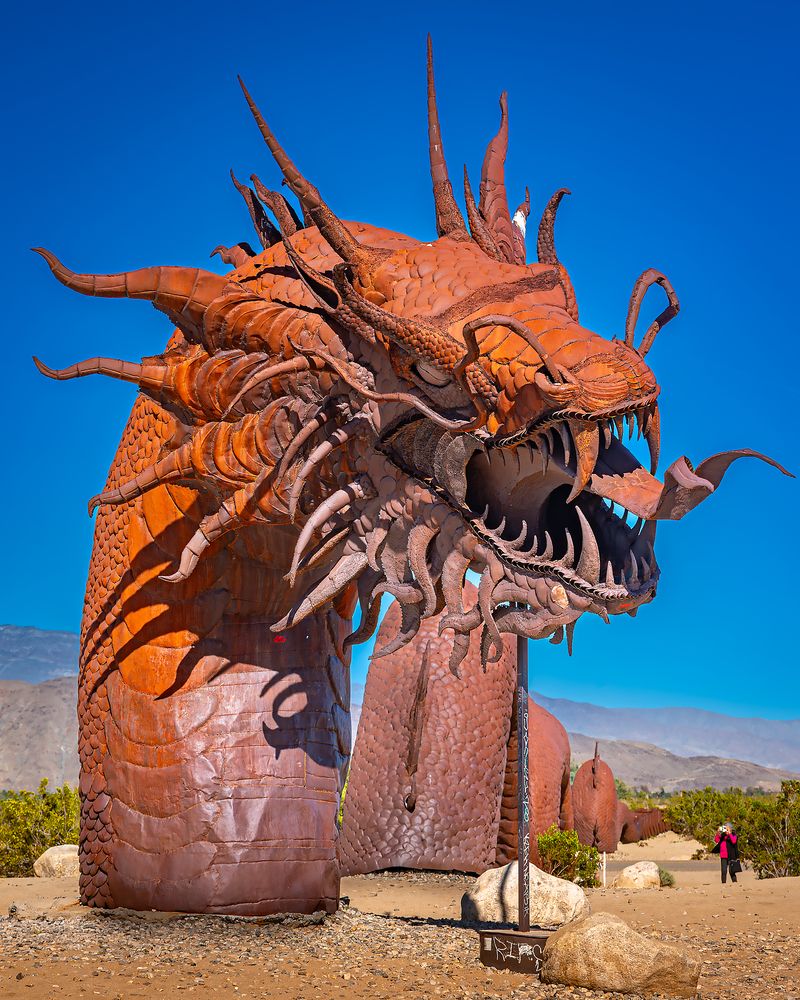
Among all the sculptures at Galleta Meadows, the serpent commands attention through sheer scale.
Measuring 350 feet from head to tail, this creature undulates across the desert floor in sections that rise and fall like a sea monster frozen mid-swim through sand instead of water.
Breceda designed the serpent to follow the natural contours of the land, creating an illusion of movement that shifts depending on viewing angle.
The serpent’s segmented construction allows each section to catch light differently throughout the day.
Morning sun illuminates the eastern-facing curves while casting dramatic shadows, and afternoon light reverses the effect.
Photographers find endless compositions along the serpent’s length, with each vantage point offering unique perspectives on how the sculpture interacts with the surrounding landscape.
Visitors can walk alongside portions of the serpent, though the desert terrain requires sturdy footwear and attention to where one steps.
The sculpture’s scale becomes most apparent when people stand near it for reference, revealing how Breceda’s work transforms the desert into a stage for mythological encounters.
The serpent represents one of the collection’s most photographed pieces, frequently appearing in articles and social media posts about Galleta Meadows.
8. Prehistoric Mammals Of The Ice Age
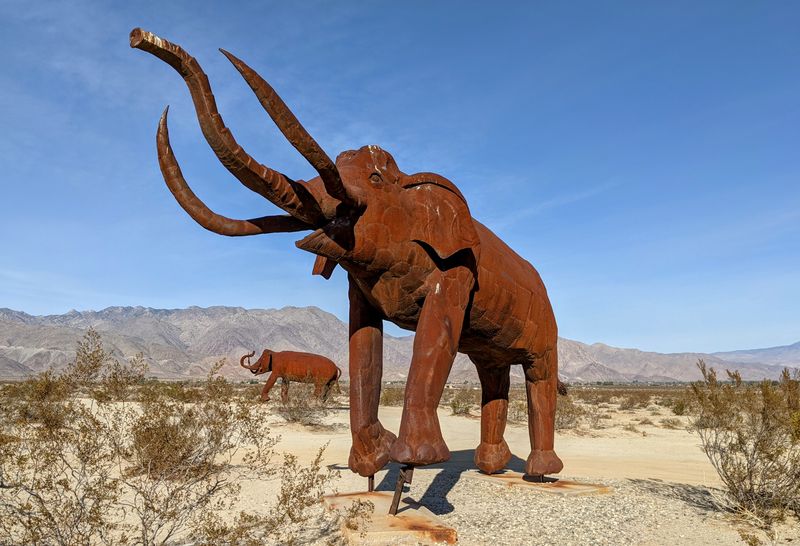
California’s prehistoric past included megafauna that would seem out of place in today’s desert landscape.
Breceda’s sculptures bring these extinct creatures back to life in metal form, including woolly mammoths with their characteristic curved tusks and shaggy profiles.
These massive herbivores once grazed across North America during the Pleistocene epoch, adapting to ice age conditions that seem impossibly different from current desert heat.
Saber-toothed cats, specifically the species Smilodon fatalis, also appear among the installations. These predators possessed distinctive elongated canine teeth used for hunting large prey.
Fossil evidence from the La Brea Tar Pits in Los Angeles confirms these cats lived in Southern California, making their presence at Galleta Meadows scientifically grounded rather than purely imaginative.
Ground sloths, another extinct Ice Age species, join the collection with their distinctive bulk and unusual proportions.
These creatures stood taller than modern humans when upright and possessed powerful claws originally used for pulling down branches.
Their metal representations capture both the strangeness and the reality of California’s ancient ecosystems, reminding visitors that landscapes change dramatically across geological time scales.
9. Dinosaurs That Never Actually Lived Here
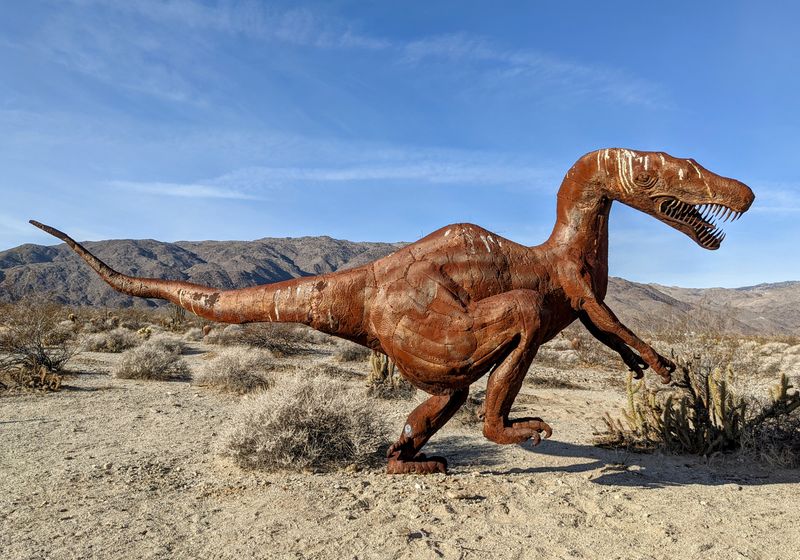
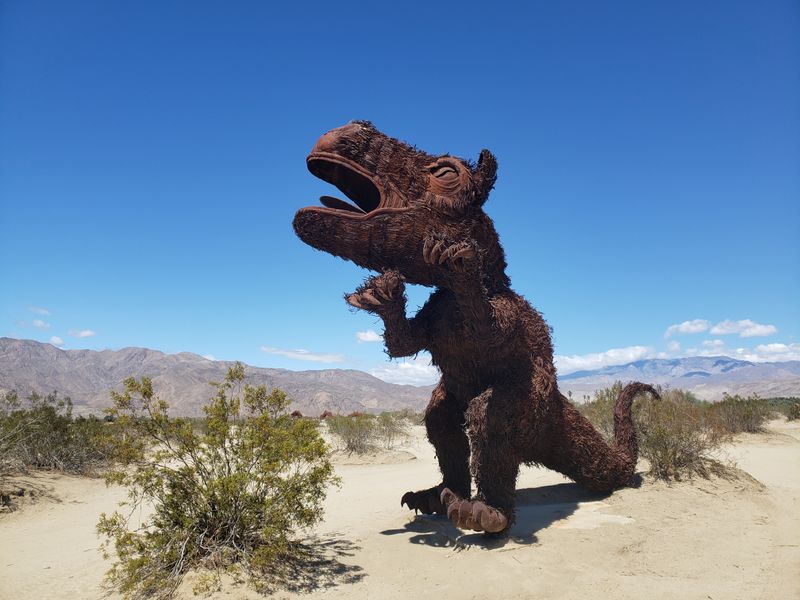
Dinosaurs occupy prominent positions throughout the sculpture collection, despite the fact that none of these specific species lived in what is now California during their respective time periods.
The Tyrannosaurus rex, Breceda’s first major sculpture, stands as a centerpiece of the collection even though T. rex fossils come primarily from Montana, Wyoming, and other regions further north and east.
The artistic choice to include dinosaurs reflects their universal appeal rather than strict paleontological accuracy for the specific location.
Children and adults alike recognize these creatures immediately, making them effective ambassadors for broader conversations about Earth’s history.
The sculptures serve educational purposes by sparking curiosity about prehistoric life, even when the specific species shown didn’t inhabit this exact desert.
Breceda’s dinosaur sculptures demonstrate attention to anatomical details that reflect current scientific understanding. The T. rex shows accurate proportions, with massive hind legs and relatively small forelimbs.
Other dinosaur species in the collection similarly reflect modern paleontological knowledge rather than outdated depictions.
This commitment to accuracy within the artistic interpretation helps visitors develop more realistic mental images of how these animals actually appeared millions of years ago.
10. The Unfenced Philosophy Of Public Access
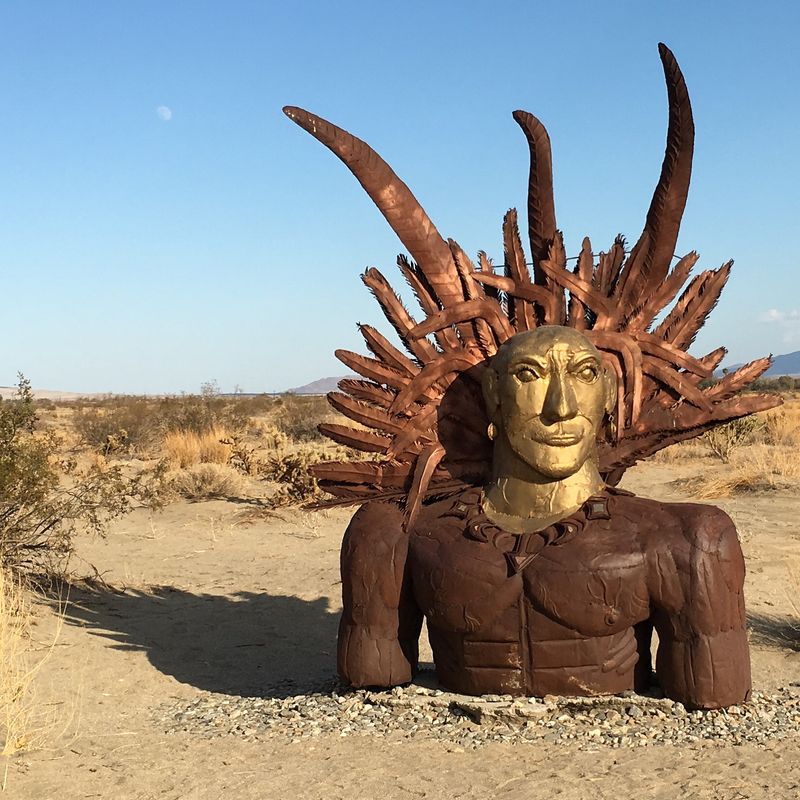
Most significant art collections exist behind walls, gates, or admission desks, but Galleta Meadows operates on a fundamentally different principle.
The property remains unfenced and accessible 24 hours a day, year-round, without requiring tickets, reservations, or any form of payment.
This openness reflects Dennis Avery’s belief that art should be available to everyone regardless of economic circumstances or advance planning ability. The unfenced approach creates unique visitor experiences that formal museums cannot replicate.
People encounter the sculptures while driving through town on other errands, discovering art unexpectedly rather than as a planned destination.
Local residents incorporate the sculptures into their daily lives, passing favorite pieces regularly and noting how different weather and light conditions transform their appearance throughout seasons and years.
This accessibility model depends on visitor respect and community stewardship.
The sculptures have occasionally suffered vandalism or theft of smaller pieces, but the overall collection remains remarkably intact.
The trust-based system works because most visitors appreciate the unusual opportunity to experience significant artwork without institutional barriers, understanding that their respectful behavior helps preserve this rare form of public access for future visitors.
11. Photography Opportunities Throughout The Day
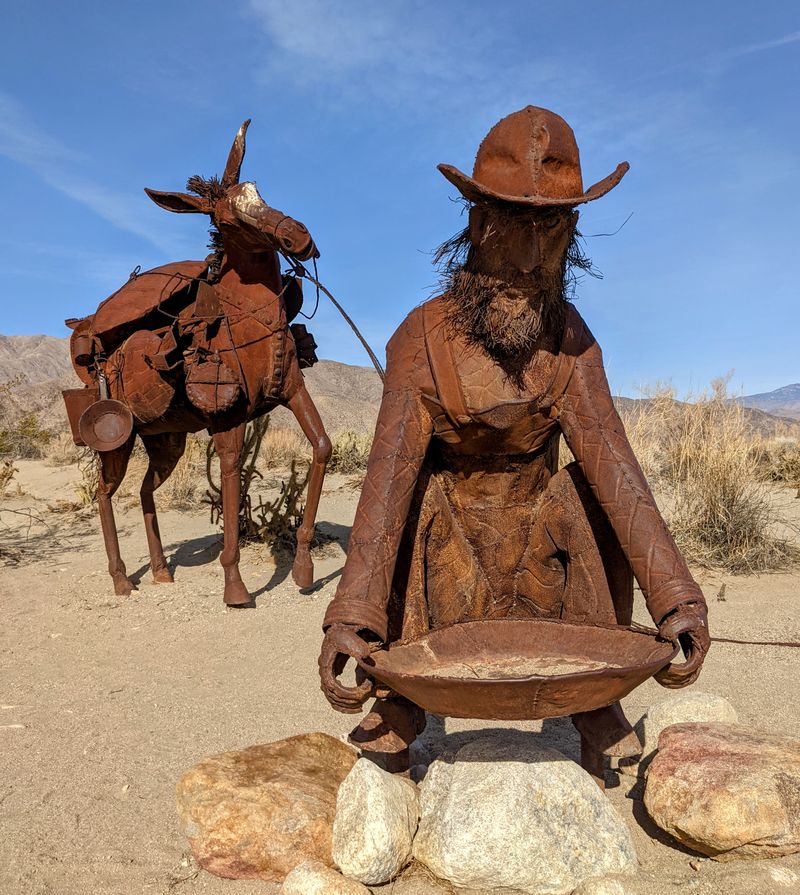
The metal sculptures change dramatically as light shifts throughout the day, offering photographers varied opportunities from dawn through dusk.
Early morning light arrives low on the horizon, creating long shadows and illuminating the eastern sides of sculptures with warm, soft tones.
The metal surfaces catch this light differently than natural desert features, making the sculptures stand out distinctly against sand and rock backgrounds.
Midday sun creates harsh shadows and bright highlights that some photographers avoid, but this lighting also emphasizes the three-dimensional forms and surface textures of Breceda’s work.
The intense overhead light reveals welding seams, metal grain patterns, and the careful construction methods used to build these massive pieces.
Heat shimmer during summer months adds an additional visual element, though it can make sharp focus challenging.
Late afternoon and evening light reverses the morning conditions, now illuminating western-facing surfaces while eastern sides fall into shadow.
Golden hour, the period shortly before sunset, provides particularly dramatic conditions as warm light intensifies and contrasts deepen. The metal takes on bronze and copper tones, and the surrounding desert landscape glows.
Night photography becomes possible during full moon periods, when the sculptures appear as mysterious silhouettes against star-filled skies.
12. Additional Natural Attractions In Anza-Borrego
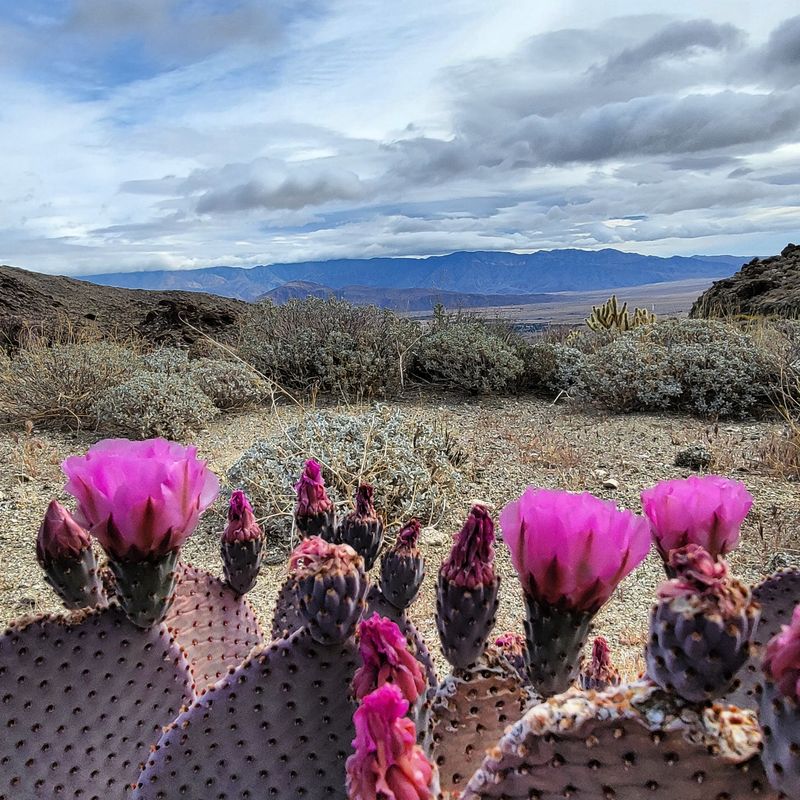
Anza-Borrego Desert State Park extends across more than 600,000 acres, making it California’s largest state park and offering numerous natural attractions beyond the Galleta Meadows sculptures.
The Mud Caves, located in the Arroyo Tapiado area, formed when water flowing through silt deposits carved tunnels and chambers into soft sedimentary rock.
These formations allow visitors to explore underground passages, though caution is necessary as cave-ins can occur.
The park preserves ancient rock art at several locations, including pictographs created by indigenous peoples who inhabited the region long before European contact.
These sites require respectful viewing from designated distances to prevent damage from touching or close approach.
The artwork provides tangible connections to human history spanning thousands of years, complementing the much older geological and paleontological stories told elsewhere in the park.
Wildflower displays during years with adequate winter rainfall transform portions of the desert into colorful landscapes that contrast sharply with the typical brown and tan palette.
Various species bloom at different elevations and times, with peak displays typically occurring between March and April.
These natural phenomena attract visitors specifically for botanical viewing, adding seasonal variety to the region’s appeal beyond the year-round presence of the metal sculptures.