The World’s Largest Kachina Doll Statue Is In Arizona, And It’s Impossible To Miss
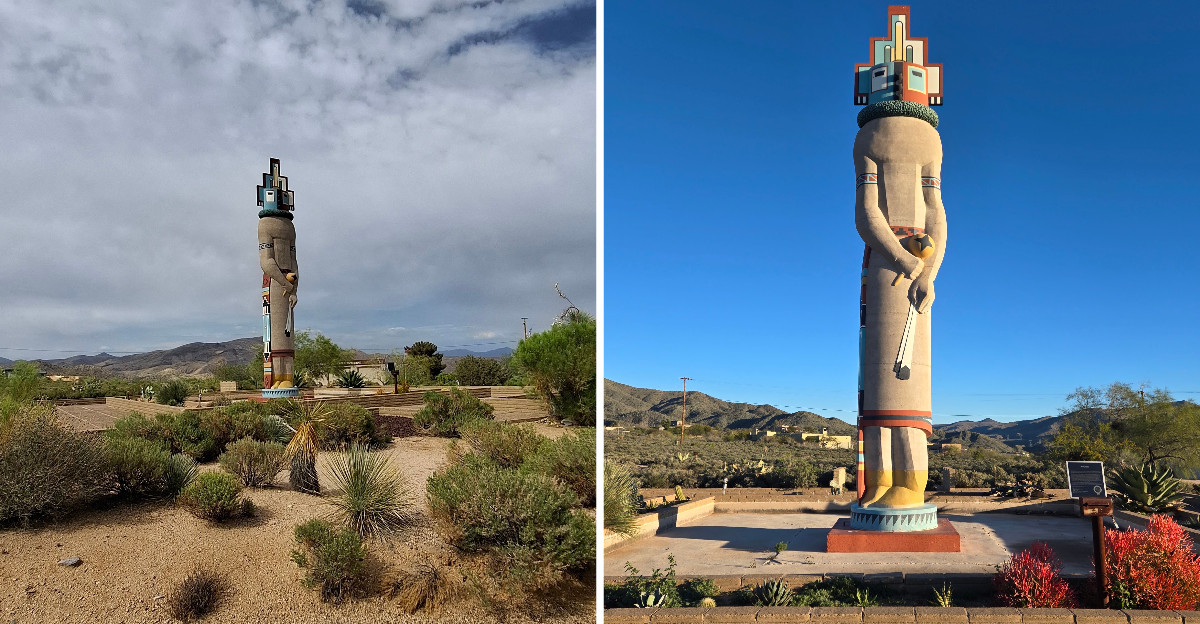
A 39-foot doll guards a desert neighborhood entrance, and it weighs 14.5 tons. That is not a typo, and it is definitely not something you tuck on a shelf.
Now we’re getting specific. The figure honors a Corn Maiden Dancer, a spirit tied to the women who grind corn for ceremonies and daily meals.
This giant isn’t a random roadside stunt. It carries real meaning from Puebloan traditions here in Arizona.
That’s the part I wanted you to notice. Traditional versions are small carvings made from cottonwood root.
This one was built from nine concrete and steel pieces, then stacked up on site like the world’s most serious building project.
Ready to see who’s keeping watch?
A 39-Foot Welcome Committee You Can’t Possibly Overlook
Most neighborhoods greet you with a sign and maybe a speed bump. The Tonto Hills community in Arizona went a little bigger with the landmark commonly called the World’s Largest Kachina Doll Statue.
It stands 39 feet tall at the entrance to the community. That’s roughly the height of a three- or four-story building, so missing it would take real effort.
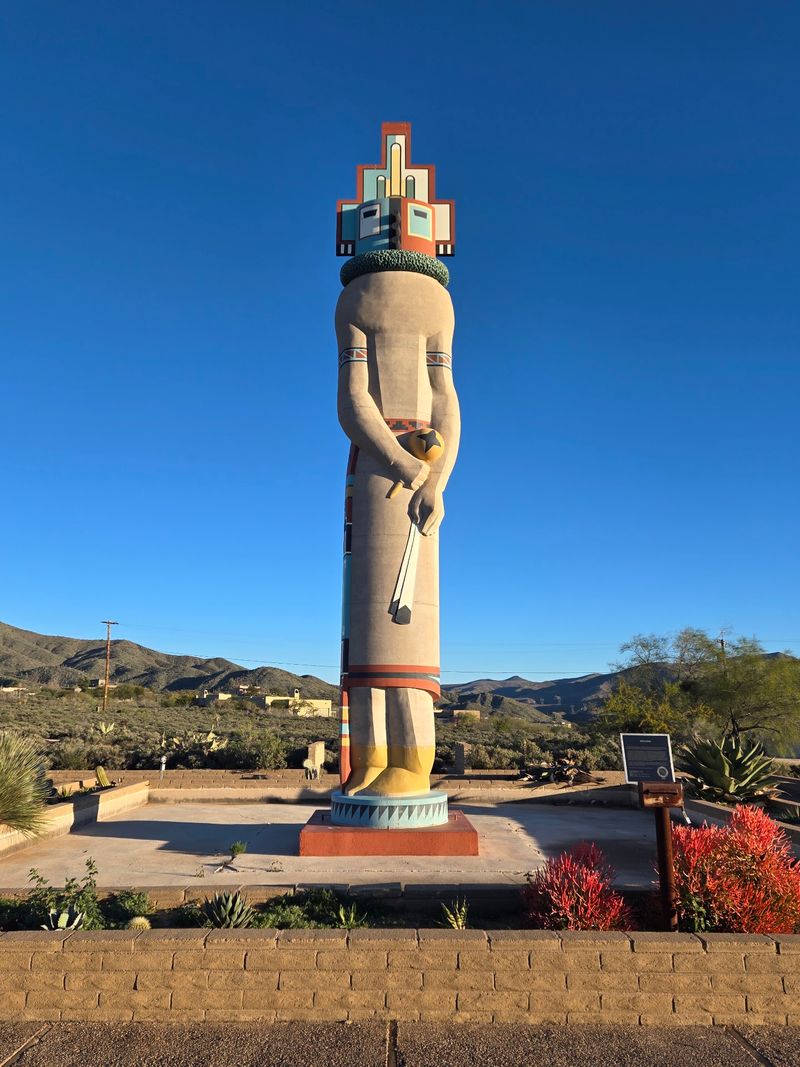
Size is the first thing that grabs you, but it’s not the whole story. Its painted patterns, unusual headdress, and folded arms give the figure a personality that becomes clearer from nearby.
The sculpture stands on a concrete base inside a low-walled desert garden.
The statue has become a landmark for Tonto Hills, a residential community in the foothills near Carefree. It’s a roadside sculpture rather than a visitor complex.
Seen from the side, its slender body looks almost like a column.
Bring a camera with a wide setting if you have one. Getting the entire figure and its surroundings in a single frame can take a little experimenting.
Meet The Corn Maiden Behind All That Concrete
Every giant has an origin story, and this one starts with corn. The statue was inspired by a Corn Maiden Dancer katsina from Hopi tradition.
The figure is associated with the preparation of corn, a crop with deep importance in Pueblo communities. Corn nourishes families, but it also connects agriculture with prayer, seasonal cycles, and ceremonial life.
Artist Phillips Sanderson designed the figure, giving it a tall, narrow body and a richly patterned mask.
Look for the distinctive turquoise, red, white, and black details. The figure holds a gourd rattle in one hand and a feather wand in the other, with an evergreen necklace around its upper body.
These aren’t decorations chosen at random. They are elements associated with the katsina form that inspired the monument, although the roadside sculpture is not itself a traditional Hopi ceremonial carving.
It’s a useful distinction to make while admiring the craftsmanship.
The Tonto Hills artwork was created as a monumental interpretation, whereas the Indigenous carving tradition has its own makers, purposes, and protocols.
Spirits That Bring Rain Deserve A Big Introduction
Rain is a big deal in the desert. In Hopi tradition, katsinam are spiritual beings associated with rain, growing crops, and the well-being of the community.
Hand-carved figures, often called katsina dolls in English, represent these beings.
Their traditional Hopi name is tithu, and they are made from cottonwood root. The soft wood is especially meaningful in a dry region because cottonwood trees grow near water.
These carvings have long been presented to children during ceremonies, helping pass along knowledge about Hopi beliefs and cultural traditions.
They are teaching objects rather than ordinary playthings, which is worth remembering when you see the giant version beside the road.
The Hopi tradition remains alive today, with artists in Arizona continuing to carve and paint figures by hand. Some pieces become gifts, while others are made for collectors.
Seeing the Tonto Hills sculpture can spark curiosity about that wider world.
In Phoenix, the Heard Museum holds a collection of Hopi katsina carvings, including examples dating back to the nineteenth century.
A little background turns the towering figure from a novelty into an invitation to learn more.
Nine Giant Pieces And Six Months Of Serious Patience
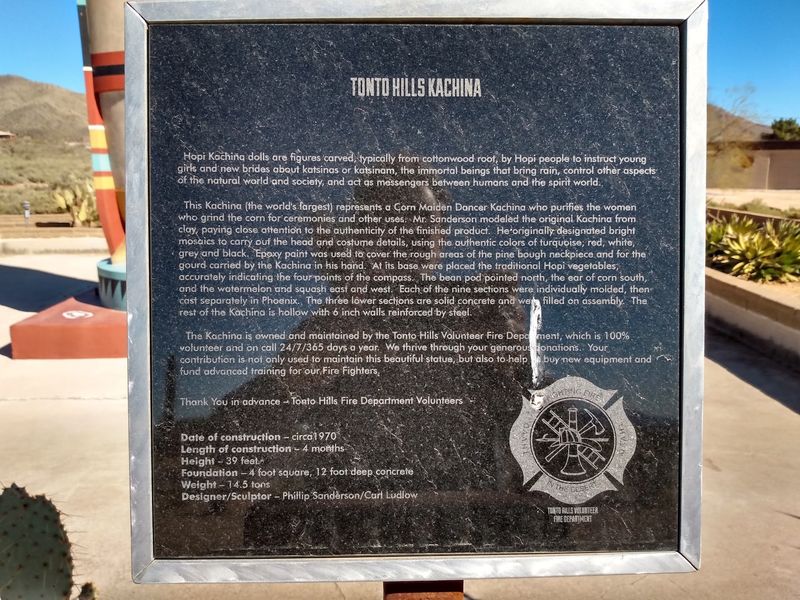
Building a doll usually takes a carving knife. This one needed a crew, a plan, and a lot of heavy lifting.
The monumental figure was engineered by Carl Ludlow from a design by Phillips Sanderson. It dates to the neighborhood’s early development.
Nine large sections of concrete and steel were fabricated in Phoenix, transported to the site, and fitted together.
The process took roughly six months. Think of it as a giant puzzle whose pieces were far too heavy to carry under one arm.
Painted concrete creates the figure’s smooth, pale body, while the steel underneath supports its imposing shape.
The geometric headdress rises above a long, narrow torso; the hands hold symbolic objects that would be delicate details on a much smaller wooden carving.
Behind the colorful design sits some serious engineering. The result has stood near the same neighborhood entrance for decades.
It’s a striking example of the lengths a community can go to when it wants a landmark people will remember.
Plug This Address In And Let The Desert Do The Rest
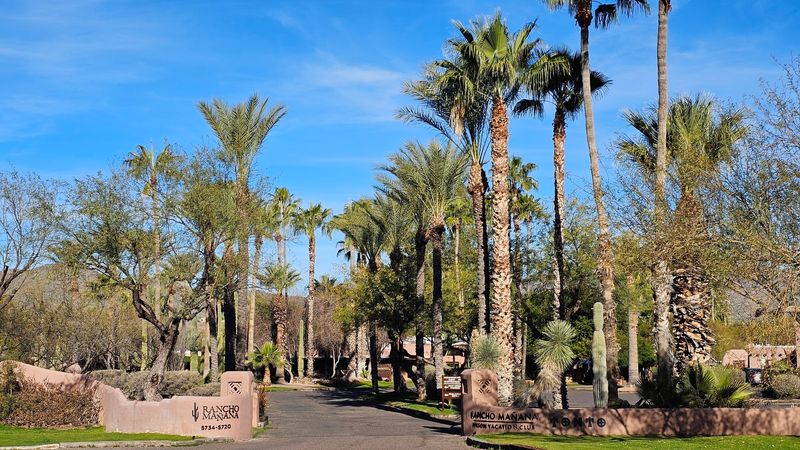
Good news for anyone who gets lost easily. A 39-foot landmark is about as easy to spot as directions get.
The statue stands at 42027 N Old Mine Rd, Cave Creek, AZ 85331, at the entrance to the Tonto Hills residential community.
It’s northeast of Carefree, reached by following Cave Creek Road toward the Bartlett Lake area and turning onto Old Mine Road.
The sculpture can be viewed from the roadside without a ticket or reservation, making this corner of Arizona easy to explore.
This is a neighborhood entrance, though, not a large visitor center with designated sightseeing facilities. Choose a safe place to stop without blocking vehicles, driveways, or emergency access.
A short viewing stop makes sense here. There are no indoor exhibits or staffed visitor facilities.
Respect the surrounding homes and remain outside the monument’s enclosed garden.
Desert weather deserves a little planning. Bring water and sun protection during warmer months; in late fall, an extra layer can be handy when the breeze picks up.
The foothills complete the scene once you’re safely stopped.
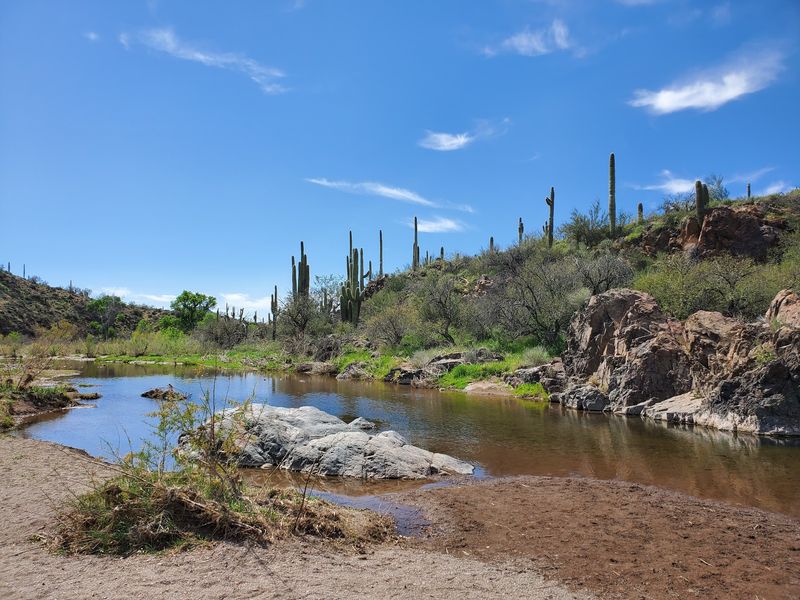
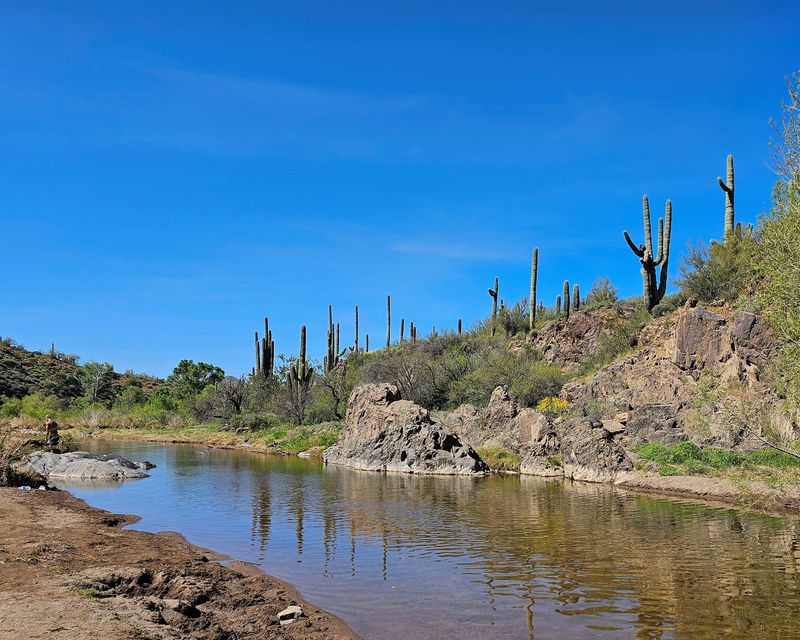
Rocks, Mountains, And Saguaros Make A Pretty Great Frame
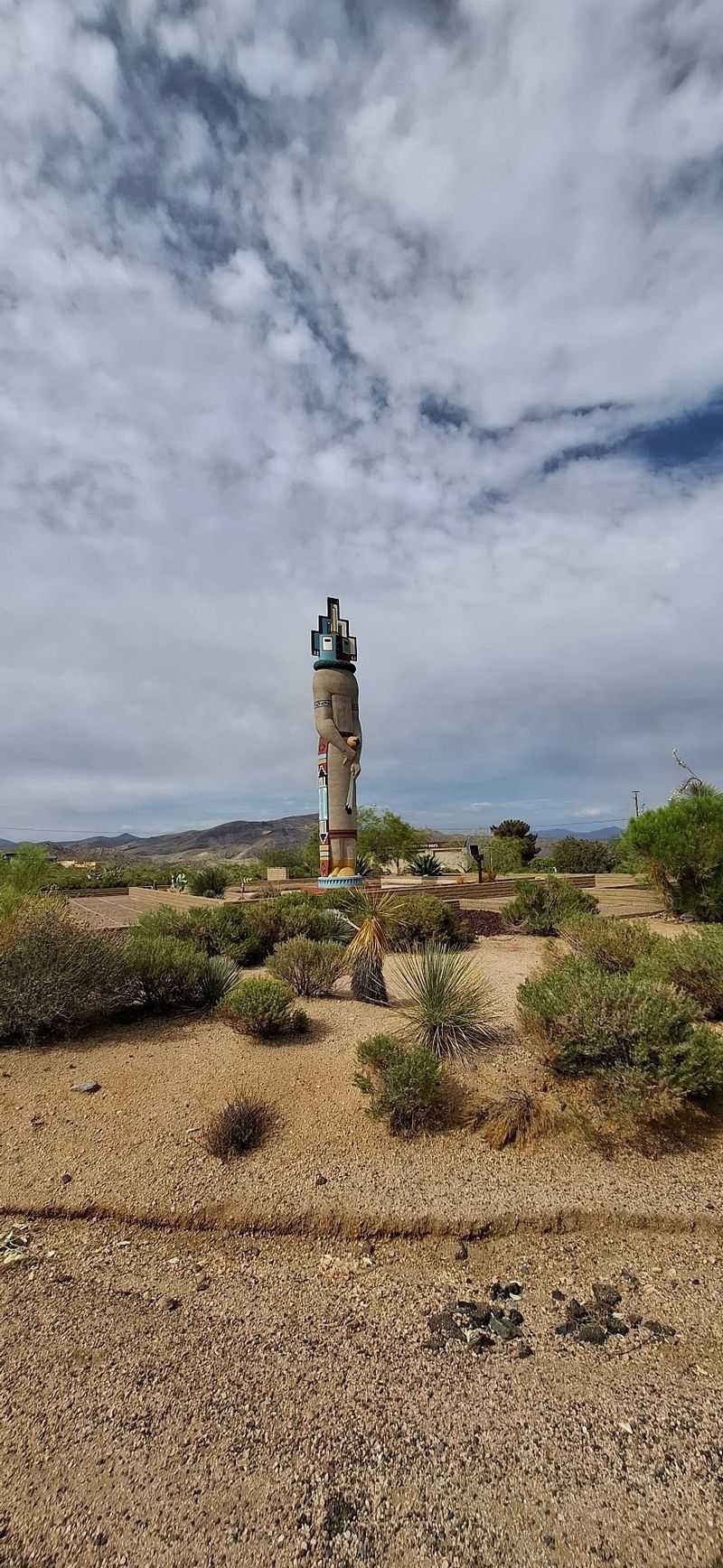
Setting matters, and this statue scored a beauty. It rises from a low-walled rock garden surrounded by the Sonoran Desert.
Mountains appear behind the monument, while prickly pear cactus, agave, and other desert plants bring different shapes and shades of green to the foreground.
Against those natural colors, the painted headdress stands out immediately.
Photographers, take note. A wide composition can show the whole sculpture along with the rocky foothills; a closer composition draws attention to the geometric patterns and the small objects held in its hands.
Morning and late-afternoon light are particularly appealing in this open landscape.
The softer angle gives the white body depth and brings out the contrast between the red and turquoise paint.
The south-facing figure changes character as you shift your camera angle.
Stay on established ground and give the plants some space. The desert garden is part of the monument’s setting, not a path for visitors to wander through.
Its neighborhood setting makes that enormous scale feel even stranger.
Local Firefighters Keep This Guardian Looking Sharp
Here’s a twist you might not expect. The statue belongs to the Tonto Hills Volunteer Fire Department, which helps look after the landmark.
The volunteer organization serves the residential community and maintains a firehouse on the same property as the sculpture. Its members have long helped care for the monument.
Desert conditions give outdoor artwork plenty to contend with. Strong sunlight, blowing dust, and seasonal rain can affect painted surfaces, making upkeep an ongoing responsibility.
The 39-foot structure isn’t exactly something you can polish from a step stool.
Donations support the volunteer department, and the monument has been connected with fundraising for its care.
That is a practical side of a landmark that seems almost entirely about scale and imagination. Its site at the community entrance makes that connection literal.
If you stop for a photograph, remember that this is a working neighborhood. Keeping the approach clear is one simple way to respect the volunteers and residents who share the space.
Make It A Double Feature With A Giant Sundial Next Door
One supersized landmark is fun. Two in the same area feels like a scavenger hunt for giants.
The nearby town of Carefree has an enormous sundial in its town center. Finished in 1959, the Carefree Sundial was once the largest in the world.
Its shadow-casting arm measures about 62 feet, rising above a landscaped plaza. Together, they make a memorable outing: one celebrates katsina-inspired imagery, and the other marks time with a shadow.
The sundial occupies the Carefree Desert Gardens area, where pathways and plantings create a different atmosphere from the quiet Tonto Hills entrance.
Its metal arm points toward the North Star, giving the clock an astronomical twist. Sunny skies help the sundial do its thing. Luckily, the desert usually cooperates. Watch the shadow mark the time.
Plan for cooler morning or late-afternoon weather if you’re visiting in summer. In Arizona’s milder months, linger over the details.
An afternoon of giant landmarks is a surprisingly entertaining way to explore this corner of the Valley.