Union Pacific Built Its Biggest Steam Engine And One Now Sits In A Nebraska Park You Can Walk Right Up To
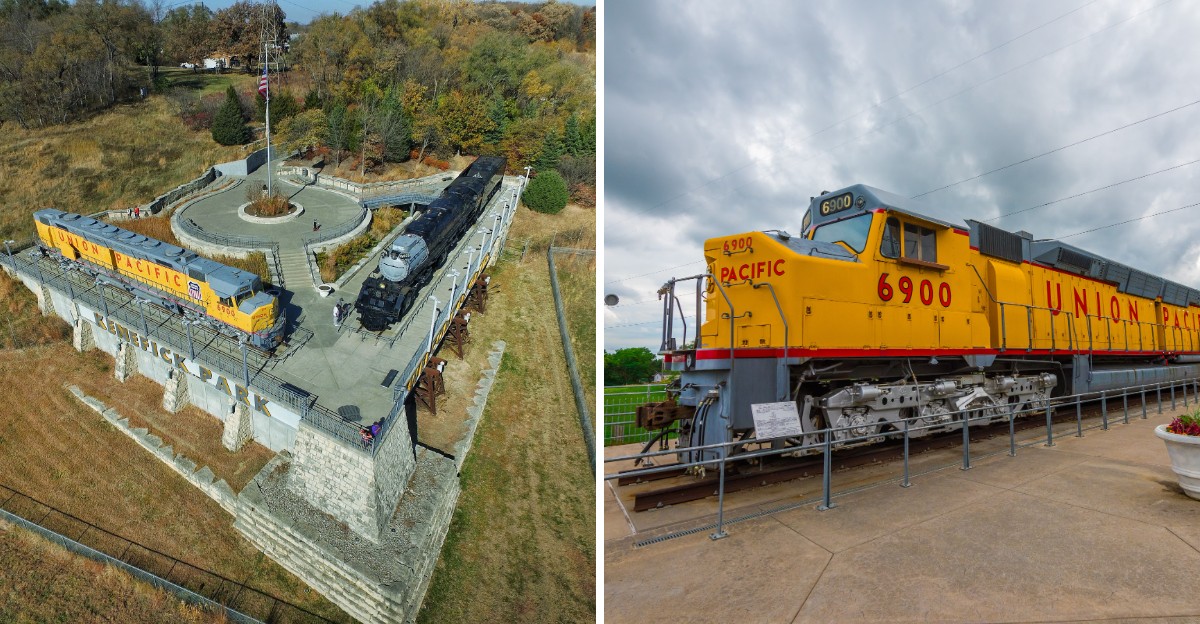
A single steam locomotive weighing about 1.2 million pounds sits parked on a grassy hilltop in Nebraska. Nobody charges a dime to walk right up and stand beside its towering wheels.
It belongs to a family of only 25 engines built back in the 1940s for one job: dragging freight over mountains. Just eight of them survive today, and this one never leaves its perch.
I like how the setting adds a little drama to the scale. The giant faces a busy interstate, so a steady stream of drivers glimpse it every single day without realizing what it is.
A record-setting diesel, the biggest of its kind ever built, keeps it company on the same hill. I can’t imagine a better way to feel small for an afternoon, so why not climb up and say hello?
A Steam Giant Keeps Watch From A Hill Above Omaha
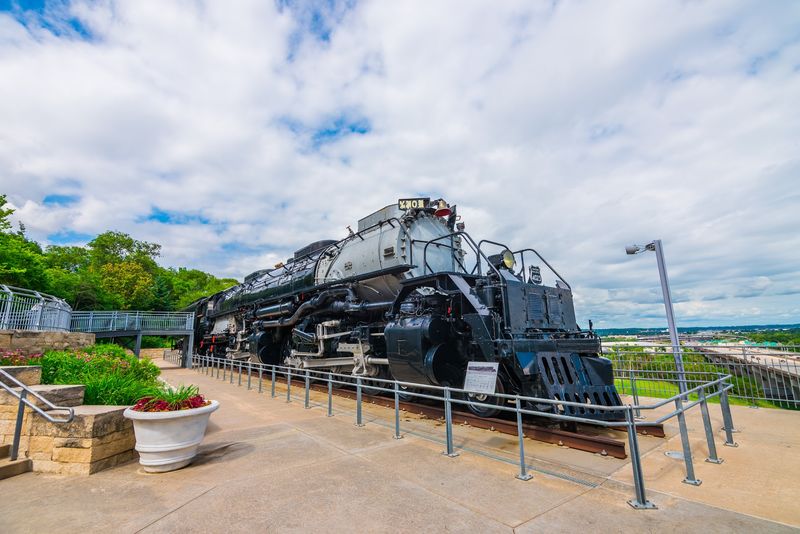
Kenefick Park – Union Pacific Locomotives is a small hilltop park in Omaha built around two legendary engines. One is Big Boy No. 4023, a steam locomotive from the biggest class Union Pacific ever ran.
The other is Centennial No. 6900, a diesel-electric that holds its own size record. Together they make a heavyweight pair you can actually walk around.
The park sits on the southern edge of Omaha, right beside Lauritzen Gardens. It overlooks Interstate 80 and the Missouri River valley, with Iowa visible across the water.
Plenty of Nebraska drivers have spotted the dark silhouette from the highway. Fewer have pulled off to see it up close, and that seems like a missed opportunity.
Admission is free, which makes this one of the easiest big-ticket sights in the city. You get history, engineering and a wide-open view without opening your wallet.
The park is compact, so it fits nicely into a busy day. Still, the engines are so large that a quick stop can stretch longer than planned.
Railroad fans will feel right at home here. Everyone else may simply find themselves staring upward, wondering how anything this big ever moved at all.
The Numbers On Big Boy No. 4023 Sound Almost Made Up
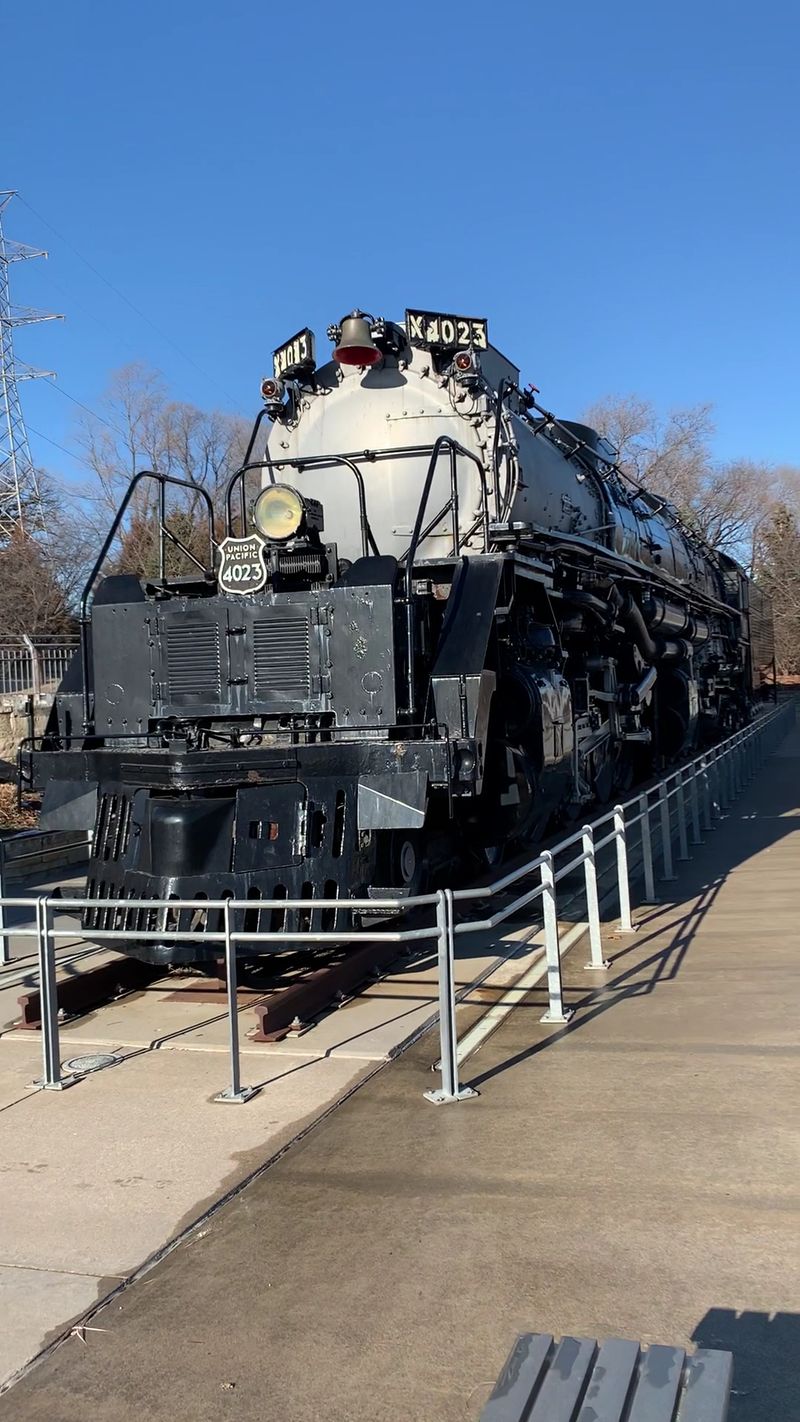
About 1.2 million pounds. That’s the combined weight of a Big Boy engine and its tender, and it’s not a typo.
Big Boy No. 4023 stretches roughly 132 feet from end to end. Park a few school buses nose to tail and you’re still falling short.
Those figures made the Big Boy class among the largest steam locomotives ever built. Union Pacific wanted raw pulling power, and the designers delivered it in heroic portions.
The engine carries 16 driving wheels, split into two sets of eight. Each set worked like its own powerhouse under one enormous boiler.
Numbers on paper rarely land the way steel does in person. Standing beside the wheels, the scale suddenly stops being trivia and starts being a little humbling.
Kids tend to grasp it fastest, since everything here is several times their height. Adults usually need a minute and a slow lap around the engine to catch up.
A smartphone photo struggles to fit the whole thing in one frame. That small frustration might be the best proof of just how big this machine really is.
One Clever Wheel Arrangement Let This Monster Bend
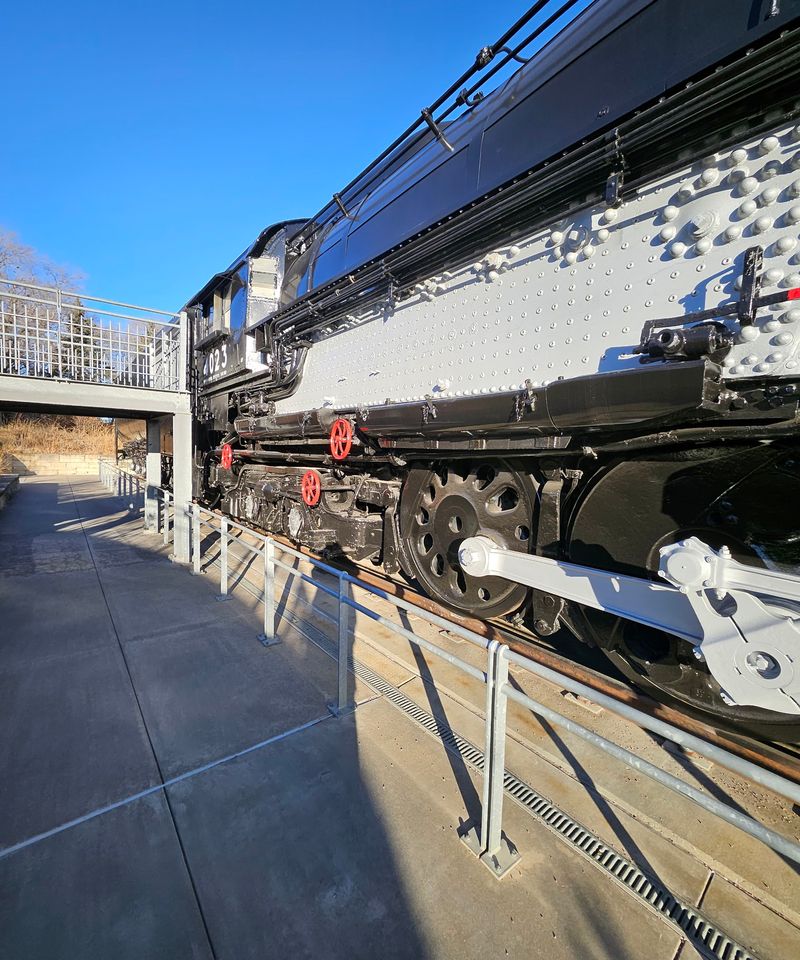
Here’s a riddle for train lovers. How do you make an engine this long take a mountain curve without jumping the rails?
The answer is the Big Boy’s 4-8-8-4 wheel arrangement. It means four leading wheels, two sets of eight drivers, and four trailing wheels underneath the cab.
The front engine unit could pivot independently from the rear. That hinge-like design is called articulation, and it let the locomotive flex through curves.
Without that trick, a machine of this length would have been a very expensive lawn ornament. With it, Union Pacific got both muscle and maneuverability.
At Kenefick Park, you can study the running gear at eye level. The rods, wheels and cylinders sit right in front of you, no binoculars needed.
Try tracing how the front set of drivers connects to its own cylinders. Then follow the rear set and notice how the two halves work as partners.
Even if mechanics usually bore you, the layout is easy to appreciate. It’s a bit like seeing two locomotives cleverly stitched into one rolling giant.
Omaha Engineers Dreamed Up The Whole Big Boy Idea
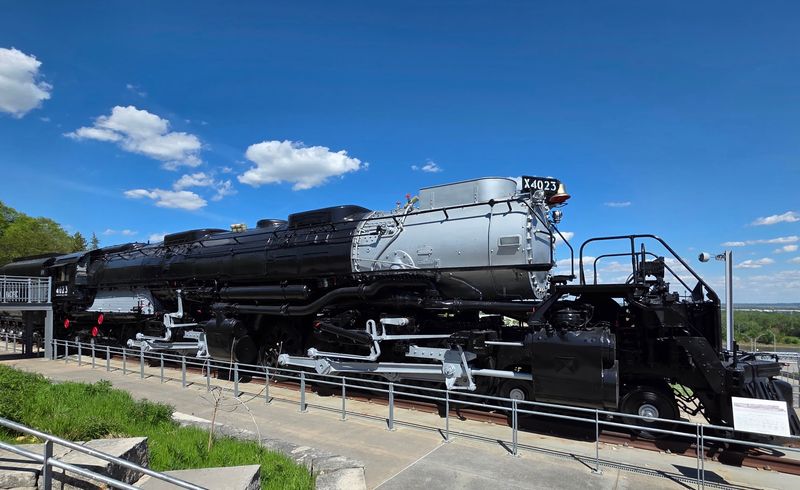
Plenty of people assume a locomotive this famous came from some faraway factory town. The design story actually traces back to Union Pacific’s headquarters city of Omaha.
Mechanical officer Otto Jabelmann led the engineering team behind the Big Boy class. Their goal was simple to state and hard to pull off.
Union Pacific needed engines that could haul heavy freight over the Wasatch Mountains without extra helper locomotives. Existing engines kept requiring that extra push on the steep grades.
The American Locomotive Company built the engines from that Omaha-born design. The first 20 arrived in 1941, numbered 4000 through 4019.
A second batch of five, numbered 4020 through 4024, followed in 1944. Big Boy No. 4023 belongs to that final group, completed in November 1944.
That makes the hilltop display feel like a homecoming of sorts. The engine now rests in the same city where its blueprint first took shape.
Nebraska can claim a quiet bit of ownership here. Few states get to say a legend of steam was imagined within their borders.
Fifteen Years Of Muscling Freight Over The Mountains
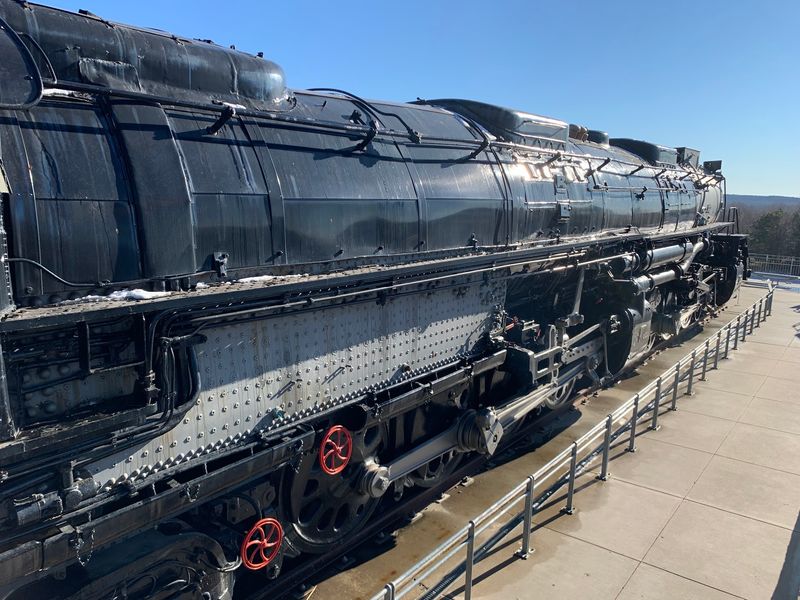
Big Boy No. 4023 didn’t spend its working years anywhere near Omaha. Its home turf stretched between Ogden, Utah, and Cheyenne, Wyoming.
That route included the tough climbs of the Wasatch Mountains. Those grades were exactly the reason the Big Boys existed in the first place.
The engines could pull freight trains of about 3,800 tons through mountain territory. On flatter track, loads could climb even higher.
Picture the steady rhythm of freight rolling west, mile after mile, year after year. Okay, that’s technically picturing, but the history earns it.
No. 4023 entered revenue service in late 1944. It kept working until July 1959, a run of roughly fifteen years.
That retirement date wasn’t about the engine wearing out. Diesel-electric locomotives were simply cheaper to run, and railroads across the country were making the switch.
Knowing that backstory changes how the engine looks on the hill. The soot-black giant reads less like a museum piece and more like a retired worker finally taking a breather.
Only Eight Of The Original Twenty-Five Survived
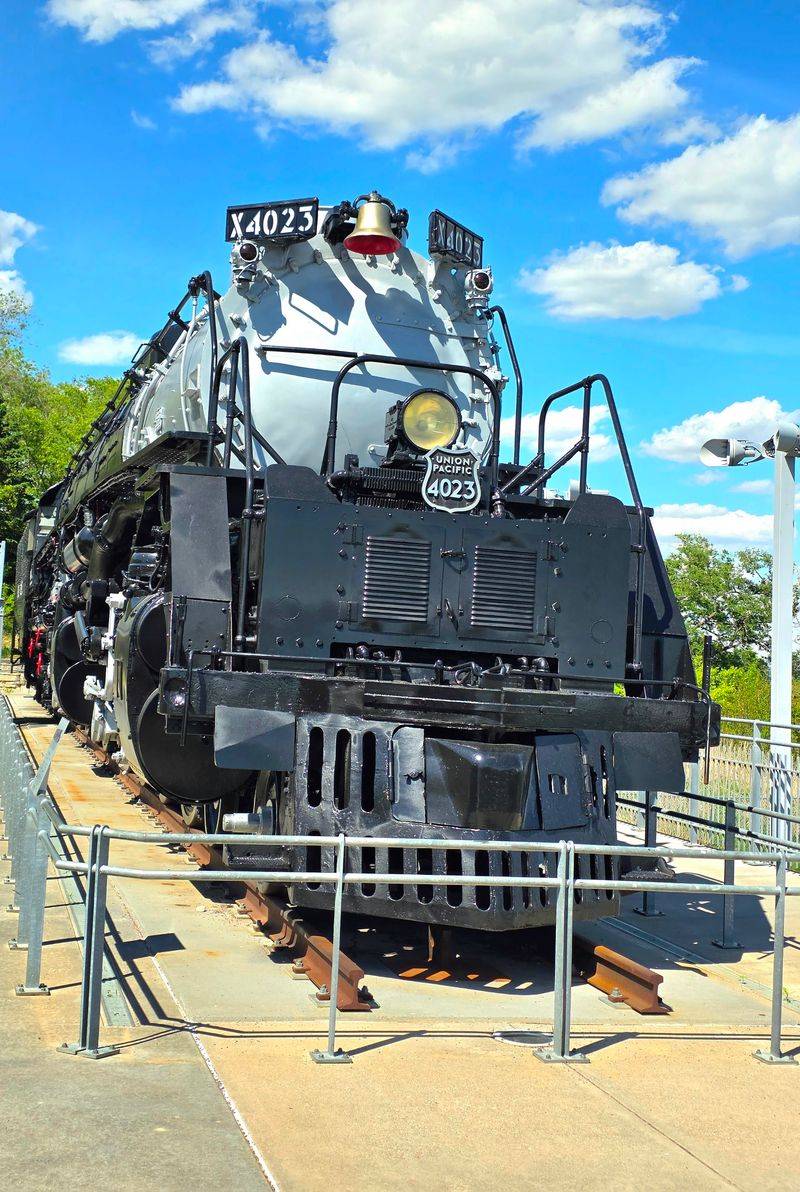
Twenty-five Big Boys rolled out of the shops. Just eight remain today, scattered across museums and parks around the country.
Omaha holds one of them, and that alone makes Kenefick Park worth a detour. Rail fans often treat the surviving eight like a checklist to complete.
Only one of those survivors still runs under its own steam. Union Pacific restored Big Boy No. 4014, and it returned to the rails in 2019.
That restored engine occasionally tours and draws big crowds wherever it travels. Its sibling in Omaha, meanwhile, stays put and is ready whenever you are.
There’s something reassuring about a giant that never changes its schedule. No chasing, no guessing, just a dependable meeting place on a Nebraska hilltop.
Seeing No. 4023 also adds context if you ever catch No. 4014 in action. You’ll already know the shape, the size and the sheer presence of the class.
For families, it can become a fun little quest. One Big Boy down, seven to go, if anyone feels like turning it into a road trip goal.
How Does A Locomotive End Up On A Hilltop Anyway
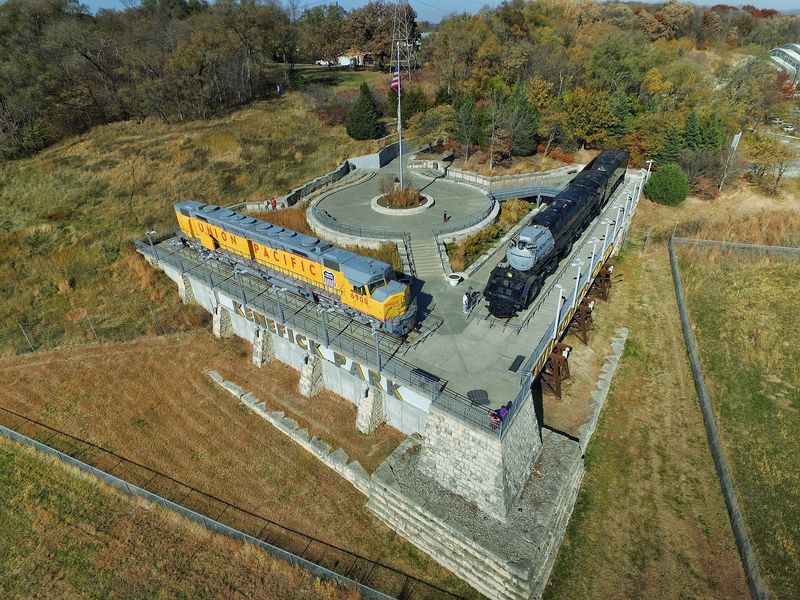
Sooner or later, almost everyone asks the same question. How did something weighing more than a million pounds get up this hill?
Before its current home, No. 4023 spent years on display elsewhere in Omaha. Union Pacific moved it to the Kenefick Park hillside in 2004.
The Centennial diesel joined it, and the park took shape around the pair. Kenefick Park was dedicated in 2005.
The name honors John C. Kenefick, a former chairman of Union Pacific.
It’s a fitting tribute, given how closely the railroad and Omaha are tied together.
The exact choreography of that big move isn’t spelled out on the hill. So you’re free to stand there and marvel at the logistics on your own.
What’s clear is the result. Two record-holding engines now share a landscaped perch above one of the busiest highways in the city.
The location was chosen to be seen. Travelers crossing into town catch a glimpse right away, almost like the railroad left its calling card on the skyline.
The Diesel Next Door Holds A Record Of Its Own
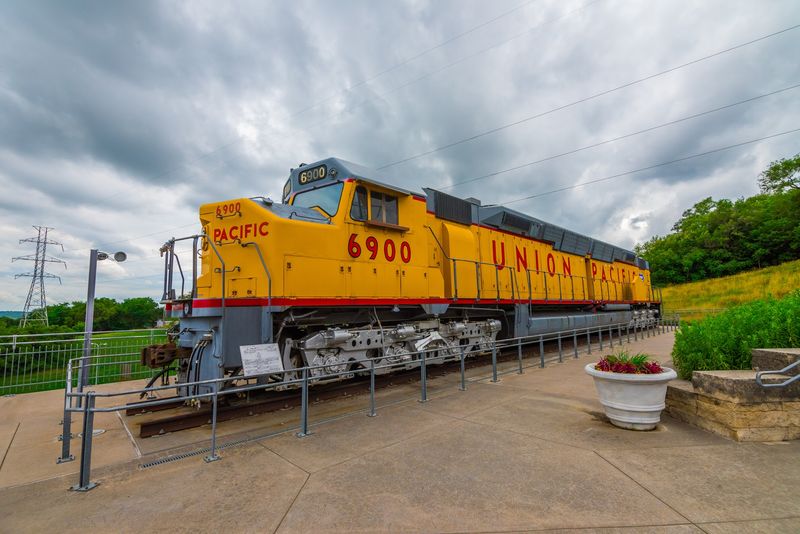
Big Boy gets most of the attention, but its neighbor deserves a long look too. Centennial No. 6900 is a DDA40X, the largest and most powerful diesel-electric locomotive class ever built.
General Motors’ Electro-Motive Division built the Centennials starting in 1969. The name celebrated the 100th anniversary of the transcontinental railroad’s completion.
Each unit carried two diesel engines under one long hood. That doubled-up design pushed out around 6,600 horsepower.
No. 6900 was the first of the class, which gives it extra bragging rights. Its yellow and gray paint makes a bright contrast with the black steam giant beside it.
Seeing the two together tells a neat story in one glance. Steam reached its peak, then diesel took over, and here they sit politely side by side.
The Centennial is long too, stretching close to 100 feet. It would dominate most displays, yet here it plays an excellent supporting role.
Take a moment to compare the noses, cabs and wheels. Spotting the differences between the two eras is half the fun of this hilltop.
A Raised Walkway Lets You Peek Into The Cab
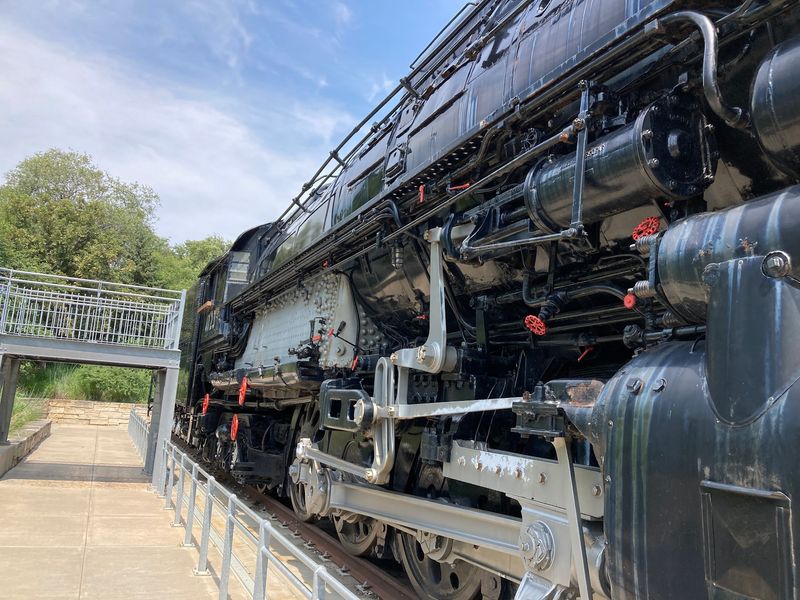
Climbing aboard isn’t allowed, and that’s probably for the best. Still, the park found a smart compromise for curious visitors.
A raised walkway near Big Boy No. 4023 brings you up to cab level. From there, you can look into the space where crews once worked.
It’s a rare angle on a steam locomotive. Most displays keep the cab well above your head, leaving only a glimpse of the roofline.
The engines sit within an enclosure, so viewing is hands-off. You can, however, walk all the way around the Big Boy for a full sense of its size.
That loop is worth taking slowly. Each side reveals different details, from the tender’s bulk to the long stretch of boiler.
Kids may wish they could pull a lever or ring a bell. The walkway at least lets them see where the action happened, which tends to spark plenty of questions.
Bring a camera for the cab view. It’s one of the more unusual photos you can snag at any railroad display in Nebraska.
Signs, Photos And Maps Do The Storytelling
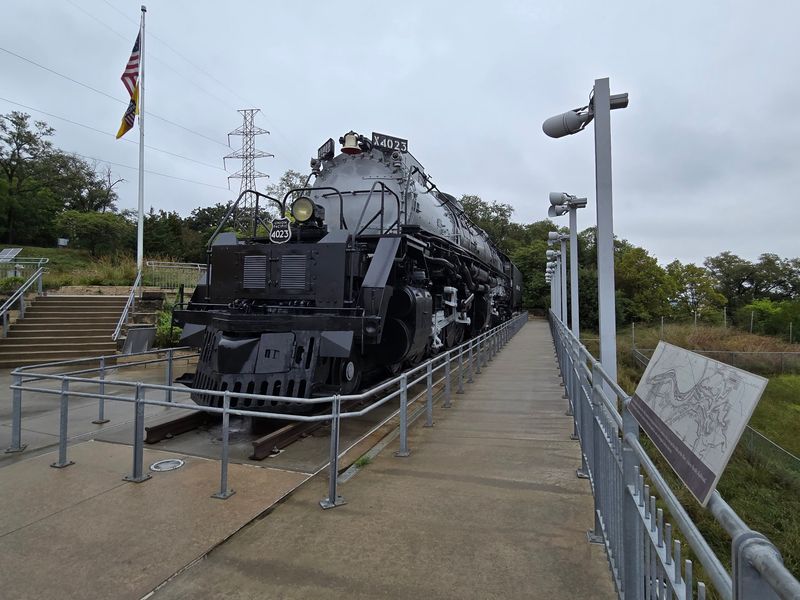
Reading material lines the route up and around the engines. Interpretive signs, historic photos and maps cover walls and railings throughout the park.
They explain how Union Pacific grew and why these machines mattered. The panels also connect the railroad’s story to Omaha itself.
That’s handy if you arrive knowing nothing about trains. By the time you reach the top, you’ll be dropping terms like articulated and tractive effort.
The signs work well for mixed groups too. A rail fan can geek out over specs while everyone else follows the bigger historical thread.
Parents may find the panels useful for turning a stop into a mini lesson. Kids can hunt for the engine numbers, then match them to the photos.
The content stays approachable rather than dense. Short reads keep things moving, which helps when little legs are eager to get to the trains.
Give yourself time to linger. The history adds weight to the visit, and not just the million-pound kind sitting on the rails nearby.