In Cross Creek, Fried Quail and Sour Orange Pie Come With a Literary Pedigree in Florida
Some of the best meals in Florida hide at the end of a two-lane road with nothing around but moss, water, and quiet. You drive past palmetto scrub thinking you have made a wrong turn, then a low wooden building appears and the parking lot is somehow full at one in the afternoon.
Inside, the walls are stacked with old books, the grits are stone-ground, and the dessert menu carries a pie recipe with a Pulitzer Prize attached to its history. It is the kind of stop that rearranges your idea of what rural Southern cooking can be.
A Swamp-Edge Dining Room at the End of County Road 325
Follow County Road 325 through Alachua County and the landscape narrows to water on both sides. Cross Creek is the thin ribbon of land between Orange Lake and Lochloosa Lake, an unincorporated dot on the map with more herons than houses.
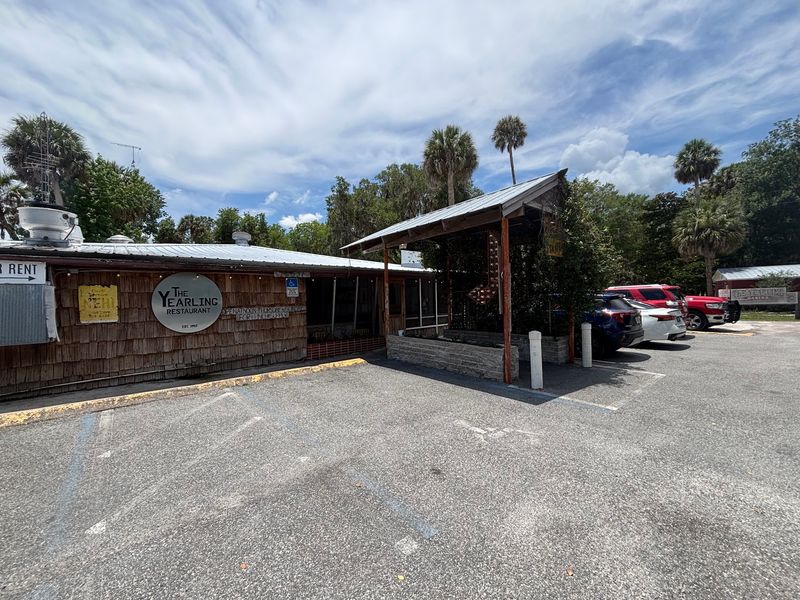
The Yearling Restaurant sits at 14531 County Road 325 in Hawthorne, a low building with a weathered exterior that gives away almost nothing about the interior. Opened in the 1950s, it has served Southern and Old Florida cooking to anyone willing to make the drive ever since.
Google Maps files it under seafood restaurant, which is accurate but incomplete. Catfish and redfish share the menu with venison, frog legs, and game preparations that trace straight back to the recipes Marjorie Kinnan Rawlings wrote down while living less than a mile away.
What makes the location work is exactly what makes it improbable. There is no strip mall, no chain signage, no traffic.
Just a restaurant that has outlasted several eras of Florida development by staying precisely where it started, cooking the food of the place around it.
Marjorie Kinnan Rawlings and the Books That Made This Corner Famous

In 1928, a writer from New York bought a 72-acre orange grove in a place almost nobody had heard of. Marjorie Kinnan Rawlings stayed until 1953, and the land rewrote her career.
Her novel The Yearling won the Pulitzer Prize in 1939 and later became a film starring Gregory Peck and Jane Wyman. Her 1942 memoir Cross Creek chronicled her neighbors, the weather, the hunting, and the cooking with an eye that missed very little.
The same year, she published Cross Creek Cookery, a collection of recipes gathered from her own kitchen and the households around her. Sour orange pie appears in it, built from fruit that grew on her property.
So do game dishes, including her practice of smother-frying quail, dove, or squirrel when the age of the meat was uncertain.
Her homestead survives today as the Marjorie Kinnan Rawlings Historic State Park, a short drive from the restaurant. Touring the house and then eating dishes from her cookbook makes the two stops feel less like separate errands and more like one long chapter.
Cracker Cuisine Explained, Florida-Style
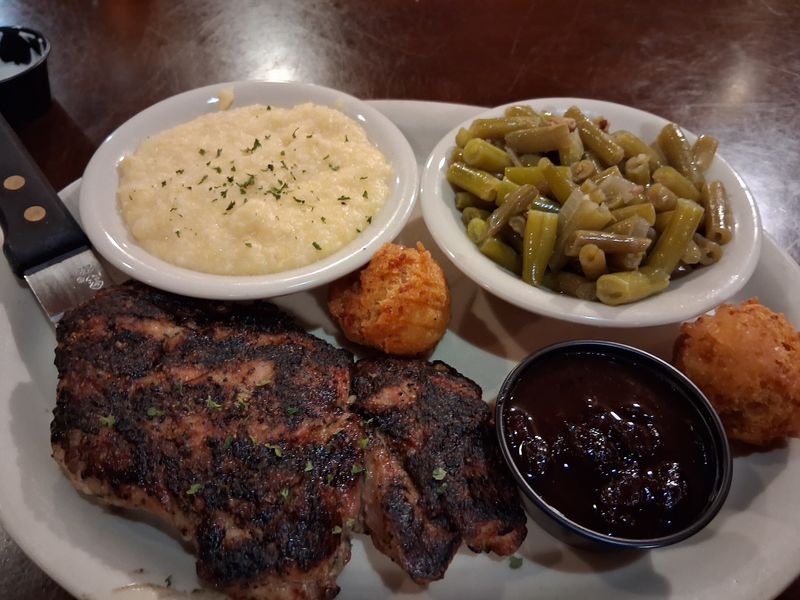
Cracker cuisine is not a marketing term invented for menus. It describes what rural Florida families cooked before refrigeration, interstates, and grocery chains reshaped the state’s pantry.
The cooking leaned on what the land and water gave up: freshwater fish, game birds, wild citrus, greens, cornmeal, and whatever the garden produced. Rawlings documented it faithfully because she was living it, not observing from a distance.
At the restaurant, that lineage shows up in the ingredient list rather than in slogans. Cheese grits, collard greens, catfish, venison, frog legs, and gator all appear, and each one has a practical reason for being there rather than a novelty one.
Sour orange deserves its own note. The fruit is too tart to eat out of hand, so cooks turned it into marinades and pies, using acidity the way other regions used lemon.
That single adaptation explains most of what cracker cooking was about.
Eating it in 2024 is a slightly different experience than eating it in 1942, but the flavors have not been sanded down. The seasoning is confident, the frying is precise, and nothing tastes apologetic.
Fried Quail, Game Birds, and the Rawlings Connection
Small bones, dark meat, crisp skin. Quail rewards patience and punishes overcooking, which is why so few restaurants bother with it anymore.
Here it turns up as part of a game combination, sharing a plate with other proteins that once came from the surrounding woods and water. The preparation nods directly to Cross Creek Cookery, where Rawlings described smother-frying birds slowly under a lid to coax tenderness out of anything of questionable age.
Venison is the single most-mentioned dish on the menu, followed closely by gator and frog legs. That trio tells you everything about the kitchen’s comfort level with proteins most chefs avoid entirely.
The venison arrives cooked with care rather than cooked into submission, and it carries the mild gaminess that comes with the territory. If that flavor is not your thing, the pork shank and the prime pork ribeye occupy the same neighborhood without the wild edge.
Ordering the game plate is the most direct way to connect dinner to the books. You are eating roughly what Rawlings served her neighbors, in the same square mile where she wrote about it.
Sour Orange Pie, Made in House
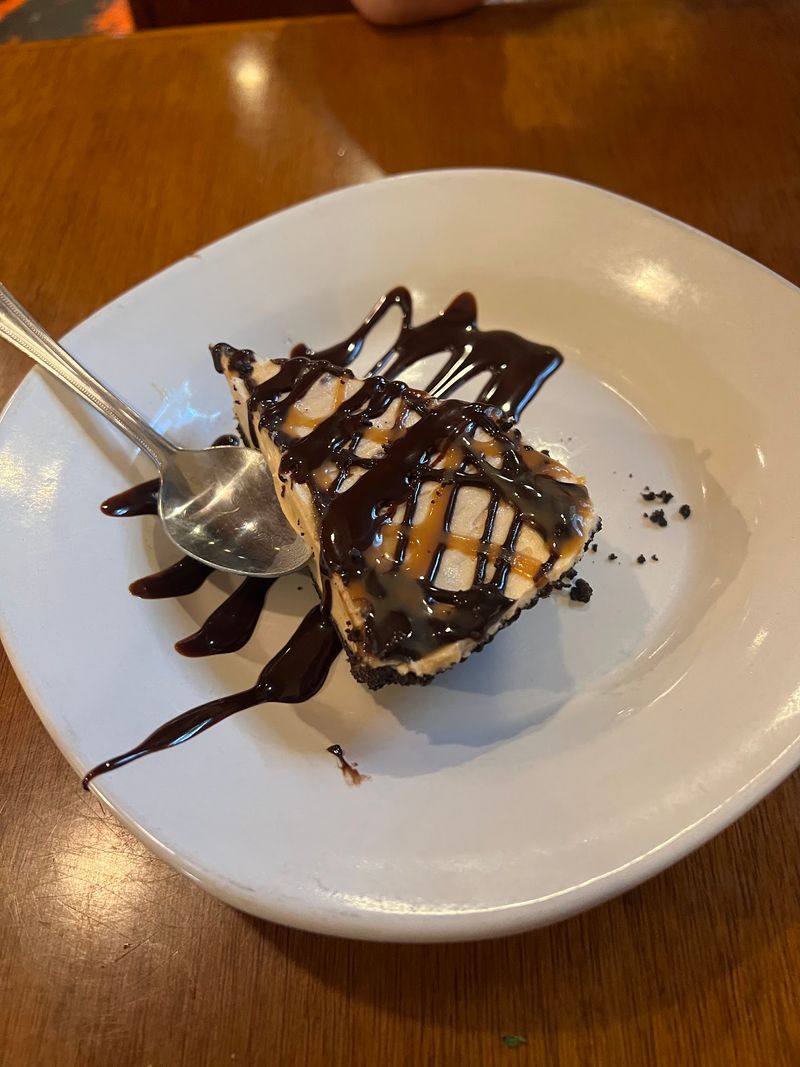
Picture key lime pie’s older, sharper cousin. Sour orange pie hits with a citrus bite that cuts through an entire plate of fried food, and the restaurant makes its own.
The recipe descends from Rawlings, who grew sour oranges on her Cross Creek property and included the pie in her cookbook. Bitter oranges were once planted across Florida groves, and cooks who could not eat them raw found smarter uses.
Not every dessert on the menu is house-made. Key lime pie comes from Mike’s Pies, which is a fine product but not the one carrying two centuries of Florida citrus history behind it.
So the choice is easy. Order the sour orange, and order it even if you are convinced you have no room, because splitting a slice four ways is a perfectly respectable outcome.
Dessert generally runs strong here, with everything prepared the same day it is served. The pie simply happens to be the only item on the table with a Pulitzer-winning author’s name in its family tree, which is a hard credential for cheesecake to match.
Fried Green Tomatoes, Grits, and the Rest of the Menu
Grits are a reliable test. Done badly they are wallpaper paste; done well they carry an entire dish, and the cheese grits here pass without argument.
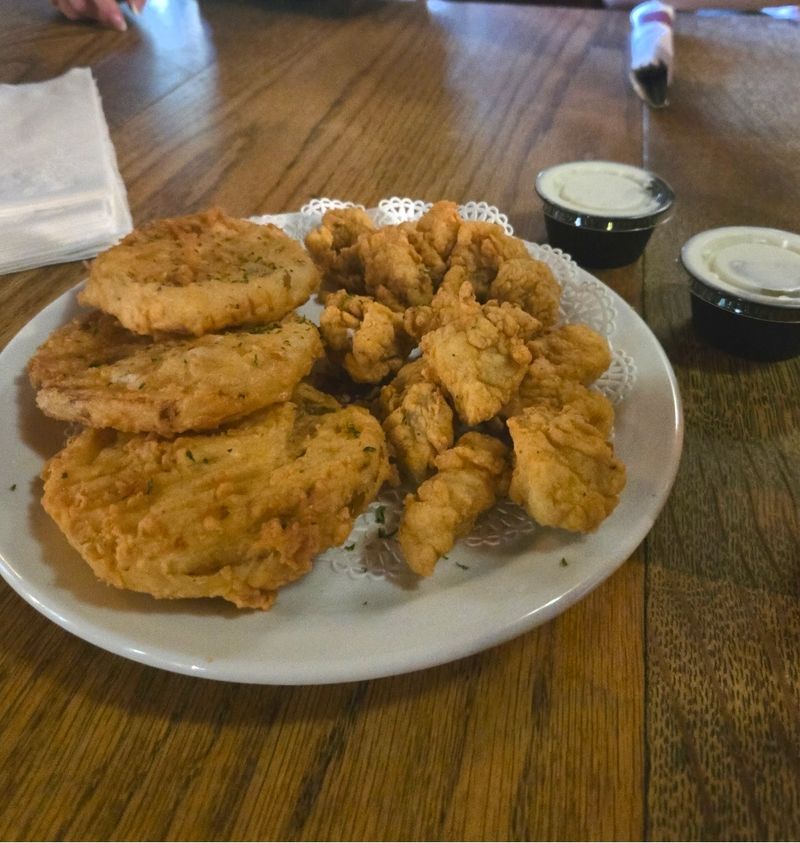
Shrimp and grits shows up constantly in conversation about the kitchen, and grilled shrimp over cheese grits is one of the plates that keeps people driving back. Fried green tomatoes come out crisp rather than oily, with breading that holds its structure instead of sliding off.
Beyond the game and the seafood, the menu is broader than the swamp setting suggests. Burgers hold their own, including a steak burger with real depth of flavor, and there are sandwiches for anyone traveling with a picky eater.
Fried clams, conch fritters, blackened redfish, fried grouper, and smoked fish dip round out the water side of things. Collard greens and hush puppies handle the rest.
Everything is prepared the day it is served and arrives hot. Fried items lean light rather than heavy, which matters when the menu tilts as far toward the fryer as this one does.
Old Books, Taxidermy, and a Room That Doubles as a Museum
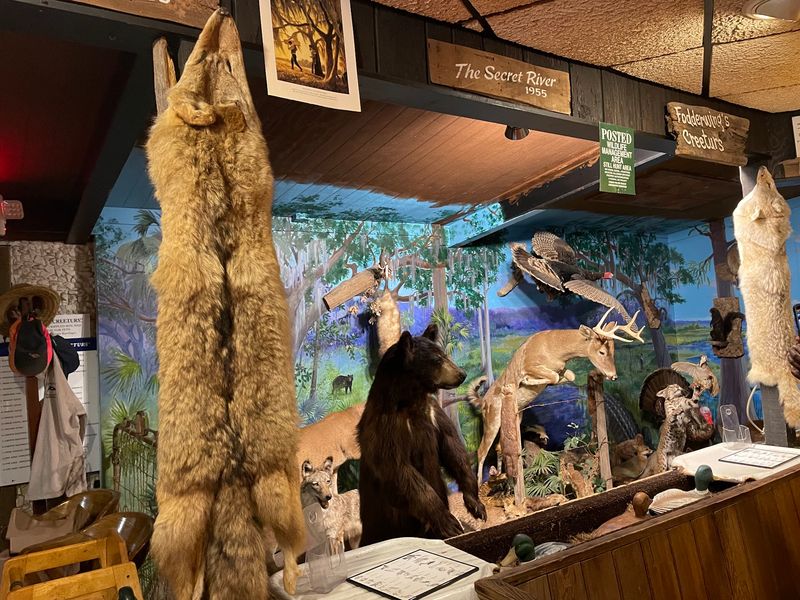
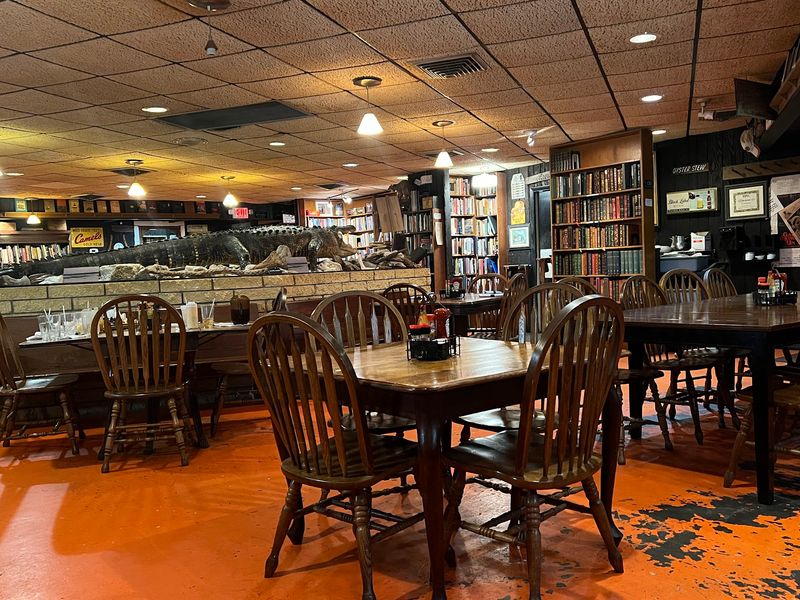
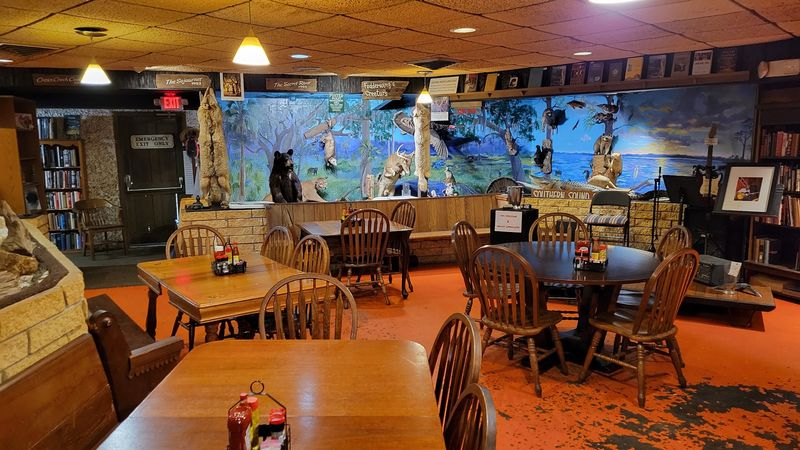
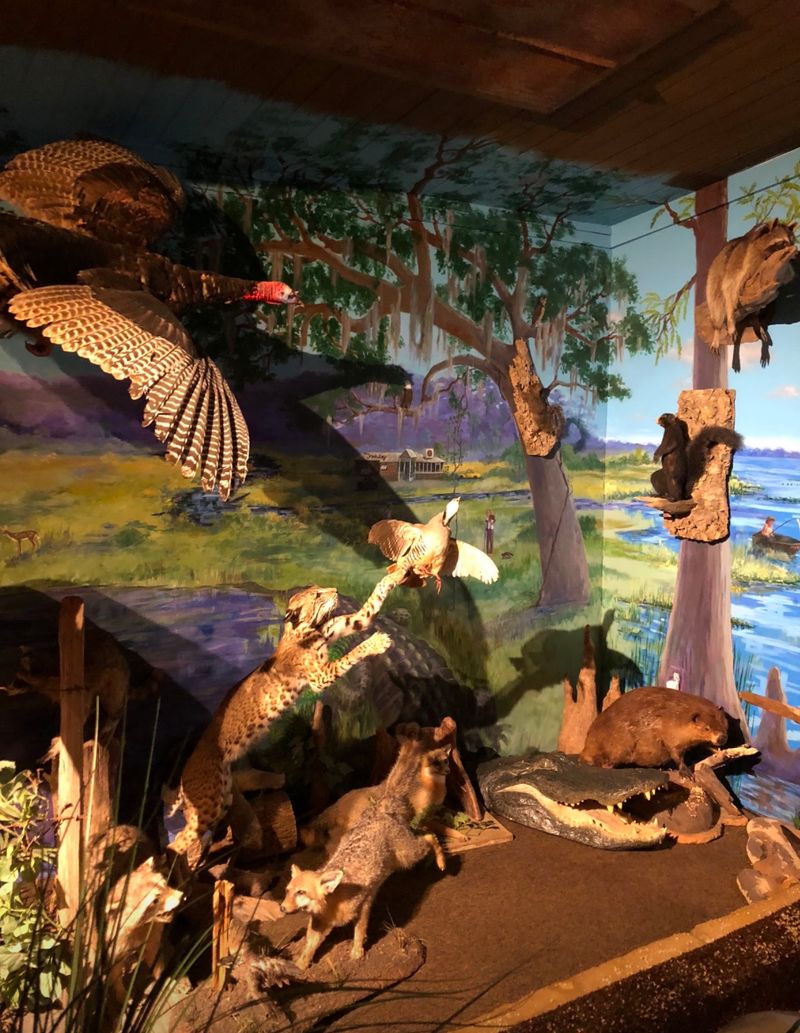
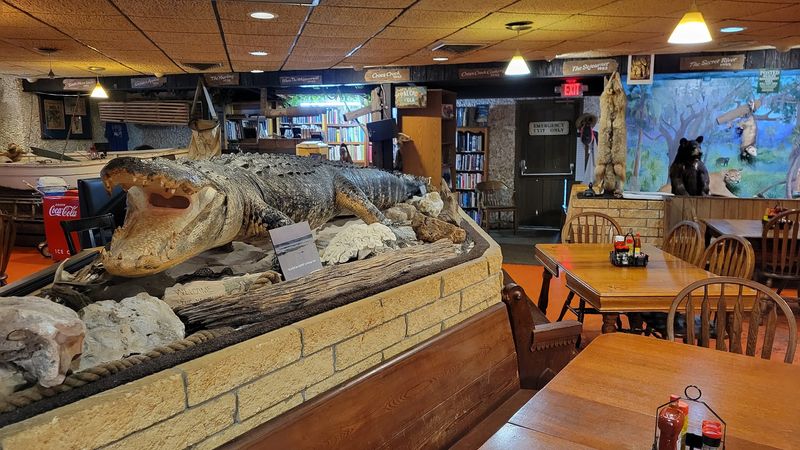
Rich dark wood, shelves crowded with old volumes, and a very large mounted gator toward the back. Walking in feels less like entering a dining room and more like wandering into somebody’s collection.
Books line the walls and many are for sale, most of them tied to Florida history or classic literature. Vintage photographs, antique odds and ends, and taxidermy fill whatever space the books leave open.
The lighting stays dim in a way that suits the wood and the clutter. Sitting in the front section means missing half the good material, so the walk to the restrooms doubles as a self-guided tour worth taking slowly.
Calling it a natural history museum with a kitchen attached is not much of a stretch. There is a stage for live music, shelves of local history, and enough visual noise that a table of four can go twenty minutes without checking a phone.
Restaurants that lean this hard on decor usually skimp on the food. That is emphatically not the arrangement here, which is what makes the room such a pleasant surprise rather than a distraction.
Friday Night Music and the Cross Creek Soundtrack
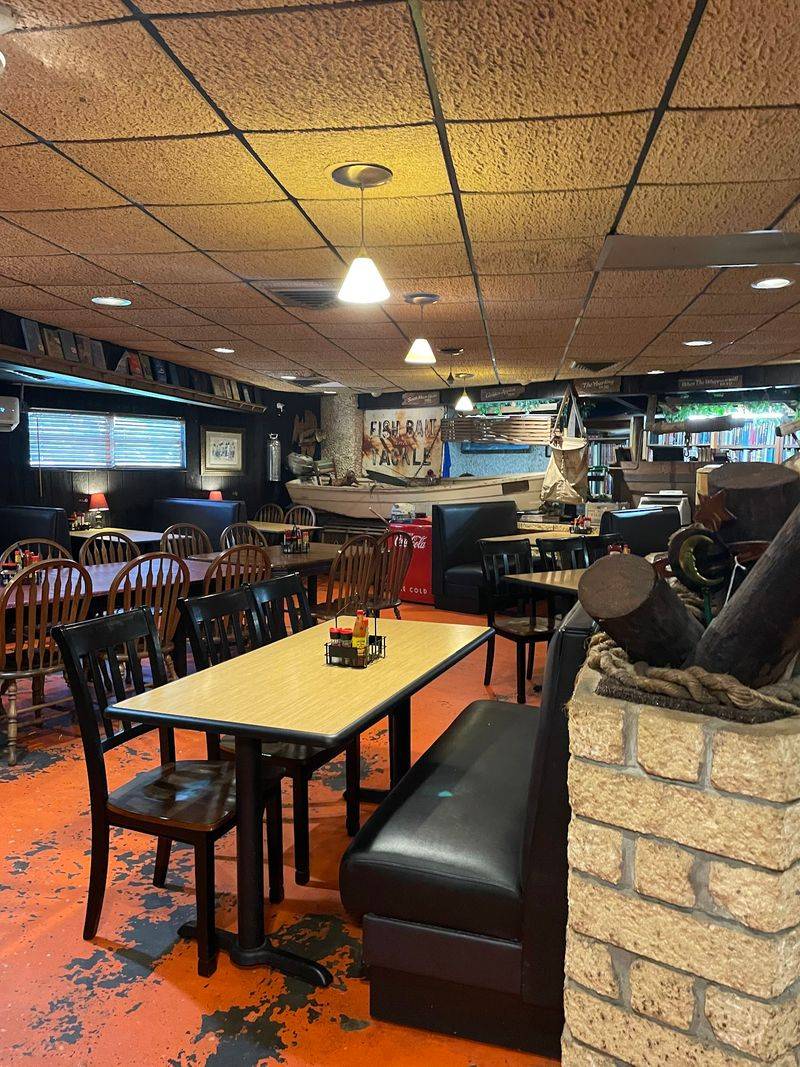
A small stage sits inside the dining room, and on Friday nights it earns its keep. Live music is a fixture rather than an occasional add-on, and it changes the temperature of the whole place.
Blues and roots-leaning acoustic sets suit the room, bouncing off wood and bookshelves instead of disappearing into drywall. The volume stays at a level where conversation survives, which is not a given at restaurants with stages.
Friday and Saturday both run until 9 PM, so the evening stretches longer than the Thursday and Sunday schedule allows. Arriving early on a music night is the smarter play, since the room fills quickly.
Music turns a meal into something closer to an evening out, particularly given how far most people travel to get here. Nobody drives forty minutes down a dark county road for a rushed dinner.
Between the stage, the books, and the food, the restaurant has quietly become a small cultural anchor for a community that barely registers on a map. That is a lot of weight for one building to carry, and it carries it well.
Cabins, Fish Camps, and Staying the Night
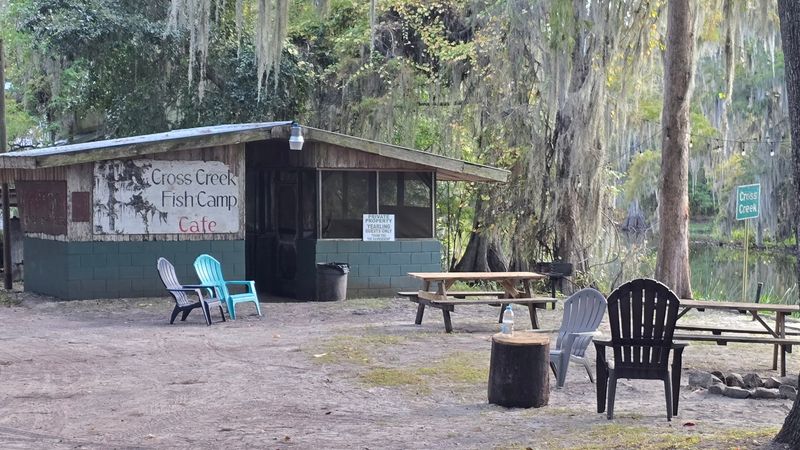
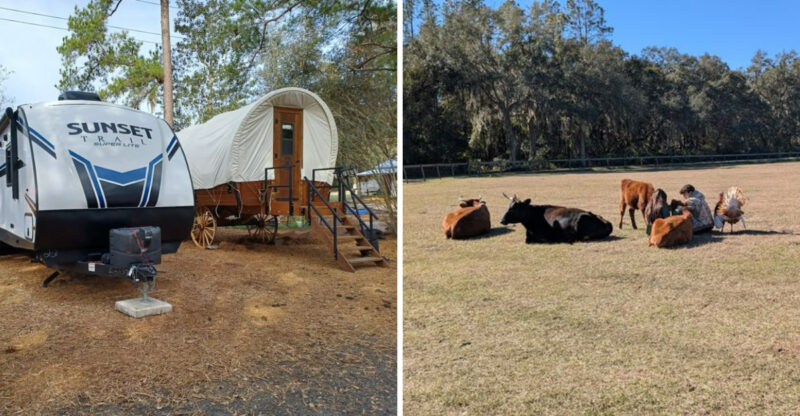
Ending dinner with a five-minute walk to bed is an underrated luxury. Cabins on the property make that possible, and they run on the same rustic logic as everything else here.
The setup mirrors an old Florida fish camp: simple wooden structures, comfortable interiors, and zero pretense about being a resort. Nobody is coming for a spa treatment.
For road-trippers cutting across the state, the combination works as a natural pause. A drive from Tennessee down to South Florida is long enough that a quiet night beside two lakes beats another interstate motel by a wide margin.
The cabins also solve the timing problem. Restaurant hours run only Thursday through Sunday, so pairing a stay with a meal removes the risk of driving out and finding the lights off.
Morning here is the payoff. Fog on the water, birds working the shoreline, and the same quiet that pulled a New York writer down in 1928 and kept her for twenty-five years.
Rawlings Historic State Park sits close enough that a walk through her house before breakfast is entirely reasonable.
The Crowd, the Service, and the Feel of the Place
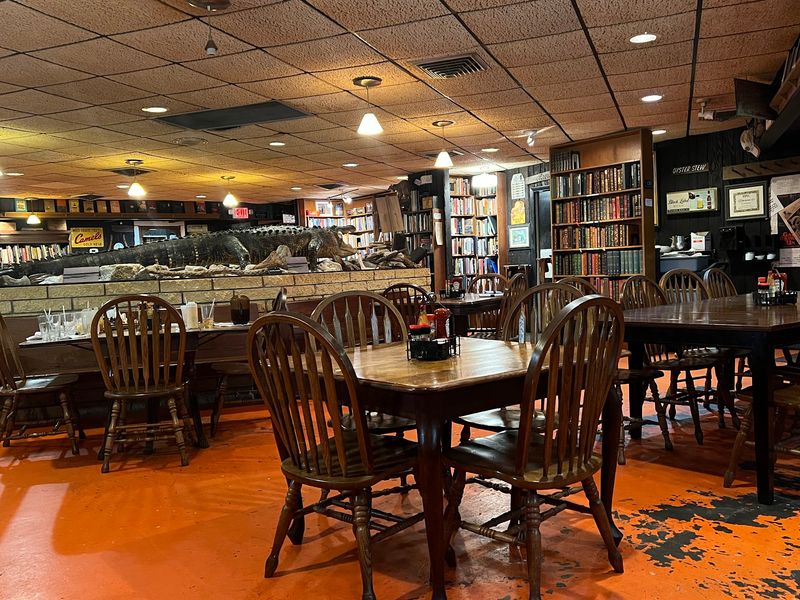
One in the afternoon on a Friday and the dining room is packed. That happens regularly, in a spot with no neighbors and no visible advertising, which says something about how word moves in this part of Florida.
Servers work with genuine warmth rather than corporate scripting. Recommendations come freely, plates arrive hot, and the pace is unhurried without tipping into slow.
The mix at the tables skews wide. Literature readers making the Rawlings pilgrimage sit near hunters, birders, road-trippers, and families who have been driving out here for decades.
It works for a relaxed date, a multi-generation family meal, or a solo lunch with a book pulled off the shelf. Anyone hoping for polished fine dining has picked the wrong building entirely, and the building would agree.
The atmosphere sits somewhere between cozy and cluttered, dim enough to feel like evening at any hour. Sunday afternoons run quieter than Friday nights, so the experience shifts depending on when you show up.
Either version delivers. One is social and loud, the other is contemplative, and both come with the same kitchen behind them.
Hours, Prices, and Planning the Drive
Check the calendar before the GPS. The restaurant closes Monday, Tuesday, and Wednesday, opening Thursday from 12 to 8 PM, Friday and Saturday from 12 to 9 PM, and Sunday from 12 to 8 PM.
Noon is the earliest anyone gets fed, every single day it operates. There is no breakfast service and no early lunch.
Typical spending lands in the $20 to $30 per person range, and lunch pricing matches dinner pricing rather than dropping. A table of three can expect a bill north of a hundred dollars once appetizers and dessert enter the picture.
The address is 14531 County Road 325, Hawthorne, FL 32640, and the phone number is 352-466-3999. The website is yearlingrestaurant.net, useful for confirming music schedules and cabin availability.
Gainesville sits roughly half an hour northwest, and Ocala is a comparable run south. Cell service thins out along the way, so download directions before leaving town.
Rawlings Historic State Park operates on its own schedule with separate house tour times, so plan that stop first and let the meal follow.
What to Order on a First Trip
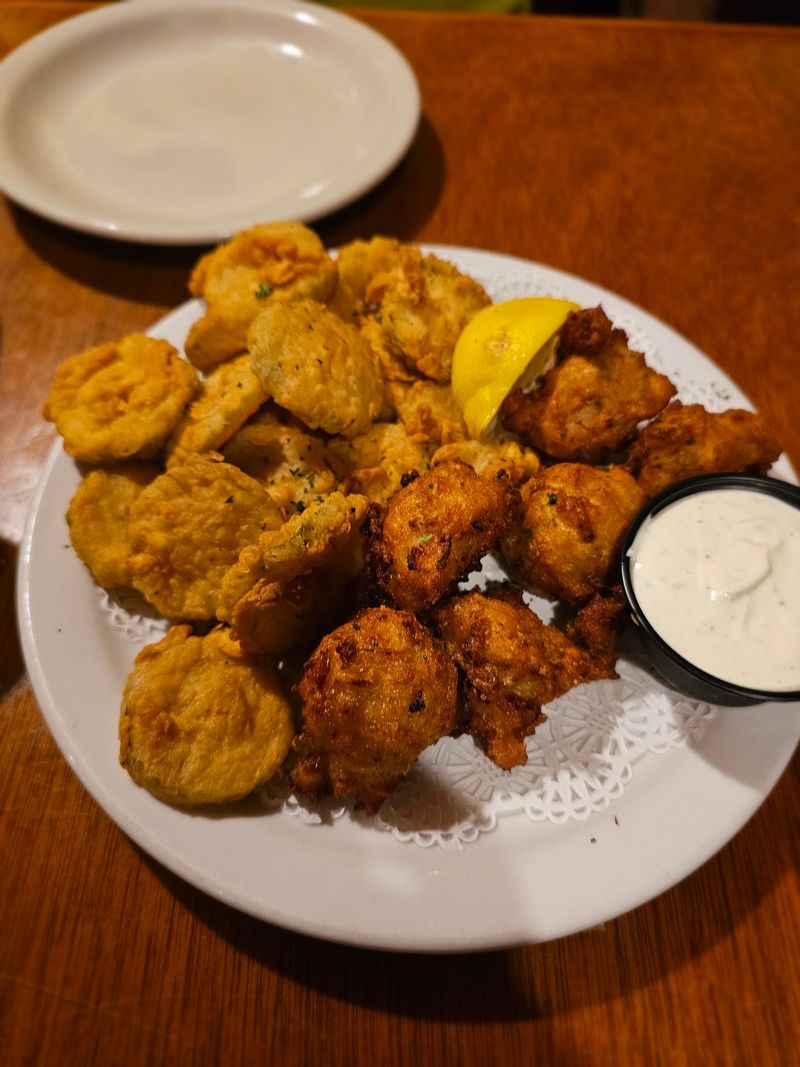
Start with fried green tomatoes. The breading is crisp, the interior stays firm, and it sets the tone for how the kitchen handles a fryer.
From there, split the table. One person takes the game combination for the quail and venison, another goes for shrimp and grits, and everybody ends up tasting the parts of the menu that actually distinguish this place from a standard Southern kitchen.
Frog legs, gator tail, and conch fritters belong in the shared-appetizer category for anyone curious but noncommittal. Blackened redfish and fried grouper handle the seafood side without any adventure required.
Collard greens and cheese grits are the sides that pull the most weight. Hush puppies can sometimes be added even when they are not printed on the menu, so asking costs nothing.
Then sour orange pie. Skip it and you have missed the one dish that ties dinner directly to Cross Creek Cookery and the woman who wrote it.
Portions run generous enough that appetizers plus entrees plus dessert is ambitious for two people. Plan accordingly, or plan to take a container home.
Why This Detour Earns Its Miles
Plenty of restaurants claim a connection to history. Very few can point down the road to the house where the recipes were written and the Pulitzer was earned.
The Yearling Restaurant has been feeding people since the 1950s in a community most Floridians could not find on a map. Its 4.5-star average across nearly 1,800 reviews reflects a kitchen that has stayed consistent through decades of the state changing around it.
Nothing here is polished. The exterior looks rough, the interior is crowded with books and mounted wildlife, and the hours are stubbornly limited to four days a week.
What you get in exchange is real cracker cooking, a room that functions as an accidental museum, live music on the weekend, cabins if you want to linger, and a slice of sour orange pie whose recipe outlived its author by seventy years.
Pair it with the Rawlings homestead tour and the whole afternoon becomes something rarer than lunch. Cross Creek is quiet, remote, and easy to drive past.
Slowing down is the entire point.