This California City Is Home To One Of America’s Best Hospital Systems, And The Latest Rankings Prove It
A hospital ranking matters most when you look beyond the number.
What actually earns that recognition? Outcomes. Safety. Specialty care. Complex procedures.
The ability to handle cases that smaller hospitals may rarely see. Those details tell a much better story than a trophy on a wall.
In Southern California, one major health system has earned fresh national recognition for the quality and depth of its care.
UC San Diego Health 2026–2027 U.S. News & World Report rankings placed it at the top of California overall, while its latest published specialty results include national recognition.
Still, rankings are not a promise that every patient will have the same experience. Insurance, physician fit, access, diagnosis, and individual needs all matter.
What the rankings do show is that San Diego has become home to a medical system operating at a high level, with the latest results giving patients another reason to take its reputation seriously.
It Just Landed On America’s Best Hospitals Honor Roll

Landing on a national honor roll is not something most hospital systems ever achieve.
UC San Diego Health earned a spot on the 2026-2027 U.S. News and World Report Best Hospitals Honor Roll, joining only 20 health systems across the entire country to receive that level of recognition.
That is a remarkably short list when you consider how many hospitals operate nationwide.
The Honor Roll is not handed out based on a single strong year or one impressive department.
Earning a place on it requires consistent excellence across multiple specialties, strong patient outcomes, and performance that holds up against rigorous national benchmarks.
UC San Diego Health met all of those criteria and then some.
For residents of San Diego and the surrounding region, that designation carries real-world meaning.
Access to a nationally honored health system close to home means patients may not have to travel far to receive care that rivals what is available in much larger metropolitan areas.
The recognition reflects years of sustained investment in medical quality and clinical performance across the board.
It Shares California’s No. 1 Spot

Sharing the top spot in a state as medically competitive as California is a genuinely impressive achievement.
UC San Diego Health holds the No. 1 position in California alongside Cedars-Sinai Medical Center, Stanford Health Care, UCLA Ronald Reagan Medical Center, and UCSF Health.
That group represents some of the most respected medical institutions in the world.
Being ranked alongside those names places UC San Diego Health in elite company that very few systems in the country can claim.
California has hundreds of hospitals, and the gap between the top tier and the rest of the field is significant.
Reaching that summit alongside institutions with decades of global reputation speaks to the depth of clinical strength that UC San Diego Health has built.
For San Diego specifically, the co-ranking at No. 1 in California means the city does not have to send patients to Los Angeles or the Bay Area to access care at the highest level the state offers.
That kind of geographic access to top-tier medicine is something not every major California city can say it has right at home.
San Diego Has Had A No. 1 Regional System For Seven Straight Years

Seven consecutive years at the top of the San Diego regional rankings is the kind of streak that removes any doubt about consistency.
UC San Diego Health has held the No. 1 position in the San Diego region every year for seven straight years, and that kind of sustained performance is genuinely rare in American healthcare.
A single strong year can happen for a variety of reasons, but seven years in a row tells a different story.
It suggests that the systems, staffing, patient care protocols, and clinical outcomes have remained strong across multiple annual evaluation cycles.
Rankings shift, methodologies update, and competition grows, yet the result has stayed the same.
For the community, that streak provides something valuable: confidence.
Knowing that the region’s top-ranked system has held its position year after year means patients and families can rely on a track record rather than a snapshot.
It also signals that the health system has continued to invest in improvement rather than resting on past results.
Eight Specialties Rank Among America’s Top 50

Earning a national ranking in one specialty is an accomplishment. Earning rankings in eight of them is something else entirely.
UC San Diego Health received national recognition in eight adult specialties for 2026-2027, which is more than any other health system in the San Diego region.
That breadth of excellence across different medical fields sets the system apart from institutions that may excel in just one or two areas.
National rankings in multiple specialties indicate that strong performance is not isolated to a single department or a handful of standout physicians.
Instead, it reflects a system-wide culture of clinical quality that carries across very different types of care, from cancer treatment to heart surgery to women’s health and beyond.
For patients, having access to a regional system with eight nationally ranked specialties means a broader range of complex conditions can be treated locally at a nationally competitive level.
People dealing with serious diagnoses often face the difficult choice of traveling to distant medical centers or accepting care closer to home.
Twenty-Two More Treatments Earned High Marks
Beyond the eight nationally ranked specialties, UC San Diego Health earned a “high performing” designation in 22 procedures and conditions for 2026-2027.
That is a substantial list that spans heart procedures, stroke care, and orthopedic surgery, among other areas.
High performing ratings from U.S. News signal that a hospital’s outcomes in those areas are meaningfully better than what is considered average nationally.
What makes the 22 high-performing designations notable is the variety they represent.
Stroke care and orthopedic surgery serve very different patient populations and require entirely different clinical teams and resources.
Earning high marks across that range of treatments suggests that strong outcomes at UC San Diego Health are not concentrated in one corner of the hospital.
For everyday patients who may not be dealing with a condition covered by the eight nationally ranked specialties, the high-performing designations offer a practical assurance of quality.
Someone scheduled for a joint replacement or a cardiac procedure can look at those ratings as a signal that the care they are about to receive has been measured against national standards and found to perform well.
San Diego Is Home To The Region’s Only Academic Health System

Academic health systems operate differently from standard hospitals, and that difference matters to patients in ways that are not always immediately obvious.
UC San Diego Health is the only academic health system in the San Diego region, meaning it combines patient treatment with medical education and active research under one institutional roof.
That structure creates an environment where clinical care and scientific discovery happen side by side.
Physicians at academic health systems are often involved in research, which means patients may have access to newer treatment approaches and clinical trials that are not yet available at community hospitals.
The integration of a medical school into the health system also means that clinical practices are regularly reviewed and updated as new evidence emerges from ongoing research.
For San Diego, having the region’s only academic health system means the city benefits from a model of care that is continually evolving.
Rather than simply applying established protocols, the system is actively contributing to the development of new ones.
That distinction separates UC San Diego Health from other hospitals in the region in a fundamental way, offering patients access to a level of medical depth that goes beyond what most regional health systems can provide on their own.
Doctors Here Helped Pioneer A Lifesaving Lung Operation
Some medical programs are nationally ranked because they perform common procedures exceptionally well. Others earn their reputation by doing something almost no one else in the world does at the same level.
UC San Diego Health’s physicians pioneered pulmonary thromboendarterectomy, or PTE, a complex surgical procedure designed to remove chronic blood clots from the lungs.
The program describes itself as a worldwide leader in the procedure, and its history with the surgery stretches back decades.
PTE is not a routine operation. Chronic blood clots in the pulmonary arteries can cause a condition called chronic thromboembolic pulmonary hypertension, which significantly restricts blood flow and strains the heart.
For patients with this condition, PTE can be a genuinely life-altering intervention, but it requires a surgical team with deep experience in a technically demanding procedure.
The fact that UC San Diego Health’s physicians helped develop and refine this procedure places the program in a different category from hospitals that simply perform it.
Pioneer programs tend to have the longest institutional experience, the largest case volumes, and the deepest familiarity with managing complex outcomes.
For patients diagnosed with chronic pulmonary blood clots, the availability of a worldwide-recognized PTE program in San Diego represents a remarkable local resource.
A Huge New Medical Pavilion Is Already Open
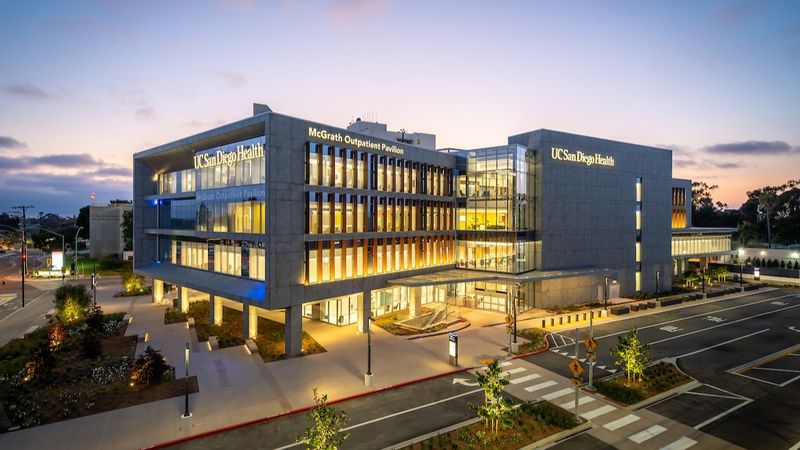
Growth in a health system’s physical infrastructure often signals confidence in its long-term direction.
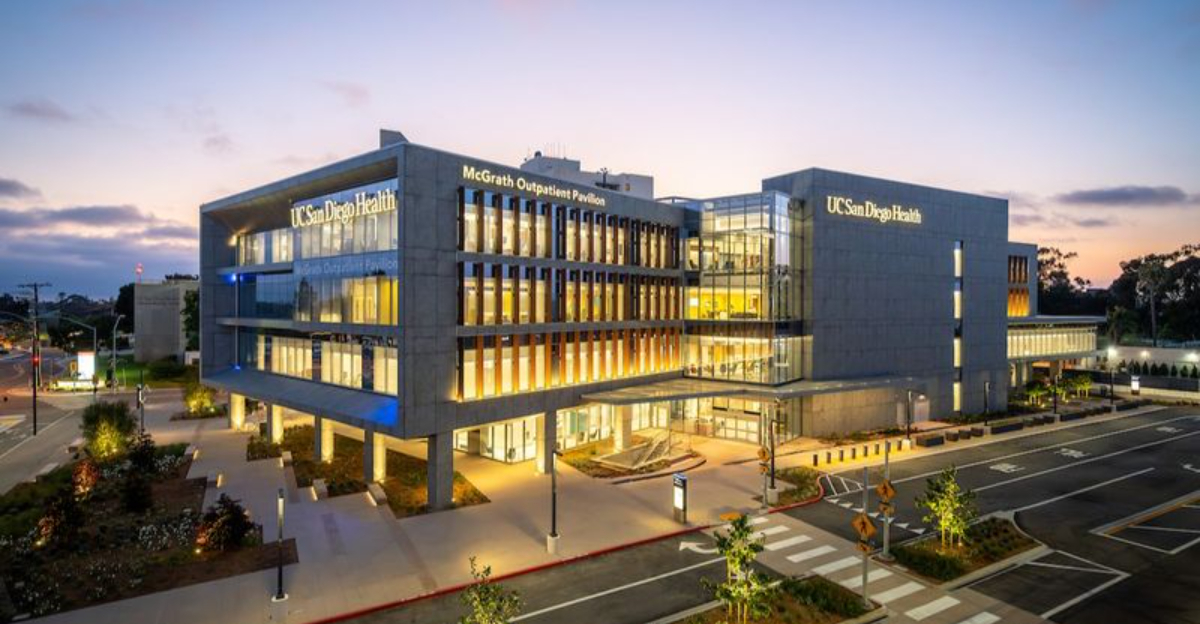
The 250,000-square-foot McGrath Outpatient Pavilion opened at the Hillcrest campus in July 2025, adding a six-floor facility designed to expand access to specialty and cancer care.
The pavilion is part of a larger redevelopment effort at the Hillcrest medical campus, one of UC San Diego Health’s primary hospital sites.
Outpatient care has become an increasingly important part of how modern health systems deliver services.
Many procedures and treatments that once required hospital admission can now be handled in outpatient settings, which tend to offer more scheduling flexibility and a different kind of patient experience compared to inpatient hospital environments.
A facility of this size dedicated to outpatient specialty and cancer care reflects that shift in how healthcare is structured.
Beyond the McGrath Outpatient Pavilion, UC San Diego Health also operates more than 40 regional clinics across the San Diego area.
That combination of a major new outpatient facility and a broad network of neighborhood clinics means the health system’s footprint extends well beyond its main hospital campuses.