Florida’s Most Famous Tree: Edison’s Banyan Now Shades An Entire Acre of Garden
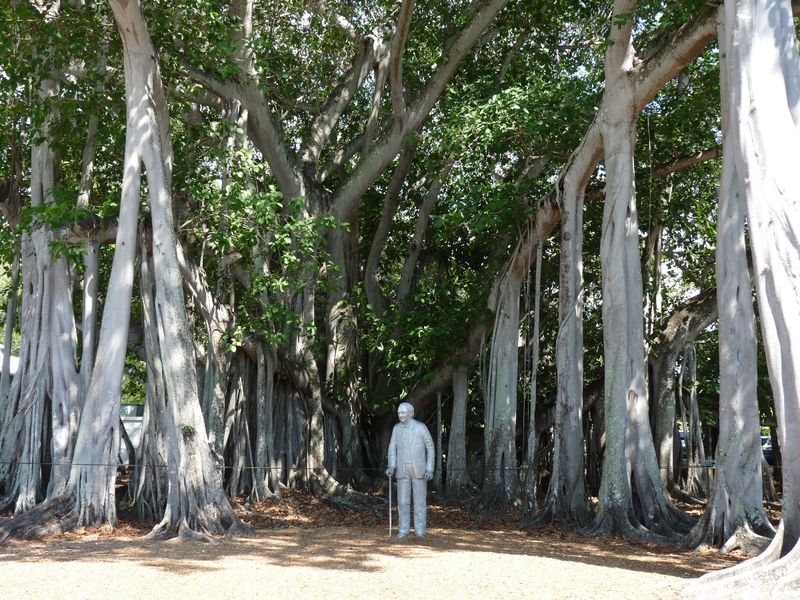
I went in expecting old houses and a few plaques, and walked out thinking about a tree. Florida has a riverfront property where a sapling handed over as a friendly gift in the 1920s grew into something closer to a green cathedral, with dozens of trunks holding up a canopy that covers roughly an acre.
It started as part of a serious hunt for homegrown rubber, and it ended up becoming the shadiest spot on the whole estate. Bring good walking shoes and plan on staying longer than you meant to.
A Riverfront Estate Where History Grows Sideways
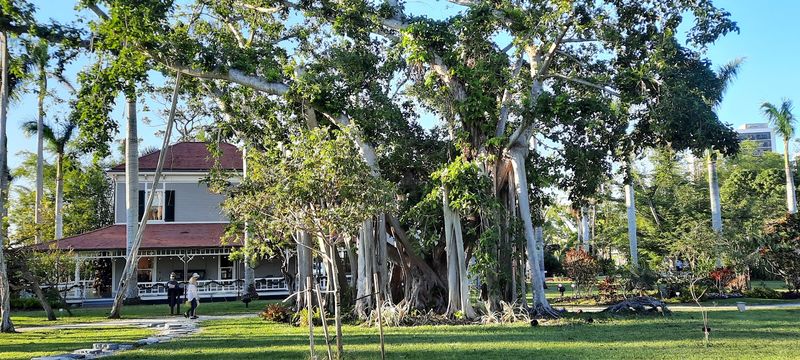
McGregor Boulevard runs past rows of royal palms, and at 2350 you reach the gate of the Edison & Ford Winter Estates. The property spans 21 acres along the Caloosahatchee River in Fort Myers, holding two preserved winter homes, a research laboratory, a museum, and botanical gardens that keep pulling attention away from the buildings.
Thomas Edison wintered here for decades. Henry Ford eventually bought the house next door, which means two of the biggest names in American industry were neighbors who could wave at each other across a hedge.
The site works as a history museum, though calling it only that undersells the acreage. Paths wind between more than 400 species of trees and palms, past reflecting pools, past a laboratory where experiments once filled the tables.
Then there is the banyan. It sits near the front of the property, so massive that first-time arrivals often stop before they have even bought a ticket, tipping their heads back to figure out where one tree ends and the next begins.
The answer, as it turns out, is that it never quite does.
The Sapling Harvey Firestone Handed Over In 1925
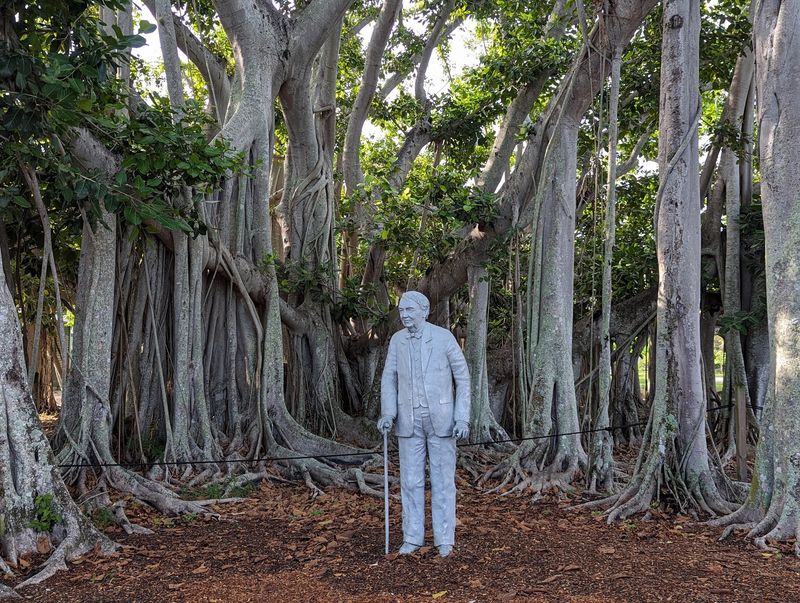
Picture a four-foot seedling, two inches thick, easy enough to carry under one arm. That was the banyan when tire manufacturer Harvey Firestone gave it to Edison in 1925 as a gift between friends.
Nobody planting it that day could have sketched what stands there now. Ficus benghalensis is native to India, a species built for humidity and heat, and southwest Florida turned out to suit it perfectly.
Firestone and Edison shared more than a friendship. Both were chasing the same industrial problem, and a tree with milky latex in its sap fit neatly into that conversation.
What makes the gift remarkable is how ordinary it must have felt at the time. A plant, a handshake, a hole in the sandy soil near the laboratory.
A century later, the sapling has become the estate’s signature living exhibit, mentioned constantly by people who came for the inventions and left talking about roots. Small beginnings rarely announce themselves, and this one arrived looking like nothing more than a promising shrub in a pot.
How Aerial Roots Build A Forest From One Trunk
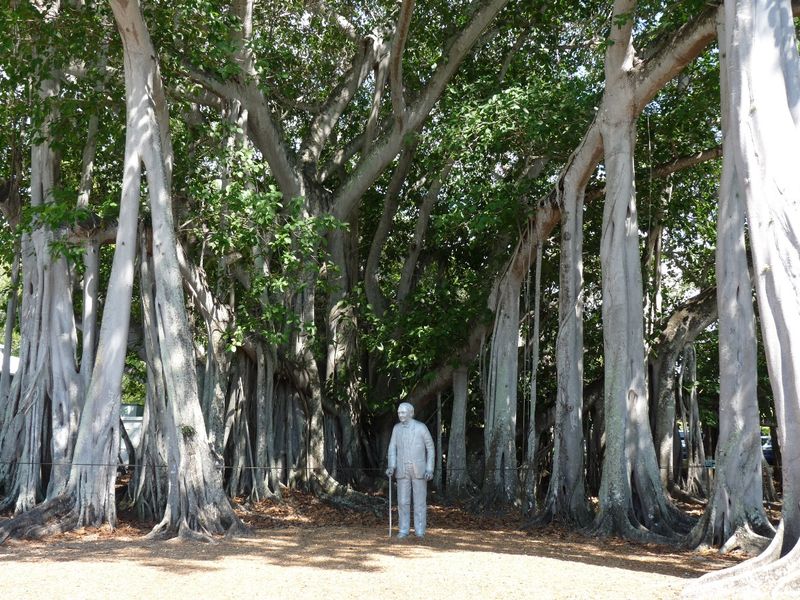
Most trees grow up. Banyans grow outward, and they cheat to do it.
Branches send down slender aerial roots that dangle in the air like ropes until they touch soil. Once anchored, each one thickens into a woody column that supports the limb above, freeing the branch to extend even farther sideways.
Repeat that process for a hundred years and you get hundreds of pillars holding up a single crown. Walking beneath it feels less like standing under a tree and more like wandering through a room with too many columns and a leafy ceiling.
The nickname that follows this species around is the walking tree, because the footprint keeps creeping in whatever direction the branches lean. Nothing about the growth is fast, but nothing about it stops either.
Height reaches roughly sixty feet, which sounds modest until you register that the canopy spread is measured in acres rather than feet. Sunlight arrives on the ground in coins and ribbons, shifting all afternoon.
Stand still for a minute and the scale sneaks up on you. The trunks nearest the path are wide enough to hide behind.
Rubber, Research, and a Tree That Was Too Slow
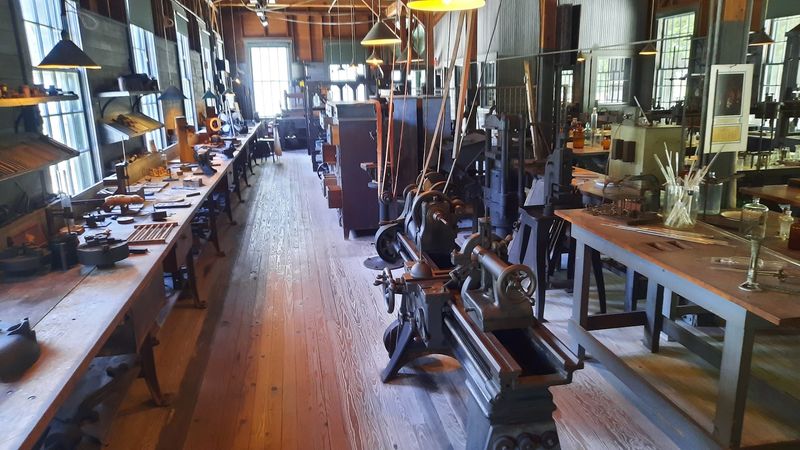
During the 1920s, the United States imported nearly all of its rubber, and that dependence worried three very influential friends. Edison, Firestone, and Ford founded the Edison Botanic Research Corporation in 1925 to find a domestic plant that could produce it.
Thousands of species passed through the laboratory on this property. Leaves were tested, sap was measured, and results were logged with the same stubbornness Edison brought to filaments and phonographs.
The banyan was one candidate on that long list, chosen because its sap carries latex. It failed the test, not for chemistry but for patience: the tree simply grew too slowly to feed an industry that needed tires by the trainload.
Goldenrod eventually proved the more promising lead, and the banyan was left alone to do what banyans do.
There is something satisfying about that outcome. A rejected experiment quietly outlasted the project that planted it, and the laboratory that judged it now sits in the shade it throws.
The lab building still stands on the grounds, workbenches and glassware intact, which makes the connection easy to trace on foot.
A Registered Florida State Champion
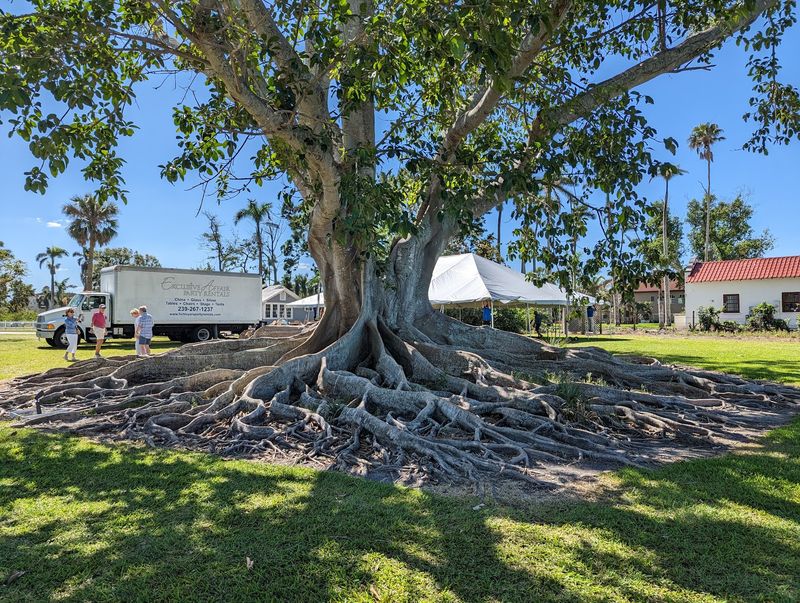
Titles get handed out to trees, and this one holds a serious one. The banyan is a registered Florida State Champion, a designation based on measured trunk size, height, and crown spread rather than sentiment.
It is widely regarded as the largest banyan growing in the continental United States, which puts it in a category with almost no competition.
Champion status matters for practical reasons too. Trees on that register get documented, monitored, and cared for with a level of attention most landscaping never receives, and a century-old specimen with hundreds of secondary trunks needs exactly that.
Across many cultures, banyans carry meaning tied to wisdom, endurance, and shelter, and a few spiritual traditions treat the endless spreading as an image of life that does not end. Standing under this one, the symbolism stops feeling abstract.
The tree anchors roughly 20 acres of botanical gardens filled with more than 400 species of trees and palms, from fruit trees to rare palms Edison collected for study.
Everything else on the grounds is arranged around it, more or less by necessity. You cannot design around something that keeps moving.
Two Winter Homes and the Friendship Between Them
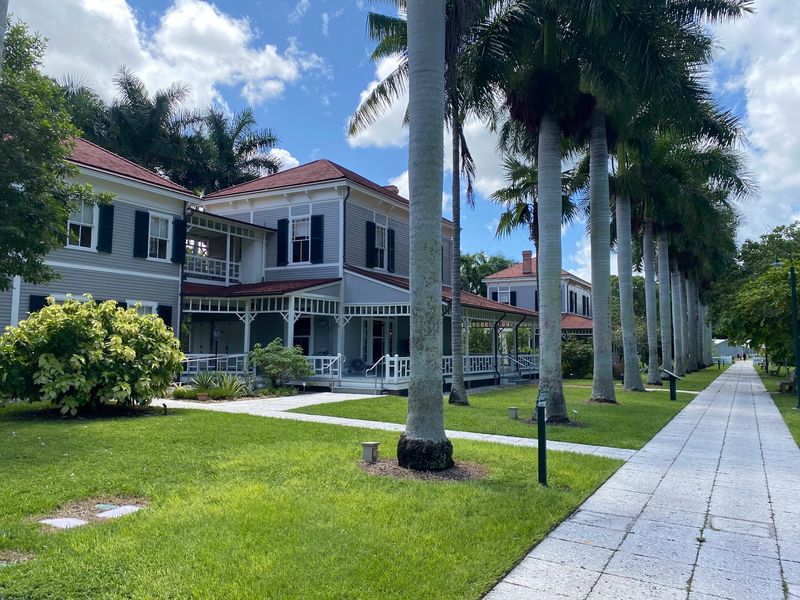
Neither house looks like a mansion, and that turns out to be the charm. Edison’s Seminole Lodge and Ford’s adjacent home, called The Mangoes, are modest wooden structures with deep porches built to catch river air long before air conditioning existed.
Furnishings inside are original or carefully restored, arranged the way the families left them. Photographs, books, and everyday objects fill the rooms rather than velvet ropes and grandeur.
The neighboring-friends angle is the detail that sticks with most people. Two men who reshaped the twentieth century spent Florida winters a short walk apart, trading ideas over breakfast.
Beyond the homes sits the museum, where early automobiles, phonographs, lighting systems, and personal artifacts lay out the scope of what both men built. The Model T display draws a steady crowd.
For anyone drawn to machinery over interior decorating, the laboratory delivers the strongest impression. Each workstation carries an adjustable electric lamp, and the whole space feels paused mid-project rather than staged.
Give the museum time before you head outside. The gardens will absorb whatever hours you have left.
Gardens That Reward Slow Walking
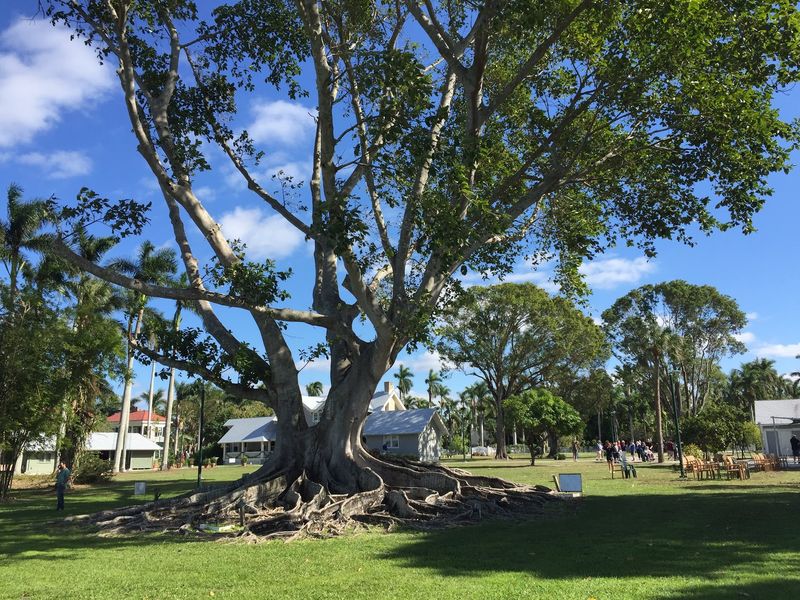
Bamboo rattles somewhere off the path, a mango tree drops fruit near a bench, and the air smells faintly of citrus and damp mulch. The botanical gardens here were never decorative window dressing; they were a working collection assembled for research.
Over 400 species of trees and palms fill the grounds, many of them brought in specifically because Edison wanted to test what they contained. Labels along the walkways explain the odder specimens.
Reflecting pools, a moonlight garden, and shaded seating break the route into pauses. Packing a lunch and eating it under the canopy is a perfectly reasonable plan.
Seasonal displays rotate through the year, with spring bringing elaborate tropical arrangements and the holidays turning the property into a corridor of decorated trees around nearly every bend.
The Garden Shoppe sells plants grown on site, which means you can carry a small piece of the collection home if your climate cooperates.
Photographers do well here in early morning, when the light slants low through the trunks and the paths are still empty. The gardens hold up in any weather, though shade becomes a strategy by midday.
Guided Tours, Audio Apps, and Choosing Your Pace
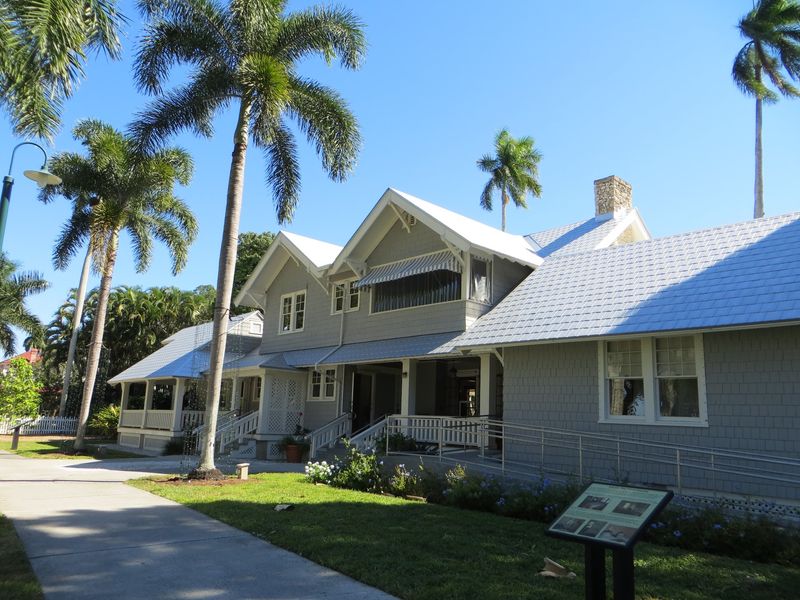
Two ways to see the place, and both work. Guided walking tours run roughly an hour to seventy-five minutes, led by docents who fill in the details signage cannot, and there is room to ask questions as the group moves between stops.
The self-guided option uses a downloadable app with narrated stops. Headphones in, pause whenever you like, linger under the banyan as long as you want without holding anyone up.
Families with restless kids often lean toward the app, partly because there is a scavenger hunt that keeps younger visitors scanning the grounds instead of asking how much longer.
Plan on two to three hours minimum. A full morning disappears easily once the museum, both homes, the laboratory, and the gardens are added together.
Interpretive signage in a few spots shows its age, and peak season brings enough foot traffic to thin out the quiet. Neither issue undercuts the experience much, though the earliest hours are noticeably calmer.
Memberships exist for anyone within driving distance and cover access to the whole property.
Hours, Parking, and Timing Your Visit Right
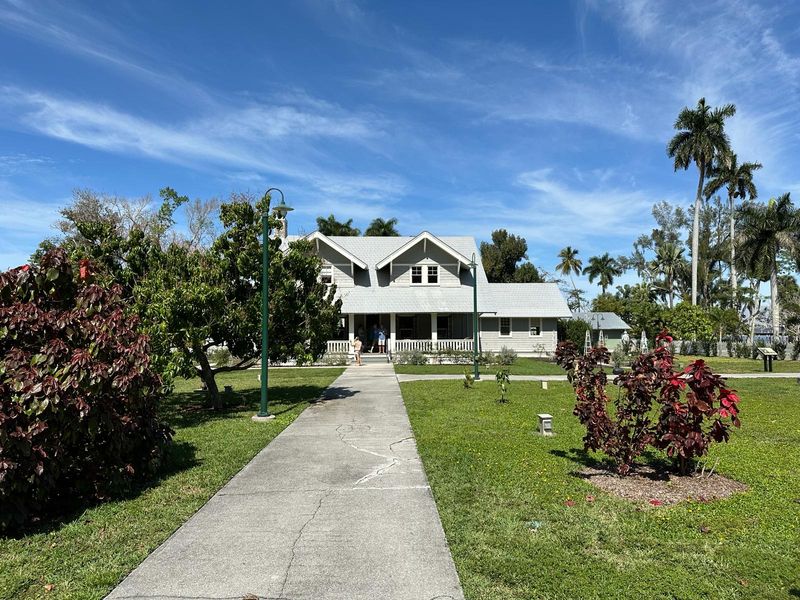
Doors open at 9 AM every day of the week, with last admission wrapping up as the site closes at 5:30 PM. Seven days, including Mondays, which is unusual for a history museum.
Arrive at opening if you can. Parking tightens as the morning goes on, and the lot fills faster during Florida’s busy winter months when the weather is at its best.
The address is 2350 McGregor Boulevard in Fort Myers, an easy drive from downtown and close enough to the airport that it works as a last-stop activity before a flight.
Heat is the main variable. Summer afternoons get heavy, so water, a hat, and a loose schedule matter more than any other piece of advice.
Restrooms are clean, the gift shop stocks decent souvenirs, and the ticket counter can back up during peak arrival windows. Ticketing covers the museum, both homes, the laboratory, and the full garden grounds.
Paths are flat and mostly paved, which makes the property manageable for slower walkers. Comfortable shoes are still the smartest thing you can wear.
Why This One Tree Is Reason Enough
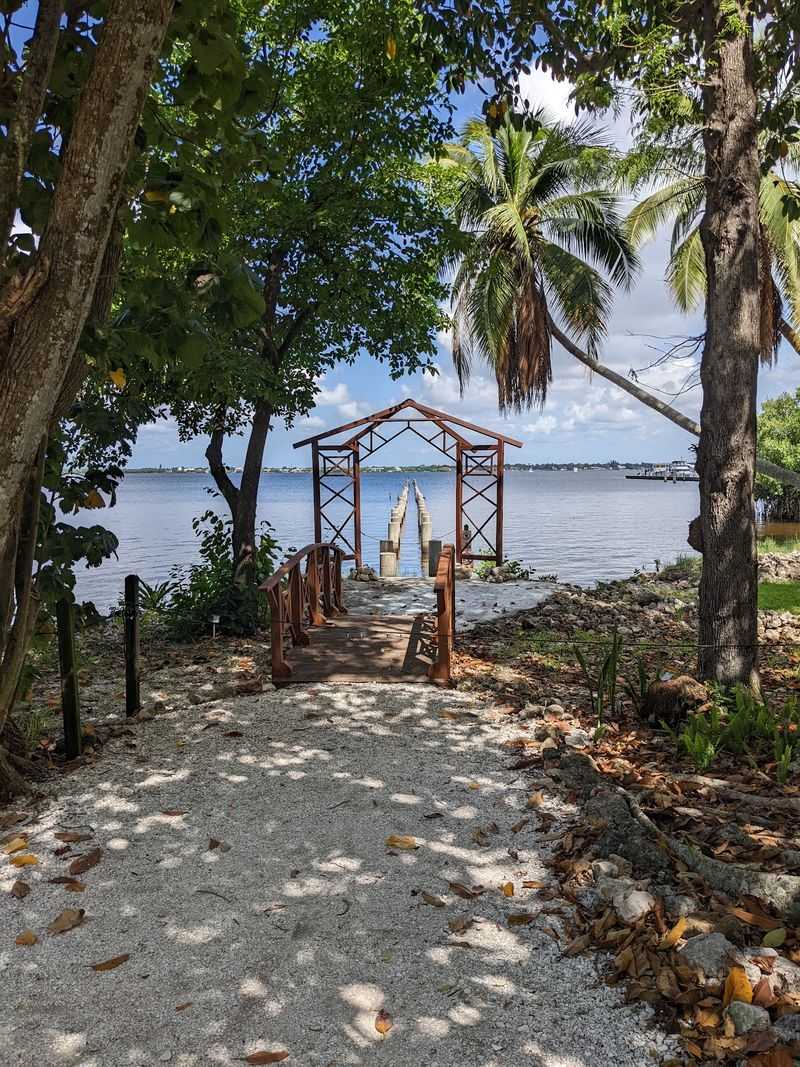
Plenty of attractions promise something big and then hand you a photo opportunity. The banyan does the opposite: it refuses to fit in a single frame, and the harder you try, the more you notice how far the trunks stretch past the edges.
A century of growth from a four-foot gift is the kind of arithmetic that sticks in your head on the drive home.
The estate around it earns its keep too. Preserved homes, a working-looking laboratory, an inventive museum, and gardens stocked with species most people have never seen add up to a full morning that never drags.
History enthusiasts, gardeners, engineers, and kids with a scavenger hunt sheet all find their own reason to slow down here. Nobody leaves without at least one photograph of the tree.
Come early, keep the pace unhurried, and give yourself permission to sit on a bench under that canopy doing nothing productive whatsoever.
Edison chased a rubber substitute and never found it in this species. What he got instead was the largest banyan in the continental United States, still spreading, still shading an acre of Florida garden.