This 50-Foot Connecticut Statue Is One Of The State’s Most Striking Sacred Sights
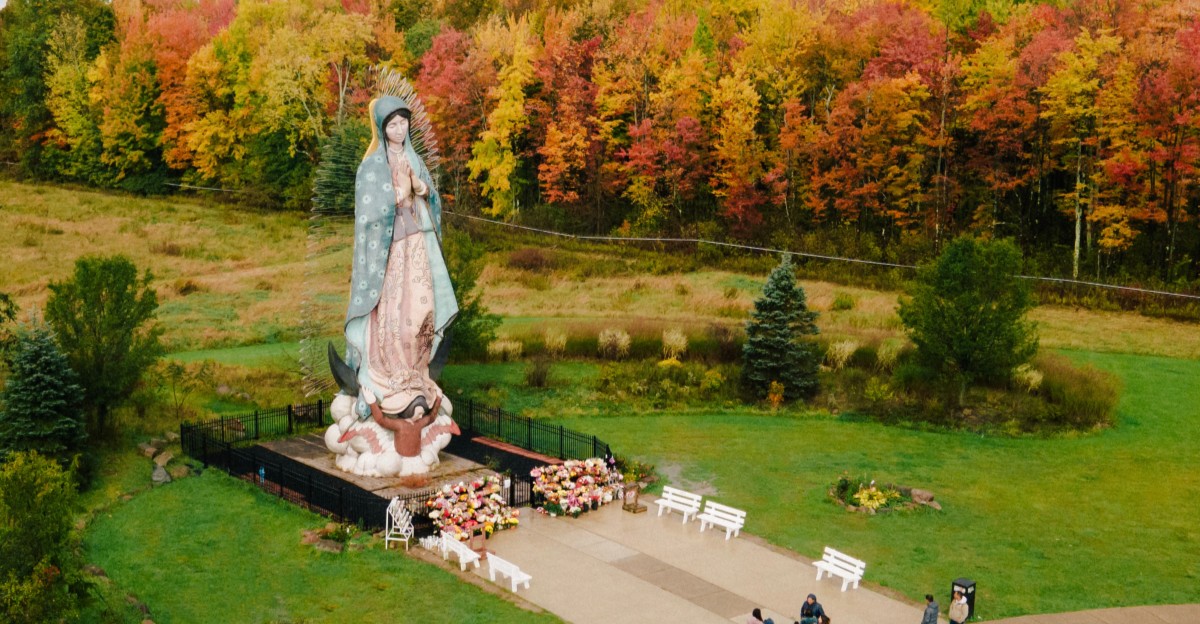
You do not expect every roadside stop to make you tilt your head all the way back. A towering sacred statue can manage that before you have even begun taking in the surroundings.
Its sheer scale is what catches you first. Then the setting starts to slow things down, turning that initial surprise into something quieter and more reflective.
Connecticut has a sacred landmark whose towering presence makes an immediate impression long before you know its full story.
Even people who normally rush through sightseeing may find themselves lingering here. It is difficult to glance casually at something created on such an imposing scale.
And how often do you come across a religious landmark that feels this visually commanding?
The size might be what gets your attention, but it is not necessarily what stays with you. There is a sense of purpose behind the monument that makes the experience feel bigger than its measurements.
1. Fifty Feet Of Stone Creates An Unforgettable First Sight
Most large roadside landmarks announce themselves from a mile away. This one does the opposite.
You drive past Connecticut barns, fields and the occasional horse and buggy, park near a cluster of farm buildings, and see only smaller statuary at first.
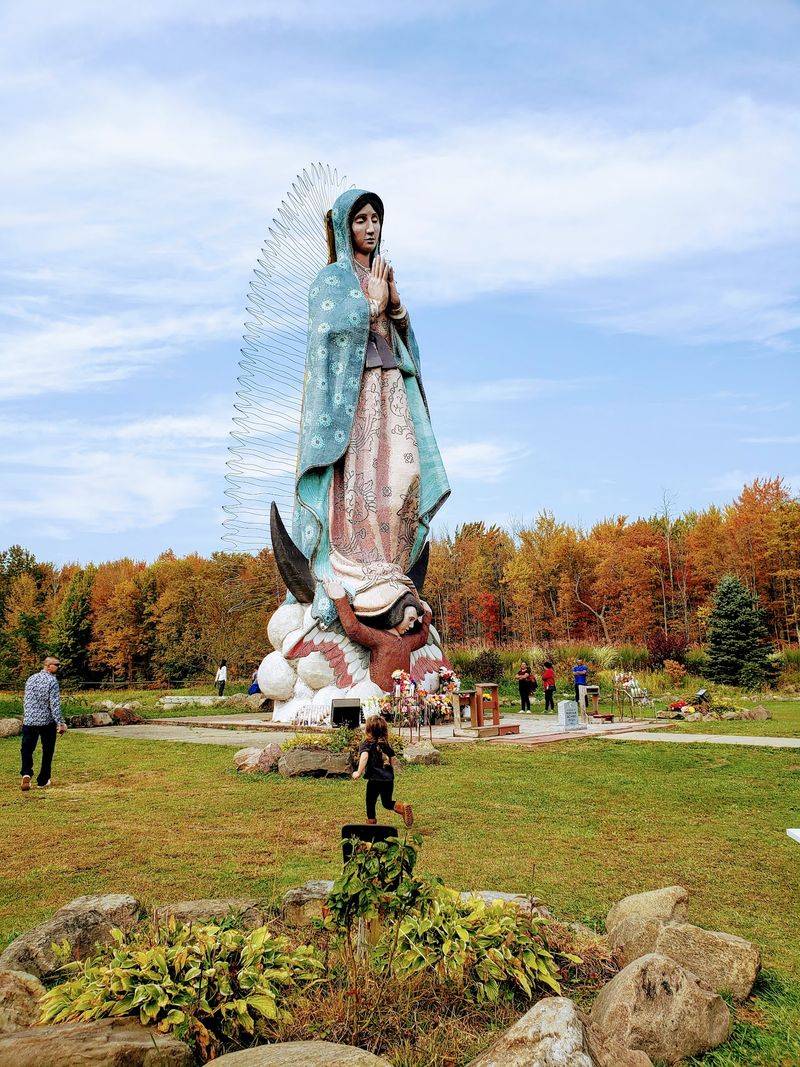
Then you turn a corner, and there she is. The figure stands about 50 feet tall, and its surface is covered with roughly 400,000 ceramic tiles.
Sunlight hits those tiles and the whole surface seems to shimmer, with the deep blue mantle standing out sharply against an open sky.
Visitors frequently describe the moment as jaw-dropping, and the reason has as much to do with scale as with surprise. Nothing nearby competes with it.
No buildings crowd the view, no trees block the sight line, so your eye has nothing to measure her against except the horizon.
A practical tip for first-timers: resist the urge to walk right up immediately. From a distance of fifty or sixty yards, you can take in the full figure and the tile detail at the same time.
Get too close and you lose the proportions that make the first look so memorable.
2. The Monument Rises Above The Peaceful Shrine Grounds
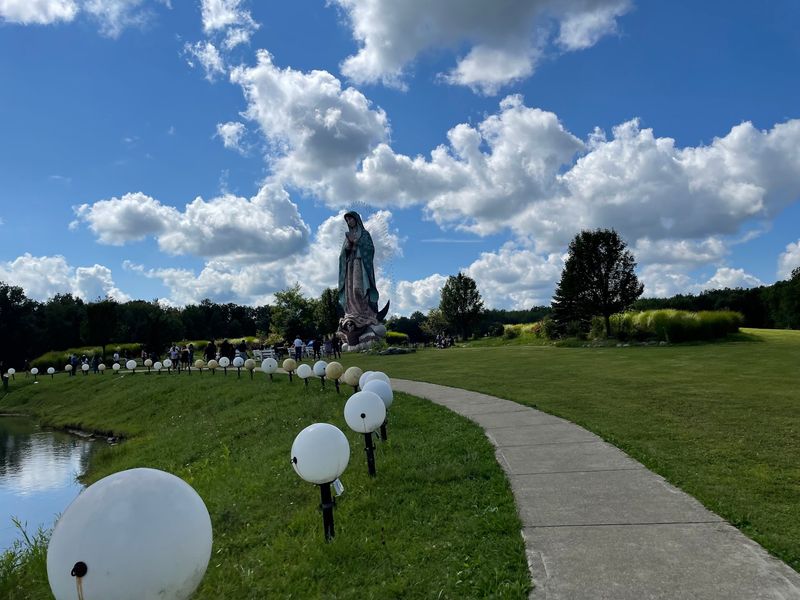
Scale alone would make this place notable, but the surrounding property is what turns a quick photo stop into an afternoon. The shrine occupies a roughly 50-acre former family farm that is now home to the nonprofit Servants of Mary Center for Peace.
There is a chapel on site that can hold a couple hundred people, and many visitors mention how unexpectedly welcoming the small, simple space feels after the drama of the statue outside.
A combined gift shop and gathering building sits nearby, staffed by people who tend to be happy to explain the history to anyone who asks.
The surrounding fields matter, too. Wind moves across open farmland here with nothing to slow it down, so a spring visit can feel genuinely brisk even on a sunny day.
Bring a jacket you might not think you need.
The quiet surroundings are part of the appeal, and the open rural setting can give the grounds a peaceful atmosphere even when other visitors are present.
The Servants of Mary Center for Peace operates as a nonprofit, and donations help maintain the buildings, lighting and landscaping that keep the property in good shape.
3. Deerfield Road Leads To This Quiet Spiritual Retreat
The drive gets quiet fast. Then the countryside opens up.
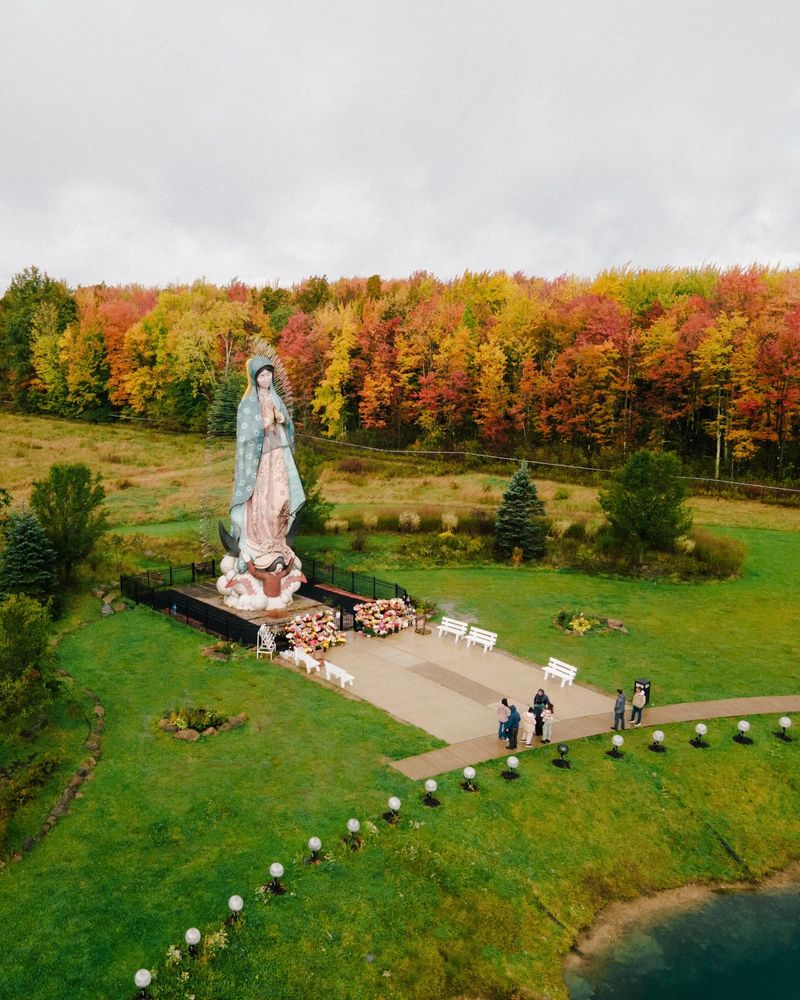
What waits at the end feels even more unexpected: a towering 50-foot image of Our Lady of Guadalupe rising above a peaceful rural property in northeastern Ohio.
The shrine is part of the Servants of Mary Center for Peace, which grew from a 50-acre farm purchased by Ed and Patricia Heinz. The property was eventually dedicated as a place centered on Catholic faith and devotion.
Sculptor Richard Hyslin created the enormous figure using a steel framework, concrete and ceramic tile. Sections were constructed separately before being assembled to reach the full 50-foot height.
The finished statue was dedicated in 1995.
In front sits the Lake of Hope, surrounded by an illuminated 15-decade rosary. Visitors can also spend time at Holy Innocents Chapel and explore the peaceful grounds.
The Servants of Mary Center for Peace welcomes visitors at 6601 Ireland Road in Windsor, Ohio.
Current 2026 listings show the grounds open daily from 9 a.m. to 10 p.m., although checking ahead before a long drive is still sensible.
It is a striking sight in photographs. Seeing its scale against the open countryside makes an even bigger impression.
4. Our Lady Of Guadalupe Towers Over The Landscape
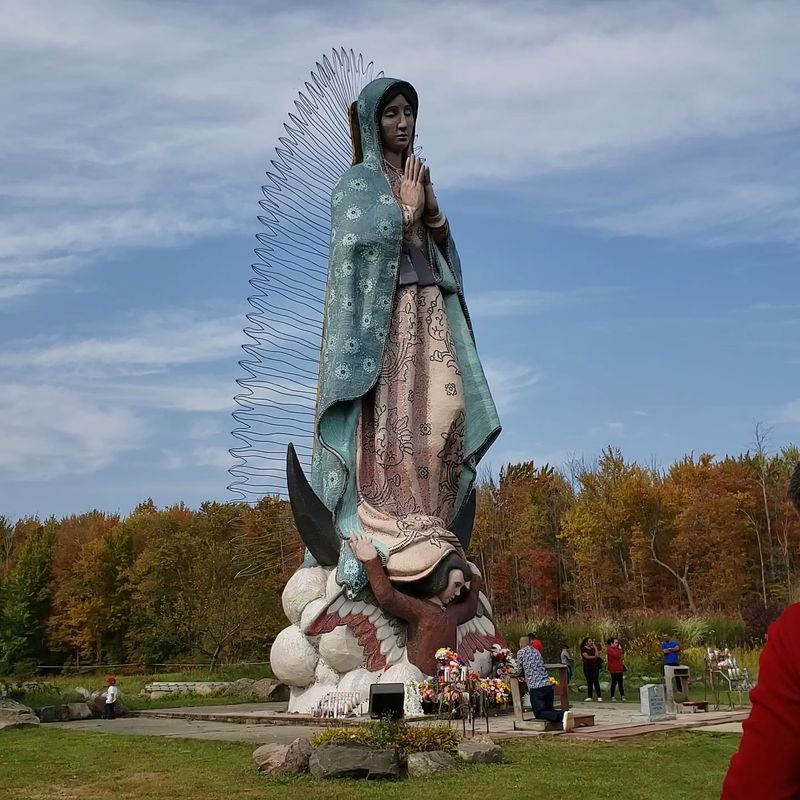
Behind every image of Our Lady of Guadalupe is a story that reaches back to Mexico in 1531, and that devotion explains why a tribute this ambitious exists in rural Ohio.
The figure follows the traditional depiction: hands joined in prayer, head slightly bowed, a blue-green mantle draped over a rose-colored gown.
Mosaic work gives the piece its unusual character. Instead of a single smooth surface, thousands upon thousands of small tiles catch light at slightly different angles, so the colors shift as clouds pass or as you walk around the base.
That changing quality is why repeat visitors say no two trips look quite the same. Morning light warms the gown.
Midday sun makes the tiles sparkle. Late afternoon deepens the blue and lengthens the shadows across the surrounding grass.
Photographers should know that capturing the full height in one frame takes some backing up, and a wide lens or panorama mode helps. For a sense of scale in your photos, ask someone in your group to stand near the base.
Without a human figure for reference, pictures rarely convey just how large she really is.
5. Smaller Sacred Details Reward A Slower Walk
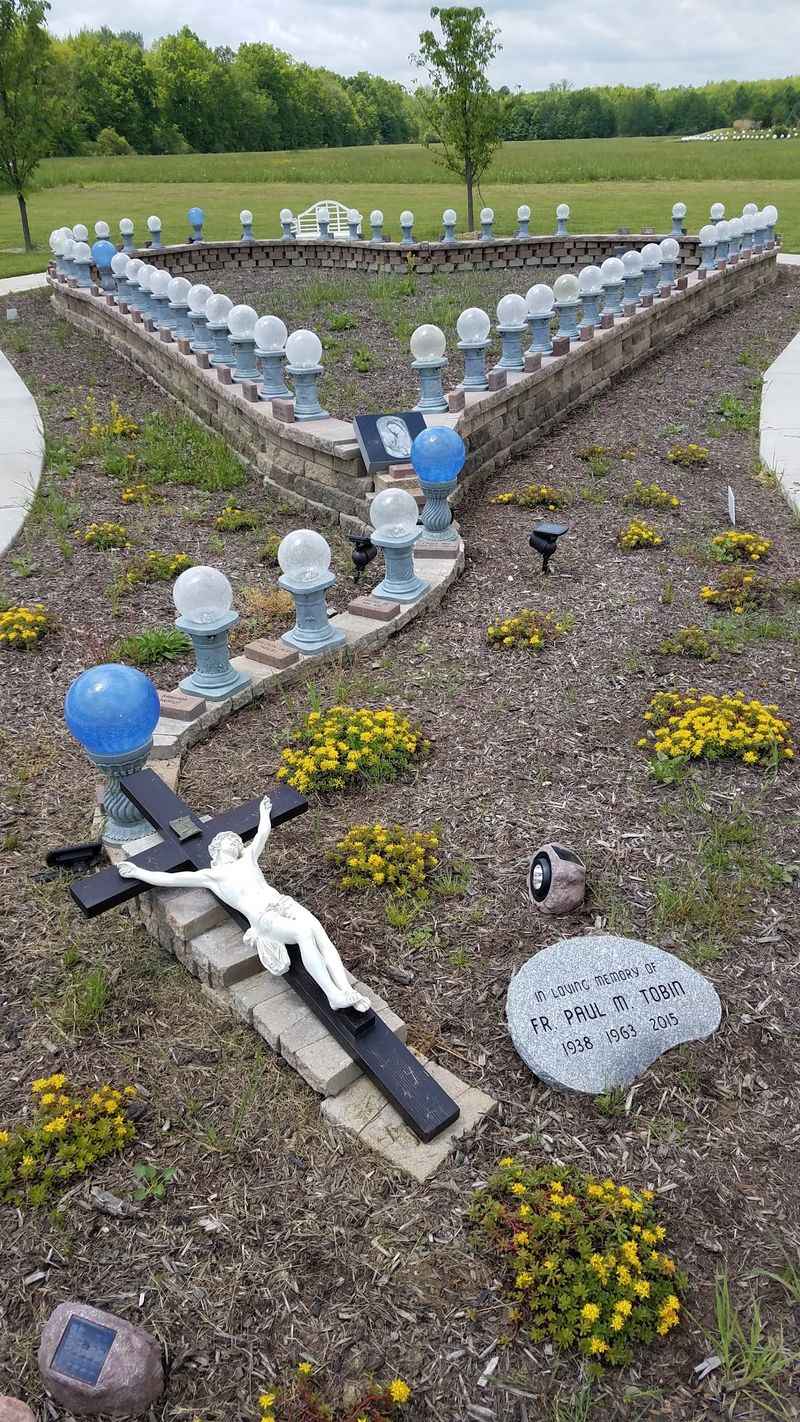
Rush straight to the main attraction and you will miss the best-kept parts of the property. Scattered among the lawns and garden beds are smaller statues and devotional spots, each set into its own little pocket of landscaping.
Many visitors encounter these first, before the big statue even comes into view, and they work almost like an introduction. The pacing feels intentional: small, quiet, human-scaled moments that prepare you for something much larger.
The chapel deserves unhurried attention as well. Guests often describe it as simple and peaceful, a place where people sit for a few minutes without any particular agenda.
Monthly Sunday services are held on the grounds, drawing regulars who treat the shrine as an ongoing part of their year rather than a one-time stop.
Don’t skip the gift shop either. It carries religious items and mementos, and the proceeds support upkeep of a nonprofit property that relies heavily on volunteers and donations.
Give yourself at least an hour, preferably more. Visitors who budget enough time consistently say the same thing afterward: the details are what stayed with them once the initial shock of the statue wore off.
6. Gardens And Walking Paths Encourage Quiet Reflection
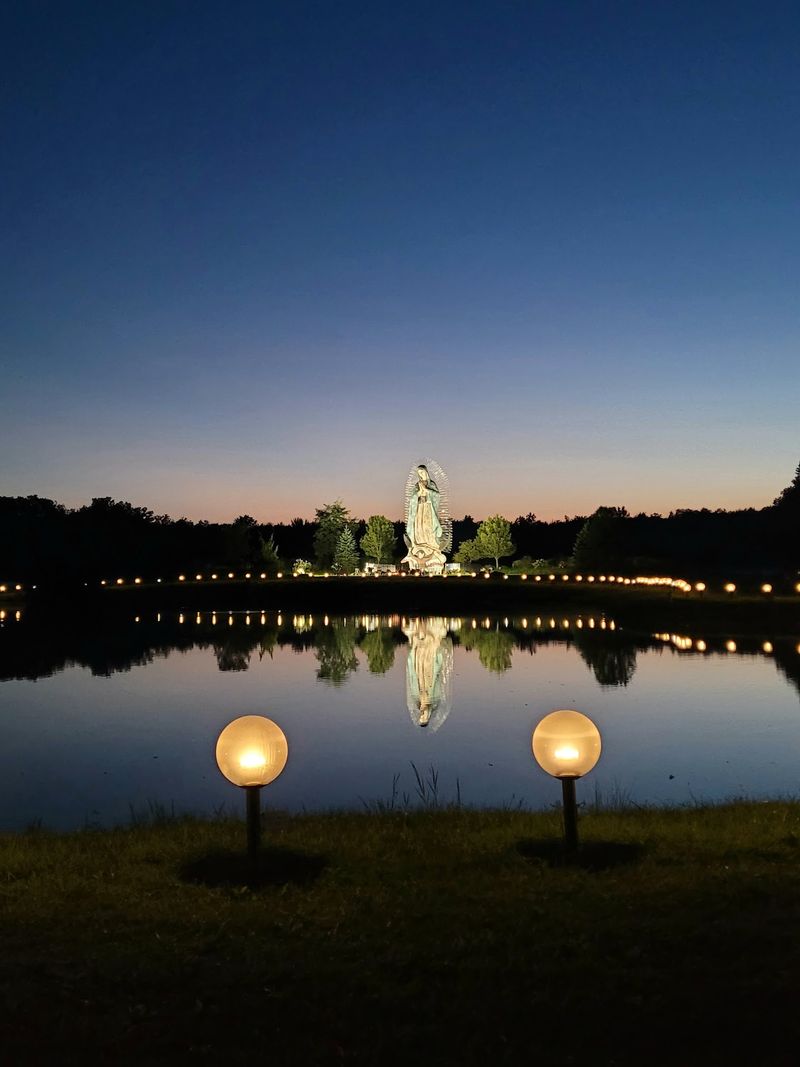
Look down for a surprise. The statue is only part of the scene.
Spread across the grounds below it is an illuminated 15-decade rosary, giving visitors another striking feature to explore at the Servants of Mary Center for Peace.
The rosary surrounds the Lake of Hope and becomes especially noticeable after dark, when its lights glow across the rural property. It was created as a devotional feature, turning the traditional Catholic prayer into something visitors can physically follow around the grounds.
Water adds to the peaceful setting. The Lake of Hope sits near the towering image of Our Lady of Guadalupe, creating an open area where visitors can slow down and spend time outdoors.
The property extends across roughly 50 acres, so comfortable footwear makes sense if you plan to explore beyond the main monument. Other devotional features include Holy Innocents Chapel, a Stations of the Cross area and spaces intended for prayer and reflection.
There is no need to hurry from one feature to another. The open countryside and generous grounds make a slower pace feel natural.
Visitors may come primarily to see the enormous statue, but the surrounding property adds considerably more to the experience.
Give yourself time here. The scale catches your attention first, while the quieter details are what encourage you to stay.
7. The Monument Feels Even More Dramatic From Below
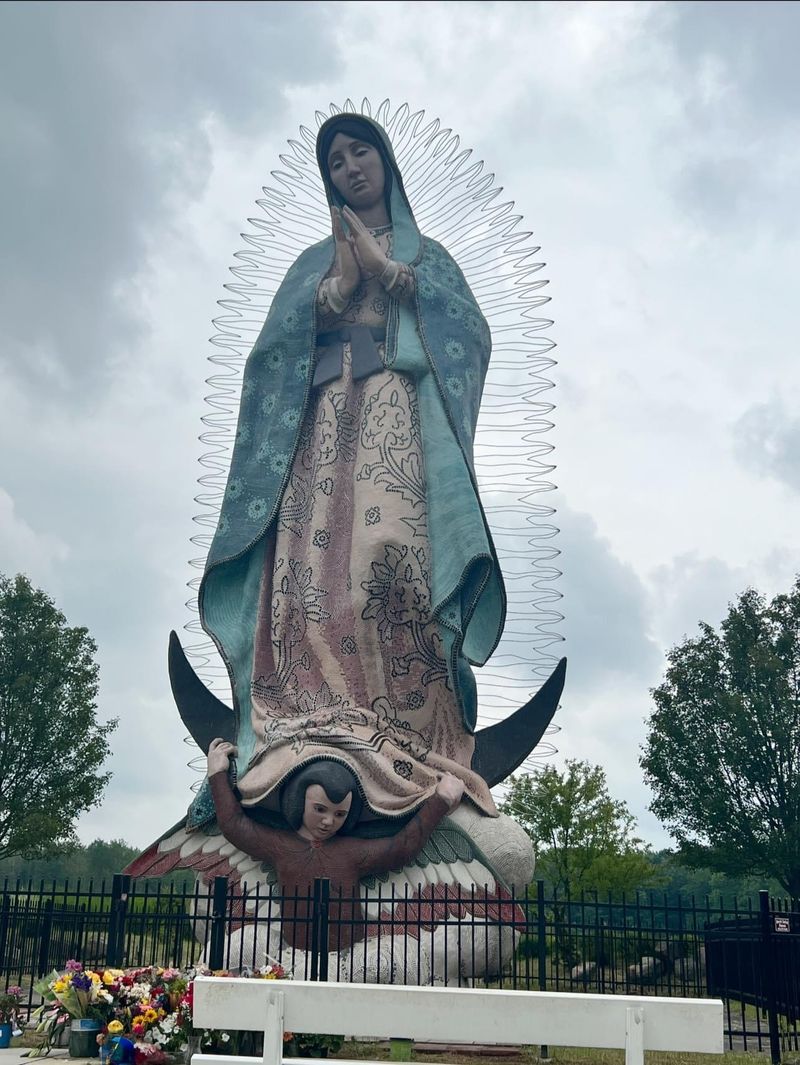
Daylight shows the details. Evening changes the mood completely.
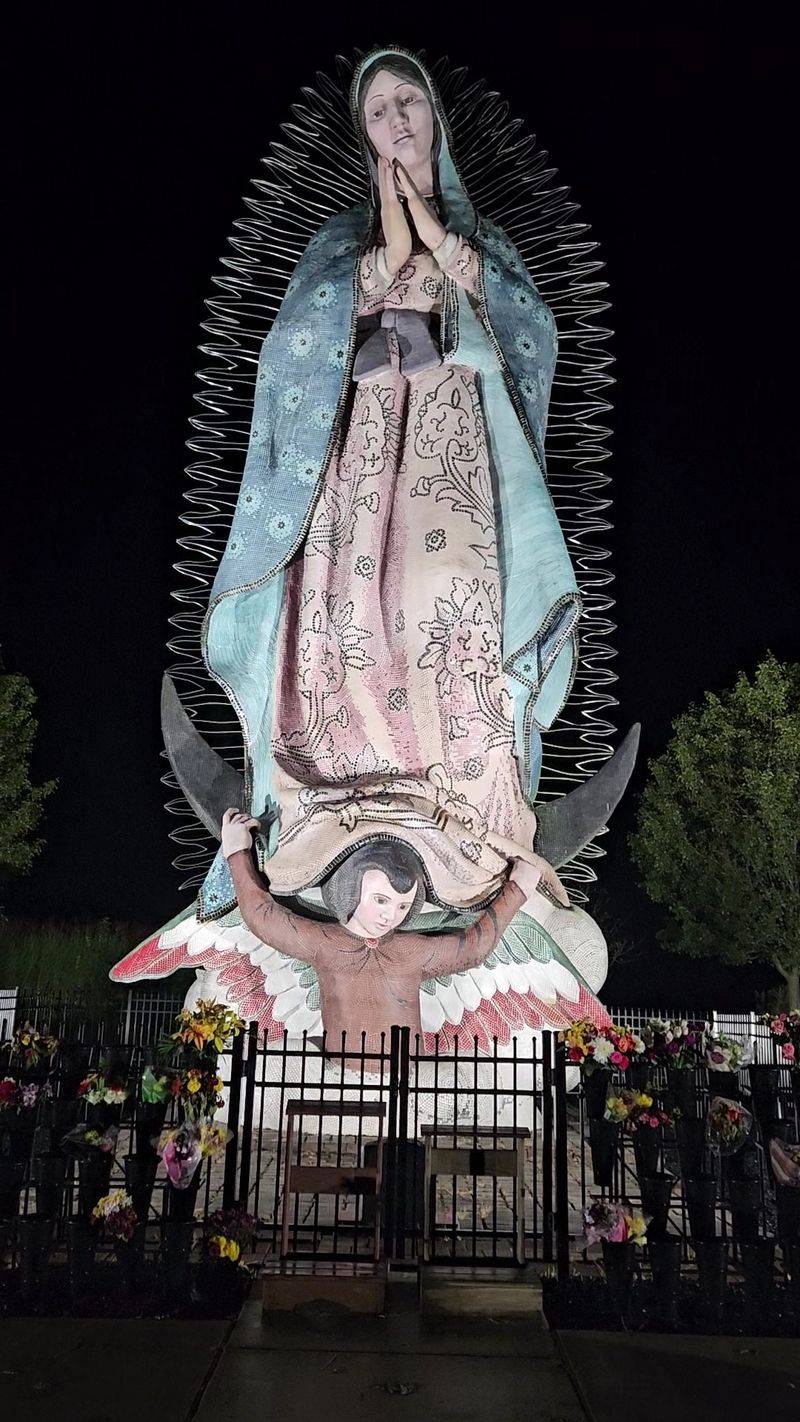
As the sky darkens over the countryside, the illuminated statue and glowing rosary create a dramatically different view of the Servants of Mary Center for Peace.
The 50-foot image of Our Lady of Guadalupe is impressive from almost anywhere on the grounds, but its scale becomes especially noticeable when viewed from below. Thousands of ceramic tiles cover the figure, forming a mosaic that reflects light differently as visitors move around it.
Nearby, the illuminated 15-decade rosary adds another distinctive feature after sunset. Its lights stretch around the Lake of Hope, creating points of brightness across an otherwise quiet rural landscape.
Seeing the property during both daylight and evening can reveal details that are easy to miss during a single visit. Sunlight makes the colors and mosaic work easier to examine, while illumination emphasizes the monument’s outline and enormous proportions.
The center remains open into the evening, although current hours should be checked before planning a late visit. Rural surroundings can also feel considerably cooler once the sun disappears, so an extra layer is useful during colder months.
Give yourself a moment before heading back to the car. Once the surrounding countryside grows dark, the illuminated figure becomes difficult to look away from.
8. The Statue Was Built In Sections Before Rising 50 Feet
Seeing the finished monument gives little hint of just how complicated it was to build. Sculptor Richard Hyslin designed the enormous figure around a skeleton of three-quarter-inch, epoxy-coated steel reinforcing bars, which were bent and welded into the shapes needed to support the sculpture.
Rather than constructing the entire 50-foot figure upright, Hyslin created it in separate sections. Those pieces were fitted together for alignment before being stacked, bolted and welded into their final positions.
Metal lath covered the framework, providing a base for concrete that was sprayed onto the structure and then shaped by hand.
Supporting something this large required serious groundwork. According to the Ohio Outdoor Sculpture database, a 10,000-pound steel base plate measuring two inches thick was anchored using 24 large J-bolts.
Twenty cubic yards of concrete helped secure the foundation.
The process did not end once the basic figure was standing. Its concrete was allowed to cure for a full year before approximately 400,000 ceramic tiles were attached and grouted across the surface.
Hyslin’s work was completed in the mid-1990s, turning an ambitious engineering project into the enormous mosaic figure visitors see today.